Refine search
Actions for selected content:
238141 results in Physics and Astronomy
9 - Molecular Dynamics Simulations
-
- Book:
- Theory of Liquids
- Published online:
- 01 September 2023
- Print publication:
- 17 August 2023, pp 90-96
-
- Chapter
- Export citation
16 - Viscous Liquids
-
- Book:
- Theory of Liquids
- Published online:
- 01 September 2023
- Print publication:
- 17 August 2023, pp 171-184
-
- Chapter
- Export citation
7 - Contentious Matters
-
- Book:
- The ALMA Telescope
- Published online:
- 03 August 2023
- Print publication:
- 17 August 2023, pp 113-140
-
- Chapter
-
- You have access
- Open access
- HTML
- Export citation
Index
-
- Book:
- Theory of Liquids
- Published online:
- 01 September 2023
- Print publication:
- 17 August 2023, pp 207-210
-
- Chapter
- Export citation
Turbulence measurements in the neutral ISM from Hi-21 cm emission–absorption spectra
-
- Journal:
- Publications of the Astronomical Society of Australia / Volume 40 / 2023
- Published online by Cambridge University Press:
- 17 August 2023, e046
-
- Article
-
- You have access
- HTML
- Export citation
-
We study the correlation between the non-thermal velocity dispersion ( $\sigma_{nth}$) and the length scale (L) in the neutral interstellar medium (ISM) using a large number of Hi gas components taken from various published Hi surveys and previous Hi studies. We notice that above the length-scale (L) of 0.40 pc, there is a power-law relationship between $\sigma_{nth}$ and L. However, below 0.40 pc, there is a break in the power law, where $\sigma_{nth}$ is not significantly correlated with L. It has been observed from the Markov chain Monte Carlo (MCMC) method that for the dataset of L $\gt$ 0.40 pc, the most probable values of intensity (A) and power-law index (p) are 1.14 and 0.55, respectively. Result of p suggests that the power law is steeper than the standard Kolmogorov law of turbulence. This is due to the dominance of clouds in the cold neutral medium. This is even more clear when we separate the clouds into two categories: one for L is $\gt$ 0.40 pc and the kinetic temperature ( $T_{k}$) is $\lt$250 K, which are in the cold neutral medium (CNM) and for other one where L is $\gt$0.40 pc and $T_{k}$ is between 250 and 5 000 K, which are in the thermally unstable phase (UNM). Most probable values of A and p are 1.14 and 0.67, respectively, in the CNM phase and 1.01 and 0.52, respectively, in the UNM phase. A greater number of data points is effective for the UNM phase in constructing a more accurate estimate of A and p, since most of the clouds in the UNM phase lie below 500 K. However, from the value of p in the CNM phase, it appears that there is a significant difference from the Kolmogorov scaling, which can be attributed to a shock-dominated medium.


8 - Collective Excitations in Liquids Post-Frenkel
-
- Book:
- Theory of Liquids
- Published online:
- 01 September 2023
- Print publication:
- 17 August 2023, pp 64-89
-
- Chapter
- Export citation

On asymmetric vortex pair interactions in shear
-
- Journal:
- Journal of Fluid Mechanics / Volume 969 / 25 August 2023
- Published online by Cambridge University Press:
- 16 August 2023, A21
-
- Article
-
- You have access
- Open access
- HTML
- Export citation
-
This study examines the two-dimensional interaction of two unequal co-rotating viscous vortices in uniform background shear. Numerical simulations are performed for vortex pairs having various circulation ratios $\varLambda _0 = \varGamma _{1,0}/\varGamma _{2,0} = (\omega _{1,0}/\omega _{2,0})(a^2_{1,0}/a^2_{2,0}) \leqslant 1$, corresponding to different initial characteristic radii $a_{i,0}$ and peak vorticities $\omega _{i,0}$ of each vortex $i=1,2$, in shears of various strengths $\zeta _0 = \omega _S/\omega _{2,0}$, where $\omega _S$ is the constant vorticity of the shear. Two primary flow regimes are observed: separations (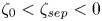 $\zeta _0 < \zeta _{sep} < 0$), in which the vortices move apart continuously, and henditions ( $\zeta _0 > \zeta _{sep}$), in which the interaction results in a single vortex (where $\zeta _{sep}$ is the adverse shear strength beyond which separation occurs). Vortex motion and values of $\zeta _{sep}(\varLambda _0)$ are well-predicted by a point-vortex model for unequal vortices. In vortex-dominated henditions, shear varies the peak–peak distance $b$, and vortex deformation. The main convective interaction begins when core detrainment of one vortex is established, and proceeds similarly to the no-shear ( $\zeta _0 = 0$) case: merger occurs if the second vortex also detrains, engendering mutual entrainment; otherwise straining out occurs. Detrainment requires persistence of straining of both sufficient magnitude, as indicated by relative straining above a consistent critical value, $(S/\omega )_i > (S/\omega )_{cr}$, where $S$ is the strain rate magnitude at the vorticity peak, and conducive direction. Hendition outcomes are assessed in terms of an enhancement factor $\varepsilon \equiv \varGamma _{end}/\varGamma _{2,start}$. Although $\varepsilon$ generally varies with $\zeta _0$, $(a^2_{1,0} /a^2_{2,0} )$ and $(\omega _{1,0}/\omega _{2,0})$ in a complicated manner, this variation is well-characterized by the pair's starting enstrophy ratio, $Z_2/Z_1$. Within a transition region between merger and straining out (approximately $1.65 < Z_2/Z_1 < 1.9$), shear of either sense may increase $\varepsilon$.


Dynamics of fixed-volume pinned films – dealing with a non-self-adjoint thin-film problem
-
- Journal:
- Journal of Fluid Mechanics / Volume 969 / 25 August 2023
- Published online by Cambridge University Press:
- 16 August 2023, A17
-
- Article
-
- You have access
- Open access
- HTML
- Export citation
Weil Sums over Small Subgroups
- Part of
-
- Journal:
- Mathematical Proceedings of the Cambridge Philosophical Society / Volume 176 / Issue 1 / January 2024
- Published online by Cambridge University Press:
- 15 August 2023, pp. 39-53
- Print publication:
- January 2024
-
- Article
- Export citation

Flow past two rotationally oscillating cylinders
-
- Journal:
- Journal of Fluid Mechanics / Volume 969 / 25 August 2023
- Published online by Cambridge University Press:
- 15 August 2023, A16
-
- Article
-
- You have access
- Open access
- HTML
- Export citation
-
Wake interaction of two rotationally oscillating cylinders in side-by-side configuration is studied experimentally at a Reynolds number of 150. Five spacing ratios, $T/D$ (ratio of centre-to-centre spacing to cylinder diameter), are considered, namely, 1.4, 1.8, 2.5, 4.0 and 7.5. Both in-phase and antiphase forcing are investigated. Oscillation amplitude is varied from ${\rm \pi} /8$ to ${\rm \pi}$, and forcing frequency, $FR$ (ratio of the oscillation frequency to the vortex-shedding frequency of a stationary cylinder) is varied from 0 to 5. The experimental investigation is done using laser-induced fluorescence, hot film anemometry and particle-image velocimetry (PIV). The interaction between the two cylinders under forcing results in new wake modes and vortex structures and a comprehensive study from the wake visualisations is conducted. Quantitative results are presented in terms of streamwise and cross-stream mean velocity profiles, centreline velocity recovery, peak velocity deficit, wake width, fluctuation intensity, circulation, vorticity contours and drag coefficient. The magnitude of streamwise velocity deficit and cross-stream velocity variation is strongly affected by the presence of second cylinder. The recirculation region behind the cylinders is found to extend further downstream with increase in the forcing. Scaling analysis is carried out to express the peak velocity deficit variation with forcing. It is observed that the relative strength of the vortices shed from inner and outer shear layers depends on the phase of oscillation. An experimental set-up for direct force measurement is designed and the drag force acting on the oscillating cylinders assembly is directly measured and the effect of forcing on the variation of ${C}_{d}$ is studied. An estimate for drag coefficient is also made from the PIV data following a detailed control volume analysis. It is observed that the set of forcing parameters that correspond to maximum and minimum drag also yield extrema in the values of circulation and fluctuation intensity.


Stratified inclined duct: direct numerical simulations
-
- Journal:
- Journal of Fluid Mechanics / Volume 969 / 25 August 2023
- Published online by Cambridge University Press:
- 15 August 2023, A20
-
- Article
- Export citation
Wake of wavy elliptic cylinder at a low Reynolds number: wavelength effect
-
- Journal:
- Journal of Fluid Mechanics / Volume 969 / 25 August 2023
- Published online by Cambridge University Press:
- 15 August 2023, A22
-
- Article
- Export citation
-
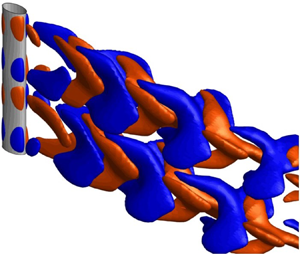
Effects of the spanwise wavelength (λ) of a sinusoidal wavy cylinder with elliptic cross-section on wake structures and fluid forces are numerically investigated at a Reynolds number Re = 100. A wide range of the wavelength, $0.43 \le \lambda /{D_m} \le 8.59$, is considered with a wave amplitude of a/Dm = 0.048, where Dm is the hydraulic diameter of the wavy cylinder. Based on vortical structures, Strouhal number (St) and wake closure length (Lc), fluid forces, streamline topologies and spatio-temporal evolutions of the near wake, five distinct flow patterns (I–V) are identified depending on λ/Dm. The drag force reaches its minimum in pattern III, the fluctuating lift force is zero in flow patterns III and IV. Distinct from the classical flow where alternate vortex shedding occurs synchronously over the entire cylinder span, flow pattern IV has alternate vortex shedding over a one half-wavelength of the wavy elliptic cylinder, antiphased with that over the other half-wavelength, thus leading to zero fluctuating lift over one complete wavelength. A thorough comparison of the wakes is made between the wavy elliptic cylinder and wavy circular or square cylinder, distinguishing the underlying flow physics behind the salient behaviours observed.
Spatio-temporal fluctuations of interscale and interspace energy transfer dynamics in homogeneous turbulence
-
- Journal:
- Journal of Fluid Mechanics / Volume 969 / 25 August 2023
- Published online by Cambridge University Press:
- 15 August 2023, A14
-
- Article
- Export citation

Non-Galilean Taylor–Culick law governs sheet dynamics in unsteady fragmentation
-
- Journal:
- Journal of Fluid Mechanics / Volume 969 / 25 August 2023
- Published online by Cambridge University Press:
- 15 August 2023, A19
-
- Article
- Export citation
High-power free-running single-longitudinal-mode diamond Raman laser enabled by suppressing parasitic stimulated Brillouin scattering
-
- Journal:
- High Power Laser Science and Engineering / Volume 11 / 2023
- Published online by Cambridge University Press:
- 15 August 2023, e72
-
- Article
-
- You have access
- Open access
- HTML
- Export citation
Instability and transition onset downstream of a laminar separation bubble at Mach 6
-
- Journal:
- Journal of Fluid Mechanics / Volume 969 / 25 August 2023
- Published online by Cambridge University Press:
- 15 August 2023, A11
-
- Article
- Export citation
-
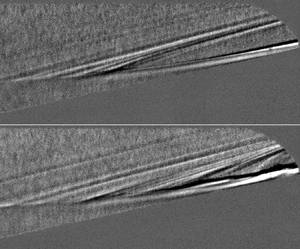
Instability measurements of an axisymmetric, laminar separation bubble were made over a sharp cone-cylinder-flare with a $12^{\circ }$ flare angle under hypersonic quiet flow. Two distinct instabilities were identified: Mack's second mode (which peaked between 190 and 290 kHz) and the shear-layer instability in the same frequency band as Mack's first mode (observed between 50 and 150 kHz). Both instabilities were measured with surface pressure sensors and were captured with high-speed schlieren. Linear stability analysis results agreed well with these measured instabilities in terms of both peak frequencies and amplification rates. Lower-frequency fluctuations were also noted in the schlieren data. Bicoherence analysis revealed nonlinear phase-locking between the shear-layer and second-mode instabilities. For the first time in axisymmetric, low-disturbance flow, naturally generated intermittent turbulent spots were observed in the reattached boundary layer. These spots appeared to evolve from shear-layer-instability wave packets convecting downstream. This work presents novel experimental evidence of the hypersonic shear-layer instability contributing directly to transition onset for an axisymmetric model.

Anisotropy of turbulence at the core of the tip and hub vortices shed by a marine propeller
-
- Journal:
- Journal of Fluid Mechanics / Volume 969 / 25 August 2023
- Published online by Cambridge University Press:
- 15 August 2023, A23
-
- Article
-
- You have access
- Open access
- HTML
- Export citation
Attenuation of perturbation growth of single-mode SF6–air interface through reflected rarefaction waves
-
- Journal:
- Journal of Fluid Mechanics / Volume 969 / 25 August 2023
- Published online by Cambridge University Press:
- 15 August 2023, R1
-
- Article
- Export citation
-
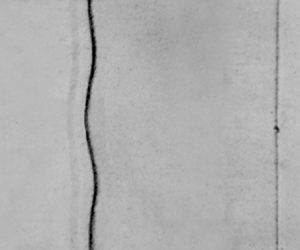
Attenuation and even freeze-out (amplitude growth stagnation) of the perturbation amplitude growth of a shocked SF $_6$–air interface are first realized in shock-tube experiments through reflected rarefaction waves, which produce reverse baroclinic vorticity offsetting the vorticity deposited by the shock. A theoretical model is constructed to predict the perturbation growth after the impact of rarefaction waves, and seven possibilities of amplitude growth are analysed. Experimentally, a planar air–helium interface is used to produce reflected rarefaction waves. Through changing the perturbation wavelength and the time interval of two impacts, five experiments with specific initial conditions are carried out, and three different possibilities of perturbation growth attenuation are realized.

Controlling secondary flows in Taylor–Couette flow using axially spaced superhydrophobic surfaces
-
- Journal:
- Journal of Fluid Mechanics / Volume 969 / 25 August 2023
- Published online by Cambridge University Press:
- 15 August 2023, A18
-
- Article
-
- You have access
- Open access
- HTML
- Export citation
Modelling the wall friction coefficient for a simple shear granular flow in view of the degradation mechanism
-
- Journal:
- Journal of Fluid Mechanics / Volume 969 / 25 August 2023
- Published online by Cambridge University Press:
- 14 August 2023, A7
-
- Article
-
- You have access
- Open access
- HTML
- Export citation
-
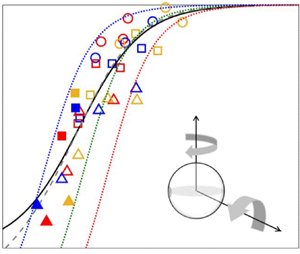
A steady granular flow experiment was performed in a confined annular shear cell to examine how the wall friction coefficient $\mu _w$ degrades from the intrinsic sliding friction coefficient $f$ between the grains and the container wall. Two existing models are invoked to examine the decay trend of $\mu _w/f$ in view of the ratio of shear velocity to the square root of granular temperature $\chi$ (Artoni & Richard, Phys. Rev. Lett., vol. 115, 2015, 158001) and the ratio of grain angular and slip velocities $\varOmega$ (Yang & Huang, Granul. Matt., vol. 18, issue 4, 2016, p. 77), respectively. As both models correlate $\mu _w/f$ to different flow properties, a hidden relation is speculated between $\chi$ and $\varOmega$, or equivalently, between the granular temperature and the grain rotation speed. We used experiment data to confirm and reveal this hidden relation. From there, a unified $\mu _w/f-\chi$ model is proposed with physical meanings for the model coefficients and to show general agreement with the measured trend. Hence we may conclude that both the fluctuations in grain translations and their mean rotation are the crucial yet equivalent mechanisms to degrade $\mu _w/f$.


