Refine search
Actions for selected content:
238141 results in Physics and Astronomy
11 - Theory: Parameter Estimation
-
- Book:
- Quantum Processes and Measurement
- Published online:
- 27 July 2023
- Print publication:
- 10 August 2023, pp 186-209
-
- Chapter
- Export citation
5 - Nonlinear Optical Phenomena
-
- Book:
- Physics and Engineering of Graded-Index Media
- Published online:
- 27 July 2023
- Print publication:
- 10 August 2023, pp 111-162
-
- Chapter
- Export citation
Preface
-
- Book:
- Physics and Engineering of Graded-Index Media
- Published online:
- 27 July 2023
- Print publication:
- 10 August 2023, pp xiii-xiv
-
- Chapter
- Export citation
9 - Continuous Variable Systems
-
- Book:
- Quantum Processes and Measurement
- Published online:
- 27 July 2023
- Print publication:
- 10 August 2023, pp 142-177
-
- Chapter
- Export citation
10 - Experiment: Parameter Estimation
-
- Book:
- Quantum Processes and Measurement
- Published online:
- 27 July 2023
- Print publication:
- 10 August 2023, pp 178-185
-
- Chapter
- Export citation
K - Basics of Circuit Quantum Electrodynamics
-
- Book:
- Quantum Processes and Measurement
- Published online:
- 27 July 2023
- Print publication:
- 10 August 2023, pp 279-288
-
- Chapter
- Export citation
A novel approach for variable star classification based on imbalanced learning
-
- Journal:
- Publications of the Astronomical Society of Australia / Volume 40 / 2023
- Published online by Cambridge University Press:
- 09 August 2023, e037
-
- Article
-
- You have access
- Open access
- HTML
- Export citation
Evolved galaxies in high-density environments across 2.0 ≤ z < 4.2 using the ZFOURGE survey
-
- Journal:
- Publications of the Astronomical Society of Australia / Volume 40 / 2023
- Published online by Cambridge University Press:
- 09 August 2023, e043
-
- Article
-
- You have access
- Open access
- HTML
- Export citation
-
To explore the role environment plays in influencing galaxy evolution at high redshifts, we study $2.0\leq z<4.2$ environments using the FourStar Galaxy Evolution (ZFOURGE) survey. Using galaxies from the COSMOS legacy field with ${\rm log(M_{*}/M_{\odot})}\geq9.5$, we use a seventh nearest neighbour density estimator to quantify galaxy environment, dividing this into bins of low-, intermediate-, and high-density. We discover new high-density environment candidates across $2.0\leq z<2.4$ and $3.1\leq z<4.2$. We analyse the quiescent fraction, stellar mass and specific star formation rate (sSFR) of our galaxies to understand how these vary with redshift and environment. Our results reveal that, across $2.0\leq z<2.4$, the high-density environments are the most significant regions, which consist of elevated quiescent fractions, ${\rm log(M_{*}/M_{\odot})}\geq10.2$ massive galaxies and suppressed star formation activity. At $3.1\leq z<4.2$, we find that high-density regions consist of elevated stellar masses but require more complete samples of quiescent and sSFR data to study the effects of environment in more detail at these higher redshifts. Overall, our results suggest that well-evolved, passive galaxies are already in place in high-density environments at $z\sim2.4$, and that the Butcher–Oemler effect and SFR-density relation may not reverse towards higher redshifts as previously thought.


High-energy and high-peak-power GHz burst-mode all-fiber laser with a uniform envelope and tunable intra-burst pulses
-
- Journal:
- High Power Laser Science and Engineering / Volume 11 / 2023
- Published online by Cambridge University Press:
- 09 August 2023, e81
-
- Article
-
- You have access
- Open access
- HTML
- Export citation
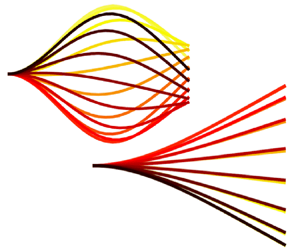
Hybrid wave/current energy harvesting with a flexible piezoelectric plate
-
- Journal:
- Journal of Fluid Mechanics / Volume 968 / 10 August 2023
- Published online by Cambridge University Press:
- 08 August 2023, A31
-
- Article
- Export citation

Static and dynamic stability of pendant drops
-
- Journal:
- Journal of Fluid Mechanics / Volume 968 / 10 August 2023
- Published online by Cambridge University Press:
- 08 August 2023, A30
-
- Article
- Export citation
Efficient kinetic Lattice Boltzmann simulation of three-dimensional Hall-MHD turbulence
-
- Journal:
- Journal of Plasma Physics / Volume 89 / Issue 4 / August 2023
- Published online by Cambridge University Press:
- 08 August 2023, 905890413
-
- Article
- Export citation
-
Simulating plasmas in the Hall-magnetohydrodynamics (Hall-MHD) regime represents a valuable approach for the investigation of complex nonlinear dynamics developing in astrophysical frameworks and fusion machines. The Hall electric field is computationally very challenging as it involves the integration of an additional term, proportional to $\boldsymbol {\nabla } \times ((\boldsymbol {\nabla }\times \boldsymbol {B})\times \boldsymbol {B})$
 , in Faraday's induction law. The latter feeds back on the magnetic field $B$
 at small scales (between the ion and electron inertial scales), requiring very high resolutions in both space and time to properly describe its dynamics. The computational advantage provided by the kinetic lattice Boltzmann (LB) approach is exploited here to develop a new code, the fast lattice-Boltzmann algorithm for MHD experiments (flame). The flame code integrates the plasma dynamics in lattice units coupling two kinetic schemes, one for the fluid protons (including the Lorentz force), the other to solve the induction equation describing the evolution of the magnetic field. Here, the newly developed algorithm is tested against an analytical wave-solution of the dissipative Hall-MHD equations, pointing out its stability and second-order convergence, over a wide range of the control parameters. Spectral properties of the simulated plasma are finally compared with those obtained from numerical solutions from the well-established pseudo-spectral code ghost. Furthermore, the LB simulations we present, varying the Hall parameter, highlight the transition from the MHD to the Hall-MHD regime, in excellent agreement with the magnetic field spectra measured in the solar wind.

An explicit representation for mean profiles and fluxes in forced passive scalar convection
-
- Journal:
- Journal of Fluid Mechanics / Volume 968 / 10 August 2023
- Published online by Cambridge University Press:
- 08 August 2023, R1
-
- Article
-
- You have access
- Open access
- HTML
- Export citation
-
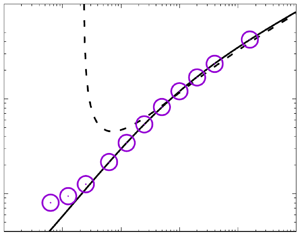
We derive explicit formulae for the mean profiles of passive scalars (either temperature or concentration of a diffusing substance), and their respective wall fluxes (either heat or mass fluxes), in forced turbulent convection, as a function of the Reynolds and Prandtl numbers. Direct numerical simulation data for turbulent flow within a smooth straight pipe of circular cross-section, at friction Reynolds number ${{Re}}_{\tau }=1140$, in the range of Prandtl numbers from ${{Pr}}=0.00625$ to ${{Pr}}=16$, are used to infer the proper analytical form of the eddy diffusivity. This is leveraged to derive accurate predictive formulae for the mean passive scalar profiles, and for the corresponding logarithmic offset function. Asymptotic scaling laws result for the thickness of the conductive (diffusive) layer, and for the Nusselt number, which significantly extend the predictive envelope of classical formulae.


Projection theorems for linear-fractional families of projections
- Part of
-
- Journal:
- Mathematical Proceedings of the Cambridge Philosophical Society / Volume 175 / Issue 3 / November 2023
- Published online by Cambridge University Press:
- 08 August 2023, pp. 625-647
- Print publication:
- November 2023
-
- Article
-
- You have access
- Open access
- HTML
- Export citation
-
Marstrand’s theorem states that applying a generic rotation to a planar set A before projecting it orthogonally to the x-axis almost surely gives an image with the maximal possible dimension $\min(1, \dim A)$. We first prove, using the transversality theory of Peres–Schlag locally, that the same result holds when applying a generic complex linear-fractional transformation in $PSL(2,\mathbb{C})$ or a generic real linear-fractional transformation in $PGL(3,\mathbb{R})$. We next show that, under some necessary technical assumptions, transversality locally holds for restricted families of projections corresponding to one-dimensional subgroups of $PSL(2,\mathbb{C})$ or $PGL(3,\mathbb{R})$. Third, we demonstrate, in any dimension, local transversality and resulting projection statements for the families of closest-point projections to totally-geodesic subspaces of hyperbolic and spherical geometries.


Lagrangian dispersion and averaging behind a two-dimensional gaseous detonation front
-
- Journal:
- Journal of Fluid Mechanics / Volume 968 / 10 August 2023
- Published online by Cambridge University Press:
- 08 August 2023, A28
-
- Article
- Export citation
-
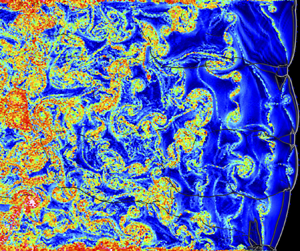
Two-dimensional numerical simulations with the particle tracking method were conducted to analyse the dispersion behind the detonation front and its mean structure. The mixtures were 2H $_2$–O $_2$–7Ar and 2H $_2$–O $_2$ of increased irregularity in ambient conditions. The detonation could be described as a two-scale phenomenon, especially for the unstable case. The first scale is related to the main heat release zone, and the second where some classical laws of turbulence remain relevant. The dispersion of the particles was promoted by the fluctuations of the leading shock and its curvature, the presence of the reaction front, and to a lesser extent transverse waves, jets and vortex motion. Indeed, the dispersion and the relative dispersion could be scaled using the reduced activation energy and the $\chi$ parameter, respectively, suggesting that the main mechanism driving the dispersion came from the one-dimensional leading shock fluctuations and heat release. The dispersion within the induction time scale was closely related to the cellular structure, particles accumulating along the trajectory of the triple points. Then, after a transient where the fading transverse waves and the vortical motions coming from jets and slip lines were present, the relative dispersion relaxed towards a Richardson–Obukhov regime, especially for the unstable case. Two new Lagrangian Favre average procedures for the gaseous detonation in the instantaneous shock frame were proposed and the mean profiles were compared with those from Eulerian procedure. The characteristic lengths for the detonation were similar, meaning that the Eulerian procedure gave the mean structure with a reasonable accuracy.


Front propagation in cellular flows: scale dependence versus scale invariance
-
- Journal:
- Journal of Fluid Mechanics / Volume 968 / 10 August 2023
- Published online by Cambridge University Press:
- 08 August 2023, A29
-
- Article
- Export citation
-
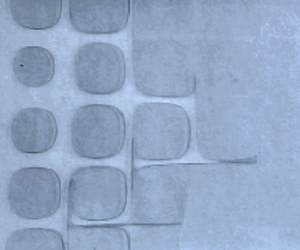
We experimentally study front propagation in a vortex lattice providing closed steady cellular flows and no mean flow. To this end, we trigger an autocatalytic reaction in a solution stirred by magnetohydrodynamic flows in a Hele-Shaw cell. We evidence a scale-invariant regime below some flow magnitude and a scale-dependent regime above, the scales referring here to the vortex scale and the front thickness. The transition between these regimes corresponds to a unitary Damköhler number $Da$:
$Da$:  $Da=1$. The enhancement of the mean front velocity with the flow magnitude nicely agrees with the literature on numerical simulations and theoretical analyses in the scale-invariant regime $Da>1$, but displays noticeable discrepancies in the scale-dependent one $Da<1$. This shows that the transition between regimes is qualitatively sharp but quantitatively smooth.


Turbulent transfer and entrainment in a low-density jet
-
- Journal:
- Journal of Fluid Mechanics / Volume 968 / 10 August 2023
- Published online by Cambridge University Press:
- 08 August 2023, A27
-
- Article
- Export citation

A Student's Guide to Rotational Motion
-
- Published online:
- 07 August 2023
- Print publication:
- 03 August 2023
-
- Textbook
- Export citation
Optimal two-dimensional roughness for transition delay in high-speed boundary layer
-
- Journal:
- Journal of Fluid Mechanics / Volume 968 / 10 August 2023
- Published online by Cambridge University Press:
- 07 August 2023, A24
-
- Article
-
- You have access
- Open access
- HTML
- Export citation
Vortex ring formation process in starting jets with uniform background co- and counter-flow
-
- Journal:
- Journal of Fluid Mechanics / Volume 968 / 10 August 2023
- Published online by Cambridge University Press:
- 07 August 2023, A26
-
- Article
- Export citation
-
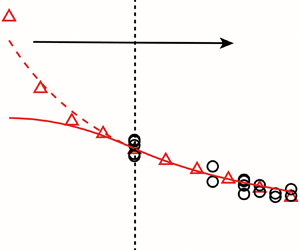
The formation process of the leading vortex ring in starting jets with uniform background co- and counter-flow has been studied numerically for $-0.5\leq R_v\leq 0.5$, where $R_v$ is the ratio of background velocity to jet velocity. For the cases with background counter-flow, the normal formation process of the leading vortex ring would be destroyed when $R_v<-0.4$, i.e. the trailing jet would overtake the leading vortex ring through the centre, a phenomenon reminiscent of vortex leapfrogging. As the velocity ratio $R_v$ increases, the formation number $F_{t^*}$ decreases from $9.6$ at $R_v=-0.4$ to $1.92$ at $R_v=0.5$. An analytical model based on the kinematic criterion has been developed so as to describe the relationship between the formation number $F_{t^*}$ and velocity ratio $R_v$. A linear relationship between the vortex core parameter and stroke ratio of starting jet ( $\varepsilon \sim k_1L/D$) for the Norbury vortex ring has been established and used effectively to close the model. For co-flow with $0< R_v\leq 0.5$, the results from this model are consistent with the present numerical simulation and the experiments by Krueger et al. (J. Fluid Mech., vol. 556, 2006, pp. 147–166). For counter-flow, two different equations are proposed for $-0.4\leq R_v\leq -0.2$ and $-0.2< R_v<0$, respectively.


