Refine search
Actions for selected content:
238141 results in Physics and Astronomy
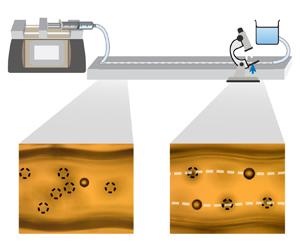
Particle focusing in a wavy channel
- Part of
-
- Journal:
- Journal of Fluid Mechanics / Volume 968 / 10 August 2023
- Published online by Cambridge University Press:
- 07 August 2023, A25
-
- Article
-
- You have access
- HTML
- Export citation
Cross-helicity effect on α-type dynamo in non-equilibrium turbulence
-
- Journal:
- Journal of Plasma Physics / Volume 89 / Issue 4 / August 2023
- Published online by Cambridge University Press:
- 07 August 2023, 905890412
-
- Article
- Export citation
Astrobioethical reflections on humanity and its consideration as multi- and interplanetary
-
- Journal:
- International Journal of Astrobiology / Volume 22 / Issue 5 / October 2023
- Published online by Cambridge University Press:
- 07 August 2023, pp. 608-615
-
- Article
-
- You have access
- Open access
- HTML
- Export citation
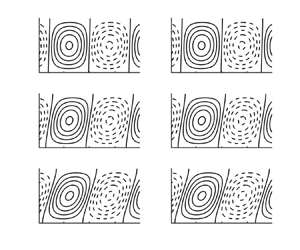
Reynolds number induced growth of the large-scale rolls in plane Couette flow using resolvent analysis
-
- Journal:
- Journal of Fluid Mechanics / Volume 968 / 10 August 2023
- Published online by Cambridge University Press:
- 04 August 2023, A23
-
- Article
-
- You have access
- Open access
- HTML
- Export citation
-
In direct numerical simulations (DNS) of turbulent Couette flow, the observation has been made that the long streamwise rolls increase in length with the Reynolds number (Lee & Moser, J. Fluid Mech., vol. 842, 2018, pp. 128–145). To understand this, we employ both linear stability theory and its extension to resolvent analysis. For this, we emphasise the high Reynolds number ( $Re \rightarrow \infty$) and small streamwise wavenumbers ( $\alpha \rightarrow 0$) limit, imposing the distinguished limit $Re_{\alpha }=Re \, \alpha = O(1)$. We find that in case of linear stability theory, $Re_{\alpha }$ acts as a global invariant in the resulting eigenvalue problem, while in case of resolvent analysis, $Re_{\alpha }$ acts as a local invariant in the behaviour of the energy of the system characterised through the first singular value $\sigma _1$ of the resolvent operator within the investigated asymptotic limit. In order to obtain constant streamwise structures for increasing Reynolds numbers, the respective streamwise wavenumber has to decrease, which verifies the observations from DNS studies of an increasing length of the streamwise structures with the Reynolds number. In linear stability theory, a parameter reduction is achieved for the above asymptotic limit, resulting in the modified Orr–Sommerfeld and Squire equations being dependent only on $Re_{\alpha }$. The behaviour of both the coherent structures obtained from linear stability theory and resolvent analysis are compared with each other and show similar behaviours over $Re_{\alpha }$.


Collision efficiency of like-charged spheres settling in a quiescent environment
-
- Journal:
- Journal of Fluid Mechanics / Volume 968 / 10 August 2023
- Published online by Cambridge University Press:
- 04 August 2023, A22
-
- Article
-
- You have access
- Open access
- HTML
- Export citation
Information gain as a tool for assessing biosignature missions
-
- Journal:
- International Journal of Astrobiology / Volume 22 / Issue 5 / October 2023
- Published online by Cambridge University Press:
- 04 August 2023, pp. 583-607
-
- Article
- Export citation
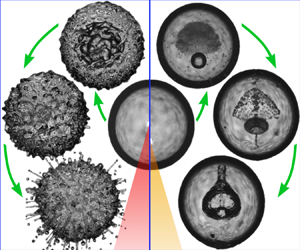
Bubble nucleation and jetting inside a millimetric droplet
-
- Journal:
- Journal of Fluid Mechanics / Volume 968 / 10 August 2023
- Published online by Cambridge University Press:
- 04 August 2023, A19
-
- Article
-
- You have access
- Open access
- HTML
- Export citation
-
In this work we present experiments and simulations on the nucleation and successive dynamics of laser-induced bubbles inside liquid droplets in free-fall motion, i.e. a case where the bubbles are subjected to the influence of a free boundary in all directions. Within this spherical millimetric droplet, we have investigated the nucleation of secondary bubbles induced by the rarefaction wave that is produced when the shock wave emitted by the laser-induced plasma reflects at the drop surface. Interestingly, three-dimensional clusters of cavitation bubbles are observed. Their shape is compared with the negative pressure distribution computed with a computational fluid dynamics model and allows us to estimate a cavitation threshold value. In particular, we observed that the focusing of the waves in the vicinity of the free surface can give rise to explosive cavitation events that end up in fast liquid ejections. High-speed recordings of the drop/bubble dynamics are complemented by the velocity and pressure fields simulated for the same initial conditions. The effect of the proximity of a curved free surface on the jetting dynamics of the bubbles was qualitatively assessed by classifying the cavitation events using a non-dimensional stand-off parameter ${\Upsilon\hskip -1,05em -\,}$ that depends on the drop size, the bubble maximum radius and the relative position of the bubble inside the drop. Additionally, we studied the role of the drop's curvature by implementing a structural similarity algorithm to compare cases with bubbles produced near a flat surface to the bubbles inside the drop. Interestingly, this quantitative comparison method indicated the existence of equivalent stand-off distances at which bubbles influenced by different boundaries behave in a very similar way. The oscillation of the laser-induced bubbles promotes the onset of Rayleigh–Taylor and Rayleigh–Plateau instabilities, observed on the drop's surface. This phenomenon was studied by varying the ratio of the maximum radii of the bubble and the drop. The specific mechanisms leading to the destabilisation of the droplet surface were identified.

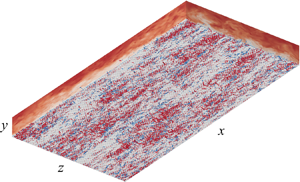
Outer-layer similarity and energy transfer in a rough-wall turbulent channel flow
-
- Journal:
- Journal of Fluid Mechanics / Volume 968 / 10 August 2023
- Published online by Cambridge University Press:
- 04 August 2023, A18
-
- Article
- Export citation
-
Direct numerical simulations (DNSs) are performed to investigate the roughness effects on the statistical properties and the large-scale coherent structures in the turbulent channel flow over three-dimensional sinusoidal rough walls. The outer-layer similarities of mean streamwise velocity and Reynolds stresses are examined by systematically varying the roughness Reynolds number $k^{+}$ and the ratio of the roughness height to the half-channel height $k / \delta$. The energy transfer mechanism of turbulent motions in the presence of roughness elements with different sizes is explored through spectral analysis of the transport equation of the two-point velocity correlation and the scale-energy path display of the generalized Kolmogorov equation. The results show that, with increasing $k^+$, the downward shift of the mean streamwise velocity profile in the logarithmic region increases and the peak intensities of turbulent Reynolds stresses decrease. At an intermediate Reynolds number ( $Re_{\tau }= 1080$), the length scale and intensity of the large-scale coherent structures increase for a small roughness ( $k^{+}=10$), which leads to failure of the outer-layer similarity in rough-wall turbulence, and decrease for a large roughness ( $k^{+}=60$), as compared with the smooth-wall case. The existence of the small roughness ( $k^{+}=10$) enhances the mechanism of inverse energy cascade from the inner-layer small-scale structures to the outer-layer large-scale structures. Correspondingly, the self-sustaining processes of the outer-layer large-scale coherent structures, including turbulent production, interscale transport, pressure transport and spatial turbulent transport, are all enhanced, whereas the large roughness ( $k^{+}=60$) weakens the energy transfer between the inner and outer regions.


PSP volume 175 issue 2 Cover and Front matter
-
- Journal:
- Mathematical Proceedings of the Cambridge Philosophical Society / Volume 175 / Issue 2 / September 2023
- Published online by Cambridge University Press:
- 04 August 2023, pp. f1-f2
- Print publication:
- September 2023
-
- Article
-
- You have access
- Export citation
Stability of electron plasmas in stellarators
- Part of
-
- Journal:
- Journal of Plasma Physics / Volume 89 / Issue 4 / August 2023
- Published online by Cambridge University Press:
- 04 August 2023, 935890402
-
- Article
-
- You have access
- Open access
- HTML
- Export citation
PSP volume 175 issue 2 Cover and Back matter
-
- Journal:
- Mathematical Proceedings of the Cambridge Philosophical Society / Volume 175 / Issue 2 / September 2023
- Published online by Cambridge University Press:
- 04 August 2023, pp. b1-b2
- Print publication:
- September 2023
-
- Article
-
- You have access
- Export citation
Hole-driven dynamics of a three-dimensional gravitational liquid curtain
-
- Journal:
- Journal of Fluid Mechanics / Volume 968 / 10 August 2023
- Published online by Cambridge University Press:
- 04 August 2023, A20
-
- Article
-
- You have access
- Open access
- HTML
- Export citation
-
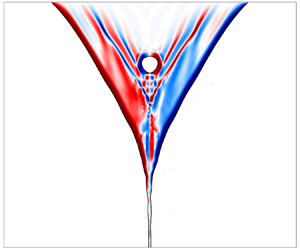
It is known that the disintegration of vertical liquid curtains (sheets) is affected crucially by the amplification of free edge holes forming inside the curtain. This paper aims to investigate the influence of the hole expansion dynamics, driven by the so-called rim retraction, on the breakup of a liquid curtain, in both supercritical (Weber number $We > 1$) and subcritical ( $We < 1$) conditions. The analysis is based on three-dimensional direct numerical simulations. For a selected supercritical configuration, the steady flow topology is first analysed. The investigation reveals the classic triangular shape regime of the steady curtain, due to the surface-tension-induced borders retraction towards its centre plane. The unsteady dynamics is then investigated as the curtain response to a hole perturbation introduced artificially in the steady flow configuration. The hole evolution determines a rim retraction phenomenon inside the curtain, which is influenced by both capillary and gravity forces. In supercritical conditions, the hole does not influence the curtain flow dynamics in the long-time limit. By reducing the Weber number slightly under the critical threshold ( $We=1$), the initial amplification rate of the hole area increases, due to the stronger retraction effect of surface tension acting on the hole rims. The free hole expansion in fully subcritical conditions ( $We < 1$) is investigated finally by simulating an edge-free curtain flow. As $We$ decreases progressively, the hole expands while it is convected downstream by gravity acceleration. In the range $0.4< We<1$, the subcritical curtain returns to the intact unperturbed configuration after the hole expulsion at the downstream outflow. For $We<0.4$, the surface tension force becomes strong enough to reverse the gravitational motion of the hole top point, which retracts upstream towards the sheet inlet section while expanding along the lateral directions. This last phenomenon causes finally the breakup of the curtain, which results in a columnar regime strictly resembling similar experimental findings of the literature.


Shock reflection with incident shock–wedge trailing-edge expansion fan interaction
-
- Journal:
- Journal of Fluid Mechanics / Volume 968 / 10 August 2023
- Published online by Cambridge University Press:
- 04 August 2023, A21
-
- Article
- Export citation

The ALMA Telescope
- The Story of a Science Mega-Project
-
- Published online:
- 03 August 2023
- Print publication:
- 17 August 2023
-
- Book
-
- You have access
- Open access
- Export citation
Preface
-
- Book:
- A Student's Guide to Rotational Motion
- Published online:
- 07 August 2023
- Print publication:
- 03 August 2023, pp ix-x
-
- Chapter
- Export citation
3 - Rotational Dynamics
-
- Book:
- A Student's Guide to Rotational Motion
- Published online:
- 07 August 2023
- Print publication:
- 03 August 2023, pp 54-71
-
- Chapter
- Export citation
5 - Angular Momentum
-
- Book:
- A Student's Guide to Rotational Motion
- Published online:
- 07 August 2023
- Print publication:
- 03 August 2023, pp 90-109
-
- Chapter
- Export citation
Copyright page
-
- Book:
- A Student's Guide to Rotational Motion
- Published online:
- 07 August 2023
- Print publication:
- 03 August 2023, pp iv-iv
-
- Chapter
- Export citation
Index
-
- Book:
- A Student's Guide to Rotational Motion
- Published online:
- 07 August 2023
- Print publication:
- 03 August 2023, pp 169-171
-
- Chapter
- Export citation
2 - Torque and Static Equilibrium
-
- Book:
- A Student's Guide to Rotational Motion
- Published online:
- 07 August 2023
- Print publication:
- 03 August 2023, pp 25-53
-
- Chapter
- Export citation
