Refine search
Actions for selected content:
238152 results in Physics and Astronomy
Nonlinear electrophoretic velocity of a spherical colloidal particle
-
- Journal:
- Journal of Fluid Mechanics / Volume 968 / 10 August 2023
- Published online by Cambridge University Press:
- 31 July 2023, A14
-
- Article
- Export citation
-
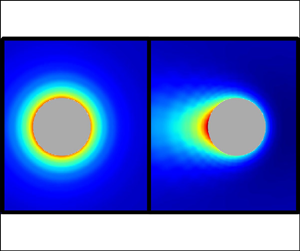
Electrophoresis is the motion of a charged colloidal particle in an electrolyte under an applied electric field. The electrophoretic velocity of a spherical particle depends on the dimensionless electric field strength $\beta =a^*e^*E_\infty ^*/k_B^*T^*$, defined as the ratio of the product of the applied electric field magnitude $E_\infty ^*$ and particle radius $a^*$, to the thermal voltage $k_B^*T^*/e^*$, where $k_B^*$ is Boltzmann's constant, $T^*$ is the absolute temperature, and $e^*$ is the charge on a proton. In this paper, we develop a spectral element algorithm to compute the electrophoretic velocity of a spherical, rigid, dielectric particle, of fixed dimensionless surface charge density $\sigma$ over a wide range of $\beta$. Here, $\sigma =(e^*a^*/\epsilon ^*k_B^*T^*)\sigma ^*$, where $\sigma ^*$ is the dimensional surface charge density, and $\epsilon ^*$ is the permittivity of the electrolyte. For moderately charged particles ( $\sigma ={O}(1)$), the electrophoretic velocity is linear in $\beta$ when $\beta \ll 1$, and its dependence on the ratio of the Debye length ( $1/\kappa ^*$) to particle radius (denoted by $\delta =1/(\kappa ^*a^*)$) agrees with Henry's formula. As $\beta$ increases, the nonlinear contribution to the electrophoretic velocity becomes prominent, and the onset of this behaviour is $\delta$-dependent. For $\beta \gg 1$, the electrophoretic velocity again becomes linear in field strength, approaching the Hückel limit of electrophoresis in a dielectric medium, for all $\delta$. For highly charged particles ( $\sigma \gg 1$) in the thin-Debye-layer limit ( $\delta \ll 1$), our computations are in good agreement with recent experimental and asymptotic results.


Breaking wave field statistics with a multi-layer model
- Part of
-
- Journal:
- Journal of Fluid Mechanics / Volume 968 / 10 August 2023
- Published online by Cambridge University Press:
- 31 July 2023, A12
-
- Article
-
- You have access
- Open access
- HTML
- Export citation
-
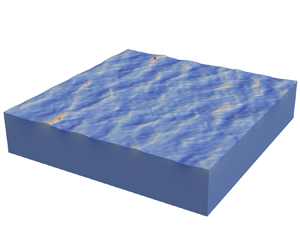
The statistics of breaking wave fields are characterised within a novel multi-layer framework, which generalises the single-layer Saint-Venant system into a multi-layer and non-hydrostatic formulation of the Navier–Stokes equations. We simulate an ensemble of phase-resolved surface wave fields in physical space, where strong nonlinearities, including directional wave breaking and the subsequent highly rotational flow motion, are modelled, without surface overturning. We extract the kinematics of wave breaking by identifying breaking fronts and their speed, for freely evolving wave fields initialised with typical wind wave spectra. The $\varLambda (c)$ distribution, defined as the length of breaking fronts (per unit area) moving with speed $c$ to $c+{\rm d}c$ following Phillips (J. Fluid Mech., vol. 156, 1985, pp. 505–531), is reported for a broad range of conditions. We recover the $\varLambda (c) \propto c^{-6}$ scaling without wind forcing for sufficiently steep wave fields. A scaling of $\varLambda (c)$ based solely on the root-mean-square slope and peak wave phase speed is shown to describe the modelled breaking distributions well. The modelled breaking distributions are in good agreement with field measurements and the proposed scaling can be applied successfully to the observational data sets. The present work paves the way for simulations of the turbulent upper ocean directly coupled to a realistic breaking wave dynamics, including Langmuir turbulence, and other sub-mesoscale processes.


Mean resolvent operator of a statistically steady flow
-
- Journal:
- Journal of Fluid Mechanics / Volume 968 / 10 August 2023
- Published online by Cambridge University Press:
- 31 July 2023, A13
-
- Article
- Export citation
-
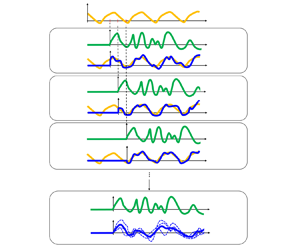
This paper introduces a new operator relevant to input–output analysis of flows in a statistically steady regime far from the steady base flow: the mean resolvent ${{\boldsymbol{\mathsf{R}}}}_0$. It is defined as the operator predicting, in the frequency domain, the mean linear response to forcing of the time-varying base flow. As such, it provides the statistically optimal linear time-invariant approximation of the input–output dynamics, which may be useful, for instance, in flow control applications. Theory is developed for the periodic case. The poles of the operator are shown to correspond to the Floquet exponents of the system, including purely imaginary poles at multiples of the fundamental frequency. In general, evaluating mean transfer functions from data requires averaging the response to many realizations of the same input. However, in the specific case of harmonic forcings, we show that the mean transfer functions may be identified without averaging: an observation referred to as ‘dynamic linearity’ in the literature (Dahan et al., J. Fluid Mech., vol. 704, 2012, pp. 360–387). For incompressible flows in the weakly unsteady limit, i.e. when amplification of perturbations by the unsteady part of the periodic Jacobian is small compared to amplification by the mean Jacobian, the mean resolvent ${{\boldsymbol{\mathsf{R}}}}_0$ is well-approximated by the well-known resolvent operator about the mean flow. Although the theory presented in this paper extends only to quasi-periodic flows, the definition of ${{\boldsymbol{\mathsf{R}}}}_0$ remains meaningful for flows with continuous or mixed spectra, including turbulent flows. Numerical evidence supports the close connection between the two resolvent operators in quasi-periodic, chaotic and stochastic two-dimensional incompressible flows.


Close-contact melting of shear-thinning fluids
-
- Journal:
- Journal of Fluid Mechanics / Volume 968 / 10 August 2023
- Published online by Cambridge University Press:
- 28 July 2023, A9
-
- Article
- Export citation
-
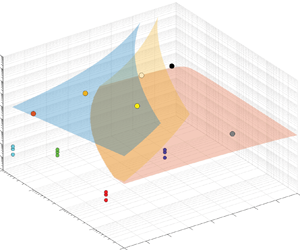
This study aims at establishing a model for close-contact melting (CCM) of shear-thinning fluids. We presented a theoretical framework for predicting the variation of liquid melt film thickness and motion of unmelted solid for both Carreau and power-law fluids. We identified the appropriate energy equation considering the convective effect and derived an analytical temperature profile across the liquid film. Using the lubrication approximation, force equilibrium relationships and the corresponding numerical approaches were built. By using laser interferometry and photographic recording methods, we found excellent agreement between numerical solutions and experimental results for Carreau liquids, revealing that the convective effect weakens heat transfer and melting rate. We identified the critical liquid film thickness that determines three situations of CCM in the theoretical model for Carreau fluids. Numerical prediction demonstrated that the CCM of Carreau fluids can be almost equivalent to that of power-law fluids if the initial film thickness is greater than the critical value. Finally, approximate analytical models were developed for both Carreau and power-law models. For the applicability of the approximate analytical solutions, we derived two- and three-dimensional dimensionless phase diagrams of validity range and identified a key dimensionless group $(\varLambda Re)^{4/3}{Re}\left [3\ln (Ste+1)\right ]^{1/3}{Pe}^{-1/3}$, where $\varLambda$ is dimensionless characteristic time, Re is Reynolds number, Ste is Stefan number and Pe is Peclect number. The reliability of the approximate solutions was verified by comparing with the numerical results. These approximate solutions enable convenient and low-cost computational prediction of the dynamic CCM process of shear-thinning fluids.

Turbulent drag reduction by spanwise wall forcing. Part 1. Large-eddy simulations
-
- Journal:
- Journal of Fluid Mechanics / Volume 968 / 10 August 2023
- Published online by Cambridge University Press:
- 28 July 2023, A6
-
- Article
-
- You have access
- Open access
- HTML
- Export citation
-
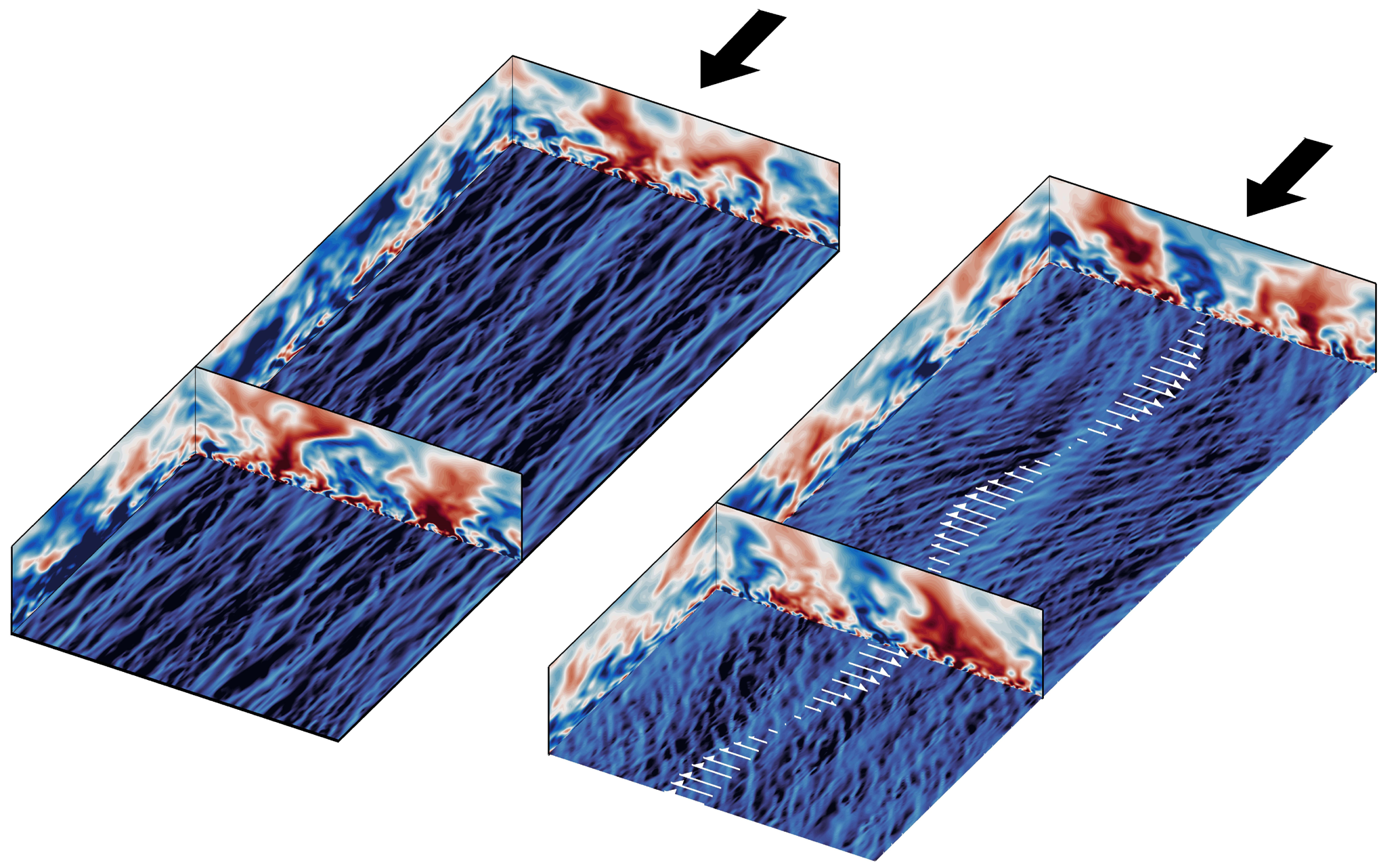
Turbulent drag reduction (DR) through streamwise travelling waves of the spanwise wall oscillation is investigated over a wide range of Reynolds numbers. Here, in Part 1, wall-resolved large-eddy simulations in a channel flow are conducted to examine how the frequency and wavenumber of the travelling wave influence the DR at friction Reynolds numbers $Re_\tau = 951$ and $4000$. The actuation parameter space is restricted to the inner-scaled actuation (ISA) pathway, where DR is achieved through direct attenuation of the near-wall scales. The level of turbulence attenuation, hence DR, is found to change with the near-wall Stokes layer protrusion height $\ell _{0.01}$. A range of frequencies is identified where the Stokes layer attenuates turbulence, lifting up the cycle of turbulence generation and thickening the viscous sublayer; in this range, the DR increases as $\ell _{0.01}$ increases up to $30$ viscous units. Outside this range, the strong Stokes shear strain enhances near-wall turbulence generation leading to a drop in DR with increasing $\ell _{0.01}$. We further find that, within our parameter and Reynolds number space, the ISA pathway has a power cost that always exceeds any DR savings. This motivates the study of the outer-scaled actuation pathway in Part 2, where DR is achieved through actuating the outer-scaled motions.


A Perron–Frobenius analysis of wall-bounded turbulence
-
- Journal:
- Journal of Fluid Mechanics / Volume 968 / 10 August 2023
- Published online by Cambridge University Press:
- 28 July 2023, A10
-
- Article
-
- You have access
- Open access
- HTML
- Export citation
On L-derivatives and biextensions of Calabi–Yau motives
-
- Journal:
- Experimental Results / Volume 4 / 2023
- Published online by Cambridge University Press:
- 28 July 2023, e16
-
- Article
-
- You have access
- Open access
- HTML
- Export citation
-
We prove that certain differential operators of the form $ DLD $ with $ L $ hypergeometric and $ D=z\frac{\partial }{dz} $ are of Picard–Fuchs type. We give closed hypergeometric expressions for minors of the biextension period matrices that arise from certain rank 4 weight 3 Calabi–Yau motives presumed to be of analytic rank 1. We compare their values numerically to the first derivative of the $ L $-functions of the respective motives at $ s=2 $.


FLM volume 967 Cover and Front matter
-
- Journal:
- Journal of Fluid Mechanics / Volume 967 / 25 July 2023
- Published online by Cambridge University Press:
- 28 July 2023, p. f1
-
- Article
-
- You have access
- Export citation

Effects of wall vibrations on channel flows
-
- Journal:
- Journal of Fluid Mechanics / Volume 968 / 10 August 2023
- Published online by Cambridge University Press:
- 28 July 2023, A8
-
- Article
-
- You have access
- Open access
- HTML
- Export citation
-
The effect of surface vibrations on the pressure-gradient-driven flows in channels has been studied. The analysis considered monochromatic waves and laminar flows. The effectiveness of the vibrations was gauged by determining the pressure gradient correction required to maintain the same flow rate as without vibrations. Waves propagating upstream always increase pressure losses. Flow response to waves propagating downstream is more complex and changes as a function of the flow Reynolds number. Such waves reduce losses if the Reynolds number $Re <\ \sim\!\!100$, but these waves must be sufficiently fast to reduce pressure losses for larger Re values. In general, the supercritical waves, i.e. waves faster than the reference flow, reduce pressure losses with the magnitude of reduction increasing monotonically with the wave phase speed and wavenumber. The need for an external pressure gradient is eliminated if sufficiently short and fast waves are used. Generally, the subcritical waves, i.e. waves with velocities similar to the reference flow, increase pressure losses. This increase changes somewhat irregularly as a function of the wave phase speed and wavenumber forming local maxima and minima. These waves can reduce pressure losses only if the Reynolds number becomes large enough. It is shown that subcritical waves with very small amplitudes but matching the natural flow frequencies produce significant pressure losses.

Separate and joint clustering characteristics of large-Stokes-number sprays subjected to turbulent co-flows
-
- Journal:
- Journal of Fluid Mechanics / Volume 968 / 10 August 2023
- Published online by Cambridge University Press:
- 28 July 2023, A11
-
- Article
-
- You have access
- Open access
- HTML
- Export citation
Turbulent drag reduction by spanwise wall forcing. Part 2. High-Reynolds-number experiments
-
- Journal:
- Journal of Fluid Mechanics / Volume 968 / 10 August 2023
- Published online by Cambridge University Press:
- 28 July 2023, A7
-
- Article
-
- You have access
- Open access
- HTML
- Export citation
-
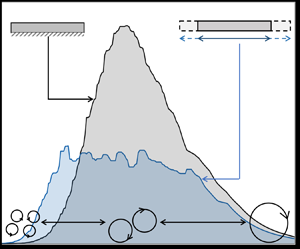
We present measurements of turbulent drag reduction (DR) in boundary layers at high friction Reynolds numbers in the range of $4500 \le Re_\tau \le 15\ 000$. The efficacy of the approach, using streamwise travelling waves of spanwise wall oscillations, is studied for two actuation regimes: (i) inner-scaled actuation (ISA), as investigated in Part 1 of this study, which targets the relatively high-frequency structures of the near-wall cycle, and (ii) outer-scaled actuation (OSA), which was recently presented by Marusic et al. (Nat. Commun., vol. 12, 2021) for high- $Re_\tau$ flows, targeting the lower-frequency, outer-scale motions. Multiple experimental techniques were used, including a floating-element balance to directly measure the skin-friction drag force, hot-wire anemometry to acquire long-time fluctuating velocity and wall-shear stress, and stereoscopic particle image velocimetry to measure the turbulence statistics of all three velocity components across the boundary layer. Under the ISA pathway, DR of up to 25 % was achieved, but mostly with net power saving (NPS) losses due to the high-input power cost associated with the high-frequency actuation. The low-frequency OSA pathway, however, with its lower input power requirements, was found to consistently result in positive NPS of 5–10 % for moderate DRs of 5–15 %. The results suggest that OSA is an attractive pathway for energy-efficient DR in high-Reynolds-number applications.


Quantum Processes and Measurement
- Theory and Experiment
-
- Published online:
- 27 July 2023
- Print publication:
- 10 August 2023

Physics and Engineering of Graded-Index Media
-
- Published online:
- 27 July 2023
- Print publication:
- 10 August 2023
4 - The pinch technique in the Batalin–Vilkovisky framework
-
- Book:
- The Pinch Technique and its Applications to Non-Abelian Gauge Theories
- Published online:
- 13 July 2023
- Print publication:
- 27 July 2023, pp 86-103
-
- Chapter
-
- You have access
- Open access
- Export citation
Part I - Short Excursion
-
- Book:
- Supersymmetric Solitons
- Published online:
- 13 July 2023
- Print publication:
- 27 July 2023, pp 5-6
-
- Chapter
-
- You have access
- Open access
- Export citation
8 - Sources of pairing in nuclei
-
- Book:
- Nuclear Superfluidity
- Published online:
- 13 July 2023
- Print publication:
- 27 July 2023, pp 170-203
-
- Chapter
-
- You have access
- Open access
- Export citation
Terahertz generation by a rotating relativistic electron beam in a magnetized plasma column
-
- Journal:
- Journal of Plasma Physics / Volume 89 / Issue 4 / August 2023
- Published online by Cambridge University Press:
- 27 July 2023, 905890410
-
- Article
-
- You have access
- Open access
- HTML
- Export citation
8 - Domain walls as D-brane prototypes
- from Part II - Long Journey
-
- Book:
- Supersymmetric Solitons
- Published online:
- 13 July 2023
- Print publication:
- 27 July 2023, pp 196-208
-
- Chapter
-
- You have access
- Open access
- Export citation
Appendix 9 - 'Shorthand' notation and nomenclature for the Argonne Lab reaction parameters
-
- Book:
- Spin in Particle Physics
- Published online:
- 13 July 2023
- Print publication:
- 27 July 2023, pp 463-464
-
- Chapter
-
- You have access
- Open access
- Export citation
5 - The observables of a reaction
-
- Book:
- Spin in Particle Physics
- Published online:
- 13 July 2023
- Print publication:
- 27 July 2023, pp 92-128
-
- Chapter
-
- You have access
- Open access
- Export citation
