Refine search
Actions for selected content:
238160 results in Physics and Astronomy
Dedication
-
- Book:
- Supermassive Black Holes
- Published online:
- 23 March 2023
- Print publication:
- 30 March 2023, pp v-vi
-
- Chapter
- Export citation
1 - Black Holes and Galaxies
-
- Book:
- Supermassive Black Holes
- Published online:
- 23 March 2023
- Print publication:
- 30 March 2023, pp 1-18
-
- Chapter
- Export citation
7 - SMBH Feedback in General
-
- Book:
- Supermassive Black Holes
- Published online:
- 23 March 2023
- Print publication:
- 30 March 2023, pp 248-272
-
- Chapter
- Export citation
References
-
- Book:
- Supermassive Black Holes
- Published online:
- 23 March 2023
- Print publication:
- 30 March 2023, pp 299-305
-
- Chapter
- Export citation
5 - Supermassive Black Hole Growth
-
- Book:
- Supermassive Black Holes
- Published online:
- 23 March 2023
- Print publication:
- 30 March 2023, pp 112-186
-
- Chapter
- Export citation
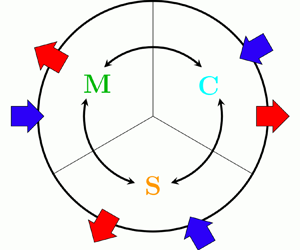
Structure function tensor equations with triple decomposition
-
- Journal:
- Journal of Fluid Mechanics / Volume 960 / 10 April 2023
- Published online by Cambridge University Press:
- 30 March 2023, A7
-
- Article
- Export citation
-
Exact budget equations are derived for the coherent and stochastic contributions to the second-order structure function tensor. They extend the anisotropic generalised Kolmogorov equations (AGKE) by considering the coherent and stochastic parts of the Reynolds stress tensor, and are useful for the statistical description of turbulent flows with periodic or quasi-periodic features, like, for example, the alternate shedding after a bluff body. While the original AGKE describe production, transport, inter-component redistribution and dissipation of the Reynolds stresses in the combined space of scales and positions, the new equations, called $\varphi$AGKE, contain the phase $\varphi$ as an additional independent variable, and describe the interplay among the mean, coherent and stochastic fields at the various phases. The newly derived $\varphi$AGKE are then applied to a case where an exactly periodic external forcing drives the flow: a turbulent plane channel flow modified by harmonic spanwise oscillations of the wall to reduce drag. The phase-by-phase action of the oscillating transversal Stokes layer generated by the forcing on the near-wall turbulent structures is observed, and a detailed description of the scale-space interaction among mean, coherent and stochastic fields is provided thanks to the $\varphi$AGKE.


Acknowledgments
-
- Book:
- Supermassive Black Holes
- Published online:
- 23 March 2023
- Print publication:
- 30 March 2023, pp xvi-xviii
-
- Chapter
- Export citation
Frontmatter
-
- Book:
- Supermassive Black Holes
- Published online:
- 23 March 2023
- Print publication:
- 30 March 2023, pp i-iv
-
- Chapter
- Export citation
2 - Black Holes and General Relativity
-
- Book:
- Supermassive Black Holes
- Published online:
- 23 March 2023
- Print publication:
- 30 March 2023, pp 19-39
-
- Chapter
- Export citation
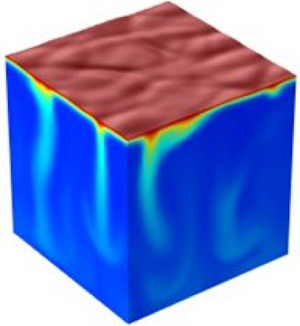
Theoretical and numerical studies on dissolution of horizontal salt body and pattern formation incorporated with a dynamic moving interface
-
- Journal:
- Journal of Fluid Mechanics / Volume 960 / 10 April 2023
- Published online by Cambridge University Press:
- 30 March 2023, A6
-
- Article
- Export citation
-
The dissolution of a horizontal salt body is theoretically and numerically investigated by considering the coupled dynamics of the dissolution reaction and the diffusive and convective mass transfer at the salt surface. To take into account the nature of the recessing salt surface and the dissolution-driven convection, a dynamic moving boundary condition coupled with a dissolution reaction are employed By employing a newly derived moving interface condition and parameters, a theoretical analysis predicts the onset of gravitational instability, suggesting scaling relationships between parameters to describe the onset of instability (in transport-dominant (Damkholer number $Da \to \infty $ and Rayleigh number $Ra > {10^5}$), onset time ${\tau _d}\sim R{a^{ - 2/3}}$ and ${\tau _d}\sim (RaDa)^{1/4}$ for reaction-dominant regimes $(Da \to 0)$). The scaling relationships on dissolution (the average height change, $\Delta {h_{avg}}\sim \sqrt \tau $ for the diffusion-dominant regime and $\Delta {h_{avg}}\sim R{a^{0.79/3}}{\tau ^{0.86}}$ for the convection-dominant regime) are also suggested to explain the pattern formation. Under a convective mass transfer condition, the concentration gradient of the solute developed during the recession of the salt surface results in an adverse density gradient, which causes gravitational instability motion and finally determines the formation of a dissolution pattern. In addition, two-dimensional and three-dimensional numerical simulations visualize dissolution-driven convective flow fields, the recession of the liquid-solid interface and pattern formation on the dissolving interface. Theoretical and numerical analyses of the dissolution process suggest that the control of gravitational instability is important to prevent or enhance dissolution pattern formation. This systematic parameter study provides a deep understanding of the effect of gravitational instability on convection-driven dissolution in a horizontal geometry.


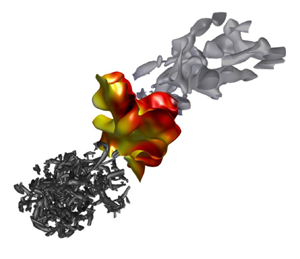
Backscatter of scalar variance in turbulent premixed flames
-
- Journal:
- Journal of Fluid Mechanics / Volume 960 / 10 April 2023
- Published online by Cambridge University Press:
- 30 March 2023, R2
-
- Article
-
- You have access
- Open access
- HTML
- Export citation
-
To explore the direction of inter-scale transfer of scalar variance between subgrid scale (SGS) and resolved scalar fields, direct numerical simulation data obtained earlier from two complex-chemistry lean hydrogen–air flames are analysed by applying Helmholtz–Hodge decomposition (HHD) to the simulated velocity fields. Computed results show backscatter of scalar (combustion progress variable $c$) variance, i.e. its transfer from SGS to resolved scales, even in a highly turbulent flame characterized by a unity-order Damköhler number and a ratio of Kolmogorov length scale to thermal laminar flame thickness as low as 0.05. Analysis of scalar fluxes associated with the solenoidal and potential velocity fields yielded by HHD shows that the documented backscatter stems primarily from the potential velocity perturbations generated due to dilatation in instantaneous local flames, with the backscatter being substantially promoted by a close alignment of the spatial gradient of mean scalar progress variable and the potential-velocity contribution to the local SGS scalar flux. The alignment is associated with the fact that combustion-induced thermal expansion increases local velocity in the direction of $\boldsymbol {\nabla } c$. These results call for development of SGS models capable of predicting backscatter of scalar variance in turbulent flames in large eddy simulations.


Particle radial distribution function and relative velocity measurement in turbulence at small particle-pair separations – CORRIGENDUM
-
- Journal:
- Journal of Fluid Mechanics / Volume 959 / 25 March 2023
- Published online by Cambridge University Press:
- 30 March 2023, E1
-
- Article
-
- You have access
- Open access
- HTML
- Export citation
3 - Astrophysical Gases
-
- Book:
- Supermassive Black Holes
- Published online:
- 23 March 2023
- Print publication:
- 30 March 2023, pp 40-65
-
- Chapter
- Export citation
FLM volume 959 Cover and Front matter
-
- Journal:
- Journal of Fluid Mechanics / Volume 959 / 25 March 2023
- Published online by Cambridge University Press:
- 30 March 2023, p. f1
-
- Article
-
- You have access
- Export citation
Preface
-
- Book:
- Supermassive Black Holes
- Published online:
- 23 March 2023
- Print publication:
- 30 March 2023, pp xi-xv
-
- Chapter
- Export citation
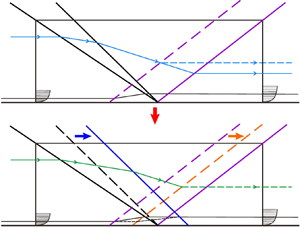
Separation length scaling for dual-incident shock wave–turbulent boundary layer interactions with different shock wave distances
-
- Journal:
- Journal of Fluid Mechanics / Volume 960 / 10 April 2023
- Published online by Cambridge University Press:
- 30 March 2023, A9
-
- Article
- Export citation
-
In this study, the length scaling for the boundary layer separation induced by two incident shock waves is experimentally and analytically investigated. The experiments are performed in a Mach 2.73 flow. A double-wedge shock generator with two deflection angles ( $\alpha _1$ and $\alpha _2$) is employed to generate two incident shock waves. Two deflection angle combinations with an identical total deflection angle are adopted: ( $\alpha _1 = 7^\circ$, $\alpha _2 = 5^\circ$) and ( $\alpha _1 = 5^\circ$, $\alpha _2 = 7^\circ$). For each deflection angle combination, the flow features of the dual-incident shock wave–turbulent boundary layer interactions (dual-ISWTBLIs) under five shock wave distance conditions are examined via schlieren photography, wall-pressure measurements and surface oil-flow visualisation. The experimental results show that the separation point moves downstream with increasing shock wave distance ( $d$). For the dual-ISWTBLIs exhibiting a coupling separation state, the upstream interaction length ( $L_{int}$) of the separation region approximately linearly decreases with increasing $d$, and the decrease rate of $L_{int}$ with $d$ increases with the second deflection angle under the condition of an identical total deflection angle. Based on control volume analysis of mass and momentum conservations, the relation between $L_{int}$ and $d$ is analytically determined to be approximately linear for the dual-ISWTBLIs with a coupling separation region, and the slope of the linear relation obtained analytically agrees well with that obtained experimentally. Furthermore, a prediction method for $L_{int}$ of the dual-ISWTBLIs with a coupling separation region is proposed, and the relative error of the predicted $L_{int}$ in comparison with the experimental result is $\sim$10 %.


8 - Black Hole Demographics
-
- Book:
- Supermassive Black Holes
- Published online:
- 23 March 2023
- Print publication:
- 30 March 2023, pp 273-288
-
- Chapter
- Export citation
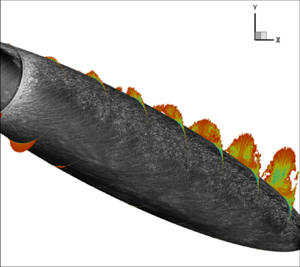
Large-eddy simulation of tripping effects on the flow over a 6 : 1 prolate spheroid at angle of attack
-
- Journal:
- Journal of Fluid Mechanics / Volume 960 / 10 April 2023
- Published online by Cambridge University Press:
- 30 March 2023, A3
-
- Article
-
- You have access
- Open access
- HTML
- Export citation
-
Large-eddy simulation is used to simulate the flow around a 6 : 1 prolate spheroid at $10^\circ$ and $20^\circ$ angles of attack, and Reynolds number $4.2 \times 10^6$. Flows with and without trip are compared to understand the relative effect of the trip on the state of the boundary layer and separation. For the tripped case, the geometry of the trip is resolved to better predict its effect on the downstream flow. The simulations employ overset grids that allow adequate resolution of the trips without significant increase in the overall computational cost. Results suggest that while the trip accelerates transition to turbulence at $10^\circ$, it does not induce a fully developed turbulent boundary layer as intended at $20^\circ$. Rather, the influence of the trip is localized, and the near-wall flow converges towards a solution similar to that of the non-tripped case upstream of separation. This is due to two distinct phenomena: directly downstream of the trip, favourable pressure gradient and streamline curvature effects suppress the disturbance on the windward side. Further along the spheroid, the boundary layer receives a small fraction of the initial perturbation due to spanwise and wall-normal streamline curvatures inducing a secondary flow that advects the low-momentum trip wake to the leeward side. The locations of transition and separation are insensitive to the presence of the trip. The simulation results are used to construct a regime map that identifies different regions characterized by distinct boundary layer properties and flow features. The present results underscore the difficulty associated with tripping smooth bodies at angle of attack, and the importance of accounting for transition in simulations of such flows, even on tripped geometries.


6 - The Black Hole Scaling Relations
-
- Book:
- Supermassive Black Holes
- Published online:
- 23 March 2023
- Print publication:
- 30 March 2023, pp 187-247
-
- Chapter
- Export citation
Contents
-
- Book:
- Supermassive Black Holes
- Published online:
- 23 March 2023
- Print publication:
- 30 March 2023, pp vii-x
-
- Chapter
- Export citation
