Refine search
Actions for selected content:
238160 results in Physics and Astronomy
10 - Rotating Stars
-
- Book:
- Stellar Structure and Evolution
- Published online:
- 02 May 2023
- Print publication:
- 06 April 2023, pp 231-254
-
- Chapter
- Export citation
5 - Stars as Fusion Reactors
-
- Book:
- Stellar Structure and Evolution
- Published online:
- 02 May 2023
- Print publication:
- 06 April 2023, pp 89-116
-
- Chapter
- Export citation
12 - Binary Stars
-
- Book:
- Stellar Structure and Evolution
- Published online:
- 02 May 2023
- Print publication:
- 06 April 2023, pp 281-305
-
- Chapter
- Export citation
2 - Equations of Stellar Structure
-
- Book:
- Stellar Structure and Evolution
- Published online:
- 02 May 2023
- Print publication:
- 06 April 2023, pp 30-42
-
- Chapter
- Export citation
Preface
-
- Book:
- A General Relativity Coursebook
- Published online:
- 03 May 2023
- Print publication:
- 06 April 2023, pp xi-xii
-
- Chapter
- Export citation
5 - Einstein’s Equations
-
- Book:
- A General Relativity Coursebook
- Published online:
- 03 May 2023
- Print publication:
- 06 April 2023, pp 83-99
-
- Chapter
- Export citation
14 - Sound in Pipes
-
- Book:
- Physics Behind Music
- Published online:
- 24 May 2023
- Print publication:
- 06 April 2023, pp 242-268
-
- Chapter
- Export citation
7 - Cosmology
-
- Book:
- A General Relativity Coursebook
- Published online:
- 03 May 2023
- Print publication:
- 06 April 2023, pp 131-150
-
- Chapter
- Export citation
Appendix A - Constants and Units
-
- Book:
- Stellar Structure and Evolution
- Published online:
- 02 May 2023
- Print publication:
- 06 April 2023, pp 306-307
-
- Chapter
- Export citation
Astrovirology: how viruses enhance our understanding of life in the Universe
-
- Journal:
- International Journal of Astrobiology / Volume 22 / Issue 4 / August 2023
- Published online by Cambridge University Press:
- 05 April 2023, pp. 247-271
-
- Article
-
- You have access
- Open access
- HTML
- Export citation
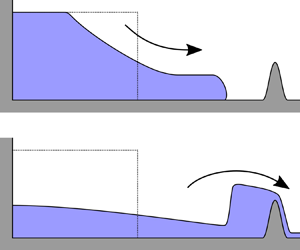
The unsteady overtopping of barriers by gravity currents and dam-break flows
-
- Journal:
- Journal of Fluid Mechanics / Volume 960 / 10 April 2023
- Published online by Cambridge University Press:
- 05 April 2023, A27
-
- Article
- Export citation
-
The collision of a gravitationally driven horizontal current with a barrier following release from a confining lock is investigated using a shallow water model of the motion, together with a sophisticated boundary condition capturing the local interaction. The boundary condition permits several overtopping modes: supercritical, subcritical and blocked flow. The model is analysed both mathematically and numerically to reveal aspects of the unsteady motion and to compute the proportion of the fluid trapped upstream of the barrier. Several problems are treated. Firstly, the idealised problem of a uniform incident current is analysed to classify the unsteady dynamical regimes. Then, the extreme regimes of a very close or distant barrier are tackled, showing the progression of the interaction through the overtopping modes. Next, the trapped volume of fluid at late times is investigated numerically, demonstrating regimes in which the volume is determined purely by volumetric considerations, and others where transient inertial effects are significant. For a Boussinesq gravity current, even when the volume of the confined region behind the barrier is equal to the fluid volume, $30\,\%$ of the fluid escapes the domain, and a confined volume three times larger is required for the overtopped volume to be negligible. For a subaerial dam-break flow, the proportion that escapes is in excess of $60\,\%$ when the confined volume equals the fluid volume, and a barrier as tall as the initial release is required for negligible overtopping. Finally, we compare our predictions with experiments, showing a good agreement across a range of parameters.


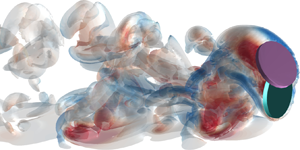
Three-dimensional sedimentation patterns of two interacting disks in a viscous fluid
-
- Journal:
- Journal of Fluid Mechanics / Volume 960 / 10 April 2023
- Published online by Cambridge University Press:
- 05 April 2023, A25
-
- Article
- Export citation
The Southern-sky MWA Rapid Two-metre (SMART) pulsar survey—I. Survey design and processing pipeline
-
- Journal:
- Publications of the Astronomical Society of Australia / Volume 40 / 2023
- Published online by Cambridge University Press:
- 05 April 2023, e021
-
- Article
-
- You have access
- Open access
- HTML
- Export citation
-
We present an overview of the Southern-sky MWA Rapid Two-metre (SMART) pulsar survey that exploits the Murchison Widefield Array’s large field of view and voltage-capture system to survey the sky south of 30 $^{\circ}$ in declination for pulsars and fast transients in the 140–170 MHz band. The survey is enabled by the advent of the Phase II MWA’s compact configuration, which offers an enormous efficiency in beam-forming and processing costs, thereby making an all-sky survey of this magnitude tractable with the MWA. Even with the long dwell times employed for the survey (4800 s), data collection can be completed in $<$100 h of telescope time, while still retaining the ability to reach a limiting sensitivity of $\sim$2–3 mJy (at 150 MHz, near zenith), which is effectively 3–5 times deeper than the previous-generation low-frequency southern-sky pulsar survey, completed in the 1990s. Each observation is processed to generate $\sim$5000–8000 tied-array beams that tessellate the full $\sim 610\, {\textrm{deg}^{2}}$ field of view (at 155 MHz), which are then processed to search for pulsars. The voltage-capture recording of the survey also allows a multitude of post hoc processing options including the reprocessing of data for higher time resolution and even exploring image-based techniques for pulsar candidate identification. Due to the substantial computational cost in pulsar searches at low frequencies, the survey data processing is undertaken in multiple passes: in the first pass, a shallow survey is performed, where 10 min of each observation is processed, reaching about one-third of the full-search sensitivity. Here we present the system overview including details of ongoing processing and initial results. Further details including first pulsar discoveries and a census of low-frequency detections are presented in a companion paper. Future plans include deeper searches to reach the full sensitivity and acceleration searches to target binary and millisecond pulsars. Our simulation analysis forecasts $\sim$300 new pulsars upon the completion of full processing. The SMART survey will also generate a complete digital record of the low-frequency sky, which will serve as a valuable reference for future pulsar searches planned with the low-frequency Square Kilometre Array.


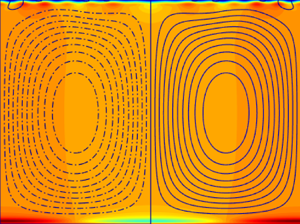
Penetrative convection: heat transport with marginal stability assumption
-
- Journal:
- Journal of Fluid Mechanics / Volume 960 / 10 April 2023
- Published online by Cambridge University Press:
- 05 April 2023, A26
-
- Article
- Export citation
-
This paper investigates heat transport in penetrative convection with a marginally stable temporal-horizontal-averaged field or background field. Assuming that the background field is steady and is stabilised by the nonlinear perturbation terms, we obtain an eigenvalue problem with an unknown background temperature $\tau$ by truncating the nonlinear terms. Using a piecewise profile for $\tau$, we derived an analytical scaling law for heat transport in penetrative convection as $Ra\rightarrow \infty$: $Nu=(1/8)(1-T_M)^{5/3}Ra^{1/3}$ ( $Nu$ is the Nusselt number; $Ra$ is the Rayleigh number and $T_M$ corresponds to the temperature at which the density is maximal). A conditional lower bound on $Nu$, under the marginal stability assumption, is then derived from a variational problem. All the solutions to the full system should deliver a higher heat flux than the lower bound if they satisfy the marginal stability assumption. However, data from the present direct numerical simulations and previous optimal steady solutions by Ding & Wu (J. Fluid Mech., vol. 920, 2021, A48) exhibit smaller $Nu$ than the lower bound at large $Ra$, indicating that these averaged fields are over-stabilised by the nonlinear terms. To incorporate a more physically plausible constraint to bound heat transport, an alternative approach, i.e. the quasilinear approach is invoked which delivers the highest heat transport and agrees well with Veronis's assumption, i.e. $Nu\sim Ra^{1/3}$ (Astrophys. J., vol. 137, 1963, p. 641). Interestingly, the background temperature $\tau$ yielded by the quasilinear approach can be non-unique when instability is subcritical.


WALLABY pre-pilot survey: Radio continuum properties of the Eridanus supergroup
-
- Journal:
- Publications of the Astronomical Society of Australia / Volume 40 / 2023
- Published online by Cambridge University Press:
- 05 April 2023, e012
-
- Article
-
- You have access
- Open access
- HTML
- Export citation
-
We present the highest resolution and sensitivity $\sim$ $1.4\,$GHz continuum observations of the Eridanus supergroup obtained as a part of the Widefield Australian Square Kilometer Array Pathfinder (ASKAP) L-band Legacy All-sky Blind surveY (WALLABY) pre-pilot observations using the ASKAP. We detect 9461 sources at 1.37 GHz down to a flux density limit of $\sim$ $0.1$ mJy at $6.1''\times 7.9''$ resolution with a median root mean square of 0.05 mJy beam $^{-1}$. We find that the flux scale is accurate to within 5 % (compared to NVSS at 1.4 GHz). We then determine the global properties of eight Eridanus supergroup members, which are detected in both radio continuum and neutral hydrogen (HI) emission, and find that the radio-derived star formation rates (SFRs) agree well with previous literature. Using our global and resolved radio continuum properties of the nearby Eridanus galaxies, we measure and extend the infrared-radio correlation (IRRC) to lower stellar masses and inferred SFRs than before. We find the resolved IRRC to be useful for: (1) discriminating between active galactic nuclei and star-forming galaxies; (2) identifying background radio sources; and (3) tracing the effects of group environment pre-processing in NGC 1385. We find evidence for tidal interactions and ram-pressure stripping in the HI, resolved spectral index and IRRC morphologies of NGC 1385. There appears to be a spatial coincidence (in projection) of double-lobed radio jets with the central HI hole of NGC 1367. The destruction of polycyclic aromatic hydrocarbons by merger-induced shocks may be driving the observed WISE W3 deficit observed in NGC 1359. Our results suggest that resolved radio continuum and IRRC studies are excellent tracers of the physical processes that drive galaxy evolution and will be possible on larger sample of sources with upcoming ASKAP radio continuum surveys.


Paucity problems and some relatives of Vinogradov’s mean value theorem
- Part of
-
- Journal:
- Mathematical Proceedings of the Cambridge Philosophical Society / Volume 175 / Issue 2 / September 2023
- Published online by Cambridge University Press:
- 05 April 2023, pp. 327-343
- Print publication:
- September 2023
-
- Article
-
- You have access
- Open access
- HTML
- Export citation
-
When $k\geqslant 4$ and $0\leqslant d\leqslant (k-2)/4$, we consider the system of Diophantine equations We show that in this cousin of a Vinogradov system, there is a paucity of non-diagonal positive integral solutions. Our quantitative estimates are particularly sharp when
 \begin{align*}x_1^j+\ldots +x_k^j=y_1^j+\ldots +y_k^j\quad (1\leqslant j\leqslant k,\, j\ne k-d).\end{align*} $d=o\!\left(k^{1/4}\right)$.


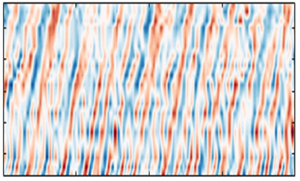
Wall-pressure fluctuations in an axisymmetric boundary layer under strong adverse pressure gradient
-
- Journal:
- Journal of Fluid Mechanics / Volume 960 / 10 April 2023
- Published online by Cambridge University Press:
- 05 April 2023, A28
-
- Article
-
- You have access
- Open access
- HTML
- Export citation
-
Measurements of fluctuating wall pressure in a high-Reynolds-number flow over a body of revolution are described. With a strong axial pressure gradient and moderate lateral curvature, this non-equilibrium flow is relevant to marine applications as well as short-haul urban transportation. The wall-pressure spectrum and its scaling are discussed, along with its relation to the space–time structure. As the flow decelerates downstream, the root-mean-square level of the pressure drops together with the wall shear stress ( $\tau _w$) and is consistently approximately 7 $\tau _w$. While the associated dimensional spectra see a broadband reduction of over 15 dB per Hz, they appear to attain a single functional form, collapsing to within 2 dB when normalized with the wall-wake scaling where $\tau _w$ is the pressure scale and $U_e/\delta$ is the frequency scale. Here, $\delta$ is the boundary layer thickness and $U_e$ is the local free-stream velocity. The general success of the wall-wake scaling, including in the viscous $f^{-5}$ region, suggests that the large-scale motions in the outer layer play a predominant role in the near-wall turbulence and wall pressure. On investigating further, we find that the instantaneous wall-pressure fluctuations are characterized by a quasi-periodic feature that appears to convect downstream at speeds consistent with the outer peak in the turbulence stresses. The conditional structure of this feature, estimated through peak detection in the time series, resembles that of a roller, supporting the embedded shear layer hypothesis (Schatzman & Thomas, J. Fluid Mech., vol. 815, 2017, pp. 592–642; Balantrapu et al., J. Fluid Mech., vol. 929, 2021, A9). Therefore, the outer-region shear-layer-type motions may be important when devising strategies for flow control, drag and noise reduction for decelerating boundary layers.


On the role of the laminar/turbulent interface in energy transfer between scales in bypass transition
-
- Journal:
- Journal of Fluid Mechanics / Volume 960 / 10 April 2023
- Published online by Cambridge University Press:
- 03 April 2023, A24
-
- Article
-
- You have access
- Open access
- HTML
- Export citation

Translational momentum of deformable submarine landslides off a slope
-
- Journal:
- Journal of Fluid Mechanics / Volume 960 / 10 April 2023
- Published online by Cambridge University Press:
- 03 April 2023, A23
-
- Article
-
- You have access
- Open access
- HTML
- Export citation
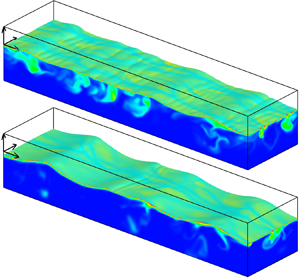
Effects of surface tension reduction on wind-wave growth and air–water scalar transfer
-
- Journal:
- Journal of Fluid Mechanics / Volume 960 / 10 April 2023
- Published online by Cambridge University Press:
- 03 April 2023, A22
-
- Article
-
- You have access
- Open access
- HTML
- Export citation
