Refine search
Actions for selected content:
238161 results in Physics and Astronomy
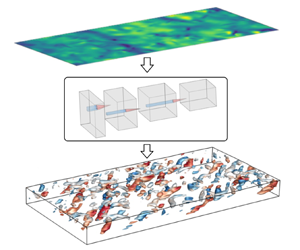
Reconstruction of three-dimensional turbulent flow structures using surface measurements for free-surface flows based on a convolutional neural network
-
- Journal:
- Journal of Fluid Mechanics / Volume 959 / 25 March 2023
- Published online by Cambridge University Press:
- 23 March 2023, A34
-
- Article
-
- You have access
- Open access
- HTML
- Export citation
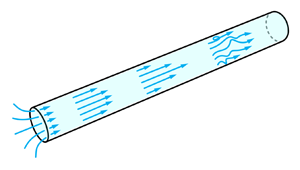
Hydrodynamics of finite-length pipes at intermediate Reynolds numbers
-
- Journal:
- Journal of Fluid Mechanics / Volume 959 / 25 March 2023
- Published online by Cambridge University Press:
- 23 March 2023, A28
-
- Article
-
- You have access
- Open access
- HTML
- Export citation
-
Extensive studies of the hydraulics of pipes have focused on limiting cases, such as fully-developed laminar or turbulent flow through long conduits and the accelerating flow through an orifice, for which there exist laws relating pressure drop and flow rate. We carry out experiments on smooth, circular pipes for dimensions and flow rates that interrogate intermediate conditions between the well-studied limits. Organizing this information in terms of dimensionless friction factor, Reynolds number and pipe aspect ratio yields a surface $f_D(Re,\alpha )$ that is shown to match the three laws associated with developed laminar, developed turbulent, and orifice flows. While each law fails outside its applicable range of $(Re,\alpha )$, we present a hybrid theoretical–empirical model that includes inlet, development and transition effects, and that proves accurate to approximately 10 % over wide ranges of $Re$ and $\alpha$. We also present simple formulas for the boundaries between the three hydraulic regimes, which intersect at a triple point. Measurements show that sipping through a straw is an everyday example of such intermediate conditions not accounted for by existing laws but described accurately by our model. More generally, our findings provide formulas for predicting frictional resistance for intermediate- $Re$ flows through finite-length pipes.


Quasi-parallel propagating solitons in magnetised relativistic electron–positron plasmas
-
- Journal:
- Journal of Plasma Physics / Volume 89 / Issue 2 / April 2023
- Published online by Cambridge University Press:
- 23 March 2023, 905890202
-
- Article
- Export citation
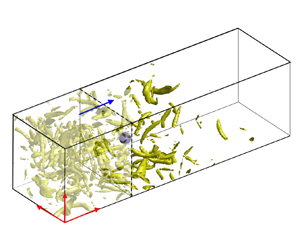
Mechanisms and models of particle drag enhancements in turbulent environments
-
- Journal:
- Journal of Fluid Mechanics / Volume 959 / 25 March 2023
- Published online by Cambridge University Press:
- 23 March 2023, A30
-
- Article
- Export citation
Electron kinetics in a high-Z plasmoid
-
- Journal:
- Journal of Plasma Physics / Volume 89 / Issue 2 / April 2023
- Published online by Cambridge University Press:
- 23 March 2023, 905890203
-
- Article
-
- You have access
- Open access
- HTML
- Export citation
-
The problem of the electron dynamics on a closed magnetic field line passing through a high-$Z$
 plasmoid is considered. The electron kinetic equation is integrated over bounce motion and pitch angle, reducing the independent variables to a single adiabatic invariant plus time. Integration of the full Landau self-collision operator is carried out exactly, resulting in a nonlinear integro-differential operator in the new invariant. Conservation laws and the $H$
 theorem of the integrated self-collision operator are proven. Numerical solutions of the integrated kinetic equation are obtained with a self-consistent quasineutral electric potential, given the initial condition of a cold plasmoid immersed in a hot ambient plasma. The fact that cold electrons are deeply trapped in a potential with a parabolic peak leads to exactly 3/4 the usual rate of collisional heating by the ambient plasma, independent of any other parameters.


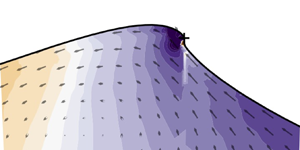
An energetic signature for breaking inception in surface gravity waves
-
- Journal:
- Journal of Fluid Mechanics / Volume 959 / 25 March 2023
- Published online by Cambridge University Press:
- 23 March 2023, A33
-
- Article
- Export citation
Comparison of smooth- and rough-wall non-equilibrium boundary layers with favourable and adverse pressure gradients
-
- Journal:
- Journal of Fluid Mechanics / Volume 959 / 25 March 2023
- Published online by Cambridge University Press:
- 23 March 2023, A35
-
- Article
- Export citation
1.2 kW all-fiber narrow-linewidth picosecond MOPA system
-
- Journal:
- High Power Laser Science and Engineering / Volume 11 / 2023
- Published online by Cambridge University Press:
- 23 March 2023, e22
-
- Article
-
- You have access
- Open access
- HTML
- Export citation
-
Achieving an all-fiber ultra-fast system with above kW average power and mJ pulse energy is extremely challenging. This paper demonstrated a picosecond monolithic master oscillator power amplifier system at a 25 MHz repetition frequency with an average power of approximately 1.2 kW, a pulse energy of approximately 48 μJ and a peak power of approximately 0.45 MW. The nonlinear effects were suppressed by adopting a dispersion stretched seed pulse (with a narrow linewidth of 0.052 nm) and a multi-mode master amplifier with an extra-large mode area; then an ultimate narrow bandwidth of 1.32 nm and a moderately broadened pulse of approximately 107 ps were achieved. Meanwhile, the great spatio-temporal stability was verified experimentally, and no sign of transverse mode instability appeared even at the maximum output power. The system has shown great power and energy capability with a sacrificed beam propagation product of 5.28 mm $\cdot$mrad. In addition, further scaling of the peak power and pulse energy can be achieved by employing a lower repetition and a conventional compressor.


Network Models for Data Science
- Theory, Algorithms, and Applications
-
- Published online:
- 22 March 2023
- Print publication:
- 05 January 2023
-
- Textbook
- Export citation
Solid grains ejected from terrestrial exoplanets as a probe of the abundance of life in the Milky Way
-
- Journal:
- International Journal of Astrobiology / Volume 22 / Issue 4 / August 2023
- Published online by Cambridge University Press:
- 22 March 2023, pp. 347-353
-
- Article
-
- You have access
- Open access
- HTML
- Export citation
Single-frequency upconverted laser generation by phase summation
-
- Journal:
- High Power Laser Science and Engineering / Volume 11 / 2023
- Published online by Cambridge University Press:
- 22 March 2023, e18
-
- Article
-
- You have access
- Open access
- HTML
- Export citation
Frequency-tuned surfaces for passive control of wall-bounded turbulent flow – a resolvent analysis study
-
- Journal:
- Journal of Fluid Mechanics / Volume 959 / 25 March 2023
- Published online by Cambridge University Press:
- 22 March 2023, A26
-
- Article
-
- You have access
- Open access
- HTML
- Export citation
Collapse of a cohesive granular column
-
- Journal:
- Journal of Fluid Mechanics / Volume 959 / 25 March 2023
- Published online by Cambridge University Press:
- 22 March 2023, A41
-
- Article
- Export citation
Propulsive performance of oscillating plates with time-periodic flexibility
-
- Journal:
- Journal of Fluid Mechanics / Volume 959 / 25 March 2023
- Published online by Cambridge University Press:
- 22 March 2023, A31
-
- Article
-
- You have access
- Open access
- HTML
- Export citation
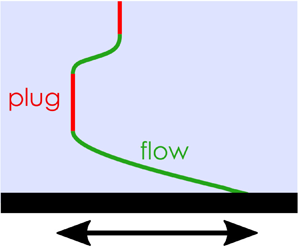
The motion of a layer of yield-stress material on an oscillating plate
-
- Journal:
- Journal of Fluid Mechanics / Volume 959 / 25 March 2023
- Published online by Cambridge University Press:
- 22 March 2023, A32
-
- Article
- Export citation
-
The motion of a finite layer of Bingham material on a solid plate that executes in-plane oscillations was reported previously by Balmforth et al. (J. Non-Newtonian Fluid Mech., vol. 158, issue 1–3, 2009, pp. 46–53). There, it was suggested that multiple yielded regions may arise within the material; this contrasts to start-up flow of the same material for which only one yielded region is generated. Here, we explore quantitatively the fluid physics of this oscillatory flow problem through analytical approximations and further numerical computation. Four new key topological properties concerning the generation and termination of the yielded regions are reported. It is shown that the existence of multiple yielded regions is equivalent to the layer never becoming entirely rigid during the periodic motion. For small inertia, the flow is approximately time-reversible with only a single yielded region generated at the plate. For large inertia, shear stress in the material decays rapidly as a function of distance from the plate. A thin zone of yielded material detaches periodically from the plate, and subsequently terminates within the layer. At high oscillation frequency, there can be any number $N$ of distinct rigid regions, satisfying $N= \lfloor 1- {\rm \pi}^{-1} \log B \rfloor$ where $B$ is the Bingham number. It is also shown that for $B>0.5370$, there are at most one yielded region and one rigid region throughout the motion. These theoretical results can be used as a basis for oscillatory rheometry, allowing for measurement of the yield stress using existing apparatus.


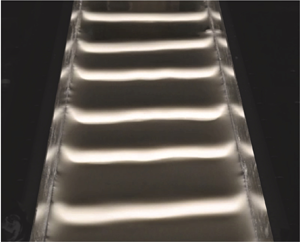
Shear-thickening suspensions down inclines: from Kapitza to Oobleck waves
-
- Journal:
- Journal of Fluid Mechanics / Volume 959 / 25 March 2023
- Published online by Cambridge University Press:
- 22 March 2023, A27
-
- Article
- Export citation
-
We investigate experimentally and theoretically the stability of a shear-thickening suspension flowing down an inclined plane. In a previous paper (Darbois Texier et al., Commun. Phys., vol. 3, 2020), we have shown that for particle volume fractions $\phi$ above the discontinuous shear-thickening fraction $\phi _{DST}$, long surface waves grow spontaneously at a flow Reynolds number much below 1. This motivated a simplified analysis based on a purely inertialess mechanism, called the ‘Oobleck waves’ mechanism, which couples the negatively sloped rheology of the suspension with the free-surface deflection and captures well the experimental instability threshold and the wave speed, for $\phi >\phi _{DST}$. However, neglecting inertia does not allow us to describe the inertial Kapitza regime observed for $\phi <\phi _{DST}$, nor does it allow us to discriminate between Oobleck waves and other inertial instabilities expected above $\phi _{DST}$. This paper fills this gap by extending our previous analysis, based on a depth-averaged approach and the Wyart–Cates constitutive shear-thickening rheology, to account for inertia. The extended analysis recovers quantitatively the experimental instability threshold in the Kapitza regime, below $\phi _{DST}$, and in the Oobleck waves regime, above $\phi _{DST}$. By providing additional measurements of the wave growth rate and investigating theoretically the effect of a strain delay in the rheology, it also confirms that the instability observed above $\phi _{DST}$ stems from the non-inertial Oobleck wave mechanism, which is specific to free-surface flows and dominates modes of inertial origin. These results emphasize the variety of instability mechanisms for shear-thickening suspensions and might be relevant to free-surface flows of other complex fluids displaying velocity-weakening rheology.


The Noonday argument: fine-graining, indexicals, and the nature of Copernican reasoning
-
- Journal:
- International Journal of Astrobiology / Volume 22 / Issue 4 / August 2023
- Published online by Cambridge University Press:
- 22 March 2023, pp. 354-398
-
- Article
-
- You have access
- Open access
- HTML
- Export citation

The linear-time-invariance notion of the Koopman analysis. Part 2. Dynamic Koopman modes, physics interpretations and phenomenological analysis of the prism wake
-
- Journal:
- Journal of Fluid Mechanics / Volume 959 / 25 March 2023
- Published online by Cambridge University Press:
- 22 March 2023, A15
-
- Article
-
- You have access
- Open access
- HTML
- Export citation
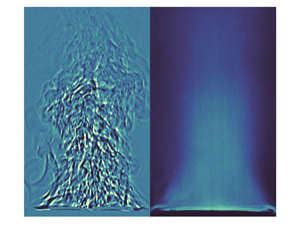
Turbulent plumes above a heated plate
-
- Journal:
- Journal of Fluid Mechanics / Volume 959 / 25 March 2023
- Published online by Cambridge University Press:
- 22 March 2023, A29
-
- Article
-
- You have access
- Open access
- HTML
- Export citation
-
Our focus concerns the turbulent convective flow above a uniformly heated high-aspect-ratio rectangular plate on $z=0$. Prior to this study, classic plume theory could not be applied directly as the Richardson number is ill-defined at the plate. Guided by observation, conservation equations are posed for the near-plate region where the attached buoyant flow is predominantly horizontal. Analytical solutions under the Boussinesq approximation reveal this to be a dynamically invariant region where the attached ‘plumes’ grow linearly toward the plate centreline, their merger forming an ‘apparent’ source for the vertical plume above. Coupling predictions with data from flow visualisation and temperature measurement, we deduce the half-width $0.72b_0$, height ${z=0.46b_0}$ and finite Richardson number $({\sim }18)$ of an apparent source from which plume theory can be applied to model the plume above a heated plate of width $2b_0$. Finally, practical implications of this advancement to the analytical theory of turbulent plumes are noted.


Versatile tape-drive target for high-repetition-rate laser-driven proton acceleration
- Part of
-
- Journal:
- High Power Laser Science and Engineering / Volume 11 / 2023
- Published online by Cambridge University Press:
- 21 March 2023, e23
-
- Article
-
- You have access
- Open access
- HTML
- Export citation
-
We present the development and characterization of a high-stability, multi-material, multi-thickness tape-drive target for laser-driven acceleration at repetition rates of up to 100 Hz. The tape surface position was measured to be stable on the sub-micrometre scale, compatible with the high-numerical aperture focusing geometries required to achieve relativistic intensity interactions with the pulse energy available in current multi-Hz and near-future higher repetition-rate lasers ( $>$kHz). Long-term drift was characterized at 100 Hz demonstrating suitability for operation over extended periods. The target was continuously operated at up to 5 Hz in a recent experiment for 70,000 shots without intervention by the experimental team, with the exception of tape replacement, producing the largest data-set of relativistically intense laser–solid foil measurements to date. This tape drive provides robust targetry for the generation and study of high-repetition-rate ion beams using next-generation high-power laser systems, also enabling wider applications of laser-driven proton sources.

