Refine search
Actions for selected content:
238152 results in Physics and Astronomy
6 - The Boltzmann Equation and Baryogenesis
- from Part II - The Early Universe
-
- Book:
- A Course in Cosmology
- Published online:
- 31 March 2023
- Print publication:
- 09 March 2023, pp 104-115
-
- Chapter
- Export citation
4 - Early-Universe Thermodynamics
- from Part II - The Early Universe
-
- Book:
- A Course in Cosmology
- Published online:
- 31 March 2023
- Print publication:
- 09 March 2023, pp 71-86
-
- Chapter
- Export citation
1 - Introduction to Cosmology
- from Part I - Foundations
-
- Book:
- A Course in Cosmology
- Published online:
- 31 March 2023
- Print publication:
- 09 March 2023, pp 3-13
-
- Chapter
- Export citation
Part II - The Early Universe
-
- Book:
- A Course in Cosmology
- Published online:
- 31 March 2023
- Print publication:
- 09 March 2023, pp 69-172
-
- Chapter
- Export citation
References
-
- Book:
- A Course in Cosmology
- Published online:
- 31 March 2023
- Print publication:
- 09 March 2023, pp 409-417
-
- Chapter
- Export citation
12 - Dark Energy
- from Part III - The Later Universe
-
- Book:
- A Course in Cosmology
- Published online:
- 31 March 2023
- Print publication:
- 09 March 2023, pp 291-315
-
- Chapter
- Export citation
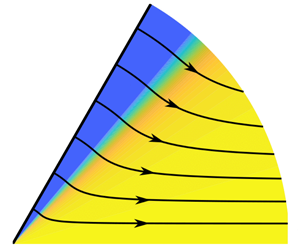
Viscoplastic flow between hinged plates
-
- Journal:
- Journal of Fluid Mechanics / Volume 958 / 10 March 2023
- Published online by Cambridge University Press:
- 09 March 2023, A38
-
- Article
-
- You have access
- Open access
- HTML
- Export citation
Appendices
-
- Book:
- A Course in Cosmology
- Published online:
- 31 March 2023
- Print publication:
- 09 March 2023, pp 399-408
-
- Chapter
- Export citation
5 - Neutrinos in Cosmology
- from Part II - The Early Universe
-
- Book:
- A Course in Cosmology
- Published online:
- 31 March 2023
- Print publication:
- 09 March 2023, pp 87-103
-
- Chapter
- Export citation
Appendix B: - Useful Constants
-
- Book:
- A Course in Cosmology
- Published online:
- 31 March 2023
- Print publication:
- 09 March 2023, pp 402-403
-
- Chapter
- Export citation
Appendix C: - Fundamental Particles
-
- Book:
- A Course in Cosmology
- Published online:
- 31 March 2023
- Print publication:
- 09 March 2023, pp 404-404
-
- Chapter
- Export citation
Part III - The Later Universe
-
- Book:
- A Course in Cosmology
- Published online:
- 31 March 2023
- Print publication:
- 09 March 2023, pp 173-398
-
- Chapter
- Export citation
Copyright page
-
- Book:
- A Course in Cosmology
- Published online:
- 31 March 2023
- Print publication:
- 09 March 2023, pp iv-iv
-
- Chapter
- Export citation
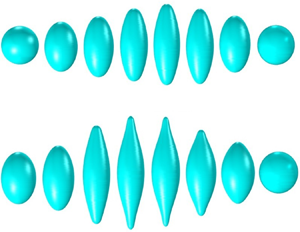
Ion emission from nanodroplets undergoing Coulomb explosions: a continuum numerical study
-
- Journal:
- Journal of Fluid Mechanics / Volume 958 / 10 March 2023
- Published online by Cambridge University Press:
- 07 March 2023, A32
-
- Article
-
- You have access
- Open access
- HTML
- Export citation
-
A droplet charged above the Rayleigh limit is unstable. In the resulting dynamical process, referred to as a Coulomb explosion, smaller droplets with higher charge-to-mass ratios are ejected, reducing the charge of the parent droplet below the Rayleigh limit. Furthermore, if the droplet is sufficiently small, the electric field on its surface can promote ion field emission. Ion emission can lower the charge of a spherical droplet below its Rayleigh limit, keeping it stable, or reduce the charge of a deforming droplet, changing its dynamics and potentially preventing the Coulomb explosion. This article develops a continuum phase field electrohydrodynamic model to study the interplay between Coulomb explosions and ion emission, using charged nanodroplets of the ionic liquid 1-ethyl-3-methylimidazolium bis(trifluoromethylsulfonyl)imide (EMI-Im) as a case study. In small droplets (diameter $D \lesssim 20$ nm for EMI-Im), the electric field is strong enough to emit ions in the early phase of the droplet's evolution, suppressing the Coulomb explosion. For $20 \lesssim D \lesssim 45$ nm, the electric field on the EMI-Im droplet may not promote significant ion emission; however, as the unstable droplet becomes ellipsoidal, ions are emitted from its vertices, ultimately suppressing the Coulomb explosion while shedding $20\unicode{x2013}40\,\%$ of the initial charge. For larger EMI-Im droplets, $45 \lesssim D \lesssim 100$ nm, the evolution typical of a Coulomb explosion is observed, accompanied by ion emission which is however insufficient to prevent the Coulomb explosion. Ion emission and the smaller progeny droplets account for $24\,\%$ and $16\,\%$ of the initial charge, respectively.


The P(4S) + NH(3Σ–) and N(4S) + PH(3Σ–)reactions as sources of interstellar phosphorus nitride
-
- Journal:
- Publications of the Astronomical Society of Australia / Volume 40 / 2023
- Published online by Cambridge University Press:
- 07 March 2023, e011
-
- Article
-
- You have access
- HTML
- Export citation
-
Phosphorus nitride (PN) is believed to be one of the major reservoirs of phosphorus in the interstellar medium (ISM). For this reason, understanding which reactions produce PN in space and predicting their rate coefficients is important for modelling the relative abundances of P-bearing species and clarifying the role of phosphorus in astrochemistry. In this work, we explore the potential energy surfaces of the $\textrm{P}(^4\textrm{S}) + \textrm{NH}(^3\Sigma^-)$ and $\textrm{N}(^4\textrm{S}) + \textrm{PH}(^3\Sigma^-)$ reactions and the formation of $\textrm{H}(^2\textrm{S}) + \textrm{PN}(^1\Sigma^+)$ through high accuracy ab initio calculations and the variable reaction coordinate transition state theory (VRC-TST). We found that both reactions proceed without an activation barrier and with similar rate coefficients that can be described by a modified Arrhenius equation ( $k(T)=\alpha\!\left( T/300 \right)^{\beta} \exp\!{(\!-\!\gamma/T)})$ with $\alpha=0.93\times 10^{-10}\rm cm^3\,s^{-1}$, $\beta=-0.18$ and $\gamma=0.24\, \rm K$ for the $\textrm{P} + \textrm{NH} \longrightarrow \textrm{H} + \textrm{PN}$ reaction and $\alpha=0.88\times 10^{-10}\rm cm^3\,s^{-1}$, $\beta=-0.18$ and $\gamma=1.01\, \rm K$ for the $\textrm{N} + \textrm{PH} \longrightarrow \textrm{H} + \textrm{PN}$ one. Both reactions are expected to be relevant for modelling PN abundances even in the cold environments of the ISM. Given the abundance of hydrogen in space, we have also predicted rate coefficients for the destruction of PN via H + PN collisions.


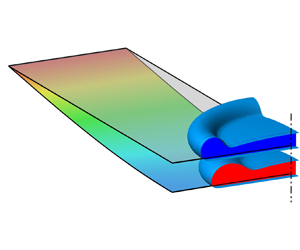
Scaling maximum spreading of droplet impacting on flexible substrates
-
- Journal:
- Journal of Fluid Mechanics / Volume 958 / 10 March 2023
- Published online by Cambridge University Press:
- 07 March 2023, A35
-
- Article
- Export citation
-
We numerically study the impact of a droplet on superhydrophobic flexible plates, aiming to understand how the flexible substrate influences the maximum spreading of the droplet. Compared with the rigid case, the vertical movement of the flexible substrate due to droplet impact reduces the maximum spreading. Besides, the average acceleration $a$ during droplet spreading changes significantly. Arising from energy conservation, we rescale the acceleration $a$ for cases with different bending stiffness $K_B$ and mass ratio $M_r$. Moreover, through theoretical analysis, we propose a scaling for the droplet's maximum spreading diameter ratio $\beta _{max}$. In the scaling, based on the derived $a$, an effective Weber number $We_m$ is well defined, which accounts for the substrate properties without any adjustable parameters. In the ( $\beta _{max}, We_m$) plane, the two-dimensional numerical results of different $K_B$, $M_r$ and rigid cases all collapse into a single curve, as do the experimental and three-dimensional (3-D) results. In particular, the collapsed 3-D data can be well represented by the universal rescaling of $\beta _{max}$ proposed by Lee et al. (J. Fluid Mech., vol. 786, 2016, R4). Furthermore, an a posteriori energy analysis confirms the validation of our a priori scaling law.


Motivic zeta functions of hyperplane arrangements
- Part of
-
- Journal:
- Mathematical Proceedings of the Cambridge Philosophical Society / Volume 175 / Issue 1 / July 2023
- Published online by Cambridge University Press:
- 07 March 2023, pp. 187-215
- Print publication:
- July 2023
-
- Article
-
- You have access
- Open access
- HTML
- Export citation
-
For each central essential hyperplane arrangement $\mathcal{A}$ over an algebraically closed field, let $Z_\mathcal{A}^{\hat\mu}(T)$ denote the Denef–Loeser motivic zeta function of $\mathcal{A}$. We prove a formula expressing $Z_\mathcal{A}^{\hat\mu}(T)$ in terms of the Milnor fibers of related hyperplane arrangements. This formula shows that, in a precise sense, the degree to which $Z_{\mathcal{A}}^{\hat\mu}(T)$ fails to be a combinatorial invariant is completely controlled by these Milnor fibers. As one application, we use this formula to show that the map taking each complex arrangement $\mathcal{A}$ to the Hodge–Deligne specialization of $Z_{\mathcal{A}}^{\hat\mu}(T)$ is locally constant on the realization space of any loop-free matroid. We also prove a combinatorial formula expressing the motivic Igusa zeta function of $\mathcal{A}$ in terms of the characteristic polynomials of related arrangements.



Experiments on Marangoni spreading – evidence of a new type of interfacial instability
-
- Journal:
- Journal of Fluid Mechanics / Volume 958 / 10 March 2023
- Published online by Cambridge University Press:
- 07 March 2023, A33
-
- Article
- Export citation

Viscoplastic lines: printing a single filament of yield stress material on a surface
-
- Journal:
- Journal of Fluid Mechanics / Volume 958 / 10 March 2023
- Published online by Cambridge University Press:
- 07 March 2023, A34
-
- Article
-
- You have access
- Open access
- HTML
- Export citation
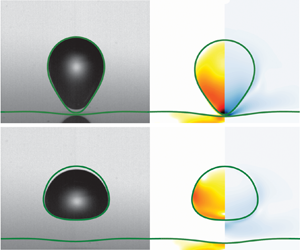
Drop impact on viscous liquid films
-
- Journal:
- Journal of Fluid Mechanics / Volume 958 / 10 March 2023
- Published online by Cambridge University Press:
- 06 March 2023, A25
-
- Article
-
- You have access
- Open access
- HTML
- Export citation
