To save content items to your account,
please confirm that you agree to abide by our usage policies.
If this is the first time you use this feature, you will be asked to authorise Cambridge Core to connect with your account.
Find out more about saving content to .
To save content items to your Kindle, first ensure no-reply@cambridge.org
is added to your Approved Personal Document E-mail List under your Personal Document Settings
on the Manage Your Content and Devices page of your Amazon account. Then enter the ‘name’ part
of your Kindle email address below.
Find out more about saving to your Kindle.
Note you can select to save to either the @free.kindle.com or @kindle.com variations.
‘@free.kindle.com’ emails are free but can only be saved to your device when it is connected to wi-fi.
‘@kindle.com’ emails can be delivered even when you are not connected to wi-fi, but note that service fees apply.
The inclusion of kinetic effects into fluid models has been a long standing problem in magnetic reconnection and plasma physics. Generally, the pressure tensor is reduced to a scalar which is an approximation used to aid in the modelling of large scale global systems such as the Earth's magnetosphere. This unfortunately omits important kinetic physics which have been shown to play a crucial role in collisionless regimes. The multi-fluid ten-moment model, however, retains the full symmetric pressure tensor. The ten-moment model is constructed by taking moments of the Vlasov equation up to second order, and includes the scalar density, the vector bulk-flow and the symmetric pressure tensor for a total of ten separate components. Use of the multi-fluid ten-moment model requires a closure which truncates the cascading system of equations. Here we look to leverage data-driven methodologies to seek a closure which may improve the physical fidelity of the ten-moment multi-fluid model in collisionless regimes. Specifically, we use the sparse identification of nonlinear dynamics (SINDy) method for symbolic equation discovery to seek the truncating closure from fully kinetic particle-in-cell simulation data, which inherently retains the relevant kinetic physics. We verify our method by reproducing the ten-moment model from the particle-in-cell (PIC) data and use the method to generate a closure truncating the ten-moment model which is analysed through the nonlinear phase of reconnection.
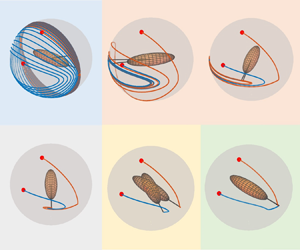
Non-spherical particles exhibit peculiar behaviour in non-Newtonian flows. In this paper, we numerically investigate the dynamics of a neutrally buoyant prolate spheroid immersed in viscoelastic shear flows at finite Reynolds numbers by means of the immersed boundary method. Our results show that the period of particle rotation changes monotonically with the solvent viscosity ratio but non-monotonically with the mobility factor. Furthermore, we find five rotation modes of the spheroid under the effects of fluid inertia and fluid rheology in the present flow configuration. With weak fluid inertia, the particle rotation rate is remarkably reduced by fluid elasticity, which also induces asymmetric rotational behaviour. While the particle tends to tumble in the shear plane with weak fluid elasticity and moderate fluid inertia. However, as the fluid elasticity increases, the particle rotates with a newly observed mode, named the asymmetric-kayaking mode, which is classified by two additional critical elastic numbers that differ from the earlier studies on Stokesian viscoelastic shear flows. The present findings imply the importance of fluid inertia and fluid elasticity on the particle dynamics and could be potentially used to control the particle orientations in viscoelastic fluid flows.
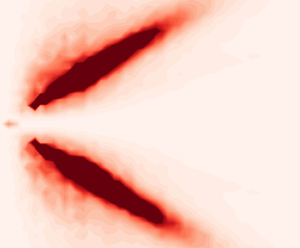
Colliding collisionless shocks appear in a great variety of astrophysical phenomena and are thought to be possible sources of particle acceleration in the Universe. We have previously investigated particle acceleration induced by single super-critical shocks (whose magnetosonic Mach number is higher than the critical value of 2.7) (Yao et al., Nat. Phys., vol. 17, issue 10, 2021, pp. 1177–1182; Yao et al., Matter Radiat. Extrem., vol. 7, issue 1, 2022, 014402), as well as the collision of two sub-critical shocks (Fazzini et al., Astron. Astrophys., vol. 665, 2022, A87). Here, we propose to make measurements of accelerated particles from interpenetrating super-critical shocks to observe the ‘phase-locking effect’ (Fazzini et al., Astron. Astrophys., vol. 665, 2022, A87) from such an event. This effect is predicted to significantly boost the energy spectrum of the energized ions compared with a single super-critical collisionless shock. We thus anticipate that the results obtained in the proposed experiment could have a significant impact on our understanding of one type of primary source (acceleration of thermal ions as opposed to secondary acceleration mechanisms of already energetic ions) of ion energization of particles in the Universe.
The rebound of droplets impacting a deep fluid bath is studied both experimentally and theoretically. Millimetric drops are generated using a piezoelectric droplet-on-demand generator and normally impact a bath of the same fluid. Measurements of the droplet trajectory and other rebound metrics are compared directly with the predictions of a linear quasipotential model, as well as fully resolved direct numerical simulations of the unsteady Navier–Stokes equations. Both models resolve the time-dependent bath and droplet shapes in addition to the droplet trajectory. In the quasipotential model, the droplet and bath shape are decomposed using orthogonal function decompositions leading to two sets of coupled damped linear harmonic oscillator equations solved using an implicit numerical method. The underdamped dynamics of the drop are directly coupled to the response of the bath through a single-point kinematic match condition which we demonstrate to be an effective and efficient model in our parameter regime of interest. Starting from the inertio-capillary limit in which both gravitational and viscous effects are negligible, increases in gravity or viscosity lead to a decrease in the coefficient of restitution and an increase in the contact time. The inertio-capillary limit defines an upper bound on the possible coefficient of restitution for droplet–bath impact, depending only on the Weber number. The quasipotential model is able to rationalize historical experimental measurements for the coefficient of restitution, first presented by Jayaratne & Mason (Proc. R. Soc. Lond. A, vol. 280, issue 1383, 1964, pp. 545–565).
Seven varieties of forage oats from China were evaluated in the temperate environment of Bhutan for morphological traits, dry matter production, and forage quality. The oat variety Qingyin No. 1 provided a greater plant height (61 cm) and the largest number of tillers per plant (five tillers per plant). The leaf-stem ratio (LSR) was highest for Longyan No. 2 (LSR 0.73). During harvest in late winter, Longyan No. 2 had a greater plant height (64 cm) and the highest number of tillers per plant (seven tillers per plant), followed by Qingyin No. 1. The top three varieties with high LSRs of 1.49, 1.31, and 1.35 were Longyan No. 1, 2, and 3, respectively. In both summer and winter, Longyan No. 2 had the highest forage yields of around 5.00 and 4.00 DM t/ha, respectively. Qingyin No. 1 was the second largest forage producer, with under 5.00 DM t/ha in summer and under 3.00 DM t/ha in winter. For forage quality, Longyan No. 2 and Longyan No. 3 had the highest levels of crude protein (15%) in summer. However, during late winter, the Linna variety had the highest crude protein content (13%). The overall results of the field experiments suggest that Longyan No. 2 and Qingyin No. 1 are promising new oat varieties for winter fodder production in the temperate environments of Bhutan.
We report a compact, tunable, self-starting, all-fiber laser-based asynchronous optical sampling (ASOPS) system. Two Er-doped fiber oscillators were used as the pulsed-laser source, whose repetition rate could be set at 100 MHz with a tuning range of 1.25 MHz through a fiber delay line. By employing phase-locked and temperature control loops, the repetition rate offset of the two lasers was stabilized with 7.13 × 10⁻¹¹ fractional instability at an average time of 1 s. Its capabilities in the terahertz regime were demonstrated by terahertz time-domain spectroscopy, achieving a spectral bandwidth of 3 THz with a dynamic range of 30 dB. The large range of repetition rate adjustment in our ASOPS system has the potential to be a powerful tool in the terahertz regime.
The scattering of three-dimensional inertia-gravity waves by a turbulent geostrophic flow leads to the redistribution of their action through what is approximately a diffusion process in wavevector space. The corresponding diffusivity tensor was obtained by Kafiabad et al. (J. Fluid Mech., vol. 869, 2019, R7) under the assumption of a time-independent geostrophic flow. We relax this assumption to examine how the weak diffusion of wave action across constant-frequency cones that results from the slow time dependence of the geostrophic flow affects the distribution of wave energy. We find that the stationary wave-energy spectrum that arises from a single-frequency wave forcing is localised within a thin boundary layer around the constant-frequency cone, with a thickness controlled by the acceleration spectrum of the geostrophic flow. We obtain an explicit analytic formula for the wave-energy spectrum which shows good agreement with the results of a high-resolution simulation of the Boussinesq equations.
We present a high-energy, hundred-picosecond (ps) pulsed mid-ultraviolet solid-state laser at 266 nm by a direct second harmonic generation (SHG) in a barium borate (BaB2O4, BBO) nonlinear crystal. The green pump source is a 710 mJ, 330 ps pulsed laser at a wavelength of 532 nm with a repetition rate of 1 Hz. Under a green pump energy of 710 mJ, a maximum output energy of 253.3 mJ at 266 nm is achieved with 250 ps pulse duration resulting in a peak power of more than 1 GW, corresponding to an SHG conversion efficiency of 35.7% from 532 to 266 nm. The experimental data were well consistent with the theoretical prediction. To the best of our knowledge, this laser exhibits both the highest output energy and highest peak power ever achieved in a hundred-ps/ps regime at 266 nm for BBO-SHG.
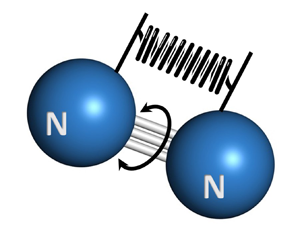
In the classical irreversible thermodynamics (CIT) framework, the Navier–Stokes–Fourier constitutive equations are obtained so as to satisfy the entropy inequality, by and large assuming that the entropy flux is equal to the heat flux over the temperature. This article is focused on the derivation of second-order constitutive equations for polyatomic gases; it takes the basis of CIT, but most importantly, allows up to quadratic nonlinearities in the entropy flux. Mathematical similarities between the proposed model and the classic Stokes–Laplace equations are exploited so as to construct analytic/semi-analytic solutions for the slow rarefied gas flow over different shapes. A set of second-order boundary conditions are formulated such that the model's prediction for the drag force is in excellent agreement with the experimental data over the whole range of Knudsen numbers. We have also computed the normal shock structure in nitrogen for Mach ${Ma} \lesssim 4$. A very good agreement was observed with the kinetic theory, as well as with the experimental data.
The mystery of gravity has captivated us for centuries. But what is gravity and how does it work? This engaging book delves into the bizarre and often counter-intuitive world of gravitational physics. Join distinguished astrophysicist Professor Luciano Rezzolla on this virtual journey into Einstein's world of gravity, with each milestone presenting ever more fascinating aspects of gravitation. Through gentle exposure to concepts such as spacetime curvature and general relativity, you will discover some of the most curious consequences of gravitational physics, such as black holes, neutron stars and gravitational waves. The author presents and explains one of the most impressive scientific achievements of recent times: the first image of a supermassive black hole. Written by one of the key scientists involved in producing these results, you'll get a behind-the-scenes view of how the image was captured and discover what happens to matter and light near a black hole.
One of the problems with the concept of spacetime is that it is hard for us to actually appreciate the implications of living in a curved spacetime, and the origin of this difficulty is that our local spacetime is essentially flat! Hence, all of our understanding of physics – of 'how things work' – has been built on the basis of perceptions that take place in almost flat spacetime. This chapter will provide a pragmatic approach to the measurement of spacetime by illustrating how it is actually not too difficult to obtain an estimate of local curvature by using simple physical quantities, such as the mass and the size of the object. In this manner, we will be able to appreciate that the curvature on Earth is only a few parts in a billion, hence explaining why we perceive everything in the actual absence of curvature. we will learn how to actually bend spacetime reaching the extreme values that are encountered near a neutron star and a black hole, both of which will be discussed more in detail in the following chapters.
Two scientists more than anyone else have contributed in defining our understanding of gravity: Newton in 1679 and Einstein in 1915. The mathematical frameworks the two have developed and proposed, however, are very different. Newton’s gravity is the one we learn at school and is normally taught at university. It provides a very natural interpretation of what we experience - the apple falls from the tree because the Earth attracts it! Einstein’s gravity is studied only in the most advanced courses at the university and provides a very counterintuitive explanation, requiring the concepts of spacetime and curvature. This chapter will provide a first description of the Einstein equations and, although it will not enter into the mathematical aspects of the equations, it will explain the basic concepts behind them. Acquiring a first qualitative understanding of Einstein equations will be useful to comprehend better the concept of spacetime curvature discussed in Chapter 4.
Gravity attracts – this is such an obvious phenomenon that writing this book was not necessary to stress it. Less obvious is that, even before it appears in the form of physical interaction, gravity attracts our attention and our imagination. As soon as we are born, before developing a conscious relationship with the physical universe, we already know gravity at an instinctive level. For the rest of our lives, it will represent the only one of the four fundamental interactions of which we will have conscious awareness. And from which we will often try to escape.
This chapter explains how the researchers of the Event Horizon Telescope Collaboration were able to obtain the first picture of a black hole through radio-astronomical observations. In particular, we first describe the technological strategies that have been exploited in order to obtain a record-high angular resolution. We will also discuss the theoretical aspects that have allowed the collaboration to model the dynamics of the plasma falling onto the black and to produce a large database of synthetic images potentially describing an accreting supermassive black hole. The chapter reviews how the comparison between the theoretical images and the observations has allowed us to deduce the presence of a supermassive black hole with a mass of 6 billion solar masses in the very heart of the giant galaxy M87. The chapter will also summarise the lessons that have been learnt from this epochal achievement and the questions that are still left unanswered about black holes and gravity in the strongest regimes.
In this research, the process of electron acceleration and wakefield generation by Gaussian-like (GL), super-Gaussian (SG) and Bessel–Gaussian (BG) laser pulses through cold collisionless plasma in the presence of a planar magnetostatic wiggler are studied. Three different types of laser spatial profiles, GL, SG and BG, are considered. Additionally, using the hydrodynamics fluid equations, Maxwell's equations as well as the perturbation technique for GL, SG and BG laser pulses in the weakly nonlinear regime and in the presence of a planar magnetostatic wiggler, governing equations for analysing the laser wakefield and electron acceleration have been derived and compared correspondingly. In addition, the effect of some important factors, including the wiggler field strengths, laser intensity, pulse length, plasma electron density and laser frequency on the wakefield and the electron energy gain, have been investigated. Numerical results show that enhancing the wiggler magnetic field results in an increase in the amplitude of the wakefield. Furthermore, it is observed that in comparison with the wakefield amplitude excited by SG and GL laser pulses, the amplitude of the wakefield excited by BG laser pulse is larger when the wiggler field is enhanced. Moreover, it is realized that the type of the laser profile, selected laser parameters and wiggler magnetic field are the most decisive and effective factors in the wakefield amplitude and shape of wakefield generation through cold collisionless plasma. Also, it is seen that as the pulse length declines, the amplitude of the wakefield increases, and correspondingly the resonance positions shift to higher ${({\varOmega _w}/{\varOmega _p})_{max}}$ values.
Characterizing exact energy density distributions for laser-accelerated ion bunches in a medium is challenging due to very high beam intensities and the electro-magnetic pulse emitted in the laser–plasma interaction. Ion-bunch energy acoustic tracing allows for reconstructing the spatial energy density from the ionoacoustic wave generated upon impact in water. We have extended this approach to tracing ionoacoustic modulations of broad energy distributions by introducing thin foils in the water reservoir to shape the acoustic waves at distinct points along the depth–dose curve. Here, we present first simulation studies of this new detector and reconstruction approach, which provides an online read-out of the deposited energy with depth within the centimeter range behind the ion source of state-of-the-art laser–plasma-based accelerators.