Refine search
Actions for selected content:
238152 results in Physics and Astronomy
Microstability of β ~ 1 tokamak equilibria
-
- Journal:
- Journal of Plasma Physics / Volume 89 / Issue 1 / February 2023
- Published online by Cambridge University Press:
- 01 March 2023, 905890112
-
- Article
-
- You have access
- Open access
- HTML
- Export citation
-
High-power-density tokamaks offer a potential solution to design cost-effective fusion devices. One way to achieve high power density is to operate at a high $\beta$
 value (the ratio of thermal to magnetic pressure), i.e. $\beta \sim 1$
 . However, a $\beta \sim 1$
 state may be unstable to various pressure- and current-driven instabilities or have unfavourable microstability properties. To explore these possibilities, we generate $\beta \sim 1$
 equilibria and investigate their stability. First, we demonstrate the generation of high-$\beta$
 equilibria with the computer code VMEC. We then analyse these equilibria to determine their stability against the infinite-$n$
 ideal-ballooning mode. We follow that by engaging in a detailed microstability study using the GS2 code, beginning with assessments of electrostatic ion-temperature-gradient and trapped election mode instabilities. We observe interesting behaviour for the high-$\beta$
 equilibria – stabilization of these modes through two distinct mechanisms – large negative local shear and reversal of electron precession drift. Finally, we perform electromagnetic gyrokinetic simulations and observe enhanced stability in the outer core of high-$\beta$
 equilibria and absence of kinetic ballooning modes in the negative-triangularity, high-$\beta$
 equilibria. The enhanced outer-core stability of high-$\beta$
 equilibria is different from their lower-$\beta$
 counterparts and offers an alternative, potentially favourable regime of tokamak operation.


Relation analysis of ship speed & environmental conditions: Can historic AIS data form a baseline for autonomous determination of safe speed?
-
- Journal:
- The Journal of Navigation / Volume 76 / Issue 2-3 / March 2023
- Published online by Cambridge University Press:
- 09 June 2023, pp. 340-374
- Print publication:
- March 2023
-
- Article
-
- You have access
- Open access
- HTML
- Export citation
The nonlinear Benjamin–Feir instability – Hamiltonian dynamics, discrete breathers and steady solutions
-
- Journal:
- Journal of Fluid Mechanics / Volume 958 / 10 March 2023
- Published online by Cambridge University Press:
- 01 March 2023, A17
-
- Article
-
- You have access
- Open access
- HTML
- Export citation
Model-based spectral coherence analysis
-
- Journal:
- Journal of Fluid Mechanics / Volume 958 / 10 March 2023
- Published online by Cambridge University Press:
- 01 March 2023, A16
-
- Article
-
- You have access
- Open access
- HTML
- Export citation
-
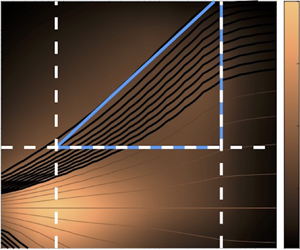
Recent data-driven efforts have utilized spectral decomposition techniques to uncover the geometric self-similarity of dominant motions in the logarithmic layer, and thereby validate the attached eddy model. In this paper, we evaluate the predictive capability of the stochastically forced linearized Navier–Stokes equations in capturing such structural features in turbulent channel flow at $Re_\tau =2003$. We use the linear coherence spectrum to quantify the wall-normal coherence within the velocity field generated by the linearized dynamics. In addition to the linearized Navier–Stokes equations around the turbulent mean velocity profile, we consider an enhanced variant in which molecular viscosity is augmented with turbulent eddy-viscosity. We use judiciously shaped white- and coloured-in-time stochastic forcing to generate a statistical response with energetic attributes that are consistent with the results of direct numerical simulation (DNS). Specifically, white-in-time forcing is scaled to ensure that the two-dimensional energy spectrum is reproduced and coloured-in-time forcing is shaped to match normal and shear stress profiles. We show that the addition of eddy-viscosity significantly strengthens the self-similar attributes of the resulting stochastic velocity field within the logarithmic layer and leads to an inner-scaled coherence spectrum. We use this coherence spectrum to extract the energetic signature of self-similar motions that actively contribute to momentum transfer and are responsible for producing Reynolds shear stress. Our findings support the use of coloured-in-time forcing in conjunction with the dynamic damping afforded by turbulent eddy-viscosity in improving predictions of the scaling trends associated with such active motions in accordance with DNS-based spectral decomposition.

Baroclinic critical layer in a viscous stratified boundary layer flow on an undulated tilted surface
-
- Journal:
- Journal of Fluid Mechanics / Volume 958 / 10 March 2023
- Published online by Cambridge University Press:
- 01 March 2023, A13
-
- Article
- Export citation
-
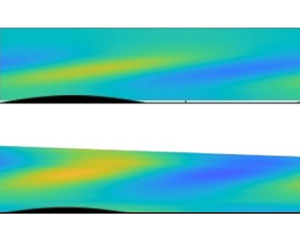
The present paper investigates theoretically and experimentally the boundary layer generated by a stably stratified fluid flowing horizontally along a surface tilted in the transverse direction and deformed by sinusoidal undulations with crests perpendicular to the flow direction. In the absence of undulations, a weak transverse velocity proportional to the normal velocity is created such that the flow remains purely horizontal. In the presence of undulations of amplitude $h$, a stronger transverse flow is generated that exhibits a singular behaviour at the critical altitude where the frequency of the perturbation matches the buoyancy frequency of the fluid. This baroclinic critical layer was previously analysed by Passaggia et al. (J. Fluid Mech., vol. 751, 2014, pp. 663–684) for a boundary layer flow with a small sliding velocity on the surface. Here, the no-slip boundary condition of the experimental flow is applied. For this purpose, we solve the viscous sub-layer to obtain a complete theoretical model for the solution in the critical layer without any adjusting parameter. The theoretical predictions for the transverse velocity are compared with experimental measurements, and a good quantitative agreement is demonstrated. Compared with the sliding case, the no-slip boundary condition on the surface reduces the amplitude of the critical layer solution by a factor $Re^{-1/3}$, where the Reynolds number Re is defined using the velocity at infinity and the thickness of the boundary layer. As a consequence, the transverse velocity has a maximum in the critical layer of order $h$, but it still induces a shear rate of order $h\,Re^{1/3}$.


Prescribed performance LOS guidance-based dynamic surface path following control of surface vessel with position and heading errors constraint
-
- Journal:
- The Journal of Navigation / Volume 76 / Issue 2-3 / March 2023
- Published online by Cambridge University Press:
- 18 April 2023, pp. 255-285
- Print publication:
- March 2023
-
- Article
- Export citation
-
Concentrating on a surface vessel with input saturation, model uncertainties and unknown disturbances, a path following the adaptive backstepping control method based on prescribed performance line-of-sight (PPLOS) guidance is proposed. First, a prescribed performance asymmetric modified barrier Lyapunov function (PPAMBLF) is used to design the PPLOS and the heading controller, which make the path following position and heading errors meet the prescribed performance requirements. Furthermore, the backstepping and dynamic surface technique (DSC) are used to design the path following controller and the adaptive assistant systems are constructed to compensate the influence of input saturation. In addition, neural networks are introduced to approximate model uncertainties, and the adaptive laws are designed to estimate the bounds of the neural network approximation errors and unknown disturbances. According to the Lyapunov stability theory, all signals are semi-globally uniformly ultimately bounded. Finally, a 76$\,{\cdot }\,$
 2 m supply surface vessel is used for simulation experiments. The experimental results show that although the control inputs are limited, the control system can still converge quickly, and both position and heading errors can be limited to the prescribed performance requirements.

Enhanced proton acceleration from laser interaction with curved surface nanowire targets
-
- Journal:
- Journal of Plasma Physics / Volume 89 / Issue 1 / February 2023
- Published online by Cambridge University Press:
- 01 March 2023, 905890113
-
- Article
-
- You have access
- HTML
- Export citation
-
A novel curved surface nanowire target is proposed to improve the cutoff energy of accelerated protons via target normal sheath acceleration. The interaction of a laser of intensity $1.37\times 10^{20}\ {\rm W}\ {\rm cm}^{-2}$
 with a curved surface nanowire target is studied by two-dimensional particle-in-cell simulations. The numerical results indicate that the sheath electric field at the target rear side is significantly enhanced by this simple target design, compared with using the planar nanowire target. The transverse motion of hot electrons is effectively confined and the energy density of electrons is naturally increased. A series of simulations with various target parameters is carried out to investigate the performance of this novel target. This tailored target may provide implications for generating high-quality proton beams in experiments.
Safety analysis of RNP approach procedure using fusion of FRAM model and Bayesian belief network
-
- Journal:
- The Journal of Navigation / Volume 76 / Issue 2-3 / March 2023
- Published online by Cambridge University Press:
- 06 June 2023, pp. 286-315
- Print publication:
- March 2023
-
- Article
- Export citation
Streamwise vortices, cellular shedding and force coefficients on finite wing at low Reynolds number
-
- Journal:
- Journal of Fluid Mechanics / Volume 958 / 10 March 2023
- Published online by Cambridge University Press:
- 28 February 2023, A10
-
- Article
-
- You have access
- Open access
- HTML
- Export citation
-
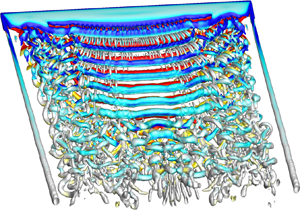
Numerical simulations for flow past a finite rectangular wing with a NACA 0012 section at $Re=1000$ for various semi-aspect ratios ( $0.25\le sAR \le 7.5$) over a range of angles of attack ( $0^{\circ }\le \alpha \le 14^{\circ }$) reveal streamwise vortices, which increase in strength and number to occupy an increasing spanwise extent with increase in $\alpha$. They result in non-monotonic spanwise variation of local force coefficients and increased strength of wing-tip vortex for $\alpha >8^{\circ }$. Viscous and pressure drag dominate for low and high sAR, respectively. The time-averaged drag coefficient first decreases and then increases with increase in $sAR$. Vortex shedding for $\alpha =14^{\circ }$ is single cell and parallel for $sAR<3$. Shedding is in two cells with an oblique angle that varies with time, leading to large spanwise variation in the root mean square of local force coefficients for higher $sAR$. Various types of dislocations, reported earlier in wakes of bluff bodies, are seen for different $\alpha$ and $sAR$. Dislocations for $\alpha =14^{\circ }$ appear at the same spanwise location for $sAR=3$ and at different spanwise locations for $sAR\ge 4$. Vortex shedding for $\alpha =12^{\circ }$ and $sAR=5$ exhibits one cell structure in the near wake and two cells in the far wake due to splitting and reconnection of vortices near the mid-span in the moderate wake. Linkages form between counter-rotating spanwise vortices for $sAR\ge 1$. Additional linkages between shed- and wing-tip vortices are observed for lower $sAR$. At each $\alpha$, the strength of the wing-tip vortex and radius of its core, estimated using Rankine and Lamb–Oseen models, increases up to a certain $sAR$ beyond which it is approximately constant.


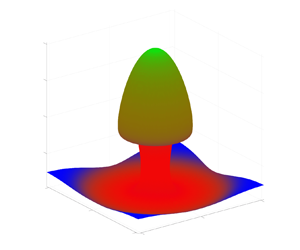
Mapping the shape and dimension of three-dimensional Lagrangian coherent structures and invariant manifolds
-
- Journal:
- Journal of Fluid Mechanics / Volume 958 / 10 March 2023
- Published online by Cambridge University Press:
- 28 February 2023, A11
-
- Article
-
- You have access
- Open access
- HTML
- Export citation
GNOMES II: Analysis of the Galactic diffuse molecular ISM in all four ground state hydroxyl transitions using Amoeba
-
- Journal:
- Publications of the Astronomical Society of Australia / Volume 40 / 2023
- Published online by Cambridge University Press:
- 28 February 2023, e015
-
- Article
-
- You have access
- Open access
- HTML
- Export citation
-
We present observations of the four $^2 \Pi _{3/2}\,J=3/2$ ground-rotational state transitions of the hydroxyl molecule (OH) along 107 lines of sight both in and out of the Galactic plane: 92 sets of observations from the Arecibo telescope and 15 sets of observations from the Australia Telescope Compact Array (ATCA). Our Arecibo observations included off-source pointings, allowing us to measure excitation temperature ( $T_{\rm ex}$) and optical depth, while our ATCA observations give optical depth only. We perform Gaussian decomposition using the Automated Molecular Excitation Bayesian line-fitting Algorithm ‘Amoeba’ (Petzler, Dawson, & Wardle 2021, ApJ, 923, 261) fitting all four transitions simultaneously with shared centroid velocity and width. We identify 109 features across 38 sightlines (including 58 detections along 27 sightlines with excitation temperature measurements). While the main lines at 1665 and 1667 MHz tend to have similar excitation temperatures (median $|\Delta T_{\rm ex}({\rm main})|=0.6\,$K, 84% show $|\Delta T_{\rm ex}({\rm main})|<2\,$K), large differences in the 1612 and 1720 MHz satellite line excitation temperatures show that the gas is generally not in LTE. For a selection of sightlines, we compare our OH features to associated (on-sky and in velocity) Hi cold gas components (CNM) identified by Nguyen et al. (2019, ApJ, 880, 141) and find no strong correlations. We speculate that this may indicate an effective decoupling of the molecular gas from the CNM once it accumulates.


A 110 W fiber gas Raman laser at 1153 nm
-
- Journal:
- High Power Laser Science and Engineering / Volume 11 / 2023
- Published online by Cambridge University Press:
- 28 February 2023, e10
-
- Article
-
- You have access
- Open access
- HTML
- Export citation
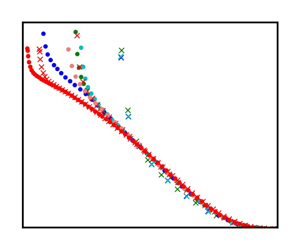
Outer scaling of the mean momentum equation for turbulent boundary layers under adverse pressure gradient
-
- Journal:
- Journal of Fluid Mechanics / Volume 958 / 10 March 2023
- Published online by Cambridge University Press:
- 28 February 2023, A9
-
- Article
- Export citation
-
A new scaling of the mean momentum equation is developed for the outer region of turbulent boundary layers (TBLs) under adverse pressure gradient (APG). The maximum Reynolds shear stress location, denoted as $y_{m}$, is employed to determine the proper scales for the outer region of an APG TBL. An outer length scale is proposed as $\delta _e - y_{m}$, where $\delta _e$ is the boundary layer thickness. An outer velocity scale for the mean streamwise velocity deficit is proposed as $U_e - U_{m}$, where $U_e$ and $U_m$ are the mean streamwise velocities at the boundary layer edge and $y_{m}$, respectively. An outer velocity scale for the mean wall-normal velocity deficit is proposed as $V_e - V_{m}$, where $V_e$ and $V_{m}$ are the wall-normal velocities at $\delta _e$ and $y_{m}$, respectively. The maximum Reynolds shear stress is found to scale as $(\delta _e - y_{m}) U_e \,{\rm d}U_e/{{\rm d}x}$. The new outer scaling collapses well the experimental and numerical data on APG TBLs over a wide range of Reynolds numbers and strengths of pressure gradient. Approximations of the new scaling are developed for TBLs under strong APG and at high Reynolds numbers. The relationships between the new scales and previously proposed scales are discussed.


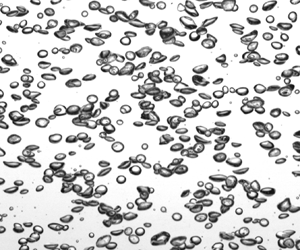
The emergence of bubble-induced scaling in thermal spectra in turbulence
-
- Journal:
- Journal of Fluid Mechanics / Volume 958 / 10 March 2023
- Published online by Cambridge University Press:
- 27 February 2023, A5
-
- Article
-
- You have access
- Open access
- HTML
- Export citation
-
We report on the modification of the spectrum of a passive scalar inside a turbulent flow by the injection of large bubbles. Although the spectral modification through bubbles is well known and well analysed for the velocity fluctuations, little is known on how bubbles change the fluctuations of an approximately passive scalar, in our case temperature. Here we uncover the thermal spectral scaling behaviour of a turbulent multiphase thermal mixing layer. The development of a $-3$ spectral scaling is triggered. By injecting large bubbles ( ${Re}_{{bub}} = {O}(10^2)$) with gas volume fractions $\alpha$ up to 5 %. For these bubbly flows, the $-5/3$ scaling is still observed at intermediate frequencies for low $\alpha$ but becomes less pronounced when $\alpha$ further increases and it is followed by a steeper $-3$ slope for larger frequencies. This $-3$ scaling range extends with increasing gas volume fraction. The $-3$ scaling exponent coincides with the typical energy spectral scaling for the velocity fluctuations in high-Reynolds-number bubbly flows. We identify the frequency scale of the transition from the $-5/3$ scaling to the $-3$ scaling and show how it depends on the gas volume fraction.


Effect of tabs on the shear layer dynamics of a jet in cross-flow
-
- Journal:
- Journal of Fluid Mechanics / Volume 958 / 10 March 2023
- Published online by Cambridge University Press:
- 27 February 2023, A6
-
- Article
-
- You have access
- Open access
- HTML
- Export citation
-
Direct numerical simulations (DNS) of a jet in cross-flow (JICF) with a triangular tab at two positions are performed at jet-to-cross-flow velocity ratios of $R = 2$ and $4$ with a jet Reynolds number of 2000 based on the jet's bulk velocity and exit diameter. The DNS and dynamic mode decomposition show the sensitivity of the tab's effect on the jet upstream shear layer (USL) structure and cross-section to $R$, echoing the experimental discoveries of Harris et al. (J. Fluid Mech., vol. 918, 2021). Furthermore, DNS reveals that the presence of a tab placed on the upstream side of the nozzle significantly modifies the USL through production of streamwise vortices that curl around the spanwise vortex tubes originating from the primary instability of the USL. This provides an explanation for the improvement in mixing that has been associated with an upstream tab. The streamwise vortex structure shows remarkable similarities to the ‘strain-oriented vortex tubes’ observed for disturbed plane shear layers by Lasheras & Choi (J. Fluid Mech., vol. 189, 1988, pp. 53–86). For both $R$ cases, the USL instability is delayed, the jet penetration is reduced, and the jet cross-section is flattened, although the tab has a less pronounced effect on the USL structure at higher velocity ratios, where the formation of the streamwise vortices is delayed. In contrast, a tab placed 45 $^\circ$ from the upstream position produces significantly different effects compared with the upstream tab. At $R = 4$, the jet cross-section is significantly skewed away from the tab and a tertiary vortex is formed, as observed in past studies of round JICFs at relatively high $R$ and low Reynolds numbers. The ability of the tab to produce a controllable steady-state tertiary vortex has implications for a variety of applications. The 45 $^\circ$ tab produces asymmetric effects in the wake of the jet at $R = 2$, but the effect on the jet cross-section is much smaller, highlighting the sensitivity of jets at high $R$ to asymmetric perturbations.


Obtaining molecular hydrogen from water radiolysis in the nano-SiO2(d = 20 nm)/H2O system under the influence of γ-quanta
-
- Journal:
- Experimental Results / Volume 4 / 2023
- Published online by Cambridge University Press:
- 27 February 2023, e19
-
- Article
-
- You have access
- Open access
- HTML
- Export citation
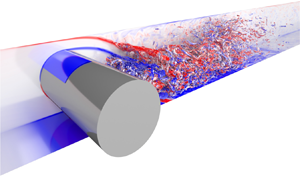
Asymmetric wakes in flows past circular cylinders confined in channels
-
- Journal:
- Journal of Fluid Mechanics / Volume 958 / 10 March 2023
- Published online by Cambridge University Press:
- 27 February 2023, A8
-
- Article
-
- You have access
- Open access
- HTML
- Export citation
-
In this paper, we investigate the flow past a circular cylinder confined in a channel at a blockage ratio of $\beta =0.7$ (the ratio of the cylinder diameter and the channel height) for Reynolds numbers between ${\textit {Re}}=300$ and $3900$ using direct numerical simulation (DNS). We show for varying Reynolds numbers a wide range of wake dynamics occur as the spanwise domain length is changed. At a lower Reynolds number of ${\textit {Re}}=300$, a reverse von Kármán wake alongside either a top- or bottom-biased asymmetry was observed at different spanwise locations. The asymmetry was structurally similar the two-dimensional asymmetry studied by prior investigators, and was found to be a result of the confinement effect. Further, wake-jumping between the two intermittent states was present. For larger Reynolds numbers, ${\textit {Re}}=1000$ and $3900$, these asymmetric structures were found to become dominant. We also examine the dependence of the asymmetries on the spanwise domain. For small spanwise domains the asymmetries were uniformly orientated across the span. In contrast, for sufficiently large spanwise domains, the asymmetry flips its orientation at different spanwise locations. Comparisons of flow statistics demonstrate good agreement between the different spanwise domains, which suggests the same mechanism maintains the asymmetry in both cases. Further analysis at ${\textit {Re}}=1000$ found the number of times the wake flips is dependent on the initial conditions, with a wake that flips zero (purely asymmetric), two and four times being observed. These structures were also determined to remain stable over time scales of $1000D/U$.


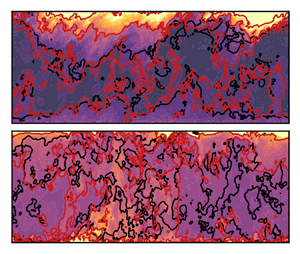
Uniform momentum and temperature zones in unstably stratified turbulent flows
-
- Journal:
- Journal of Fluid Mechanics / Volume 958 / 10 March 2023
- Published online by Cambridge University Press:
- 27 February 2023, A7
-
- Article
-
- You have access
- Open access
- HTML
- Export citation
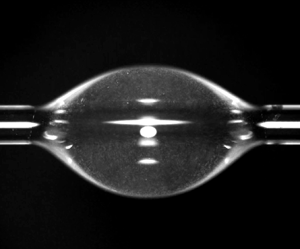
Coffee stain effect on a fibre from axisymmetric droplets
-
- Journal:
- Journal of Fluid Mechanics / Volume 957 / 25 February 2023
- Published online by Cambridge University Press:
- 27 February 2023, A24
-
- Article
- Export citation
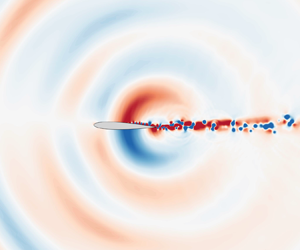
On the origin of quadrupole sound from a two-dimensional aerofoil trailing edge
-
- Journal:
- Journal of Fluid Mechanics / Volume 958 / 10 March 2023
- Published online by Cambridge University Press:
- 27 February 2023, A3
-
- Article
-
- You have access
- Open access
- HTML
- Export citation
-
Tonal noise emitted from the trailing edge of an airfoil is considered using modal analysis techniques to investigate secondary quadrupole tones. We examine the origin of quadrupole sound generated from two-dimensional unsteady laminar flow over a NACA0012 airfoil. In this paper, we consider two flow configurations at Mach numbers of $M_\infty = 0.1$ and 0.05 that lead to different acoustic characteristics: the former has a significant high-frequency quadrupole noise source, whereas the latter does not. We use vortex sound theory, dynamic mode decomposition (DMD), and resolvent analysis to analyze the sound source. First, we employ DMD modes to reveal that the quadrupole sound is only observed in the higher Mach number case. Next, the vortex dynamics in the vicinity of the trailing edge are studied to identify the origin of quadrupole sound. It is found that the quadrupole sound is caused by vortex shedding in the vicinity of the trailing edge. The complex vortex interaction between both sides of the airfoil strengthens the quadrupole source in the higher Mach number case, while it is negligible in the lower one. Furthermore, we perform resolvent analysis to examine the vortex generation over the airfoil. The resolvent mode indicates that the interaction between the vortices on both sides of the airfoil causes a multi-scale vortex structure on the suction-side wall.

