Refine search
Actions for selected content:
238152 results in Physics and Astronomy

Direct numerical simulation of one-sided forced thermal convection in plane channels
-
- Journal:
- Journal of Fluid Mechanics / Volume 957 / 25 February 2023
- Published online by Cambridge University Press:
- 23 February 2023, A31
-
- Article
-
- You have access
- Open access
- HTML
- Export citation
-
We carry out direct numerical simulations (DNS) of turbulent flow and heat transfer in pressure-driven plane channels, by considering cases with heating on both walls, as well as asymmetric heating limited to one of the channel walls. Friction Reynolds numbers up to ${Re}_{\tau } \approx 2000$ are considered, and Prandtl numbers from ${Pr}=0.025$ to ${Pr} = 4$, the temperature field being regarded as a passive scalar. Whereas cases with symmetric heating show close similarity between the temperature and the streamwise velocity fields, with turbulent structures confined to either half of the channel, in the presence of one-sided heating the temperature field exhibits larger regions with coherent fluctuations extending beyond the channel centreline. Validity of the logarithmic law for the mean temperature is confirmed, as well as universality of the associated von Kármán constant, which we estimate to be $k_{\theta } = 0.459$. Deviations from the logarithmic behaviour are much clearer in cases with one-sided heating, which feature a wide outer region with parabolic mean temperature profile. The DNS data are exploited to construct a predictive formula for the heat transfer coefficient as a function of both Reynolds and Prandtl number. We find that the reduction of the thermal efficiency in the one-sided case is approximately $20\,\%$ at unit Prandtl number; however, it can become much more significant at low Prandtl number.


Index
-
- Book:
- Physics of Charged Macromolecules
- Published online:
- 16 February 2023
- Print publication:
- 23 February 2023, pp 502-505
-
- Chapter
- Export citation
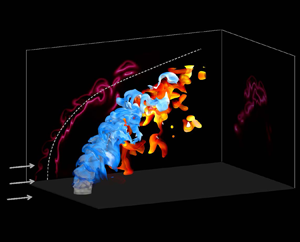
A direct numerical simulation study on the structures and turbulence–flame interactions of a laboratory-scale lean premixed jet flame in cross-flow
-
- Journal:
- Journal of Fluid Mechanics / Volume 957 / 25 February 2023
- Published online by Cambridge University Press:
- 22 February 2023, A27
-
- Article
- Export citation
-
In the present work, direct numerical simulation of a laboratory-scale lean premixed reacting jet in cross-flow was performed to explore the flow–flame structures and turbulence–flame interactions. A jet of lean premixed ethylene–air mixtures (equivalence ratio $\phi = 0.6$) was injected into a hot vitiated cross-flow. Both non-reacting and reacting cases were simulated. It was found that the reacting jet penetrates deeper in the cross-flow with a weaker shear layer compared with the non-reacting one. The wake of the non-reacting and reacting jet is characterized by vertical vortices and recirculation zones, respectively. As for the flame structure of the reacting case, the reaction intensity varies considerably in different flame zones. The heat release rate on the leeward side is higher than that on the windward side, but lower than that of the corresponding laminar flame. The analysis of the turbulence–flame interactions of the reacting case showed that the large local Damköhler number ( $Da$) related to reaction-induced dilatations results in an increased tendency of the scalar gradient to align with the most extensive strain rate, which is more evident in the regions with high heat release rate on the leeward side. Negative dilatation regions with positive tangential strain rate and negative normal strain rate are observed on the windward side. High positive dilatations appear on the flame front of the leeward side. The tangential strain rate is negatively correlated with the normal strain rate and curvature. Regions with a high local $Da$ on the windward side correspond with high positive curvature regions.


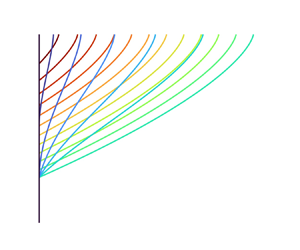
Basal boundary conditions for granular surface flows over fragile and brittle erodible beds
-
- Journal:
- Journal of Fluid Mechanics / Volume 957 / 25 February 2023
- Published online by Cambridge University Press:
- 22 February 2023, A26
-
- Article
-
- You have access
- Open access
- HTML
- Export citation
Parametric generation and phase locking of multiple sidebands in the regime of full-back-conversion
-
- Journal:
- High Power Laser Science and Engineering / Volume 11 / 2023
- Published online by Cambridge University Press:
- 21 February 2023, e21
-
- Article
-
- You have access
- Open access
- HTML
- Export citation
The transience and persistence of high optical polarisation state in beamed radio quasars
-
- Journal:
- Publications of the Astronomical Society of Australia / Volume 40 / 2023
- Published online by Cambridge University Press:
- 21 February 2023, e006
-
- Article
-
- You have access
- HTML
- Export citation
-
We examine the long-term stability (on decade-like timescales) of optical ‘high polarisation’ (HP) state with ${p_{opt}}$ ${> 3\%}$, which commonly occurs in flat-spectrum (i.e., beamed) radio quasars (FSRQs) and is a prominent marker of blazar state. Using this clue, roughly a quarter of the FSRQ population has been reported to undergo HP $\leftrightarrow$ non-HP state transition on year-like timescales. This work examines the extent to which HP (i.e., blazar) state can endure in a FSRQ, despite these ‘frequent’ state transitions. This is the first attempt to verify, using purely opto-polarimetric data for a much enlarged sample of blazars, the recent curious finding that blazar state in individual quasars persists for at least a few decades, despite its changing/swinging observed fairly commonly on year-like timescales. The present analysis is based on a well-defined sample of 83 radio quasars, extracted from the opto-polarimetric survey RoboPol (2013–2017), for which old opto-polarimetric data taken prior to 1990 could be found in the literature. By a source-wise comparison of these two datasets of the same observable ( $p_{opt}$), we find that $\sim$90% of the 63 quasars found in blazar state in our RoboPol sample, were also observed to be in that state about three decades before. On the other hand, within the RoboPol survey itself, we find that roughly a quarter of the blazars in our sample migrated to the other polarisation state on year-like timescales, by crossing the customary $p_{opt}$ = 3% threshold. Evidently, these relatively frequent transitions (in either direction) do not curtail the propensity of a radio quasar to retain its blazar (i.e., HP) state for at least a few decades. The observed transitions/swings of polarisation state are probably manifestation of transient processes, like ejections of synchrotron plasma blobs (VLBI radio knots) from the active nucleus.


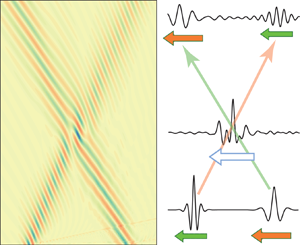
Breather interactions in a three-layer fluid
-
- Journal:
- Journal of Fluid Mechanics / Volume 957 / 25 February 2023
- Published online by Cambridge University Press:
- 21 February 2023, A22
-
- Article
- Export citation

Triadic resonant instability in confined and unconfined axisymmetric geometries
-
- Journal:
- Journal of Fluid Mechanics / Volume 957 / 25 February 2023
- Published online by Cambridge University Press:
- 21 February 2023, A20
-
- Article
- Export citation
-
We present an investigation of the resonance conditions governing triad interactions of cylindrical internal waves, i.e. Kelvin modes, described by Bessel functions. Our analytical study, supported by experimental measurements, is performed both in confined and unconfined axisymmetric domains. We are interested in two conceptual questions: can we find resonance conditions for a triad of Kelvin modes? What is the impact of the boundary conditions on such resonances? In both the confined and unconfined cases, we show that sub-harmonics can be spontaneously generated from a primary wave field if they satisfy at least a resonance condition on their frequencies of the form $\omega _0 = \pm \omega _1 \pm \omega _2$. We demonstrate that the resulting triad is also spatially resonant, but that the resonance in the radial direction may not be exact in confined geometries due to the prevalence of boundary conditions – a key difference compared with Cartesian plane waves.
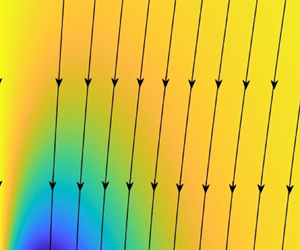
Inertial and viscous dynamics of jump-to-contact between fluid drops under van der Waals attraction
-
- Journal:
- Journal of Fluid Mechanics / Volume 957 / 25 February 2023
- Published online by Cambridge University Press:
- 21 February 2023, A25
-
- Article
-
- You have access
- Open access
- HTML
- Export citation
-
When two small fluid drops are sufficiently close, the van der Waals force overcomes surface tension and deforms the surfaces into contact, initiating coalescence. The dynamics of surface deformation across an inviscid gap falls into two distinct regimes (Stokes and inertial–viscous) characterized by the forces that balance the van der Waals attraction at leading order (viscosity, and both inertia and viscosity). The previously studied Stokes regime holds for very viscous drops but fails for less viscous drops as inertia becomes significant before contact is reached. We show that the subsequent inertial–viscous dynamics is self-similar as contact is approached, with the gap width decreasing as $t{'^{3/8}}$ and the radial scale of the deformed region decreasing as $t{'^{1/2}}$ as $t{'}\to 0$, for time until contact $t'$. The self-similar behaviour is universal and is the generic asymptotic behaviour observed in time-dependent simulations. The unique self-similar gap profile of the inertial–viscous regime suggests new initial conditions for the coalescence of the drops after contact.


AllBRICQS: The All-sky BRIght, Complete Quasar Survey
-
- Journal:
- Publications of the Astronomical Society of Australia / Volume 40 / 2023
- Published online by Cambridge University Press:
- 21 February 2023, e010
-
- Article
-
- You have access
- Open access
- HTML
- Export citation
-
We describe the first results from the All-sky BRIght, Complete Quasar Survey (AllBRICQS), which aims to discover the last remaining optically bright quasars. We present 156 spectroscopically confirmed quasars (140 newly identified) having $|b|>10^{\circ}$. 152 of the quasars have Gaia DR3 magnitudes brighter than $B_{P}=16.5$ or $R_{P}=16$ mag, while four are slightly fainter. The quasars span a redshift range of $z=0.07-3.93$. In particular, we highlight the properties of J0529-4351 at $z=3.93$, which, if unlensed, is one of the most intrinsically luminous quasars in the Universe. The AllBRICQS sources have been selected by combining data from the Gaia and WISE all-sky satellite missions, and we successfully identify quasars not flagged as candidates by Gaia Data Release 3. We expect the completeness to be $\approx$96% within our magnitude and latitude limits, while the preliminary results indicate a selection purity of $\approx$96%. The optical spectroscopy used for source classification will also enable detailed quasar characterisation, including black hole mass measurements and identification of foreground absorption systems. The AllBRICQS sources will greatly enhance the number of quasars available for high-signal-to-noise follow-up with present and future facilities.


Transient leading-edge vortex development on a wing rolling in uniform flow
-
- Journal:
- Journal of Fluid Mechanics / Volume 957 / 25 February 2023
- Published online by Cambridge University Press:
- 21 February 2023, A23
-
- Article
- Export citation
-
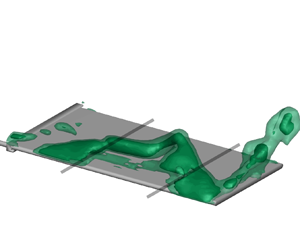
Plenoptic particle image velocimetry and surface pressure measurements were used to analyse the early development of leading-edge vortices (LEVs) created by a flat-plate wing of aspect ratio 2 rolling in a uniform flow parallel to the roll axis. Four cases were constructed by considering two advance coefficients, $J=0.54$ and 1.36, and two wing radii of gyration, $R_g/c=2.5$ and 3.25. In each case, the wing pitch angle was articulated such as to achieve an angle of attack of $33^{\circ }$ at the radius of gyration of the wing. The sources and sinks of vorticity were quantified for a chordwise rectangular control region, using a vorticity transport framework in a non-inertial coordinate system attached to the wing. Within this framework, terms associated with Coriolis acceleration provide a correction to tilting and spanwise convective fluxes measured in the rotating frame and, for the present case, have insignificant values. For the baseline case ( $J=0.54, R_g/c=3.25$), three distinct spanwise regions were observed within the LEV, with distinct patterns of vortex evolution and vorticity transport mechanisms in each region. Reducing the radius of gyration to $R_g/c=2.5$ resulted in a more stable vortex with the inboard region extending over a broader spanwise range. Increasing advance ratio eliminated the conical vortex, resulting in transport processes resembling the mid-span region of the baseline case. Although the circulation of the LEV system was generally stronger at the larger advance coefficient, the shear-layer contribution was diminished.


Tango Controls and data pipeline for petawatt laser experiments
- Part of
-
- Journal:
- High Power Laser Science and Engineering / Volume 11 / 2023
- Published online by Cambridge University Press:
- 21 February 2023, e44
-
- Article
-
- You have access
- Open access
- HTML
- Export citation
Milliarcsecond structures of variable-peaked spectrum sources
-
- Journal:
- Publications of the Astronomical Society of Australia / Volume 40 / 2023
- Published online by Cambridge University Press:
- 21 February 2023, e005
-
- Article
-
- You have access
- Open access
- HTML
- Export citation
-
Spectral variability offers a new technique to identify small scale structures from scintillation, as well as determining the absorption mechanism for peaked-spectrum (PS) radio sources. In this paper, we present very long baseline interferometry (VLBI) imaging using the long baseline array (LBA) of two PS sources, MRC 0225–065 and PMN J0322–4820, identified as spectrally variable from observations with the Murchison Widefield Array (MWA). We compare expected milliarcsecond structures based on the detected spectral variability with direct LBA imaging. We find MRC 0225–065 is resolved into three components, a bright core and two fainter lobes, roughly 430 pc projected separation. A comprehensive analysis of the magnetic field, host galaxy properties, and spectral analysis implies that MRC 0225–065 is a young radio source with recent jet activity over the last $10^2$– $10^3$ yr. We find PMN J0322–4820 is unresolved on milliarcsecond scales. We conclude PMN J0322–4820 is a blazar with flaring activity detected in 2014 with the MWA. We use spectral variability to predict morphology and find these predictions consistent with the structures revealed by our LBA images.


Small-scale intermittency of premixed turbulent flames
-
- Journal:
- Journal of Fluid Mechanics / Volume 957 / 25 February 2023
- Published online by Cambridge University Press:
- 20 February 2023, A21
-
- Article
-
- You have access
- Open access
- HTML
- Export citation
-
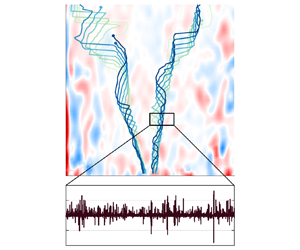
Premixed turbulent flames, encountered in power generation and propulsion engines, are an archetype of a randomly advected, self-propagating surface. While such a flame is known to exhibit large-scale intermittent flapping, the possible intermittency of its small-scale fluctuations has been largely disregarded. Here, we experimentally reveal the inner intermittency of a premixed turbulent V-flame, while clearly distinguishing this small-scale feature from large-scale outer intermittency. From temporal measurements of the fluctuations of the flame, we find a frequency spectrum that has a power-law subrange with an exponent close to $-2$, which is shown to follow from Kolmogorov phenomenology. Crucially, however, the moments of the temporal increment of the flame position are found to scale anomalously, with exponents that saturate at higher orders. This signature of small-scale inner intermittency is shown to originate from high-curvature, cusp-like structures on the flame surface, which have significance for modelling the heat release rate and other key properties of premixed turbulent flames.

Growth and stability of bubbles in a yield stress fluid
-
- Journal:
- Journal of Fluid Mechanics / Volume 957 / 25 February 2023
- Published online by Cambridge University Press:
- 20 February 2023, A16
-
- Article
-
- You have access
- Open access
- HTML
- Export citation
Heat-induced changes in molecular biosignatures and the influence of Mars-relevant minerals
-
- Journal:
- International Journal of Astrobiology / Volume 22 / Issue 3 / June 2023
- Published online by Cambridge University Press:
- 20 February 2023, pp. 167-184
-
- Article
-
- You have access
- Open access
- HTML
- Export citation
Multibeam laser–plasma interaction at the Gekko XII laser facility in conditions relevant for direct-drive inertial confinement fusion
- Part of
-
- Journal:
- High Power Laser Science and Engineering / Volume 11 / 2023
- Published online by Cambridge University Press:
- 20 February 2023, e24
-
- Article
-
- You have access
- Open access
- HTML
- Export citation
-
Laser–plasma interaction and hot electrons have been characterized in detail in laser irradiation conditions relevant for direct-drive inertial confinement fusion. The experiment was carried out at the Gekko XII laser facility in multibeam planar target geometry at an intensity of approximately $3\times {10}^{15}$ W/cm2. Experimental data suggest that high-energy electrons, with temperatures of 20–50 keV and conversion efficiencies of $\eta <1\%$, were mainly produced by the damping of electron plasma waves driven by two-plasmon decay (TPD). Stimulated Raman scattering (SRS) is observed in a near-threshold growth regime, producing a reflectivity of approximately $0.01\%$, and is well described by an analytical model accounting for the convective growth in independent speckles. The experiment reveals that both TPD and SRS are collectively driven by multiple beams, resulting in a more vigorous growth than that driven by single-beam laser intensity.


Null-homotopic knots have Property R
-
- Journal:
- Mathematical Proceedings of the Cambridge Philosophical Society / Volume 175 / Issue 1 / July 2023
- Published online by Cambridge University Press:
- 20 February 2023, pp. 217-223
- Print publication:
- July 2023
-
- Article
- Export citation
-
We prove that if K is a nontrivial null-homotopic knot in a closed oriented 3–manfiold Y such that $Y-K$ does not have an $S^1\times S^2$ summand, then the zero surgery on K does not have an $S^1\times S^2$ summand. This generalises a result of Hom and Lidman, who proved the case when Y is an irreducible rational homology sphere.


Characteristics of geometry-and pressure-induced laminar separation bubbles at an enhanced level of free-stream turbulence
-
- Journal:
- Journal of Fluid Mechanics / Volume 957 / 25 February 2023
- Published online by Cambridge University Press:
- 20 February 2023, A19
-
- Article
-
- You have access
- Open access
- HTML
- Export citation
-
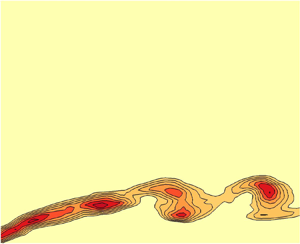
Responses of a geometry-induced separation bubble (GISB) and a pressure-induced separation bubble (PISB) at enhanced levels of free-stream turbulence (FST) have experimentally been investigated for a comparative study using the particle image velocimetry (PIV) technique. The outlines of separation bubbles based on the dividing streamlines are self-similar for different levels of FST and Reynolds numbers. The spectral analyses of the time-resolved PIV data show that the vortex shedding frequency of a separated shear layer remains unchanged for the GISB cases even with an enhanced level of FST. In contrast, it is different for the PISB cases. We propose a criterion that determines whether the frequency will remain the same even for the cases with FST. Linear stability analyses reveal that the inviscid-inflectional instability dominates the transition process, and the linear stages of transition are not completely bypassed even at an enhanced level of FST. The most amplified frequencies, while scaling with the displacement thickness and the boundary layer edge velocity, collapse in a single curve for all the cases. Furthermore, measurements in the spanwise plane show that the streamwise velocity streak/Klebanof mode at an enhanced level of FST is not a general flow feature for all types of separation bubbles. However, at an enhanced level of FST for the PISB case, the boundary layer streaks are found to distort the two-dimensional vortex structure associated with the Kelvin–Helmholtz instability, eventually leading to a three-dimensional $\varLambda$-like structure in the spanwise plane.

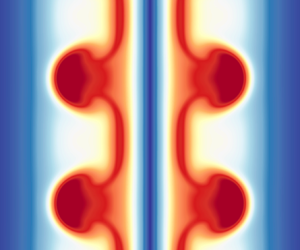
Weakly nonlinear versus semi-linear models of the nonlinear evolution of the centrifugal instability
-
- Journal:
- Journal of Fluid Mechanics / Volume 957 / 25 February 2023
- Published online by Cambridge University Press:
- 20 February 2023, A18
-
- Article
- Export citation
-
We carry out a weakly nonlinear analysis of the centrifugal instability for a columnar vortex in a rotating fluid, and compare the results to those of the semi-linear model derived empirically by Yim et al. (J. Fluid Mech., vol. 897, 2020, A34). The asymptotic analysis assumes that the Reynolds number is close to the instability threshold so that the perturbation is only marginally unstable. This leads to two coupled equations that govern the evolutions of the amplitude of the perturbation and of the mean flow under the effect of the Reynolds stresses due to the perturbation. These equations differ from the Stuart–Landau amplitude equation or coupled amplitude equations involving a mean field that have been derived previously. In particular, the amplitude does not saturate to a constant as in the supercritical Stuart–Landau equation, but decays afterwards reflecting the instability disappearance when the mean flow tends toward a neutrally stable profile in the direct numerical simulations (DNS). These equations resemble those of the semi-linear model except that the perturbation in the weakly nonlinear model keeps at leading order the structure of the eigenmode of the unperturbed base flow. The predictions of the weakly nonlinear equations are compared to those of the semi-linear model and to DNS for the Rossby number $Ro=-4$ and various Reynolds numbers and wavenumbers. They are in good agreement with the DNS when the growth rate is sufficiently small. However, the agreement deteriorates and becomes only qualitative for parameters away from the marginal values, whereas the semi-linear model continues to be in better agreement with the DNS.

