Refine search
Actions for selected content:
238161 results in Physics and Astronomy
Tango Controls and data pipeline for petawatt laser experiments
- Part of
-
- Journal:
- High Power Laser Science and Engineering / Volume 11 / 2023
- Published online by Cambridge University Press:
- 21 February 2023, e44
-
- Article
-
- You have access
- Open access
- HTML
- Export citation
Milliarcsecond structures of variable-peaked spectrum sources
-
- Journal:
- Publications of the Astronomical Society of Australia / Volume 40 / 2023
- Published online by Cambridge University Press:
- 21 February 2023, e005
-
- Article
-
- You have access
- Open access
- HTML
- Export citation
-
Spectral variability offers a new technique to identify small scale structures from scintillation, as well as determining the absorption mechanism for peaked-spectrum (PS) radio sources. In this paper, we present very long baseline interferometry (VLBI) imaging using the long baseline array (LBA) of two PS sources, MRC 0225–065 and PMN J0322–4820, identified as spectrally variable from observations with the Murchison Widefield Array (MWA). We compare expected milliarcsecond structures based on the detected spectral variability with direct LBA imaging. We find MRC 0225–065 is resolved into three components, a bright core and two fainter lobes, roughly 430 pc projected separation. A comprehensive analysis of the magnetic field, host galaxy properties, and spectral analysis implies that MRC 0225–065 is a young radio source with recent jet activity over the last $10^2$– $10^3$ yr. We find PMN J0322–4820 is unresolved on milliarcsecond scales. We conclude PMN J0322–4820 is a blazar with flaring activity detected in 2014 with the MWA. We use spectral variability to predict morphology and find these predictions consistent with the structures revealed by our LBA images.


Small-scale intermittency of premixed turbulent flames
-
- Journal:
- Journal of Fluid Mechanics / Volume 957 / 25 February 2023
- Published online by Cambridge University Press:
- 20 February 2023, A21
-
- Article
-
- You have access
- Open access
- HTML
- Export citation
-
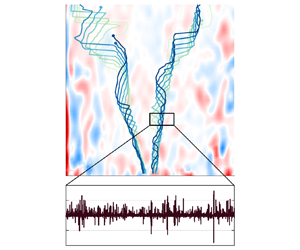
Premixed turbulent flames, encountered in power generation and propulsion engines, are an archetype of a randomly advected, self-propagating surface. While such a flame is known to exhibit large-scale intermittent flapping, the possible intermittency of its small-scale fluctuations has been largely disregarded. Here, we experimentally reveal the inner intermittency of a premixed turbulent V-flame, while clearly distinguishing this small-scale feature from large-scale outer intermittency. From temporal measurements of the fluctuations of the flame, we find a frequency spectrum that has a power-law subrange with an exponent close to $-2$, which is shown to follow from Kolmogorov phenomenology. Crucially, however, the moments of the temporal increment of the flame position are found to scale anomalously, with exponents that saturate at higher orders. This signature of small-scale inner intermittency is shown to originate from high-curvature, cusp-like structures on the flame surface, which have significance for modelling the heat release rate and other key properties of premixed turbulent flames.

Growth and stability of bubbles in a yield stress fluid
-
- Journal:
- Journal of Fluid Mechanics / Volume 957 / 25 February 2023
- Published online by Cambridge University Press:
- 20 February 2023, A16
-
- Article
-
- You have access
- Open access
- HTML
- Export citation
Heat-induced changes in molecular biosignatures and the influence of Mars-relevant minerals
-
- Journal:
- International Journal of Astrobiology / Volume 22 / Issue 3 / June 2023
- Published online by Cambridge University Press:
- 20 February 2023, pp. 167-184
-
- Article
-
- You have access
- Open access
- HTML
- Export citation
Multibeam laser–plasma interaction at the Gekko XII laser facility in conditions relevant for direct-drive inertial confinement fusion
- Part of
-
- Journal:
- High Power Laser Science and Engineering / Volume 11 / 2023
- Published online by Cambridge University Press:
- 20 February 2023, e24
-
- Article
-
- You have access
- Open access
- HTML
- Export citation
-
Laser–plasma interaction and hot electrons have been characterized in detail in laser irradiation conditions relevant for direct-drive inertial confinement fusion. The experiment was carried out at the Gekko XII laser facility in multibeam planar target geometry at an intensity of approximately $3\times {10}^{15}$ W/cm2. Experimental data suggest that high-energy electrons, with temperatures of 20–50 keV and conversion efficiencies of $\eta <1\%$, were mainly produced by the damping of electron plasma waves driven by two-plasmon decay (TPD). Stimulated Raman scattering (SRS) is observed in a near-threshold growth regime, producing a reflectivity of approximately $0.01\%$, and is well described by an analytical model accounting for the convective growth in independent speckles. The experiment reveals that both TPD and SRS are collectively driven by multiple beams, resulting in a more vigorous growth than that driven by single-beam laser intensity.


Null-homotopic knots have Property R
-
- Journal:
- Mathematical Proceedings of the Cambridge Philosophical Society / Volume 175 / Issue 1 / July 2023
- Published online by Cambridge University Press:
- 20 February 2023, pp. 217-223
- Print publication:
- July 2023
-
- Article
- Export citation
-
We prove that if K is a nontrivial null-homotopic knot in a closed oriented 3–manfiold Y such that $Y-K$ does not have an $S^1\times S^2$ summand, then the zero surgery on K does not have an $S^1\times S^2$ summand. This generalises a result of Hom and Lidman, who proved the case when Y is an irreducible rational homology sphere.


Characteristics of geometry-and pressure-induced laminar separation bubbles at an enhanced level of free-stream turbulence
-
- Journal:
- Journal of Fluid Mechanics / Volume 957 / 25 February 2023
- Published online by Cambridge University Press:
- 20 February 2023, A19
-
- Article
-
- You have access
- Open access
- HTML
- Export citation
-
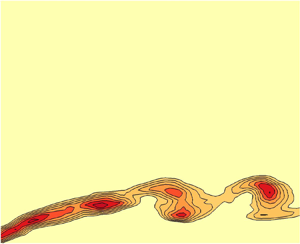
Responses of a geometry-induced separation bubble (GISB) and a pressure-induced separation bubble (PISB) at enhanced levels of free-stream turbulence (FST) have experimentally been investigated for a comparative study using the particle image velocimetry (PIV) technique. The outlines of separation bubbles based on the dividing streamlines are self-similar for different levels of FST and Reynolds numbers. The spectral analyses of the time-resolved PIV data show that the vortex shedding frequency of a separated shear layer remains unchanged for the GISB cases even with an enhanced level of FST. In contrast, it is different for the PISB cases. We propose a criterion that determines whether the frequency will remain the same even for the cases with FST. Linear stability analyses reveal that the inviscid-inflectional instability dominates the transition process, and the linear stages of transition are not completely bypassed even at an enhanced level of FST. The most amplified frequencies, while scaling with the displacement thickness and the boundary layer edge velocity, collapse in a single curve for all the cases. Furthermore, measurements in the spanwise plane show that the streamwise velocity streak/Klebanof mode at an enhanced level of FST is not a general flow feature for all types of separation bubbles. However, at an enhanced level of FST for the PISB case, the boundary layer streaks are found to distort the two-dimensional vortex structure associated with the Kelvin–Helmholtz instability, eventually leading to a three-dimensional $\varLambda$-like structure in the spanwise plane.

Weakly nonlinear versus semi-linear models of the nonlinear evolution of the centrifugal instability
-
- Journal:
- Journal of Fluid Mechanics / Volume 957 / 25 February 2023
- Published online by Cambridge University Press:
- 20 February 2023, A18
-
- Article
- Export citation
-
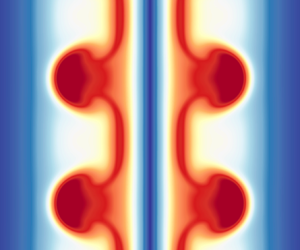
We carry out a weakly nonlinear analysis of the centrifugal instability for a columnar vortex in a rotating fluid, and compare the results to those of the semi-linear model derived empirically by Yim et al. (J. Fluid Mech., vol. 897, 2020, A34). The asymptotic analysis assumes that the Reynolds number is close to the instability threshold so that the perturbation is only marginally unstable. This leads to two coupled equations that govern the evolutions of the amplitude of the perturbation and of the mean flow under the effect of the Reynolds stresses due to the perturbation. These equations differ from the Stuart–Landau amplitude equation or coupled amplitude equations involving a mean field that have been derived previously. In particular, the amplitude does not saturate to a constant as in the supercritical Stuart–Landau equation, but decays afterwards reflecting the instability disappearance when the mean flow tends toward a neutrally stable profile in the direct numerical simulations (DNS). These equations resemble those of the semi-linear model except that the perturbation in the weakly nonlinear model keeps at leading order the structure of the eigenmode of the unperturbed base flow. The predictions of the weakly nonlinear equations are compared to those of the semi-linear model and to DNS for the Rossby number $Ro=-4$ and various Reynolds numbers and wavenumbers. They are in good agreement with the DNS when the growth rate is sufficiently small. However, the agreement deteriorates and becomes only qualitative for parameters away from the marginal values, whereas the semi-linear model continues to be in better agreement with the DNS.

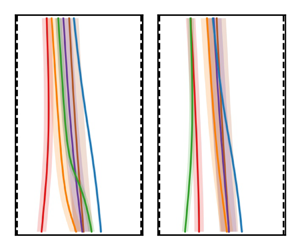
Inertial focusing of spherical particles in curved microfluidic ducts at moderate Dean numbers
-
- Journal:
- Journal of Fluid Mechanics / Volume 957 / 25 February 2023
- Published online by Cambridge University Press:
- 20 February 2023, A17
-
- Article
-
- You have access
- Open access
- HTML
- Export citation
Hosking integral in non-helical Hall cascade
-
- Journal:
- Journal of Plasma Physics / Volume 89 / Issue 1 / February 2023
- Published online by Cambridge University Press:
- 20 February 2023, 175890101
-
- Article
-
- You have access
- Open access
- HTML
- Export citation
-
The Hosking integral, which characterizes magnetic helicity fluctuations in subvolumes, is known to govern the decay of magnetically dominated turbulence. Here, we show that, when the evolution of the magnetic field is controlled by the motion of electrons only, as in neutron star crusts, the decay of the magnetic field is still controlled by the Hosking integral, but now it has effectively different dimensions than in ordinary magnetohydrodynamic (MHD) turbulence. This causes the correlation length to increase with time $t$
 like $t^{4/13}$
 instead of $t^{4/9}$
 in MHD. The magnetic energy density decreases like $t^{-10/13}$
 , which is slower than in MHD, where it decays like $t^{-10/9}$
 . These new analytic results agree with earlier numerical simulations for the non-helical Hall cascade.



The Large Scale Structure of Space-Time
- 50th Anniversary Edition
-
- Published online:
- 17 February 2023
- Print publication:
- 16 February 2023
Optical beat notes assisted attosecond soft X-ray pulse generation in high-gain free electron lasers
-
- Journal:
- High Power Laser Science and Engineering / Volume 11 / 2023
- Published online by Cambridge University Press:
- 17 February 2023, e33
-
- Article
-
- You have access
- Open access
- HTML
- Export citation

Physics of Charged Macromolecules
- Synthetic and Biological Systems
-
- Published online:
- 16 February 2023
- Print publication:
- 23 February 2023
17 - Migdal–Kadanoff recursion relations
-
- Book:
- Quarks, Gluons and Lattices
- Published online:
- 05 November 2022
- Print publication:
- 16 February 2023, pp 117-126
-
- Chapter
-
- You have access
- Open access
- Export citation
9 - Loop representation: further developments
-
- Book:
- Loops, Knots, Gauge Theories and Quantum Gravity
- Published online:
- 10 November 2022
- Print publication:
- 16 February 2023, pp 209-237
-
- Chapter
-
- You have access
- Open access
- Export citation
I - Inputs to the Standard Model
-
- Book:
- Dynamics of the Standard Model
- Published online:
- 04 November 2022
- Print publication:
- 16 February 2023, pp 1-27
-
- Chapter
-
- You have access
- Open access
- Export citation
8 - Space-time singularities
-
- Book:
- The Large Scale Structure of Space-Time
- Published online:
- 17 February 2023
- Print publication:
- 16 February 2023, pp 256-298
-
- Chapter
- Export citation
Preface
-
- Book:
- Quarks, Gluons and Lattices
- Published online:
- 05 November 2022
- Print publication:
- 16 February 2023, pp vi-vi
-
- Chapter
-
- You have access
- Open access
- Export citation
9 - Gauge–invariance and order parameters
-
- Book:
- Quarks, Gluons and Lattices
- Published online:
- 05 November 2022
- Print publication:
- 16 February 2023, pp 51-59
-
- Chapter
-
- You have access
- Open access
- Export citation
