Refine search
Actions for selected content:
238152 results in Physics and Astronomy
Entrainment mechanism of turbulent synthetic jet flow
-
- Journal:
- Journal of Fluid Mechanics / Volume 958 / 10 March 2023
- Published online by Cambridge University Press:
- 06 March 2023, A31
-
- Article
- Export citation
-
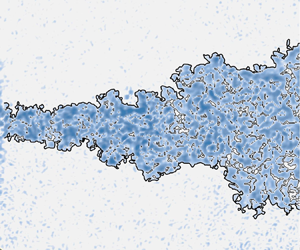
Synthetic jets have received extensive attention due to their superior mixing property. However, its mechanisms have not been investigated from the perspective of the turbulent/non-turbulent interface (TNTI). To shed new light on this issue, the entrainment and TNTI properties of a synthetic jet are experimentally investigated and compared with a continuous jet at $Re_j = 3150$. The fuzzy clustering method is applied to select an appropriate vorticity threshold to detect the TNTI. Statistically, it is revealed that the entrainment coefficients of the two jets significantly differ in the near field, while they become almost identical in the far field. Instead of the vortex ring, the ‘breakdown of the vortex ring’ enhances the entrainment in the present synthetic jet. Instantaneously, the TNTI more violently fluctuates in the near field of the synthetic jet, which leads to a larger fluctuation in the TNTI radial position, a higher fractal dimension and enhanced local entrainment. Moreover, the transition of the probability density function of the TNTI orientation from the unimodal distribution in the near field to the bimodal distribution in the far field is found in both jets. The multi-scale analysis reveals a new mechanism for the bimodal distribution caused by the TNTI-thickness-scale structures.

Effect of temperature anisotropy on the dynamics of geodesic acoustic modes
-
- Journal:
- Journal of Plasma Physics / Volume 89 / Issue 1 / February 2023
- Published online by Cambridge University Press:
- 06 March 2023, 905890109
-
- Article
- Export citation

When does an impacting drop stop bouncing?
-
- Journal:
- Journal of Fluid Mechanics / Volume 958 / 10 March 2023
- Published online by Cambridge University Press:
- 06 March 2023, A26
-
- Article
-
- You have access
- Open access
- HTML
- Export citation
-
Non-wetting substrates allow impacting liquid drops to spread, recoil and take-off, provided they are not too heavy (Biance et al., J. Fluid Mech., vol. 554, 2006, pp. 47–66) or too viscous (Jha et al., Soft Matt., vol. 16, no. 31, 2020, pp. 7270–7273). In this article, using direct numerical simulations with the volume of fluid method, we investigate how viscous stresses and gravity oppose capillarity to inhibit drop rebound. Close to the bouncing to non-bouncing transition, we evidence that the initial spreading stage can be decoupled from the later retraction and take-off, allowing us to understand the rebound as a process converting the surface energy of the spread liquid into kinetic energy. Drawing an analogy with coalescence-induced jumping, we propose a criterion for the transition from the bouncing to the non-bouncing regime, namely by the condition ${Oh}_{c} + {Bo}_{c} \sim 1$, where ${Oh}_{c}$ and ${Bo}_{c}$ are the Ohnesorge number and Bond number at the transition, respectively. This criterion is in excellent agreement with the numerical results. We also elucidate the mechanisms of bouncing inhibition in the heavy and viscous drop limiting regimes by calculating the energy budgets and relating them to the drop's shape and internal flow.


Exponential asymptotics and the generation of free-surface flows by submerged line vortices
-
- Journal:
- Journal of Fluid Mechanics / Volume 958 / 10 March 2023
- Published online by Cambridge University Press:
- 06 March 2023, A29
-
- Article
- Export citation
The Lyman–Huggins interpretation of enstrophy transport
-
- Journal:
- Journal of Fluid Mechanics / Volume 958 / 10 March 2023
- Published online by Cambridge University Press:
- 06 March 2023, A30
-
- Article
-
- You have access
- Open access
- HTML
- Export citation
Rossby waves past the breaking point in zonally dominated turbulence
-
- Journal:
- Journal of Fluid Mechanics / Volume 958 / 10 March 2023
- Published online by Cambridge University Press:
- 06 March 2023, A28
-
- Article
-
- You have access
- Open access
- HTML
- Export citation
-
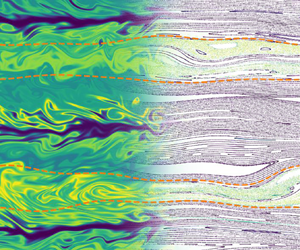
The spontaneous emergence of structure is a ubiquitous process observed in fluid and plasma turbulence. These structures typically manifest as flows which remain coherent over a range of spatial and temporal scales, resisting statistically homogeneous description. This work conducts a computational and theoretical study of coherence in turbulent flows in the stochastically forced barotropic $\beta$-plane quasi-geostrophic equations. These equations serve as a prototypical two-dimensional model for turbulent flows in Jovian atmospheres, and can also be extended to study flows in magnetically confined fusion plasmas. First, analysis of direct numerical simulations demonstrates that a significant fraction of the flow energy is organized into coherent large-scale Rossby wave eigenmodes, comparable with the total energy in the zonal flows. A characterization is given for Rossby wave eigenmodes as nearly integrable perturbations to zonal flow Lagrangian trajectories, linking finite-dimensional deterministic Hamiltonian chaos in the plane to a laminar-to-turbulent flow transition. Poincaré section analysis reveals that Lagrangian flows induced by the zonal flows plus large-scale waves exhibit localized chaotic regions bounded by invariant tori, manifesting as Rossby wave breaking in the absence of critical layers. It is argued that the surviving invariant tori organize the large-scale flows into a single temporally and zonally varying laminar flow, suggesting a form of self-organization and wave stability that can account for the resilience of the observed large-amplitude Rossby waves.

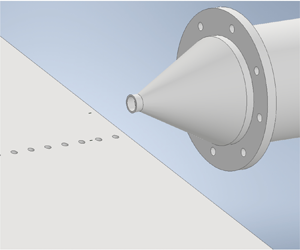
Experimental characterisation and data-driven modelling of unsteady wall pressure fields induced by a supersonic jet over a tangential flat plate
-
- Journal:
- Journal of Fluid Mechanics / Volume 958 / 10 March 2023
- Published online by Cambridge University Press:
- 06 March 2023, A27
-
- Article
-
- You have access
- Open access
- HTML
- Export citation
Validating the behavioral Defining Issues Test across different genders, political, and religious affiliations
-
- Journal:
- Experimental Results / Volume 4 / 2023
- Published online by Cambridge University Press:
- 03 March 2023, e6
-
- Article
-
- You have access
- Open access
- HTML
- Export citation
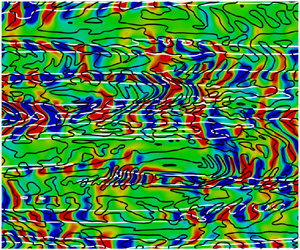
Scaling of pressure fluctuations in compressible turbulent plane channel flow
-
- Journal:
- Journal of Fluid Mechanics / Volume 958 / 10 March 2023
- Published online by Cambridge University Press:
- 03 March 2023, A19
-
- Article
-
- You have access
- Open access
- HTML
- Export citation
-
The purpose of the paper is to identify Mach-number effects on pressure fluctuations $p'$ in compressible turbulent plane channel flow. We use data from a specifically constructed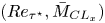 $(Re_{\tau ^\star },\bar {M}_{{CL}_x})$-matrix direct numerical simulation (DNS) database, with systematic variation of the centreline streamwise Mach number $0.32\leqslant \bar {M}_{{CL}_x}\leqslant 2.49$ and of the HCB (Huang et al., J. Fluid Mech., vol. 305, 1995, pp. 185–218) friction Reynolds number $66\leqslant Re_{\tau ^\star }\lessapprox 1000$. Strong $\bar {M}_{{CL}_x}$ effects (enhanced by the increasingly cold-wall condition) appear for $\bar {M}_{{CL}_x}\gtrapprox 2$, for all $Re_{\tau ^\star }$, very close to the wall ( $y^\star \lessapprox 15$). Compared with incompressible flow at the same $Re_{\tau ^\star }$, the wall root-mean-square $[p'_{rms}]^+_w$ (in wall-units, i.e. scaled by the average wall shear stress $\bar {\tau }_w$) strongly increases with $\bar {M}_{{CL}_x}$. In contrast, the peak level across the channel, $[p'_{rms}]^+_{PEAK}$, slightly decreases with increasing $\bar {M}_{{CL}_x}$. In order to study the near-wall coherent structures we introduce a new wall-distance-independent non-local system of units, based for all $y$ on wall friction and the extreme values of density and dynamic viscosity, namely, for cold walls $\{\bar {\tau }_w,\min _y\bar {\rho },\max _y\bar {\mu }\}$. The average spanwise distance between streaks, scaled by this length-unit, is nearly independent of $\bar {M}_{{CL}_x}$ at constant $Re_{\tau ^\star }$. Using the in-plane (parallel to the wall) Laplacian $\nabla ^2_{xz}p'$ we find that the $(+/-)\text {-}p'$ wave-packet-like structures appearing inside the low-speed streaks ( $y^\star \lessapprox 15$) with increasing $\bar {M}_{{CL}_x}\gtrapprox 2$ are part of a more complex wave system with spanwise extent over several streaks, whose spatial density decreases rapidly with decreasing $\bar {M}_{{CL}_x}$ or increasing $y^\star$. These $p'$ wave packets appear to be collocated with strong $(+/-)$- $v'$ events and could be responsible for compensating towards 0 the negative incompressible-flow correlation coefficient $c_{p'v'}$, with increasing $\bar {M}_{{CL}_x}$ very near the wall.


Beyond analytic approximations with machine learning inference of plasma parameters and confidence intervals
-
- Journal:
- Journal of Plasma Physics / Volume 89 / Issue 1 / February 2023
- Published online by Cambridge University Press:
- 03 March 2023, 905890111
-
- Article
-
- You have access
- Open access
- HTML
- Export citation
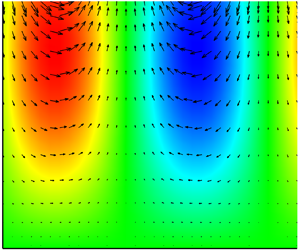
Surface wave instability in the thermocapillary migration of a flat droplet
-
- Journal:
- Journal of Fluid Mechanics / Volume 958 / 10 March 2023
- Published online by Cambridge University Press:
- 03 March 2023, A22
-
- Article
- Export citation
Relationship between drift kinetics, gyrokinetics and magnetohydrodynamics in the long-wavelength limit
-
- Journal:
- Journal of Plasma Physics / Volume 89 / Issue 1 / February 2023
- Published online by Cambridge University Press:
- 03 March 2023, 905890115
-
- Article
-
- You have access
- Open access
- HTML
- Export citation
-
Gyrokinetic theories, even ‘global’ models, typically rely on a separation in scale (in perpendicular wavelength) between the fluctuations and the system scale. In such models direct simulation of system-scale dynamics like magnetohydrodynamic (MHD) motion is formally not consistent. Drift-kinetic theory, on the other hand, may be directly applied to model system-scale MHD-ordered behaviour. I review the long-wavelength limit of standard gyrokinetics and drift kinetics to present the relationships between these theories in an elementary fashion. This provides a pathway to global gyrokinetic modelling, resulting in an approach that is structurally similar to kinetic MHD, and I present dynamical equations for solving global field evolution in this framework. Departures from certain earlier global gyrokinetic theories include the appearance of magnetosonic (fast) modes, and the cross-coupling of the parallel and perpendicular currents with perpendicular and parallel magnetic field components. A periodic two-dimensional testcase is outlined as a benchmarking and implementation target, to help clarify practical aspects of these theories, with minimal complexity in terms of boundary conditions, and a proof-of-principle implementation of a field-solver is exhibited. To motivate this work, I first illustrate certain limitations of existing global gyrokinetic frameworks and directly identify how scale separation approximations lead to certain ‘missing’ system-scale field terms in global gyrokinetics, largely as a result of simplifications associated with the field representation in terms of $A_{\|}$
 and $B_{\|}$
 . As a result, the currents in the gyrokinetic Ampère's law resulting from a gyrokinetic equilibrium distribution do not match the currents implied by Ampère's law in a force-balance MHD equilibrium. I present a simple choice of equilibrium distribution function whose drift-kinetic currents are consistent with MHD currents; a specific Grad–Shafranov equilibrium is used to illustrate the size of the components of the parallel currents.


In search of a data-driven symbolic multi-fluid ten-moment model closure
- Part of
-
- Journal:
- Journal of Plasma Physics / Volume 89 / Issue 1 / February 2023
- Published online by Cambridge University Press:
- 03 March 2023, 895890105
-
- Article
-
- You have access
- Open access
- HTML
- Export citation
Rotational dynamics of a neutrally buoyant prolate spheroid in viscoelastic shear flows at finite Reynolds numbers
-
- Journal:
- Journal of Fluid Mechanics / Volume 958 / 10 March 2023
- Published online by Cambridge University Press:
- 03 March 2023, A20
-
- Article
- Export citation
Investigating particle acceleration dynamics in interpenetrating magnetized collisionless super-critical shocks
- Part of
-
- Journal:
- Journal of Plasma Physics / Volume 89 / Issue 1 / February 2023
- Published online by Cambridge University Press:
- 03 March 2023, 915890101
-
- Article
- Export citation

Inertio-capillary rebound of a droplet impacting a fluid bath
-
- Journal:
- Journal of Fluid Mechanics / Volume 958 / 10 March 2023
- Published online by Cambridge University Press:
- 03 March 2023, A24
-
- Article
-
- You have access
- Open access
- HTML
- Export citation
Chinese oats in temperate Bhutan: Results of field experiments
-
- Journal:
- Experimental Results / Volume 4 / 2023
- Published online by Cambridge University Press:
- 03 March 2023, e9
-
- Article
-
- You have access
- Open access
- HTML
- Export citation
Tunable compact asynchronous optical sampling system using Er-doped fiber laser
-
- Journal:
- High Power Laser Science and Engineering / Volume 11 / 2023
- Published online by Cambridge University Press:
- 03 March 2023, e29
-
- Article
-
- You have access
- Open access
- HTML
- Export citation
Inertia-gravity-wave diffusion by geostrophic turbulence: the impact of flow time dependence
-
- Journal:
- Journal of Fluid Mechanics / Volume 958 / 10 March 2023
- Published online by Cambridge University Press:
- 03 March 2023, A21
-
- Article
-
- You have access
- Open access
- HTML
- Export citation
High-energy, hundred-picosecond pulsed 266 nm mid-ultraviolet generation by a barium borate crystal
-
- Journal:
- High Power Laser Science and Engineering / Volume 11 / 2023
- Published online by Cambridge University Press:
- 03 March 2023, e31
-
- Article
-
- You have access
- Open access
- HTML
- Export citation
