Refine search
Actions for selected content:
26333 results in Theoretical Physics and Mathematical Physics
PSP volume 180 issue 1 Cover and Front matter
-
- Journal:
- Mathematical Proceedings of the Cambridge Philosophical Society / Volume 180 / Issue 1 / January 2026
- Published online by Cambridge University Press:
- 19 December 2025, pp. f1-f2
- Print publication:
- January 2026
-
- Article
-
- You have access
- Export citation
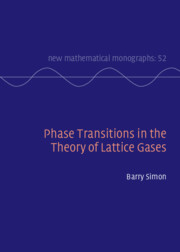
Phase Transitions in the Theory of Lattice Gases
-
- Published online:
- 17 December 2025
- Print publication:
- 13 November 2025
A construction of minimal coherent filling pairs
- Part of
-
- Journal:
- Mathematical Proceedings of the Cambridge Philosophical Society , First View
- Published online by Cambridge University Press:
- 16 December 2025, pp. 1-22
-
- Article
-
- You have access
- Open access
- HTML
- Export citation
-
Let $S_g$ denote the genus g closed orientable surface. A coherent filling pair of simple closed curves, $(\alpha,\beta)$ in $S_g$, is a filling pair that has its geometric intersection number equal to the absolute value of its algebraic intersection number. A minimally intersecting filling pair, $(\alpha,\beta)$ in $S_g$, is one whose intersection number is the minimal among all filling pairs of $S_g$. In this paper, we give a simple geometric procedure for constructing minimally intersecting coherent filling pairs on $S_g, \ g \geq 3,$ from the starting point of a coherent filling pair of curves on a torus. Coherent filling pairs have a natural correspondence to square-tiled surfaces, or origamis, and we discuss the origami obtained from the construction.


How safe are the United Kingdom’s ports? A statistical analysis using accident data and AIS vessel movements
-
- Journal:
- The Journal of Navigation , First View
- Published online by Cambridge University Press:
- 11 December 2025, pp. 1-27
-
- Article
-
- You have access
- Open access
- HTML
- Export citation
The rational (non-)formality of the non-3-equal manifolds
- Part of
-
- Journal:
- Mathematical Proceedings of the Cambridge Philosophical Society , First View
- Published online by Cambridge University Press:
- 08 December 2025, pp. 1-17
-
- Article
-
- You have access
- Open access
- HTML
- Export citation
-
Let $M^{({k})}_{d}(n)$ be the manifold of n-tuples $(x_1,\ldots,x_n)\in(\mathbb{R}^d)^n$ having non-k-equal coordinates. We show that, for $d\geq2$, $M^{({3})}_{d}(n)$ is rationally formal if and only if $n\leq6$. This stands in sharp contrast with the fact that all classical configuration spaces $M^{({2})}_d(n)=\text{Conf}(\mathbb{R}^d,n)$ are rationally formal, just as are all complements of arrangements of arbitrary complex subspaces with geometric lattice of intersections. The rational non-formality of $M^{({3})}_{d}(n)$ for $n \gt 6$ is established via detection of non-trivial triple Massey products, which are assessed geometrically through Poincaré duality.


WiFi-RTT indoor positioning using Particle, Genetic and Grid filters with RSSI-based outlier detection
-
- Journal:
- The Journal of Navigation , First View
- Published online by Cambridge University Press:
- 04 December 2025, pp. 1-19
-
- Article
-
- You have access
- Open access
- HTML
- Export citation
A note on transverse sets and bilinear varieties
- Part of
-
- Journal:
- Mathematical Proceedings of the Cambridge Philosophical Society , First View
- Published online by Cambridge University Press:
- 27 November 2025, pp. 1-13
-
- Article
- Export citation
-
Let G and H be finite-dimensional vector spaces over $\mathbb{F}_p$. A subset $A \subseteq G \times H$ is said to be transverse if all of its rows $\{x \in G \colon (x,y) \in A\}$, $y \in H$, are subspaces of G and all of its columns $\{y \in H \colon (x,y) \in A\}$, $x \in G$, are subspaces of H. As a corollary of a bilinear version of the Bogolyubov argument, Gowers and the author proved that dense transverse sets contain bilinear varieties of bounded codimension. In this paper, we provide a direct combinatorial proof of this fact. In particular, we improve the bounds and evade the use of Fourier analysis and Freiman’s theorem and its variants.


Wayfinding behaviours in natural environments
-
- Journal:
- The Journal of Navigation , First View
- Published online by Cambridge University Press:
- 25 November 2025, pp. 1-15
-
- Article
-
- You have access
- Open access
- HTML
- Export citation
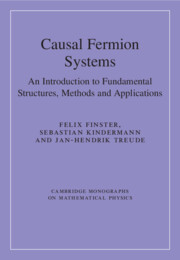
Causal Fermion Systems
- An Introduction to Fundamental Structures, Methods and Applications
-
- Published online:
- 15 November 2025
- Print publication:
- 23 October 2025
-
- Book
-
- You have access
- Open access
- Export citation
Local central limit theorem for triangle counts in sparse random graphs
- Part of
-
- Journal:
- Mathematical Proceedings of the Cambridge Philosophical Society / Volume 180 / Issue 2 / March 2026
- Published online by Cambridge University Press:
- 14 November 2025, pp. 459-475
- Print publication:
- March 2026
-
- Article
- Export citation
-
Let $X_H$ be the number of copies of a fixed graph H in G(n,p). In 2016, Gilmer and Kopparty conjectured that a local central limit theorem should hold for $X_H$ as long as H is connected, $p\gg n^{-1/m(H)}$ and $n^2(1-p)\gg 1$, where m(H) denotes the m-density of H. Recently, Sah and Sawhney showed that the Gilmer–Kopparty conjecture holds for constant p. In this paper, we show that the Gilmer–Kopparty conjecture holds for triangle counts in the sparse range. More precisely, if $p \in (4n^{-1/2}, 1/2)$, then where
 \[ {} {} {}\sup_{x\in \mathcal{L}}\left| \dfrac{1}{\sqrt{2\pi}}e^{-x^2/2}-\sigma\cdot \mathbb{P}(X^* = x)\right|=n^{-1/2+o(1)}p^{1/2}, {} {}\] $\sigma^2 = \mathbb{V}\text{ar}(X_{K_3})$, $X^{*}=(X_{K_3}-\mathbb{E}(X_{K_3}))/\sigma$ and $\mathcal{L}$ is the support of $X^*$. By combining our result with the results of Röllin–Ross and Gilmer–Kopparty, this establishes the Gilmer–Kopparty conjecture for triangle counts for $n^{-1}\ll p \lt c$, for any constant $c\in (0,1)$. Our quantitative result is enough to prove that the triangle counts converge to an associated normal distribution also in the $\ell_1$-distance. This is the first local central limit theorem for subgraph counts above the so-called $m_2$-density threshold.


2 - Correlation Inequalities
-
- Book:
- Phase Transitions in the Theory of Lattice Gases
- Published online:
- 17 December 2025
- Print publication:
- 13 November 2025, pp 39-205
-
- Chapter
- Export citation
4 - Peierls Argument
-
- Book:
- Phase Transitions in the Theory of Lattice Gases
- Published online:
- 17 December 2025
- Print publication:
- 13 November 2025, pp 283-345
-
- Chapter
- Export citation
Subject Index
-
- Book:
- Phase Transitions in the Theory of Lattice Gases
- Published online:
- 17 December 2025
- Print publication:
- 13 November 2025, pp 611-616
-
- Chapter
- Export citation
7 - Stochastic Geometric Representations
-
- Book:
- Phase Transitions in the Theory of Lattice Gases
- Published online:
- 17 December 2025
- Print publication:
- 13 November 2025, pp 427-507
-
- Chapter
- Export citation
Frontmatter
-
- Book:
- Phase Transitions in the Theory of Lattice Gases
- Published online:
- 17 December 2025
- Print publication:
- 13 November 2025, pp i-vi
-
- Chapter
- Export citation
Notation
-
- Book:
- Phase Transitions in the Theory of Lattice Gases
- Published online:
- 17 December 2025
- Print publication:
- 13 November 2025, pp xvi-xxvi
-
- Chapter
- Export citation
9 - Final Thoughts
-
- Book:
- Phase Transitions in the Theory of Lattice Gases
- Published online:
- 17 December 2025
- Print publication:
- 13 November 2025, pp 557-570
-
- Chapter
- Export citation
1 - A Framework for Lattice Gases
-
- Book:
- Phase Transitions in the Theory of Lattice Gases
- Published online:
- 17 December 2025
- Print publication:
- 13 November 2025, pp 1-38
-
- Chapter
-
- You have access
- Export citation
Author Index
-
- Book:
- Phase Transitions in the Theory of Lattice Gases
- Published online:
- 17 December 2025
- Print publication:
- 13 November 2025, pp 604-610
-
- Chapter
- Export citation
3 - The Lee–Yang Theorem
-
- Book:
- Phase Transitions in the Theory of Lattice Gases
- Published online:
- 17 December 2025
- Print publication:
- 13 November 2025, pp 206-282
-
- Chapter
- Export citation
