To save content items to your account,
please confirm that you agree to abide by our usage policies.
If this is the first time you use this feature, you will be asked to authorise Cambridge Core to connect with your account.
Find out more about saving content to .
To save content items to your Kindle, first ensure no-reply@cambridge.org
is added to your Approved Personal Document E-mail List under your Personal Document Settings
on the Manage Your Content and Devices page of your Amazon account. Then enter the ‘name’ part
of your Kindle email address below.
Find out more about saving to your Kindle.
Note you can select to save to either the @free.kindle.com or @kindle.com variations.
‘@free.kindle.com’ emails are free but can only be saved to your device when it is connected to wi-fi.
‘@kindle.com’ emails can be delivered even when you are not connected to wi-fi, but note that service fees apply.
Throughout the long history of Christianity, Christians have celebrated their faith in a myriad of ways. This Companion offers new insights into the theological depths of the liturgical mysteries that are the essence of Christian worship services, rituals, and sacraments. It investigates how these mysteries order time and space, and how they permeate the life of the Churches. The volume explores how Christian liturgy, as a corporeal and communal set of activities, has had a profound impact on spiritualities, preaching, pastoral engagement, and ecumenical relations, as well as encounters with religious others. Written by an international team of scholars, it also explores the intrinsic connections between liturgy and the arts, and why liturgy matters theologically. Ultimately, The Cambridge Companion to Christian Liturgy demonstrates the inextricable link between theology and liturgy and provides incentives for critical and constructive reflections about the relevance of liturgy in today's world.
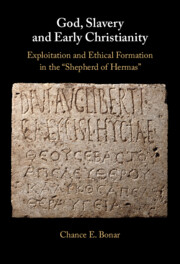
Ancient Christians understood themselves to be enslaved to God, an attitude that affected their ethics, theology, and self-understanding. This widespread belief is made especially clear in the Shepherd of Hermas, an overlooked early Christian text written by an enslaved person, which was nearly included in the New Testament. In this book, Chance Bonar provides a robust analysis of the ancient discourses and practices of slavery found in the Shepherd of Hermas. He shows how the text characterizes God's enslaved persons as useful, loyal property who could be put to work, surveilled, and disciplined throughout their lives – and the afterlife. Bonar also investigates the notion that God enslaved believers, which allowed the Shepherd to theorize key early Christian concepts more deeply and in light of ancient Mediterranean slavery. Bonar's study clarifies the depth to which early Christians were entrenched – intellectually, practically, and theologically – in Roman slave society. It also demonstrates how the Shepherd offers new approaches to early Christian literary and historical interpretation.
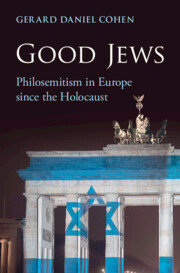
The Holocaust is now widely recognized as a central event in twentieth-century Europe. But how did the genocide of the Jews affect European attitudes towards Jews, Judaism and Jewishness after 1945? While many histories of antisemitism exist, Good Jews offers an investigation of philosemitism – defined as a politics of post-Holocaust friendship. Gerard Daniel Cohen presents a critical exploration of the languages of philosemitism in mainstream European politics and culture from 1945 to the present day, with particular emphasis on Germany and France. Within this framework Cohen explores how the 'Jewish question', or the problem of Jewish difference and incorporation in Western countries during the postwar decades, has been distinctively foregrounded in the language of philosemitism. Ultimately, Good Jews demonstrates that philosemitic Europe is not an idealised love story, but a reflection of European attitudes towards Jews from the Holocaust to the present.
This Element, through detailed example, scrutinizes the exact nature of Christian storytelling in the case of the Greek Pseudo-Clementines, or Klementia, and examines what exactly is involved in the correct interpretation of this Christian prose fiction as a redefined pepaideumenos. In the act of such reconsideration of paideia, Greek cultural capital, and the accompanying reflections on prose literature and fiction, it becomes clear that the Klementinist exploits certain cases of intertextual and meta-literary reflections on the Greek novelistic fiction, such as Chariton's Chaereas and Callirhoe and Achilles Tatius' Leucippe and Cleitophon, in order to evoke these reconsiderations of storytelling, interpretive hermeneutics, and one's role as a culturally Greek reader pepaideumenos. This Element argues that the Klementia bears witness to a rich, dynamic, and Sophistic context in which reflections on paideia, dynamics regarding Greek identity, and literary production were neatly intertwined with reflections on reading and interpreting truth and fiction.
This essay examines Aquinas’s views on necessity in the created world. Although Aquinas holds that all created being is contingent upon God’s free act of creation, he nevertheless maintains that there are aspects of the created world that cannot be otherwise. This raises difficult questions about how such necessities arise in a contingent world and how they relate to God’s power. Aquinas’s analysis is complicated by his view that “necessity” is said in many ways. In various contexts, he distinguishes between absolute, natural, material, conditional, intrinsic, and extrinsic necessity. The essay offers a roadmap through these diverse kinds of created necessity, clarifying their sources and interrelations. It also considers the diverse ways Aquinas deploys the term “absolute necessity” in different contexts and explores how created necessities relate to God’s power.
In 1962, Fr Emmanuel Doronzo – a towering figure in preconciliar neo-Thomism – published a seminary textbook containing an 11-page Nota examining whether it can be said Mary belongs proprie ad ordinem sacerdotalem – properly to the sacerdotal order. His answer was yes: Mary can be said to have exercised ministerium proprie sacerdotale – a properly sacerdotal ministry – namely, a unique form of diaconate to Christ the priest.
Far from speculative novelty, Fr Doronzo’s Nota stood within a long-standing tradition – emerging alongside the feast of Mary’s Presentation – attributing to her the grace of Holy Orders. This tradition is reflected across papal teaching, a 7th-century mosaic in the Lateran, authorized devotions, the spirituality of the Sulpicians, approved hymns for the Divine Office, and – arguably – within Lumen Gentium.
Given the Dicastery for the Doctrine of the Faith’s invitation for continued study on the female diaconate, this long-neglected strand of Mariology warrants fresh attention. Across the centuries, Mary is portrayed as possessing Holy Orders non-sacramentally, by divine prerogative, analogous to her prevenient reception of baptismal grace at the Immaculate Conception. Mary’s plenitude of grace may therefore offer a historically grounded and theologically coherent rationale for reflection on the diaconate’s openness to women – in fidelity to legitimate ecclesiastical authority.
This article develops two logical arguments from evil that bypass Alvin Plantinga’s Free Will Defence through a critical examination of the relationship between freedom and value. The first argument assumes that morally innocent freedom is valuable, challenging the traditional emphasis on significant freedom. The second argument draws on an interpretation of J.L. Mackie’s underexplored ethical perspective, which highlights a form of evil that contrasts with the positive value of free will.
This Element argues for a novel approach to the sciences within Thomism, namely, science-engaged Thomism, which, aligned with the recent science-engaged theology movement, asks theological and metaphysical questions that require the input of the natural sciences. Recent developments within Thomism show a new approach to the natural sciences, and, thus, the proposal is to encourage more of this discourse by portraying the differences between contemporary and past Thomism. Still, even if it takes a novel approach, science-engaged Thomism relies on a tradition of thought that possesses a vast arsenal of metaphysical tools. Thus, after presenting this approach and a concise introduction to some basic notions of Thomistic metaphysics, the Element reviews some theological and philosophical questions and their relation to the natural sciences: issues about creation, cosmology, and astrobiology, divine involvement in evolutionary biology, providence and indeterministic quantum processes, and some ideas for further development at the end.
This article reimagines emotional intelligence as a theological and sacramental dimension of Anglican ministry, moving beyond secular paradigms of psychology towards a model rooted in incarnational presence, pastoral vulnerability and ecclesial formation. Drawing on qualitative research with Church of England Archdeacons, it explores clergy emotional ecology, the affective demands of priesthood and the implications for ministerial formation, discernment and leadership. The study proposes that emotional intelligence, when understood as theological praxis, contributes to spiritual maturity, vocational resilience and ecclesial integrity. It calls for integrative pedagogies, reflective disciplines and ecclesial cultures that honour emotional life as a site of divine encounter and priestly authenticity.
At least some people want to be loved simply for being the particular individuals they are, as distinct from any properties they might possess. However, the most prominent theories in contemporary philosophical work on love are framed so as to exclude that possibility. In this article, I argue that Christians have the resources to say that one can be loved for oneself if they appeal to the love God has for his creatures in making them from nothing. This article comprises four sections. In the first two sections, I introduce and characterize the desire to be loved for oneself, distinguishing the relevant desideratum from other, similar phenomena. In the third section, I note that the appraisal and bestowal views exclude the possibility that one could be loved for oneself in the relevant sense and note some other possible, initial objections. Finally, in the fourth section, I attempt to show one way in which God can be said to love his creatures in creating them – despite the fact that they do not exist before their own creation. I do so by attempting to show that, plausibly, there is a sense in which, if God engages in the creative act for its own sake and the creature itself is that act seen under a certain aspect, God can plausibly be said to create the creature for its own sake – and so, plausibly, to create it in love.
This paper argues that the problem of unconceived alternatives (PUA), originally formulated as a much-noted intervention in the realist/antirealist debate about scientific theories, has notable implications for discussions of hypotheses concerning ultimate reality – particularly for the debate about so-called (alternative) concepts of God in both philosophy of religion and theology. Despite the substantial differences between scientific theories and concepts of God, or other hypotheses concerning ultimate reality, certain common strategies for establishing their central claims as true show surprising similarities in their vulnerability to the PUA. The main thesis advanced is that inferences that the central claims of a given concept of God are (probably or approximately) true are unreliable if, and to the extent to which, that concept of God is accepted on the basis of, and its central claims are arrived at and justified through, inferences to the best explanation or eliminative inferences. If the argument is successful, then if theological realism in the form of realist theism is to be maintained, the central claims of concepts of God must be based also on other epistemic grounds.
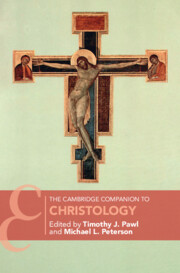
The idea that God became incarnate as a human is a doctrine at the core of historic Christianity. Defined by the Great Councils and Creeds of the Christian church, the study of this doctrine, christology, has been a focus of inquiry for two millennia. This Companion reflects the most recent paths of inquiry for our understanding of christology. Covering Biblical and other sources, it explores the reception of christology over the course of Christianity's history, from the early patristic ages to postmodernity, as well Jewish and Islamic treatments of the christological claims. The volume also considers the recent contributions of systematic theology, metaphysics, and political theology to the study of christology. It demonstrates how the conceptual substance of christological doctrine interacts with a range of areas on the intellectual landscape. Designed for use by students and experts, The Cambridge Companion to Christology also points to the new and dynamic directions in scholarship on this topic.
The 1973 Billy Graham Crusade in Seoul witnessed a record-breaking attendance not just in terms of Graham’s career, but in the entire history of Christianity. The event’s success attracted significant American attention. But the Korean side of the story remains largely untold. This article explores the Korean background, aims for the crusade and their interpretation of its success. It argues that Korean Protestants leveraged their American connections to advance their own national agenda, causing tensions in the process, and that the crusade’s numerical success stimulated Korean Protestant exceptionalism which challenged ideas of American uniqueness.
This article is part of Religious Studies’ initiative to publish a series of interviews with distinguished philosophers of religion. Each interview explores the personal and academic background of the interviewee and discusses their core philosophical views. The aim is to inspire students and scholars and to provide an overview of some of the most important works developed by contemporary philosophers of religion. In this interview, Chris Tweedt interviews Jonathan Kvanvig, covering such topics as his upbringing, his educational and career trajectory, and his views on philosophical methodology, epistemic humility, divine providence, faith, and hell.
Is Christian nationalism a threat to democracy in Africa, and to what extent are its adherents “anti-democratic” as is often claimed? Using the Afrobarometer Round 7 (2016-18), I examine how extensive these attitudes are held among Africans. Although I find that the proportion of the population on the continent that holds Christian nationalist views is somewhat limited, I find support for the argument that Christian nationalists tend to be less supportive of democracy than others, and more receptive to authoritarian alternatives to democracy. However, they are not more likely to hold intolerant attitudes with regard to other religions and LGBTQ individuals. In addition, I do not find, contrary to the existing literature on Christian nationalism in Africa, that Pentecostals are more intolerant of out groups than other Africans.
This paper compares Aquinas’ account of the fundamental evaluative notions of good and bad with the theories of normativity offered by the philosophers Christine Korsgaard and T. M. Scanlon. This paper was initially motivated by the observation that Korsgaard and Scanlon each share a point of contact with Aquinas’ thought, even though their views on normativity are very different from one another, and from Aquinas’ own views. Korsgaard’s approach to normativity shares at least one feature with Aquinas’ moral theory, namely, an acknowledgment of the normativity of nature, correctly understood. Scanlon does not have any such commitment, but he does offer an account of the fundamental status of reasons which is suggestively similar to Aquinas’ claim that practical reason depends on first principles. The upshot is that Aquinas seems to agree with some significant aspect of two distinct theories of normativity, whose proponents disagree with each other in fundamental ways. And this raises a question – what is it about Aquinas’ understanding of normativity, as we would put it, which allows him to hold together seemingly incompatible approaches in this way? This paper offers an answer to this question.
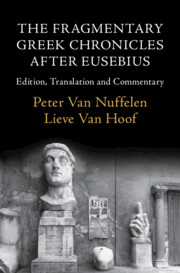
This is the first systematic collection of the remains of the lost Greek chronicles from the period AD 350–650 and provides an edition and translation of and commentary on the fragments. Introducing neglected authors and proposing new interpretations, it reveals the diversity of the genre and revises traditional views about its development, nuancing in particular the role usually attributed to Eusebius of Caesarea. It shows how the writing of chronicles was deeply entangled in controversies about exegesis and liturgy, especially the dates of Christmas and Easter. Drawing from Latin, Armenian, Syriac and Arabic sources besides Greek ones, the book also studies how chronographic material travelled across linguistic and cultural boundaries. In this way, it sheds a profoundly new light on historiography in transition from Antiquity to the Middle Ages.