
Contents
Original Article
Strongly aperiodic SFTs on generalized Baumslag–Solitar groups
- Part of:
-
- Published online by Cambridge University Press:
- 20 June 2023, pp. 1209-1238
-
- Article
- Export citation
-
We look at constructions of aperiodic subshifts of finite type (SFTs) on fundamental groups of graph of groups. In particular, we prove that all generalized Baumslag-Solitar groups (GBS) admit a strongly aperiodic SFT. Our proof is based on a structural theorem by Whyte and on two constructions of strongly aperiodic SFTs on $\mathbb {F}_n\times \mathbb {Z}$ and $BS(m,n)$ of our own. Our two constructions rely on a path-folding technique that lifts an SFT on $\mathbb {Z}^2$ inside an SFT on $\mathbb {F}_n\times \mathbb {Z}$ or an SFT on the hyperbolic plane inside an SFT on $BS(m,n)$. In the case of $\mathbb {F}_n\times \mathbb {Z}$, the path folding technique also preserves minimality, so that we get minimal strongly aperiodic SFTs on unimodular GBS groups.


Hausdorff dimension of multidimensional multiplicative subshifts
- Part of:
-
- Published online by Cambridge University Press:
- 19 July 2023, pp. 1239-1268
-
- Article
- Export citation
-
The purpose of this study is two-fold. First, the Hausdorff dimension formula of the multidimensional multiplicative subshift (MMS) in $\mathbb {N}^d$ is presented. This extends the earlier work of Kenyon et al [Hausdorff dimension for fractals invariant under multiplicative integers. Ergod. Th. & Dynam. Sys. 32(5) (2012), 1567–1584] from $\mathbb {N}$ to $\mathbb {N}^d$. In addition, the preceding work of the Minkowski dimension of the MMS in $\mathbb {N}^d$ is applied to show that their Hausdorff dimension is strictly less than the Minkowski dimension. Second, the same technique allows us to investigate the multifractal analysis of multiple ergodic average in $\mathbb {N}^d$. Precisely, we extend the result of Fan et al, [Multifractal analysis of some multiple ergodic averages. Adv. Math. 295 (2016), 271–333] of the multifractal analysis of multiple ergodic average from $\mathbb {N}$ to $\mathbb {N}^d$.


On the abundance of k-fold semi-monotone minimal sets in bimodal circle maps
- Part of:
-
- Published online by Cambridge University Press:
- 12 July 2023, pp. 1269-1314
-
- Article
-
- You have access
- Open access
- HTML
- Export citation
-
Inspired by a twist map theorem of Mather. we study recurrent invariant sets that are ordered like rigid rotation under the action of the lift of a bimodal circle map g to the k-fold cover. For each irrational in the rotation set’s interior, the collection of the k-fold ordered semi-Denjoy minimal sets with that rotation number contains a $(k-1)$-dimensional ball with the weak topology on their unique invariant measures. We also describe completely their periodic orbit analogs for rational rotation numbers. The main tool used is a generalization of a construction of Hedlund and Morse that generates symbolic analogs of these k-fold well-ordered invariant sets.

Disjoint hypercyclicity, Sidon sets and weakly mixing operators
- Part of:
-
- Published online by Cambridge University Press:
- 22 August 2023, pp. 1315-1329
-
- Article
- Export citation
-
We prove that a finite set of natural numbers J satisfies that $J\cup \{0\}$ is not Sidon if and only if for any operator T, the disjoint hypercyclicity of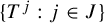 $\{T^j:j\in J\}$ implies that T is weakly mixing. As an application we show the existence of a non-weakly mixing operator T such that $T\oplus T^2\oplus\cdots \oplus T^n$ is hypercyclic for every n.

Word complexity of (measure-theoretically) weakly mixing rank-one subshifts
- Part of:
-
- Published online by Cambridge University Press:
- 05 July 2023, pp. 1330-1366
-
- Article
- Export citation
-
We exhibit, for arbitrary $\epsilon> 0$, subshifts admitting weakly mixing (probability) measures with word complexity p satisfying $\limsup p(q) / q < 1.5 + \epsilon $. For arbitrary $f(q) \to \infty $, said subshifts can be made to satisfy $p(q) < q + f(q)$ infinitely often. We establish that every subshift associated to a rank-one transformation (on a probability space) which is not an odometer satisfies $\limsup p(q) - 1.5q = \infty $ and that this is optimal for rank-ones.


Finitely presented left orderable monsters
- Part of:
-
- Published online by Cambridge University Press:
- 06 July 2023, pp. 1367-1378
-
- Article
-
- You have access
- Open access
- HTML
- Export citation
-
A left orderable monster is a finitely generated left orderable group all of whose fixed point-free actions on the line are proximal: the action is semiconjugate to a minimal action so that for every bounded interval I and open interval J, there is a group element that sends I into J. In his 2018 ICM address, Navas asked about the existence of left orderable monsters. By now there are several examples, all of which are finitely generated but not finitely presentable. We provide the first examples of left orderable monsters that are finitely presentable, and even of type $F_\infty $. These groups satisfy several additional properties separating them from the previous examples: they are not simple, they act minimally on the circle, and they have an infinite-dimensional space of homogeneous quasimorphisms. Our construction is flexible enough that it produces infinitely many isomorphism classes of finitely presented (and type $F_{\infty }$) left orderable monsters.


Tame or wild Toeplitz shifts
- Part of:
-
- Published online by Cambridge University Press:
- 18 August 2023, pp. 1379-1417
-
- Article
-
- You have access
- Open access
- HTML
- Export citation
On infinitely many foliations by caustics in strictly convex open billiards
- Part of:
-
- Published online by Cambridge University Press:
- 11 July 2023, pp. 1418-1467
-
- Article
-
- You have access
- Open access
- HTML
- Export citation
-
Reflection in a strictly convex bounded planar billiard acts on the space of oriented lines and preserves a standard area form. A caustic is a curve C whose tangent lines are reflected by the billiard to lines tangent to C. The famous Birkhoff conjecture states that the only strictly convex billiards with a foliation by closed caustics near the boundary are ellipses. By Lazutkin’s theorem, there always exists a Cantor family of closed caustics approaching the boundary. In the present paper, we deal with an open billiard, whose boundary is a strictly convex embedded (non-closed) curve $\gamma $. We prove that there exists a domain U adjacent to $\gamma $ from the convex side and a $C^\infty $-smooth foliation of $U\cup \gamma $ whose leaves are $\gamma $ and (non-closed) caustics of the billiard. This generalizes a previous result by Melrose on the existence of a germ of foliation as above. We show that there exists a continuum of above foliations by caustics whose germs at each point in $\gamma $ are pairwise different. We prove a more general version of this statement for $\gamma $ being an (immersed) arc. It also applies to a billiard bounded by a closed strictly convex curve $\gamma $ and yields infinitely many ‘immersed’ foliations by immersed caustics. For the proof of the above results, we state and prove their analogue for a special class of area-preserving maps generalizing billiard reflections: the so-called $C^{\infty }$-lifted strongly billiard-like maps. We also prove a series of results on conjugacy of billiard maps near the boundary for open curves of the above type.


A note on preimage entropy
- Part of:
-
- Published online by Cambridge University Press:
- 19 June 2023, pp. 1468-1472
-
- Article
- Export citation
-
Cheng and Newhouse (Ergod. Th. & Dynam. Sys. 25 (2005), 1091–1113) proved a variational principle for topological preimage entropy $h_{\mathrm {pre}}(f)$:
  $$ \begin{align*} h_{\mathrm{pre}}(f)=\sup_{\mu\in\mathcal{M}(X,f)}h_{\mathrm{pre},\mu}(f). \end{align*} $$
Unfortunately, we show in this note that this variational principle is not true.

Front Cover (OFC, IFC) and matter
ETS volume 44 issue 5 Cover and Front matter
-
- Published online by Cambridge University Press:
- 04 April 2024, pp. f1-f2
-
- Article
-
- You have access
- Export citation
Back Cover (OBC, IBC) and matter
ETS volume 44 issue 5 Cover and Back matter
-
- Published online by Cambridge University Press:
- 04 April 2024, pp. b1-b2
-
- Article
-
- You have access
- Export citation