Published on behalf of Australian Mathematical Society
We partner with a secure submission system to handle manuscript submissions.
Please note:
Click Proceed to submission system to continue to our partner's website.

We study natural families of  $\bar {\partial } $-operators on the moduli space of stable parabolic vector bundles. Applying a families index theorem for hyperbolic cusp operators from our previous work, we find formulae for the Chern characters of the associated index bundles. The contributions from the cusps are explicitly expressed in terms of the Chern characters of natural vector bundles related to the parabolic structure. We show that our result implies formulae for the Chern classes of the associated determinant bundles consistent with a result of Takhtajan and Zograf.
In this paper we investigate the zeros of the Estermann zeta function  $E(s; k/ \ell , \alpha )= { \mathop{\sum }\nolimits}_{n= 1}^{\infty } {\sigma }_{\alpha } (n) \exp (2\pi ink/ \ell ){n}^{- s} $ as a function of a complex variable $s$, where $k$ and $\ell $ are coprime integers and ${\sigma }_{\alpha } (n)= {\mathop{\sum }\nolimits}_{d\vert n} {d}^{\alpha } $ is the generalized divisor function with a fixed complex number $\alpha $. In particular, we study the question on how the zeros of $E(s; k/ \ell , \alpha )$ depend on the parameters $k/ \ell $ and $\alpha $. It turns out that for some zeros there is a continuous dependency whereas for other zeros there is not.
For any positive integer  $n$, let $f(n)$ denote the number of solutions to the Diophantine equation with
 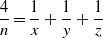 $$\begin{eqnarray*}\frac{4}{n} = \frac{1}{x} + \frac{1}{y} + \frac{1}{z}\end{eqnarray*}$$ $x, y, z$ positive integers. The Erdős–Straus conjecture asserts that $f(n)\gt 0$ for every $n\geq 2$. In this paper we obtain a number of upper and lower bounds for $f(n)$ or $f(p)$ for typical values of natural numbers $n$ and primes $p$. For instance, we establish that These upper and lower bounds show that a typical prime has a small number of solutions to the Erdős–Straus Diophantine equation; small, when compared with other additive problems, like Waring’s problem.
 $$\begin{eqnarray*}N\hspace{0.167em} {\mathop{\log }\nolimits }^{2} N\ll \displaystyle \sum _{p\leq N}f(p)\ll N\hspace{0.167em} {\mathop{\log }\nolimits }^{2} N\log \log N.\end{eqnarray*}$$
Let  $p$ be a prime. In this paper, we present a detailed $p$-adic analysis on factorials and double factorials and their congruences. We give good bounds for the $p$-adic sizes of the coefficients of the divided universal Bernoulli number ${B}_{n} / n$ when $n$ is divisible by $p- 1$. Using these, we then establish the universal Kummer congruences modulo powers of a prime $p$ for the divided universal Bernoulli numbers ${B}_{n} / n$ when $n$ is divisible by $p- 1$.
Let  $\Lambda $ be an Auslander 1-Gorenstein Artinian algebra with global dimension two. If $\Lambda $ admits a trivial maximal 1-orthogonal subcategory of $\text{mod } \Lambda $, then, for any indecomposable module $M\in \text{mod } \Lambda $, the projective dimension of $M$ is equal to one if and only if its injective dimension is also equal to one, and $M$ is injective if the projective dimension of $M$ is equal to two. In this case, we further get that $\Lambda $ is a tilted algebra.