To save content items to your account,
please confirm that you agree to abide by our usage policies.
If this is the first time you use this feature, you will be asked to authorise Cambridge Core to connect with your account.
Find out more about saving content to .
To save content items to your Kindle, first ensure no-reply@cambridge.org
is added to your Approved Personal Document E-mail List under your Personal Document Settings
on the Manage Your Content and Devices page of your Amazon account. Then enter the ‘name’ part
of your Kindle email address below.
Find out more about saving to your Kindle.
Note you can select to save to either the @free.kindle.com or @kindle.com variations.
‘@free.kindle.com’ emails are free but can only be saved to your device when it is connected to wi-fi.
‘@kindle.com’ emails can be delivered even when you are not connected to wi-fi, but note that service fees apply.
Affective and non-affective psychoses are characterized by deficits in neuro and social cognition, which strongly impact the patient’s psychosocial functioning and health and social system. Recent literature suggests that such deficits could benefit from the innovative combination of evidence-based interventions.
This lecture aims to describe an Italian multisite (Verona, Milano, Pavia), longitudinal randomized controlled trial funded by the Italian Ministry of Health investigating the impact of Cognitive Remediation (CR) alone or combined with other approaches (namely, Mindfulness and Social Skills Training (SST)) on clinical, neuropsychological, social and brain-related outcomes in patients with a DSM5 diagnosis of affective or non-affective psychosis.
In our study, patients underwent clinical and neuropsychological evaluation at baseline (T0), end of treatment (T1), and six months post-treatment (T2), which consisted of nearly four months of CR, CR+ Mindfulness, or CR + SST. The cognitive assessment included the Brief Assessment of Cognition for Schizophrenia (BAC-S) or Affective Disorders (BAC-A) and the Executive and Social Cognition Battery (ESCB), specifically designed to identify impairments in social cognition and executive functions in patients’ real life. Participants underwent a 3T multimodal MRI, including structural and functional sequences at T0 and T1. We also recruited healthy controls for comparative brain mapping at T0.
The present lecture will provide an overview of the research project, along with some preliminary findings on the effect of CR alone or combined with other interventions on clinical and social functioning and brain plasticity, with a focus on the degree of durability and generalization of CR effects to patients’ real life. The study’s outcomes have the potential to inform clinical and rehabilitative settings and tailor combined therapeutic interventions.
Disclosure of Interest
C. Perlini Grant / Research support from: Italian Ministry of Health GR-2016-02361283
This quality improvement (QI) programme was proposed to integrate co-production principles into rehabilitation psychiatry, focusing on enhancing patient-centred care and promoting positive step-down discharges within the mental health system. The backdrop of the QI programme was the essential role of rehabilitation psychiatry in aiding the recovery and reintegration of individuals with mental health challenges, and sub-optimal audit results about patient’s attendance and positive step-down discharges at an in-patient psychiatric unit.
Objectives
The QI programme aimed to implement and explore Co-production, a transformative approach involving patients and healthcare professionals as equal partners.
- To promote co-production in psychiatric in-patient service
- To improve patient experience in the CPA meetings
- To reduce anxiety associated with the CPA meetings and discharge planning
- To assess staff’s limitations and barriers in promoting co-production.
Methods
The QI programme was divided into phases, including diagnostic, problem-solving, and evaluation. It employed diagnostic tools such as the fishbone cause and effect diagram and the 5-Why Technique for root cause analysis. The project’s aim was aligned with the Model of Improvement, guided by the three fundamental questions. Change ideas were developed using driver’s diagram and were then evaluated through PDSA cycles. Quantitative analysis utilized paired t-tests to assess the significance of changes, and qualitative analysis focused on patient perspectives gathered through the co-produced CPA questionnaire. Emerging themes from the questionnaire responses were integrated into the project’s trajectory through narrative synthesis. Predictions were formulated to measure project success: 50% patient attendance in the next CPA meetings, 70% positive step-down discharges, and improved Hamilton Anxiety Rating Scale (HAM-A) scores.
Results
The iterative Plan-Do-Study-Act (PDSA) cycles demonstrated the evolving impact of interventions on patient engagement and discharge outcomes. Implementation of patient information leaflets, staff training, and a CPA agenda template led to increased attendance and positive step-down discharges. Analysis of HAM-A scores revealed a substantial decline in anxiety levels for almost all participants, suggesting the effectiveness of the interventions. Discharge outcomes were influenced by patient engagement and tailored interventions. Patient responses revealed themes such as challenges during transitions to community care, empowerment from shared decision-making, and diverse experiences in communication with healthcare professionals.
Conclusions
The CPA agenda template improved patient experiences by enhancing communication and patient-centeredness.
Gynecomastia refers to the abnormal development of breast tissue in males, often posing a concerning symptom. Often, gynecomastia is associated with multiple factors, including the use of various drugs, notably certain atypical antipsychotics. Gynecomastia is a significant side effect that affects the quality of life of male patients taking antipsychotic medications. Among these, risperidone and paliperidone have been identified as the most prone to causing gynecomastia, although aripiprazole has garnered attention for its superior profile in controlling prolactin and gynecomastia. The relationship between these drugs and the development of gynecomastia lies in their ability to elevate prolactin levels, a hormone that regulates reproductive function and is involved in milk production. Several studies have shown that prolactin levels are more commonly elevated with risperidone and paliperidone prescription, thus triggering gynecomastia.
Objectives
The study aims to investigate the management of gynecomastia in male patients receiving antipsychotic medications.
Methods
This research employs a retrospective analysis of patient records to examine the association between specific antipsychotic drugs, prolactin levels, and the development of gynecomastia, while also evaluating the effectiveness of aripiprazole as an alternative treatment.
Results
We present the case of a 21-year-old male with no prior medical history who initiated treatment with oral paliperidone and later switched to 100 mg of long-acting injectable paliperidone once monthly during his initial admission for psychotic symptoms. After six months, he developed gynecomastia, which was ruled out as breast tissue and was determined to be an increase in adipose tissue. Since his hospital discharge, he has gained 25 kg (30%) in body weight, and his baseline prolactin level has decreased. This weight gain, a common side effect of several antipsychotics, was linked to gynecomastia. However, a promising approach for gynecomastia antipsychotic-associated treatment is aripiprazole, which has a milder impact on prolactin levels. In this case, during the next appointment, a switch to 400 mg of long-acting injectable aripiprazole once-monthly was made, which led to weight loss, a reduction in breast size and blood prolactin levels in the following weeks.
Conclusions
The detection and management of gynecomastia in these patients are crucial to improving their quality of life and treatment adherence. This management encompasses changes in medication, hormonal therapy, or surgery in severe cases. Physicians must be aware of this potential complication when prescribing antipsychotics and closely monitor at-risk patients. In summary, antipsychotic-associated gynecomastia in men represents a medical challenge that requires careful attention and an individualized treatment strategy for each affected patient.
Suicide is one of the leading causes of death worldwide and scientific community investigates suicide risk factors relentlessly. Among these, anxiety symptoms were strongly related to suicidal ideation in several studies. Moreover, sleep and its disturbances are closely connected to mental well-being and psychiatric disorders in a bidirectional pathway.
Objectives
The main purpose of the present study is to assess the relationship between anxiety symptoms and suicidal ideation in a sample of psychiatric patients and the mediational role of insomnia in this association.
Methods
Participants were 116 consecutive adult psychiatric inpatients (61 women and 55 men) enrolled to the psychiatric inpatient unit of Sant’Andrea Hospital in Rome. The measures used were a socio-anamnestic form, the Columbia Suicide Severity Rating Scale (C-SSRS), the Hamilton Anxiety Rating Scale (HAM-A), and the Insomnia Severity Index (ISI).
Results
Based on the results of statistical analysis, patients with suicidal ideation showed higher severity of insomnia and higher severity of anxiety symptoms than patients with no suicidal ideation. Moreover, the intensity of suicidal ideation was positively and significantly associated with the severity of anxiety symptoms and with the severity of insomnia. Finally, the mediation analysis showed that the effect of anxiety symptoms on suicidal ideation was completely mediated by insomnia severity.
Conclusions
The main result of the study indicates that patients who perceive more anxiety symptoms were more likely to experience higher suicidal ideation intensity through higher levels of insomnia. These findings implies that screening for sleep disturbances may help identify individuals at risk for suicide, and improving sleep quality through psychosocial and pharmacological treatments could mitigate the association between anxiety and suicidal ideation.
Cognitive characteristics that differentiate normal from problematic gaming need to be identified, owing to the growing popularity of internet games and the rapid rise in mental health problems. Gaming disorder (GD) involves playing games despite their negative effects and is often related to unsuccessful attempts to reduce gaming. GD frequently results in adverse outcomes related to education, employment, and social responsibilities, thereby significantly influencing daily life.
Objectives
We aimed to elucidate the neurocognitive features underlying GD development and preservation, and possible overlapping features between GD and other psychiatric disorders.
Methods
We performed a literature search to identify GD-related studies. We focused on two key aspects: (a) altered executive functions (EFs) and (b) gaming urge. We mainly searched the PubMed and Web of Science databases using relevant keywords. All retrieved literature were assessed for eligibility to reduce selection biases.
Results
Our preliminary review identified that GD features prominent deficits in EFs, including cognitive inflexibility, poor response inhibition, altered decision-making, and intensified susceptibility to game-related stimuli. These deficits were found to be associated with abnormal neural activity in brain regions subserving EFs and reward-based learning. Hence, excessive gaming may maladaptively suppress controlled and conscious processing, which can amplify automatic and implicit processes to develop gaming urges. In addition, many of these neuropsychological deficits have been observed in other addictions and seemingly unrelated disorders such as autism spectrum disorder (ASD). Similar EF deficits have been identified in ASD, which involve reduced cognitive flexibility and related dysfunction, including excessive attention focus, restricted interest, maladaptive reward processing, and reduced self-control. However, there is considerable variation among individuals and study methods, which requires more comprehensive research strategies.
Conclusions
We elucidated comparable cognitive features among individuals with GD, addiction disorders, and ASD. These similarities provide clues regarding GD etiology, ideas for improving preventative therapies, and markers for risk evaluation. Additional investigations on how GD and other disorders possess similar and distinctive cognitive functions are worth pursuing. It is also crucial to further examine the extent of shared cognitive features in the general population, wherein the peripheral pathological characteristics lie on a continuum with typical and atypical populations.
In 2021, Solent NHS Trust advertised for a fully remote consultant psychiatrist to meet increasing clinical demand. This pilot scheme was evaluated to determine its success. The job applications underwent content analysis, recruitment and support staff were interviewed, and in-depth rolling interviews were conducted with the three now-employed virtual psychiatrists.
Results
We have gained an objective understanding of this new and innovative way of working and, overall, shown that fully remote working in the National Health Service (NHS) is feasible.
Implications
The findings were used to create a step-by-step guide for the remote hiring process, which outlines the necessary steps for conducting it in a safe, swift and successful way. This guide could help other NHS organisations to advertise, recruit and manage fully remote employees.
While technology continues to evolve and the prevalence of screen-based activities is rising, limited studies have investigated the effect of various types of screen time on youth behavioural problems. Further, the influence of mindfulness intervention programs on behavioural problems beyond hyperactivity is largely understudied.
Objectives
This study aims to address a research gap by examining the associations between four types of screen time and hyperactivity and conduct problems among community youth during the pandemic. The current study also aimed to investigate the efficacy of a mindfulness-based intervention in reducing hyperactivity and conduct problems.
Methods
Community youth aged 12-25 from Ontario, Canada, were recruited between April 2021 and April 2022 (n=117, mean age=16.82, male=22%, non-White=21%). The Mindfulness Ambassador Program, a structured, 12-week, evidence-based intervention program, was offered live, online and led by two MAP-certified facilitators. We conducted linear regression analyses using pre-intervention data to examine the unique association between the four types of screen time and behavioural problems (hyperactivity and conduct problems). The efficacy of the MAP on adolescent hyperactivity and conduct problems was examined considering the three survey time points (pre-, post-, and follow-up) using a series of linear regression models utilizing the Generalized Least Squares (GLS) Maximum Likelihood (ML), unstructured model.
Results
The average score for conduct problems was classified within the normal range, while the average score for hyperactivity was considered borderline at baseline. More than 5 hours of playing video games were significantly associated with increased conduct problems [β= -1.75, 95% CI=-0.20 – 3.30, p=0.03]. Accounting for age, sex, baseline mental health status, and screen time, the mindfulness intervention program significantly contributed to decreased hyperactivity at post-intervention compared to the baseline [β=-0.49, 95% CI=-0.91 to -0.08, p=0.02]. It was maintained at follow-up [β=-0.64, 95% CI=-1.26 to -0.03, p=0.04].
Conclusions
Our findings suggest an adverse impact of excessive video gaming on behavioural problems among community youth and confirm that the trend remains the same. Considering the simplicity, brevity, non-invasive nature and other mental health benefits of the mindfulness intervention, we argue that the results are promising and worthy of further study and larger-scale implementation. Clinicians, parents, and educators should work collaboratively to provide developmentally appropriate strategies to moderate screen time spent on video games among youth.
The seminal contributions of Dante Cicchetti to the field/paradigm/metaparadigm of developmental psychopathology (DP) – and its continuing ascendance as a guiding force for multidisciplinary investigation of normative and atypical development – are legion. Our aim is to illustrate a number of DP’s core principles in the context of (a) prospective longitudinal research on children (particularly girls) with attention-deficit hyperactivity disorder and (b) theoretical and empirical work dedicated to alleviating the stigma and discrimination toward those experiencing mental health, substance use, and neurodevelopmental challenges. We feature (i) the mutual interplay of perspectives on normative and non-normative development, (ii) reciprocal and transactional processes, and the constructs of equifinaliy and multifinality; (iii) continuities and discontinuities in developmental processes and outcomes, with particular focus on heterotypic continuity; (iv) the inseparability of heritable and environmental risk; (v) multiple levels of analysis, and (vi) the benefits of qualitative perspectives. We highlight that interventions promoting recovery, along with the multi-level facilitation of protective factors/strengths, lie at the heart of both DP and anti-stigma efforts. The ongoing youth mental-health crisis provides a sobering counterpoint to the gains of the DP enterprise over the past half century.
Personality neuroscience employs a broad range of methods to identify the neurobiological mechanisms of complex psychological phenomena. The role of the insula is often associated with its involvement in emotion processing.
Objectives
The study aims to identify the associations between neural activity in the anterior insula cortex (AInC) and self-stigma (or its components) in a scoping review.
Methods
We searched in PubMed (MEDLINE), PsychINFO, EMBASE via the Ovid platform through September 21st, 2022. Included studies had to use fMRI to assess neurophysiological markers in AInC, and to include a measure of association between fMRI results and a measure of self-stigma and/or its components as assessed by a scale or questionnaire in participants aged 18-65 y.o. The PRISMA-ScR checklist was used.
Results
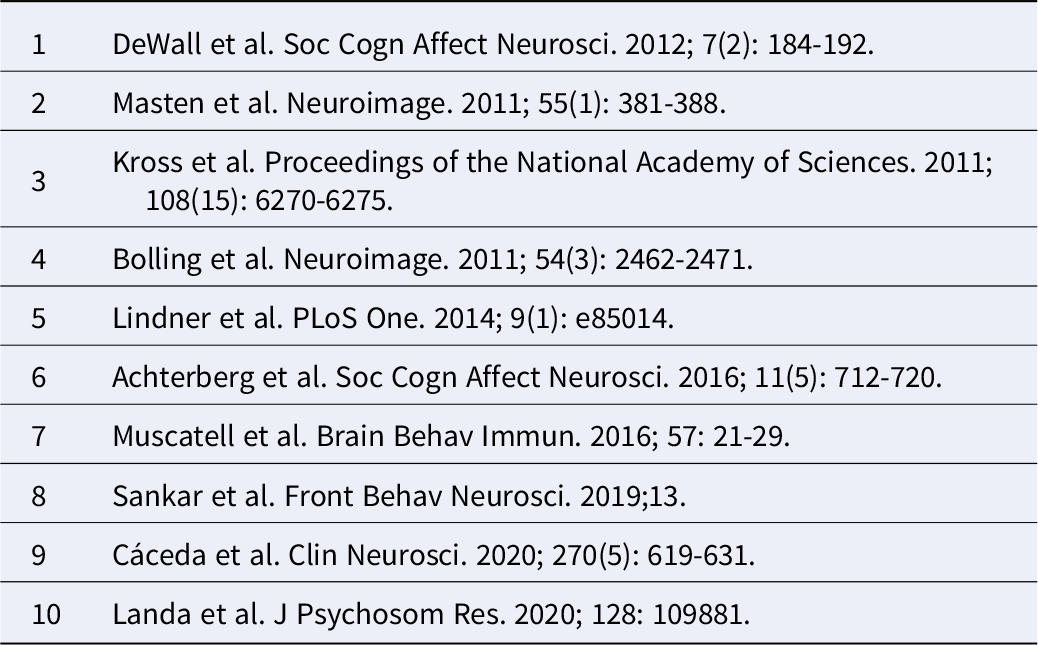
After full-text screening 10 of 206 original researches were chosen for the final analysis (Table 1).Table 1:
Included studies in the analysis.
1
DeWall et al. Soc Cogn Affect Neurosci. 2012; 7(2): 184-192.
2
Masten et al. Neuroimage. 2011; 55(1): 381-388.
3
Kross et al. Proceedings of the National Academy of Sciences. 2011; 108(15): 6270-6275.
4
Bolling et al. Neuroimage. 2011; 54(3): 2462-2471.
5
Lindner et al. PLoS One. 2014; 9(1): e85014.
6
Achterberg et al. Soc Cogn Affect Neurosci. 2016; 11(5): 712-720.
7
Muscatell et al. Brain Behav Immun. 2016; 57: 21-29.
8
Sankar et al. Front Behav Neurosci. 2019;13.
9
Cáceda et al. Clin Neurosci. 2020; 270(5): 619-631.
10
Landa et al. J Psychosom Res. 2020; 128: 109881.
In 5 studies, the results were presented with MNI-space coordinates. Figure 1 illustrats the regions of local activity change maxima according to MNI-space coordinates based on the results of the included studies in the analysis.
Neural activation in the regions of the AInC was positively associated with greater levels of social rejection sensitivity and other components of self-stigma in 9 studies. Reduced activity was observed in only one study (Lindner et al., PLoS One. 2014; 9(1): e85014) among highly self-stigmatized patients with schizophrenia. This finding may reflect a biological manifestation of deficits in self-awareness and affective processing in schizophrenia.
Image:
Conclusions
Associations between neural activity changes in specific brain regions and levels of self-stigma and/or its components, as reported in included neuroimaging studies, have the potential to shed light on the neurobiological mechanisms underlying such a complex psychological phenomenon as stigma.
The concept of “life engagement” encompasses several aspects of one’s life, including personal well-being, contentment, purpose, and engagement in meaningful activities. In 2006, the group led by Scheier designed a 6-item scale to measure this concept in the general population: the Life Engagement Test (LET), however, this tool was never validated in clinical populations (Scheier et al. 2006 J Clin Psychiatry 2006; 29 291-298). In subjects living with schizophrenia life engagement can be measured through the Positive and Negative Syndrome Scale-Life Engagement (PANSS-LE), derived by isolating 11 items (i.e., N01, N02, N03, N04, N05, N06, G06, G07, G13, G15, G16) from the PANSS (Correll et al. 2022 J Clin Psychiatry 2022; 83-4) (Correll et al. 2022 J Clin Psychiatry 2022; 83-5).
Objectives
The aim of this study was to investigate the clinical and functional correlates of two different measures of life engagement in a cohort of individuals living with schizophrenia spectrum disorders (SSD).
Methods
Ninety-five subjects living with SSD recruited from the ASST Spedali Civili of Brescia (Italy) were included in the preliminary ad-interim analysis of the present study: for each patient information regarding the clinical presentation were measured with the Clinical Global Impression (CGI) scale, the Health of the Nation Outcome Scales (HoNOS), the Brief Negative Symptoms Scale (BNSS) and the PANSS; additionally, information related to the psychosocial functioning were collected through the Global Assessment of Functioning (GAF) scale; finally, life engagement was evaluated through the LET and the PANSS-LE. Spearman’s correlations were performed using SPSS v28 and p values < 0.05 were considered significant.
Results
Both the LET and the PANSS-LE were correlated with the CGI (p=0.002 and p<0.001 respectively), but only the PANSS-LE was found to be correlated with the GAF (p<0.001), the BNSS (p<0.001) and the HoNOS (p<0.001).
Conclusions
The concept of life engagement is of growing interest for healthcare professionals working in the mental health field, in line with the concept of reaching a full functional recovery and considering patient-reported outcomes. From our study it is evident that life engagement in individuals living with SSD is better characterized through the PANSS-LE rather than the LET, as the former is more specific to define the complexity of the SSD symptomatology.
Young people (YP) (between 10 and 24 years) are disproportionally vulnerable to developing and being affected by mental health conditions due to physical, social and emotional risk factors. YP in low-and middle-income countries (LMICs) have poorer access to, and quality of, mental health services compared to those in high-income countries. Digital mental health interventions (DMHIs) have been proposed as tools to address this burden of disease and reduce the global treatment gap in youth mental health outcomes. This study aimed to examine the evidence for DMHIs for treating mental disorders in YP based in LMICs. To do this, the author searched academic databases (MEDLINE, PsycINFO, Embase and Web of Science) for primary studies on DMHIs targeting YP in LMICs. Preferred Reporting Items for Systematic Reviews and Meta-Analyses criteria were followed. The quality of the studies was assessed using the Critical Appraisal Skills Programme) framework. A narrative synthesis methodology was used to summarise and explain the findings. The authors identified 287 studies of which 7 were eligible in the final review. The authors found evidence of the effectiveness of multiple forms of DMHI (especially internet-based cognitive behavioural therapy) on anxiety and depression outcomes. Studies reported a lack of long-term benefits of treatment, high dropout rates, and did not include key geographical settings or data on cost-effectiveness. No studies were judged to be of high quality. This review highlights the available evidence showing that DMHIs can improve mental health outcomes for YP in LMICs, but due to the limited number of studies and lack of high-quality data, increased adoption and scaling up of digital interventions require more rigorous studies showing clinical effectiveness and ability to provide return on investment.
Intranasal esketamine has recently been approved for the treatment of treatment-resistant depression in adults, with different studies showing its efficacy and tolerability. However, the real-world tolerability of this treatment is still unclear.
Objectives
Evaluate the tolerability of intranasal esketamine in a case series of 15 patients.
Methods
Our case series includes 15 patients, who received treatment with intranasal esketamine during 2022-2023. In order to evaluate the tolerability of intranasal esketamine, patients were asked to complete the TSQM and a side effect questionnaire on different moments of the treatment (one week, six weeks and six months after the beginning of the treatment).
Results
The most common adverse effects were dissociation, dizziness, and somnolence, which resolved within the hours following the administration. All of them were mild or moderate in severity, having a minor impact on the patient, so none of the patients discontinued the treatment due to adverse effects. Other adverse effects noticed were: transitory increment of blood pressure in several patients, and worsening of obsessions in a patient with previous obsessive-compulsive symptoms.
Conclusions
Our data suggests that intranasal esketamine is well tolerated, with transient and mild adverse effects. In all cases the risk-benefit ratio must be evaluated, but until more studies are done, it seems to be a safe treatment for treatment-resistant depression.
Sexual dysfunctions are prevalent issues affecting individuals’ sexual well-being and relationships. These conditions encompass a range of difficulties in sexual functioning, from desire and arousal to orgasm and pain. Psychological factors, such as dysfunctional beliefs about sexuality, play a significant role in the development and perpetuation of sexual dysfunctions (Nobre, Pinto-Gouveia, 2006; Nobre, Pinto-Gouveia, 2008). Additionally, personality traits, particularly those associated with the Dark Triad (Machiavellianism, narcissism, and psychopathy), have been suggested as potential protective factors to sexual problems, probably in interaction with sexual assertiveness and a wider experience in sexual behavior (Pilch, Smolorz, 2019).
Objectives
This study investigates the interplay between sexual dysfunctions, sexual dysfunctional beliefs, and Dark Triad personality traits, and compares the differences and similarities in the two different cultural (Hungarian and Spanish) samples.
Methods
Both samples were collected online by sharing the questionnaires on various platforms. Apart from the demographic and sexuality related background questions (age, sex, gender, sexual orientation, sexual lifestyle, etc.) our set of questionnaires included the Arizona Sexual Experience Scale (ASEX), Sexual Dysfunctional Beliefs Questionnaire (SDBQ, Male and Female Version) and The Short Dark Triad Questionnaire (SD3).
Results
The Hungarian sample consists of 465 participants, the Spanish of 215. However, the processing of the data is still underway, our preliminary results show, that there is a connection between the number of dysfunctional beliefs and occurrence of sexual dysfunctions. Just like Dark Triad traits seem to have negative correlation with dysfunctions.
Conclusions
Our research gives an opportunity to a better understanding of the psychological background of sexual dysfunctions. By taking in consideration the relationship between dysfunctional beliefs and said disorders, professionals can optimize sexual education to aid the prevention of them. Nevertheless, our findings can help the practice of psychotherapy in finding more advanced treatments, thus improving individuals’ overall sexual, and general well-being.
Amphetamines may induce symptoms of psychosis very similar to those of acute schizophrenia spectrum psychosis. This has been an argument for using amphetamine-induced psychosis as a model for primary psychotic disorders. To distinguish the two types of psychosis on the basis of acute symptoms is difficult. However, acute psychosis induced by amphetamines seems to have a faster recovery and appears to resolve more completely compared to schizophrenic psychosis.
Objectives
The objectives of this e-poster is to identify the pathophysiology of amphetamine-related psychiatric disorders and outline the available treatment and management options for amphetamine-related psychiatric disorders.
Methods
A bibliopgraphical review was performed using PubMed platform. All relevant articles were found using the keywords: psychotic episode, amphetamines, pathophysiology and menagement.
Results
Amphetamines inhibit monoamine (dopamine, norepinephrine, epinephrine, serotonin) reuptake, leading to increased monoamine concentrations in the neuronal synapse. Amphetamines can also lead to increased monoamines in the cytosol by interactions with vesicular monoamine transporter 2. Dopamine and norepinephrine release in the nucleus accumbens results in a feeling of euphoria and a reward feedback loop, which may result in addiction. Studies also suggest increased dopaminergic pathways lead to glutamate excesses in the cerebral cortex, altering the function of cortical GABAergic neurons. This damage leads to dysregulation of glutamate in the cerebral cortex, a precursor to psychosis. Prior psychiatric studies have found that GABAergic cortical dysfunction seems to relate to schizophrenia. Generally, acutely agitated psychotic patients are treated with intravenous benzodiazepines (lorazepam, diazepam, or midazolam) as first-line agents. However, if a second-line agent is needed, antipsychotic medicines like risperidone, haloperidol, ziprasidone, and olanzapine have been successful in managing amphetamine-associated psychosis. Lipophilic beta-blockers, such as metoprolol and labetalol, have also been used successfully to resolve agitation and hyperadrenergic vital signs.
Conclusions
Compared to schizophrenic psychosis, amphetamine-induced acute psychosis induced appears to demonstrate a more rapid recovery. It also seems to resolve with substance abstinence; however, this recovery may be incomplete.
Therapeutic leave, the temporary and authorized absence of a patient from a psychiatric inpatient facility, is a practice rooted in the shift of mental illness towards more humane and recovery oriented care. This shift began to gain momentum in the mid-20th century, with the deinstitutionalization movement, which sought to treat psychiatric patients in less restrictive environments and facilitate their integration into the community. Today, therapeutic leave remains relevant in general psychiatry inpatient treatment facilities, and on an international level. It’s additionally used as a way to assess the progress and the stability of the patient outside the controlled environment that is the hospital, and to provide a gradual transition back into independent living and potential stressors of the outside world. But it is administered more on tradition and perceived benefits than on solid scientific grounding, reflecting a practice guided by clinical experience rather than empirical data or guidelines.
Objectives
Our review aims to evaluate the existing body of research on therapeutic leave in general psychiatry inpatient units. We intend to identify the outcomes that have been studied, and assess the extent and nature of their impact.
Methods
This scoping review was conducted through a comprehensive search of academic databases, including Google Scholar, PubMed, Embase, Cochrane Library, and PsycINFO. Search terms were carefully selected to capture relevant publications, and the results were screened for their pertinence to the review’s aims. Studies focused on forensic settings were excluded.
Results
The literature on therapeutic leave is notably limited, and the prevalence of its utilization in clinical practice remains unclear. Scientific publications primarily address readmission rates, with two indicating an increased risk in patients granted leave during their inpatient treatment. However, one report suggested a potential reduction. Length of stay (LOS) was negatively impacted, with prolonged hospitalization in these patients shown in one report. Post-discharge emergency room visits seem unaffected. A rise in readmission rates and LOS typically suggests higher subsequent healthcare costs. However, findings from another study contradict this expectation, with reduction of costs post-initial inpatient treatment. The literature also explores the hazards linked to therapeutic leave, highlighting that a significant portion, between 30 to 80%, of inpatient suicides transpire during such leave. Additional concerns extend to non-fatal self-harm, as well as the possibility of patients causing harm to others or to property.
Conclusions
Our review reveals a significant research gap in therapeutic leave’s effects, with a reduced number of outcomes studied and inconclusive findings. Future studies should aim to clarify these outcomes and eventually define therapeutic leave protocols.
Subclinical psychotic experiences (PEs) are far more prevalent than psychotic disorders, with an estimated prevalence of 7.2% (Linscott & Van Os. Psychol Med 2013;43(6) 1133-1149). PEs are particularly prevalent in late adolescence and young adulthood, when obtaining academic education is one of the main developmental tasks. University students are at the peak age of onset of mental disorders, and often experience high levels of social and academic stress that may contribute to the onset of psychopathology. Hence, estimating the prevalence and correlates of PEs among university students is particularly important.
Objectives
To estimate the prevalence of PEs in a sample of Israeli students; assess whether rates of PEs differ by selected sociodemographic characteristics; and examine the association between PEs and non-specific psychological distress.
Methods
150 students from universities and colleges in Israel participated in a cross-sectional online survey. All students were over the age of 18 and were not diagnosed with psychotic disorders. Participants completed self-report questionnaires, including the Prodromal Questionnaire - Brief Version (PQ-B), Kessler Psychological Distress Scale (K10) and sociodemographic details. The PQ-B yields a score for the total number of items endorsed (range 0–21), and a total distress score (range 0–105). A cutoff of ≥8 distressing symptoms was used to identify participants at high-risk for psychosis.
Results
21 participants (14.0%) reported 8 or more distressing PEs. PEs were more common in males and among those with a psychiatric illness (Table 1). PEs were not associated with marital status, religiosity, or immigrant status. While a greater number of PEs was positively associated with non-specific psychological distress (r=0.589, p<.001), there was no association between distress caused by PEs and non-specific psychological distress (r=0.145, NS).Table 1.
Sociodemographic characteristics by group
PEs-
PEs+
X2, p
Sex
M
29.5%
52.4%
4.32, .038
F
70.5%
47.6%
Marital Status
Married
17.1%
23.8%
0.56, NS
Unmarried
82.9%
76.2%
Immigrant
No
89.9%
85.7%
0.34, NS
Yes
10.1%
14.3%
Religiosity
Secular
74.4%
57.1%
2.67, NS
Other
25.6%
42.9%
Psychiatricillness
No
87.6%
61.9%
8.87, .003
Yes
12.4%
38.1%
Conclusions
The findings confirm that self-reported PEs are much more prevalent than clinically diagnosed psychotic disorders, particularly among young adults. As PEs were found to be associated with non-specific psychological distress, and as they are known forerunners for severe mental disorders, it is important to address mental health issues in school settings and promote prevention and early intervention programs.
The relationship between autistic traits and eating disturbances, although gaining considerably more attention in the last decades, is still unclear. Most of the studies up to date were conducted on individuals with a full diagnosis of Autism Spectrum Disorders (ASD) and/or of Eating Disorders (ED). One of the common features reported in both conditions is the alteration of sensory sensitivity, which is, in both cases, widely discussed in the literature, but mostly in the pediatric age.
Objectives
To investigate the association between sensory sensitivity, autistic traits, and eating disorders symptomatology in a group of young adults (18-24) who were referred, for the first time, to a mental health outpatient clinic.
Methods
259 patients completed: the Eating Attitude Test (EAT-26), the Autism Quotient (AQ), the Ritvo Autism Asperger Diagnostic Scale-Revised (RAADS-R), the Sensory Perception Quotient - Short Form 35 item (SPQ-SF35) and the Swedish Eating Assessment for Autism Spectrum Disorders (SWEAA), which investigates specific eating behaviour related to autism.
Results
23.55% participants scored above the cut-off at the EAT-26, suggesting that they should be assessed for the presence of an eating disorder by a specialized clinician. The RAADS-R explained a great proportion of variance in the relationship between sensory sensitivity and both the SWEAA (Total Score and subscales) and the EAT-26 (Total Scores and subscales).
Conclusions
Our study revealed a substantial prevalence of potential eating disorders among young adults in our sample, with nearly one-fourth of participants surpassing the EAT-26 cutoff score. Additionally, we observed a noteworthy association between the presence of autistic traits and not only autistic-like eating behaviors but also a broader spectrum of eating disorder symptoms; this relationship was found in a cohort of young adult patients seeking clinical attention due to generalized distress, prior to receiving specific diagnoses of Autism Spectrum Disorder (ASD) or Eating Disorders (ED). These findings give rise to several intriguing inquiries. Could the existence of autistic traits, even when subthreshold, function as a mediator between alterations in sensory sensitivity and the emergence of maladaptive eating behaviors? Furthermore, if these traits exist at subthreshold levels, might they manifest in various psychiatric conditions, distinct from traditional categorizations, during episodes of acute distress? What potential precipitating factors should be considered in such cases?
Nurses working in psychiatric departments regularly encounter intricate, stress-inducing, and emotionally challenging situations. The mental well-being of these nurses directly influences the quality of care they deliver.
Objectives
To assess the prevalence of psychological distress among psychiatric nurses and to identify the socio-demographic and clinical factors associated with it.
Methods
Cross-sectional, descriptive, and analytical study conducted over the course of one month from October 11th to November 8th 2023. Participants included were psychiatric nurses working in Razi Hospital, Tunisia. We collected data using pre-established questionnaire which included socio-demographic and clinical data of the participants. The assessment of psychological distress was conducted using the Depression, Anxiety and Stress Scale (DASS-21), validated in Arabic. Statistical analysis was performed using the Statistical Package for Social Sciences (SPSS) in its 25th version
Results
We collected data from 55 nurses working in Razi psychiatry hospital during the time of the study. Among them, 80% (n=44) were female. Their median age was 35 (Min=25, Max=62). Most of participants were married (81.8%, n=45) and 70.9 (n=39) had kids. In our sample, 5.5% (n=3) and 23.6% (n=13) had respectively personal psychiatric and somatic history. Some addictive behaviors were identified among our participants, especially smoking (14.5%, n=379) and alcohol use (3.6%, n=2).
Regarding working conditions, 81.8% (n=45) were assigned shift work. They worked in the men’s ward (43.6%, n=24), the women’s ward (34.5%, n=19), or in both (21.8%, n=12). Furthermore, 45.5% (n=25) reported witnessing a suicide attempt during their work, and 74.5% (n=41) were victims of aggression, primarily by patients (82.5%, n=33). Sixty percent (n=33) said expressed a desire to transfer.
Moderate to extremely severe depression, anxiety and stress was observed in respectively 34.5% (n=19), 61.8% (n=34) and 36.4% (n=20) of cases.
A significant association was found between stress among psychiatry nurses and personal somatic history (p <10-3). No further links were found between depression, anxiety, stress and other clinical factors.
Conclusions
These results emphasize the difficult working environment within psychiatric settings, emphasizing the critical requirement for specific interventions aimed at improving the mental health and well-being of psychiatric nurses.
The delivery of mental health care worldwide often involves compulsory treatment, a practice encountered by early career psychiatrists from the outset of their training. Despite its prevalence, little research has explored the challenges faced by trainees and early career psychiatrists when compelled to administer treatment without patient’s consent. This presentation will synthesize research data and offer personal reflections on the author’s experiences.
Challenges that early career psychiatrists can face regarding compulsory treatment can be categorized into personal, professional, and institutional. Personal challenges encompass the emotional stress associated with applying coercive measures, coping with negative emotions, and managing service users’ attitudes toward treatment without consent. There is also concern that compulsory treatment may elevate the risk of emotional burnout. Professional challenges involve the administrative burden associated with organizing compulsory treatment, often exacerbated by the formalization of the process as a bureaucratic procedure in many European countries. Additionally, dealing with legal processes, including interactions with lawyers and courts, can pose significant difficulties, even though it is clearly done to protect the rights of the persons receiving care. Institutional challenges encompass the overall policy of providing compulsory psychiatric care in the psychiatrist’s home country and the specific practices of coercive measures in a given treatment facility. Furthermore, the lack of dedicated time for ethics of coercion during training is a common issue.
In the current landscape of mental health care, early career psychiatrists must undergo training to handle coercive measures. While these measures are sometimes unavoidable, ethical principles must guide their administration. Additionally, access to supervision/mentoring is crucial for early career professionals facing challenging cases.
Adolescents with depression have distinct affective reactions to daily events, but current research is controversial. The emotional context insensitivity theory suggests blunted reactivity in depression, whereas the hypotheses of negative potentiation and mood brightening effect suggest otherwise. While nonlinear associations between depression severity and affective reactivity have been observed, studies with a separate subclinical group remain rare. Subthreshold depression (SD), defined by two to four symptoms lasting for two weeks or more, provides a dimensional view to the underpinnings of affective reactivity. In this study, we compared positive affect (PA) and negative affect (NA) reactivity to positive and negative daily events (uplifts and stress) among adolescents with Major Depressive Disorder (MDD), SD and healthy controls (HC) using experience sampling methods (ESM).
Objectives
We hypothesized a stepped difference in affective reactivity along the depression spectrum: the MDD group will have the strongest reactivity of PA and NA to uplifts and stress, followed by SD and HC.
Methods
Three groups (MDD, SD, and HC) of adolescents were recruited from an epidemiologic sample entitled ‘Hong Kong Child and Adolescent Psychiatric Epidemiologic Survey: Age 6 to 17’. Group status was determined by the Diagnostic Interview Schedule for Children Version 5. They completed an experience sampling diary on smartphone for 14 consecutive days, with 5-10 entries per day. Momentary levels of PA (happy, relaxed, contented), NA (irritated, low, nervous), uplifts and stress experienced before the entry were measured on a 1-7 Likert scale.
Results
The sample consisted of 19 adolescents with MDD, 30 with SD, and 59 HC. The M:F ratio was 17:19. The age range was 12-18 with a mean of 14.8. The overall ESM completion rate was 46%. The MDD group had the highest levels of stress and NA, and the lowest levels of uplifts and PA, followed by the SD and HC groups respectively (p<0.01). Across groups, levels of PA were positively associated with uplifts and negatively associated with stress, whereas levels of NA were positively associated with stress and negatively associated with uplifts. The Group x Uplift interaction effect on PA was significant, with greater PA reactivity in SD (p<0.01) and MDD (p=0.07) when compared with HC. The Group x Uplift interaction effect on NA was significant, with greater NA reactivity in SD than HC (p<0.01). The Group x Stress interaction effect on PA was significant, with greater PA reactivity in SD than HC (p<0.01) and MDD (p<0.01). The Group x Stress interaction effect with NA is non-significant.
Conclusions
Contrary to our hypothesis, adolescents with SD experienced strongest PA and NA reactivity in uplifts and PA reactivity in stress. It provides evidence towards a nonlinear relationship between severity of depression and affective reactivity.