To save content items to your account,
please confirm that you agree to abide by our usage policies.
If this is the first time you use this feature, you will be asked to authorise Cambridge Core to connect with your account.
Find out more about saving content to .
To save content items to your Kindle, first ensure no-reply@cambridge.org
is added to your Approved Personal Document E-mail List under your Personal Document Settings
on the Manage Your Content and Devices page of your Amazon account. Then enter the ‘name’ part
of your Kindle email address below.
Find out more about saving to your Kindle.
Note you can select to save to either the @free.kindle.com or @kindle.com variations.
‘@free.kindle.com’ emails are free but can only be saved to your device when it is connected to wi-fi.
‘@kindle.com’ emails can be delivered even when you are not connected to wi-fi, but note that service fees apply.
Within the last twenty years a large-scale bottom-up privatization has taken place in Vietnam, changing and dismantling the public health care system. This process has led to severe tensions inherent in the transitional society of Vietnam between equity and access to health care support – especially for the poor, elderly, migrants, and ethnic minorities – on the one hand, and its efficiency on the other hand. The book traces the reform efforts to modernize the health care system by the Communist Party of Vietnam and the Vietnamese government. The author bases her findings on little known primary literature and interviews with key stakeholders of the policy network involved in the reform of the health care system, thereby painting an authentic atmospheric picture of the profound changes in the health care system in Vietnam.
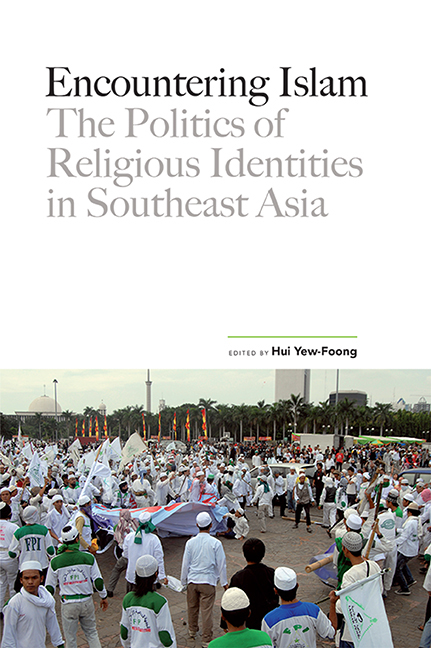
This volume seeks to introduce and deepen the understanding of Islam and its role in politics as encountered in different national and transnational contexts in Southeast Asia, eschewing the neo-orientalist approach that has informed public discourse in recent years. In Encountering Islam, the book lingers beyond the summary moment and reflects on the multiple impressions, suppressions and repressions, whether coherent or incoherent, associated with Islam as a socio-political force in public life. To this end, it is not adequate simply to represent the divergent identities associated with Islam in Southeast Asia, whether embedded in state-endorsed orthodoxy or Islamic movements that contest such orthodoxy. It is also important to examine religious minorities in political contexts where Islam is dominant and Muslim communities in national contexts where they are minorities. By situating these religious identities within their larger socio-political contexts, this volume seeks to provide a more holistic understanding of what is encountered as Islam in Southeast Asia.
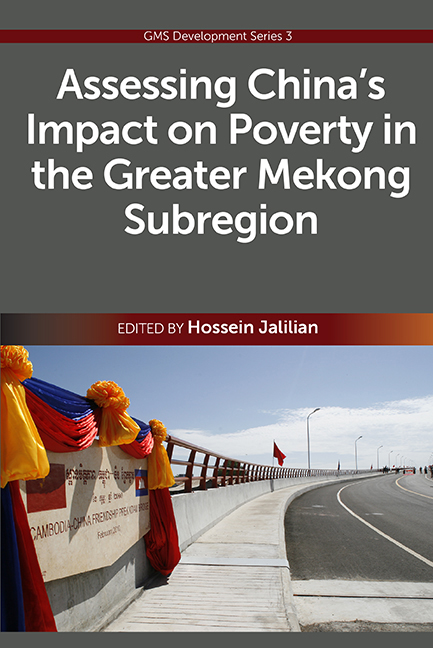
Since the dawn of the industrial revolution, and the ushering in of an era of global economic relations, the United States and Europe have been the core poles of economic power. However, China along with India are increasingly challenging the traditional economic hegemony. An issue of great importance is how this shift in the global economic balance of power will affect developing economies and the transition economies of the Greater Mekong Subregion (GMS), which are located in China's backyard and deeply integrated into its economy through regional supply chains. This volume examines the relationship between transition economies and the rise of China through presenting empirical case studies from the GMS. In doing so, it offers insights into the effect of China on developing countries in general, and offers practical policy directions for the place-specific economies of the GMS.
There is already much literature on the significance of NGOs in the development process. However, there has been little discussion on why the NGOs take on different forms in different countries. This volume examines the state-NGO relationships in fifteen countries. It is not, however, a pot-pourri of country reports. All the contributors use the same analytical framework and focus on the key concept of "economic and political space" for NGOs. Readers will find that the analysis of the various NGO forms is well synthesized in this volume.
Seeking to look beyond the day-to-day headlines and judgemental comments on developments in Myanmar, this volume gets under the surface to look at the underlying issues which the country faces regardless of its political future. After looking back to essay the historical forces and human agencies which have shaped contemporary Myanmar, the volume addresses health care and public policy provision with suggestions as to what potential roles the international community might have in assisting Myanmar's future socioeconomic development. Myanmar: Beyond Politics to Societal Imperatives broadens the debate on this state of more than 50 million people beyond the usual narrow didactics about democratization and economic policies.
"Few books address the sensitive issue of Islamic education with empathy as well as critical distance as Joseph C. Liow's Islam, Education, and Reform in Southern Thailand. He examines global networks of religious learning within a local Thai as well as regional Asian context by brilliantly revealing the intersections between religion, politics and modernity in an accessible and illuminating manner. Traditional educational institutions rarely receive such sensitive and balanced treatment. Liow's book is a tour de force and mandatory reading for policy-makers, academics and all of those interested in current affairs." - Ebrahim Moosa, Associate Professor of Islamic Studies, Department of Religion, Associate Director, Duke Islamic Studies Center (DISC), Duke University, USA
ASEAN has an abiding interest in peace and stability in this region and in freedom of navigation in and overflight above the South China Sea. Much of ASEAN's commerce, including its members' traded food and energy resources, passes through or over the South China Sea. The stakes for ASEAN and its members in the South China Sea are very high. This book is the product of a conference on 'Entering Uncharted Waters? ASEAN and the South China Sea Dispute', initiated to remind all claimants to bring their claims as close as possible to the provisions of the 1982 UN Convention on the Law of the Sea. After all, ASEAN has sought to promote the rule of law in the region. The conference and this book were inspired by the following objectives: peace, stability, freedom of navigation and overflight, confidence building, cooperation, and the rule of law.
This is a comprehensive survey of Singapore's dominating regional role as provider of petroleum refining, blending, and storage services, exporter of refined petroleum products, port of call for bunker and jet fuels, and spot market for the Asia-Pacific petroleum trade. Substantively based on industry data sources, this book is conceived of as an initial step in a continued and independent research interest on one of the Pacific Basin's most dynamic and strategic industries.
"At a time when Southeast Asian Studies is declining in North America and Europe, this book serves to remind us of the fresh, constructive and encouraging view of the field from Asia. On behalf of Taiwan’s Southeast Asian research community, I sincerely congratulate Professors Park and King for making such a great and timely contribution to the making of Southeast Asian Studies in Asia."—Hsin-Huang Michael Hsiao, Director of Institute of Sociology, Academia Sinica, and former President of Taiwan Association of Southeast Asian Studies"The Historical Construction of Southeast Asian Studies: Korea and Beyond is an important and long-overdue step in the task of bringing Southeast Asian Studies to where it rightfully belongs - the Asian region. At the same time, it avoids being narrowly regionalistic and instead views Southeast Asia as an 'open system' that transcends 'national units' or 'fixed territorial categories' and welcomes the contributions of both Asian and non-Asian scholars in crafting a fresh post-colonial approach to the study of the region’s societies and peoples."—Eduardo Climaco Tadem, Professor of Asian Studies, University of the Philippines-Diliman“An insightful and systemic analysis of the intriguing trajectories, evolving themes, and multi-lingual scholarship of Southeast Asian Studies in Asia and beyond, this book serves as an important foundation in setting future research agendas as well as for closer global collaborations in knowledge production in Asian Studies.”—Liu Hong, Tan Kah Kee Professor and Chair, School of Humanities and Social Sciences, Nanyang Technological University, Singapore
This book incorporates a selection of eight revised papers presented at the Conference on "Managing Economic Crisis in Southeast Asia", organized jointly by the Saw Centre for Financial Studies, NUS Business School and the Institute of Southeast Asian Studies, in January 2010. The chapters deal with the management of the 2008–09 economic crisis in Singapore, Malaysia, Thailand, Vietnam, the Philippines, Indonesia, and the region as a whole. They represent an analysis of the impact of the economic crisis and the stimulus packages that were swiftly put in place by the governments to mitigate the economic recession and to pave the way for a quick recovery. The success of the monetary and fiscal policy measures in engendering a strong economic recovery in these countries is also discussed in considerable depth. The book, with contributions from experts on the topics covered, will be extremely valuable to businessmen, analysts, academics, students, policy-makers and the general public interested in seeking a greater understanding of the sub-prime crisis that led to the global economic recession.
This study of the national parliaments of India, Indonesia, the Philippines, South Korea, and Thailand is inspired by four major theoretical discourses: neo-institutionalism, parliamentarianism versus presidentialism, majoritarian versus consensus democracy, and transition theory. The book examines the specific role of parliaments in political decision-making, regime change, democratization, and consolidation of democracy in a comparative perspective. It argues that parliaments play a greater part in the political decision-making than is often asserted and that there is no cogent causal relationship between parliamentary performance and system of government.
This book discusses three major elements - MTV, the Music of Malaysia, and the Music of Indonesia - and how these three interact in the modern cultural setting. The research objective behind the book was to study the impact of globalization, in the form of the MTV onslaught on the youth musical culture and identities of Indonesia and Malaysia, and to determine what theoretical basis could explain the new cultural products which have risen in response to this process. The book goes on to examine whether the nasyid and irama Malaysia music genres in Malaysia and dangdut in Indonesia are part of this process and how it is achieved
Drawing on critical theory and post-modernism, this book argues for a new strategy for writing about the social and cultural experiences of living in modern Southeast Asian states. Contributors -- many of whom work in universities in the region -- question the processes of cultural transformation under conditions of globalization and rapid economic and political change. By paying attention to the specificity of what is taking place in the particular state, the book questions the conventional narratives of developmentalism and state-sponsored national peace as they are understood in Southeast Asia, and shows how such understanding can be made and unmade.
The book addresses questions such as: how should historians treat the earlier pasts of each country and the nationalism that guided the nation-building tasks? Where did political culture come in, especially when dealing with modern challenges of class, secularism and ethnicity? What part do external or regional pressures play when the nations are still being built? The authors have thought deeply about the issues of writing nation-building histories and have tried to put them not only in the perspective of Southeast Asian developments of the past five decades, but also the larger areas of historiography today.
Is Myanmar (Burma) democratizing, or is it moving towards a new form of authoritarianism, perhaps one more consonant with other contemporary authoritarian regimes in Asia?Coming at a critical time, and one of growing interest in this Southeast Asian country among researchers and policy-makers, Debating Democratization in Myanmar addresses this complex question from a range of disciplinary and professional perspectives. Chapters by leading international scholars and practitioners, activists and politicians from Myanmar and around the world cover political and economic updates, as well as the problems of democratization; the re-engagement of democratic activists and exiles in domestic affairs; the new parliament, the electoral system, and everyday politics; prospects for the economy; ethnic cooperation, contestation and conflict; the role of the army and police forces; and conditions for women. Together they constitute an empirically deep and analytically rich source of readable and relevant material for anyone keen to obtain a greater understanding of what is happening in Myanmar today, and why.
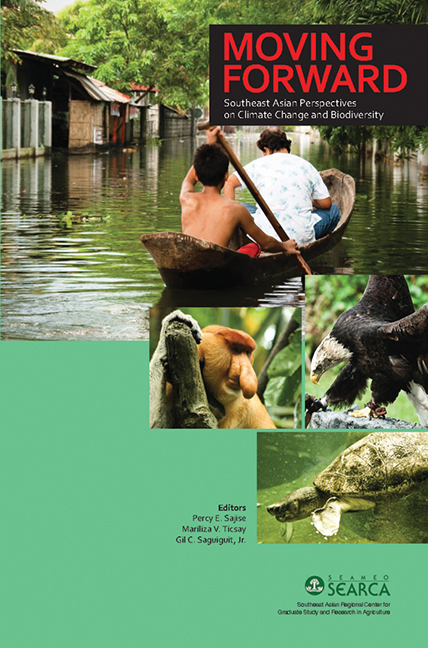
Climate change is a global phenomenon that is being experienced by all levels of society, regardless of race and species, and in all types of ecosystems, regardless of geographic location. It will have diverse effects on biodiversity which will directly impact on food security, water supply, and livelihood among others, especially for the poor and more vulnerable sectors of human society. More importantly, all forms of life including human society are trying their best to adapt and survive.This book explores the two-way link between climate change and the state of biodiversity in Southeast Asia. By drawing on the experiences and lessons shared by representatives from research and development agencies, academic institutions, donors, and other organizations; and the crosscutting issues contributed by experts, this book aims to provide insights, lessons, and perspectives on how Southeast Asia is dealing with these twin concerns.This book is invaluable to all who are interested in assessing research gaps, identifying future research areas, drafting effective policy agenda, and implementing critical activities at the community, national, and international levels.
This timely volume reviews the rapidly changing international economic environment and raises a range of issues and concerns pertaining to recent developments and the future of AFTA, ASEAN Free Trade Area. Part one is devoted to thematic analyses and perspectives dealing with trade; enlarging the ASEAN regional grouping; and relations with the World Trade Organization (WTO). Part two analyses AFTA in a wider comparative perspectives, examining relationships with the major trading partners of ASEAN, namely the United States (and more broadly NAFTA); Japan; and the European Union.
The book examines ASEAN's mechanisms in managing challenges and threats to regional security. Its extensive analyses of the ASEAN story of managing regional security cover the different phases of ASEAN's development as a regional organization and explore the perceptible changes that have occurred in regional mechanisms of conflict management. The book also examines the roles of relevant actors beyond the states of ASEAN and the key interactions that have evolved over time, which have been instrumental in moving regional mechanisms beyond the ASEAN way.The book argues that the ASEAN way has not been impervious to change. As the association finds its way through periods of crises and continues to confront the many challenges ahead, ASEAN and its mechanisms are already being transformed beyond the narrow confines of the modalities associated with the ASEAN way. The changes in the political and security landscape of the region, as well as the democratic transitions taking place in some member states, have set the stage for a much more dynamic set of regional actors and processes that bring into question the kind of regionalism that is now taking place in the region. This book therefore attempts to capture these evolving dynamics and examines the way regionalism is changing in Southeast Asia.
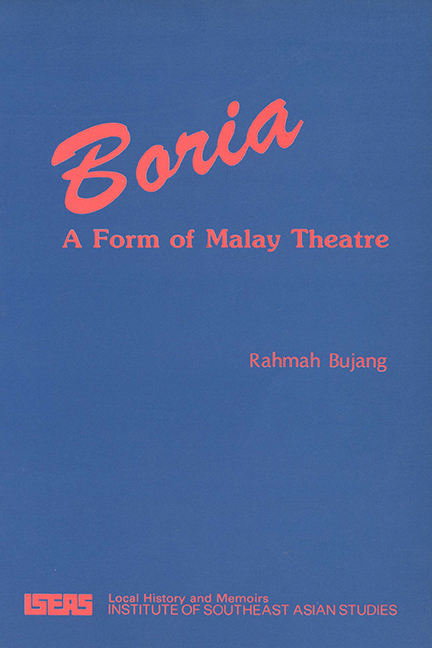
Boria is a popular form of Penang Malay theatre performed at weddings and other social functions. There are two parts – a farcical comic sketch, and a song and dance sequence. This study covers some of the sketches, songs, audience reaction, and the actors and performers.
Alternately lauded as a democratic success story and decried as a flawed democracy, Indonesia deserves serious consideration by anyone concerned with the global state of democracy. Yet, more than ten years after the collapse of the authoritarian Suharto regime, we still know little about how the key institutions of Indonesian democracy actually function. This book, written by leading democracy experts and scholars of Indonesia, presents a sorely needed study of the inner workings of Indonesia's political system, and its interactions with society. Combining careful case studies with an eye to the big picture, it is an indispensable guide to democratic Indonesia, its achievements, shortcomings and continuing challenges.