Refine search
Actions for selected content:
18 results
Degeneracy locus formulas for amenable Weyl group elements
- Part of
-
- Journal:
- Nagoya Mathematical Journal / Volume 261 / 2026
- Published online by Cambridge University Press:
- 22 January 2026, e13
-
- Article
-
- You have access
- Open access
- HTML
- Export citation
Borel-type presentation of the torus-equivariant quantum K-ring of flag manifolds of type C
- Part of
-
- Journal:
- Forum of Mathematics, Sigma / Volume 13 / 2025
- Published online by Cambridge University Press:
- 10 December 2025, e198
-
- Article
-
- You have access
- Open access
- HTML
- Export citation
Vanishing of Schubert coefficients via the effective Hilbert nullstellensatz
- Part of
-
- Journal:
- Forum of Mathematics, Sigma / Volume 13 / 2025
- Published online by Cambridge University Press:
- 01 October 2025, e162
-
- Article
-
- You have access
- Open access
- HTML
- Export citation
-
Schubert Vanishing is a problem of deciding whether Schubert coefficients are zero. Until this work it was open whether this problem is in the polynomial hierarchy ${{\mathsf {PH}}}$. We prove this problem is in ${{\mathsf {AM}}} \cap {{\mathsf {coAM}}}$ assuming the Generalized Riemann Hypothesis ( $\mathrm{GRH}$), that is, relatively low in ${{\mathsf {PH}}}$. Our approach uses Purbhoo’s criterion [57] to construct explicit polynomial systems for the problem. The result follows from a reduction to Parametric Hilbert’s Nullstellensatz, recently analyzed in [2]. We extend our results to all classical types.


On the formal Peterson subalgebra and its dual
- Part of
-
- Journal:
- Canadian Journal of Mathematics , First View
- Published online by Cambridge University Press:
- 07 August 2025, pp. 1-21
-
- Article
-
- You have access
- Open access
- HTML
- Export citation
-
In the present notes, we study a generalization of the Peterson subalgebra to an oriented (generalized) cohomology theory which we call the formal Peterson subalgebra. Observe that by recent results of Zhong the dual of the formal Peterson algebra provides an algebraic model for the oriented cohomology of the affine Grassmannian.
Our first result shows that the centre of the formal affine Demazure algebra (FADA) generates the formal Peterson subalgebra. Our second observation is motivated by the Peterson conjecture. We show that a certain localization of the formal Peterson subalgebra for the extended Dynkin diagram of type $\hat A_1$ provides an algebraic model for “quantum” oriented cohomology of the projective line. Our last result can be viewed as an extension of the previous results on Hopf algebroids of structure algebras of moment graphs to the case of affine root systems. We prove that the dual of the formal Peterson subalgebra (an oriented cohomology of the affine Grassmannian) is the zeroth Hochschild homology of the FADA.

Zero-one dual characters of flagged Weyl modules
- Part of
-
- Journal:
- Canadian Journal of Mathematics , First View
- Published online by Cambridge University Press:
- 08 July 2025, pp. 1-23
-
- Article
- Export citation
-
We prove a criterion of when the dual character $\chi _{D}(x)$ of the flagged Weyl module associated a diagram D in the grid $[n]\times [n]$ is zero-one, that is, the coefficients of monomials in $\chi _{D}(x)$ are either 0 or 1. This settles a conjecture proposed by Mészáros–St. Dizier–Tanjaya. Since Schubert polynomials and key polynomials occur as special cases of dual flagged Weyl characters, our approach provides a new and unified proof of known criteria for zero-one Schubert/key polynomials due to Fink–Mészáros–St. Dizier and Hodges–Yong, respectively.


Infinite flags and Schubert polynomials
- Part of
-
- Journal:
- Forum of Mathematics, Sigma / Volume 13 / 2025
- Published online by Cambridge University Press:
- 10 February 2025, e36
-
- Article
-
- You have access
- Open access
- HTML
- Export citation
A presentation of the torus-equivariant quantum K-theory ring of flag manifolds of type A, Part II: quantum double Grothendieck polynomials
- Part of
-
- Journal:
- Forum of Mathematics, Sigma / Volume 13 / 2025
- Published online by Cambridge University Press:
- 30 January 2025, e19
-
- Article
-
- You have access
- Open access
- HTML
- Export citation
-
In our previous paper, we gave a presentation of the torus-equivariant quantum K-theory ring $QK_{H}(Fl_{n+1})$ of the (full) flag manifold $Fl_{n+1}$ of type $A_{n}$ as a quotient of a polynomial ring by an explicit ideal. In this paper, we prove that quantum double Grothendieck polynomials, introduced by Lenart-Maeno, represent the corresponding (opposite) Schubert classes in the quantum K-theory ring $QK_{H}(Fl_{n+1})$ under this presentation. The main ingredient in our proof is an explicit formula expressing the semi-infinite Schubert class associated to the longest element of the finite Weyl group, which is proved by making use of the general Chevalley formula for the torus-equivariant K-group of the semi-infinite flag manifold associated to $SL_{n+1}(\mathbb {C})$.


A new generic vanishing theorem on homogeneous varieties and the positivity conjecture for triple intersections of Schubert cells
- Part of
-
- Journal:
- Compositio Mathematica / Volume 161 / Issue 1 / January 2025
- Published online by Cambridge University Press:
- 10 March 2025, pp. 1-12
- Print publication:
- January 2025
-
- Article
- Export citation
-
In this paper we prove a new generic vanishing theorem for $X$ a complete homogeneous variety with respect to an action of a connected algebraic group. Let $A, B_0\subset X$ be locally closed affine subvarieties, and assume that $B_0$ is smooth and pure dimensional. Let ${\mathcal {P}}$ be a perverse sheaf on $A$ and let $B=g B_0$ be a generic translate of $B_0$. Then our theorem implies $(-1)^{\operatorname {codim} B}\chi (A\cap B, {\mathcal {P}}|_{A\cap B})\geq 0$. As an application, we prove in full generality a positivity conjecture about the signed Euler characteristic of generic triple intersections of Schubert cells. Such Euler characteristics are known to be the structure constants for the multiplication of the Segre–Schwartz–MacPherson classes of these Schubert cells.


An inverse Grassmannian Littlewood–Richardson rule and extensions
- Part of
-
- Journal:
- Forum of Mathematics, Sigma / Volume 12 / 2024
- Published online by Cambridge University Press:
- 03 December 2024, e114
-
- Article
-
- You have access
- Open access
- HTML
- Export citation
-
Chow rings of flag varieties have bases of Schubert cycles $\sigma _u $, indexed by permutations. A major problem of algebraic combinatorics is to give a positive combinatorial formula for the structure constants of this basis. The celebrated Littlewood–Richardson rules solve this problem for special products $\sigma _u \cdot \sigma _v$, where u and v are p-Grassmannian permutations.
Building on work of Wyser, we introduce backstable clans to prove such a rule for the problem of computing the product $\sigma _u \cdot \sigma _v$ when u is p-inverse Grassmannian and v is q-inverse Grassmannian. By establishing several new families of linear relations among structure constants, we further extend this result to obtain a positive combinatorial rule for $\sigma _u \cdot \sigma _v$ in the case that u is covered in weak Bruhat order by a p-inverse Grassmannian permutation and v is a q-inverse Grassmannian permutation.


COMBINED COUNT OF REAL RATIONAL CURVES OF CANONICAL DEGREE 2 ON REAL DEL PEZZO SURFACES WITH $K^2=1$
- Part of
-
- Journal:
- Journal of the Institute of Mathematics of Jussieu / Volume 23 / Issue 1 / January 2024
- Published online by Cambridge University Press:
- 14 June 2022, pp. 123-148
- Print publication:
- January 2024
-
- Article
- Export citation
-
We propose two systems of “intrinsic” weights for counting such curves. In both cases the result acquires an exceptionally strong invariance property: it does not depend on the choice of a surface. One of our counts includes all divisor classes of canonical degree 2 and gives in total 30. The other one excludes the class $-2K$, but adds up the results of counting for a pair of real structures that differ by Bertini involution. This count gives 96.


Frobenius splitting of Schubert varieties of semi-infinite flag manifolds
- Part of
-
- Journal:
- Forum of Mathematics, Pi / Volume 9 / 2021
- Published online by Cambridge University Press:
- 13 July 2021, e5
-
- Article
-
- You have access
- Open access
- HTML
- Export citation
-
We exhibit basic algebro-geometric results on the formal model of semi-infinite flag varieties and its Schubert varieties over an algebraically closed field ${\mathbb K}$ of characteristic $\neq 2$ from scratch. We show that the formal model of a semi-infinite flag variety admits a unique nice (ind-)scheme structure, its projective coordinate ring has a $\mathbb {Z}$-model and it admits a Frobenius splitting compatible with the boundaries and opposite cells in positive characteristic. This establishes the normality of the Schubert varieties of the quasi-map space with a fixed degree (instead of their limits proved in [K, Math. Ann. 371 no.2 (2018)]) when $\mathsf {char}\, {\mathbb K} =0$ or $\gg 0$, and the higher-cohomology vanishing of their nef line bundles in arbitrary characteristic $\neq 2$. Some particular cases of these results play crucial roles in our proof [47] of a conjecture by Lam, Li, Mihalcea and Shimozono [60] that describes an isomorphism between affine and quantum K-groups of a flag manifold.


Inverse K-Chevalley formulas for semi-infinite flag manifolds, I: minuscule weights in ADE type
- Part of
-
- Journal:
- Forum of Mathematics, Sigma / Volume 9 / 2021
- Published online by Cambridge University Press:
- 07 July 2021, e51
-
- Article
-
- You have access
- Open access
- HTML
- Export citation
-
We prove an explicit inverse Chevalley formula in the equivariant K-theory of semi-infinite flag manifolds of simply laced type. By an ‘inverse Chevalley formula’ we mean a formula for the product of an equivariant scalar with a Schubert class, expressed as a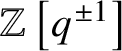 $\mathbb {Z}\left [q^{\pm 1}\right ]$-linear combination of Schubert classes twisted by equivariant line bundles. Our formula applies to arbitrary Schubert classes in semi-infinite flag manifolds of simply laced type and equivariant scalars $e^{\lambda }$, where $\lambda $ is an arbitrary minuscule weight. By a result of Stembridge, our formula completely determines the inverse Chevalley formula for arbitrary weights in simply laced type except for type $E_8$. The combinatorics of our formula is governed by the quantum Bruhat graph, and the proof is based on a limit from the double affine Hecke algebra. Thus our formula also provides an explicit determination of all nonsymmetric q-Toda operators for minuscule weights in ADE type.


An arithmetic count of the lines on a smooth cubic surface
- Part of
-
- Journal:
- Compositio Mathematica / Volume 157 / Issue 4 / April 2021
- Published online by Cambridge University Press:
- 08 April 2021, pp. 677-709
- Print publication:
- April 2021
-
- Article
- Export citation
-
We give an arithmetic count of the lines on a smooth cubic surface over an arbitrary field $k$, generalizing the counts that over ${\mathbf {C}}$ there are $27$ lines, and over ${\mathbf {R}}$ the number of hyperbolic lines minus the number of elliptic lines is $3$. In general, the lines are defined over a field extension $L$ and have an associated arithmetic type $\alpha$ in $L^*/(L^*)^2$. There is an equality in the Grothendieck–Witt group $\operatorname {GW}(k)$ of $k$,where
 \[ \sum_{\text{lines}} \operatorname{Tr}_{L/k} \langle \alpha \rangle = 15 \cdot \langle 1 \rangle + 12 \cdot \langle -1 \rangle, \] $\operatorname {Tr}_{L/k}$ denotes the trace $\operatorname {GW}(L) \to \operatorname {GW}(k)$. Taking the rank and signature recovers the results over ${\mathbf {C}}$ and ${\mathbf {R}}$. To do this, we develop an elementary theory of the Euler number in $\mathbf {A}^1$-homotopy theory for algebraic vector bundles. We expect that further arithmetic counts generalizing enumerative results in complex and real algebraic geometry can be obtained with similar methods.


Chern class formulas for classical-type degeneracy loci
- Part of
-
- Journal:
- Compositio Mathematica / Volume 154 / Issue 8 / August 2018
- Published online by Cambridge University Press:
- 18 July 2018, pp. 1746-1774
- Print publication:
- August 2018
-
- Article
- Export citation
Chern–Schwartz–MacPherson classes for Schubert cells in flag manifolds
- Part of
-
- Journal:
- Compositio Mathematica / Volume 152 / Issue 12 / December 2016
- Published online by Cambridge University Press:
- 14 November 2016, pp. 2603-2625
- Print publication:
- December 2016
-
- Article
- Export citation
-
We obtain an algorithm computing the Chern–Schwartz–MacPherson (CSM) classes of Schubert cells in a generalized flag manifold $G/B$ . In analogy to how the ordinary divided difference operators act on Schubert classes, each CSM class of a Schubert class is obtained by applying certain Demazure–Lusztig-type operators to the CSM class of a cell of dimension one less. These operators define a representation of the Weyl group on the homology of $G/B$ . By functoriality, we deduce algorithmic expressions for CSM classes of Schubert cells in any flag manifold $G/P$ . We conjecture that the CSM classes of Schubert cells are an effective combination of (homology) Schubert classes, and prove that this is the case in several classes of examples. We also extend our results and conjecture to the torus equivariant setting.


Hilbert series of residual intersections
- Part of
-
- Journal:
- Compositio Mathematica / Volume 151 / Issue 9 / September 2015
- Published online by Cambridge University Press:
- 09 June 2015, pp. 1663-1687
- Print publication:
- September 2015
-
- Article
- Export citation
Castelnuovo bounds for higher-dimensional varieties
- Part of
-
- Journal:
- Compositio Mathematica / Volume 148 / Issue 4 / July 2012
- Published online by Cambridge University Press:
- 09 July 2012, pp. 1085-1132
- Print publication:
- July 2012
-
- Article
-
- You have access
- Export citation
K-theory Schubert calculus of the affine Grassmannian
- Part of
-
- Journal:
- Compositio Mathematica / Volume 146 / Issue 4 / July 2010
- Published online by Cambridge University Press:
- 26 January 2010, pp. 811-852
- Print publication:
- July 2010
-
- Article
-
- You have access
- Export citation
