Refine search
Actions for selected content:
9 results
COMPLEX DIFFERENTIAL EQUATIONS AND SYSTEMS FROM TRIGONOMETRIC FORMULAS
- Part of
-
- Journal:
- Bulletin of the Australian Mathematical Society , First View
- Published online by Cambridge University Press:
- 20 February 2026, pp. 1-14
-
- Article
- Export citation
Corrections of formulas in ‘An elementary derivation of moments of Hawkes processes’
- Part of
-
- Journal:
- Advances in Applied Probability , First View
- Published online by Cambridge University Press:
- 22 December 2025, pp. 1-9
-
- Article
- Export citation
Asymptotic formulas of the eigenvalues for the linearization of the scalar field equation
- Part of
-
- Journal:
- Proceedings of the Royal Society of Edinburgh. Section A: Mathematics / Volume 155 / Issue 1 / February 2025
- Published online by Cambridge University Press:
- 11 September 2023, pp. 307-344
- Print publication:
- February 2025
-
- Article
-
- You have access
- Open access
- HTML
- Export citation
-
We establish asymptotic formulas for all the eigenvalues of the linearization problem of the Neumann problem for the scalar field equation in a finite interval
\[ \begin{cases} \varepsilon^2u_{xx}-u+u^3=0, & 0< x<1,\\ u_x(0)=u_x(1)=0. \end{cases} \]In the previous paper of the third author [T. Wakasa and S. Yotsutani, J. Differ. Equ. 258 (2015), 3960–4006] asymptotic formulas for the Allen–Cahn case $\varepsilon ^2u_{xx}+u-u^3=0$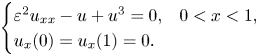
 were established. In this paper, we apply the method developed in the previous paper to our case. We show that all the eigenvalues can be classified into three categories, i.e., near $-3$
 eigenvalues, near $0$
 eigenvalues and the other eigenvalues. We see that the number of the near $-3$
 eigenvalues (resp. the near $0$
 eigenvalues) is equal to the number of the interior and boundary peaks (resp. the interior peaks) of a solution for the nonlinear problem. The main technical tools are various asymptotic formulas for complete elliptic integrals.


Positive solutions to the prey–predator equations with dormancy of predators
- Part of
-
- Journal:
- European Journal of Applied Mathematics / Volume 35 / Issue 1 / February 2024
- Published online by Cambridge University Press:
- 24 April 2023, pp. 96-108
-
- Article
-
- You have access
- Open access
- HTML
- Export citation
-
The time-global unique classical positive solutions to the reaction–diffusion equations for prey–predator models with dormancy of predators are constructed. The feature appears on the nonlinear terms of Holling type $\rm I\!I$ functional response. The crucial step is to establish time-local positive classical solutions by using a new approximation associated with time-evolution operators. Although the system does not equip usual comparison principle for solutions to partial differential equation, a priori bounds are derived by enclosing and renormalising arguments of solutions to the corresponding ordinary differential equations. Furthermore, time-global existence, invariant regions and asymptotic behaviours of solutions follow from such a priori bounds.

Ooid growth: Uniqueness of time-invariant, smooth shapes in 2D
- Part of
-
- Journal:
- European Journal of Applied Mathematics / Volume 31 / Issue 1 / February 2020
- Published online by Cambridge University Press:
- 08 February 2019, pp. 172-182
-
- Article
- Export citation
Separation of variables in equations of mean-curvature type
- Part of
-
- Journal:
- Proceedings of the Royal Society of Edinburgh. Section A: Mathematics / Volume 146 / Issue 5 / October 2016
- Published online by Cambridge University Press:
- 01 July 2016, pp. 1017-1035
- Print publication:
- October 2016
-
- Article
- Export citation
The group of automorphisms of a differential algebraic function field
-
- Journal:
- Nagoya Mathematical Journal / Volume 74 / July 1979
- Published online by Cambridge University Press:
- 22 January 2016, pp. 87-94
-
- Article
-
- You have access
- Export citation
Application of the τ-function theory of Painlevé equations to random matrices: PVI , the JUE, CyUE, cJUE and scaled limits
-
- Journal:
- Nagoya Mathematical Journal / Volume 174 / 2004
- Published online by Cambridge University Press:
- 22 January 2016, pp. 29-114
-
- Article
-
- You have access
- Export citation
Fonctions Elliptiques et Équations Différentielles Ordinaires
-
- Journal:
- Canadian Mathematical Bulletin / Volume 40 / Issue 3 / 01 September 1997
- Published online by Cambridge University Press:
- 20 November 2018, pp. 276-284
- Print publication:
- 01 September 1997
-
- Article
-
- You have access
- Export citation
