Contents
Research Article
Nonchaotic N-expansive homeomorphisms
- Part of:
-
- Published online by Cambridge University Press:
- 31 August 2023, pp. 1-9
-
- Article
- Export citation
-
In this paper, we give necessary conditions for an $N$
 -expansive homeomorphism of a compact metric space to be nonchaotic in the Li–Yorke sense. As application we give a partial answer to a conjecture in [2].

Combined effects in mixed local–nonlocal stationary problems
- Part of:
-
- Published online by Cambridge University Press:
- 04 September 2023, pp. 10-56
-
- Article
- Export citation
Discrete heat equation with irregular thermal conductivity and tempered distributional data
- Part of:
-
- Published online by Cambridge University Press:
- 04 September 2023, pp. 57-80
-
- Article
-
- You have access
- Open access
- HTML
- Export citation
-
In this paper, we consider a semi-classical version of the nonhomogeneous heat equation with singular time-dependent coefficients on the lattice $\hbar \mathbb {Z}^n$
 . We establish the well-posedness of such Cauchy problems in the classical sense when regular coefficients are considered, and analyse how the notion of very weak solution adapts in such equations when distributional coefficients are regarded. We prove the well-posedness of both the classical and the very weak solution in the weighted spaces $\ell ^{2}_{s}(\hbar \mathbb {Z}^n)$
 , $s \in \mathbb {R}$
 , which is enough to prove the well-posedness in the space of tempered distributions $\mathcal {S}'(\hbar \mathbb {Z}^n)$
 . Notably, when $s=0$
 , we show that for $\hbar \rightarrow 0$
 , the classical (resp. very weak) solution of the heat equation in the Euclidean setting $\mathbb {R}^n$
 is recaptured by the classical (resp. very weak) solution of it in the semi-classical setting $\hbar \mathbb {Z}^n$
 .
.


Coupling capacity in C*-algebras
- Part of:
-
- Published online by Cambridge University Press:
- 07 September 2023, pp. 81-103
-
- Article
-
- You have access
- Open access
- HTML
- Export citation
On the linearized Whitham–Broer–Kaup system on bounded domains
- Part of:
-
- Published online by Cambridge University Press:
- 07 September 2023, pp. 104-123
-
- Article
- Export citation
-
We consider the system of partial differential equations
\[ \begin{cases} \eta_t - \alpha u_{xxx} - \beta \eta_{xx} = 0 \\ u_t + \eta_x + \beta u_{xx} = 0 \end{cases} \]on bounded domains, known in the literature as the Whitham–Broer–Kaup system. The well-posedness of the problem, under suitable boundary conditions, is addressed, and it is shown to depend on the sign of the number \[ \varkappa=\alpha-\beta^2. \]In particular, existence and uniqueness occur if and only if $\varkappa >0$
 . In which case, an explicit representation for the solutions is given. Nonetheless, for the case $\varkappa \leq 0$
 we have uniqueness in the class of strong solutions, and sufficient conditions to guarantee exponential instability are provided.


A weighted Trudinger–Moser inequalities and applications to some weighted $(N,q)-$
 Laplacian equation in $\mathbb {R}^N$
 with new exponential growth conditions
- Part of:
-
- Published online by Cambridge University Press:
- 07 September 2023, pp. 124-175
-
- Article
- Export citation
-
In this paper, we prove some weighted sharp inequalities of Trudinger–Moser type. The weights considered here have a logarithmic growth. These inequalities are completely new and are established in some new Sobolev spaces where the norm is a mixture of the norm of the gradient in two different Lebesgue spaces. This fact allowed us to prove a very interesting result of sharpness for the case of doubly exponential growth at infinity. Some improvements of these inequalities for the weakly convergent sequences are also proved using a version of the Concentration-Compactness principle of P.L. Lions. Taking profit of these inequalities, we treat in the last part of this work some elliptic quasilinear equation involving the weighted $(N,q)-$
 Laplacian operator where $1 < q < N$
 and a nonlinearities enjoying a new type of exponential growth condition at infinity.


Periodic and solitary waves in a Korteweg–de Vries equation with delay
- Part of:
-
- Published online by Cambridge University Press:
- 07 September 2023, pp. 176-198
-
- Article
- Export citation
Stability properties of multidimensional symmetric hyperbolic systems with damping, differential constraints and delay
- Part of:
-
- Published online by Cambridge University Press:
- 07 September 2023, pp. 199-241
-
- Article
- Export citation
On the dimension of planar self-affine sets with non-invertible maps
- Part of:
-
- Published online by Cambridge University Press:
- 07 September 2023, pp. 242-257
-
- Article
- Export citation
Order continuity of Arens extensions of regular multilinear operators
- Part of:
-
- Published online by Cambridge University Press:
- 11 September 2023, pp. 258-279
-
- Article
- Export citation
-
First we give a counterexample showing that recent results on separate order continuity of Arens extensions of multilinear operators cannot be improved to get separate order continuity on the product of the whole of the biduals. Then we establish conditions on the operators and/or on the underlying Riesz spaces/Banach lattices so that the extensions are order continuous on the product of the whole biduals. We also prove that all Arens extensions of any regular multilinear operator are order continuous in at least one variable and we study when Arens extensions of regular homogeneous polynomials on a Banach lattice $E$
 are order continuous on $E^{**}$
 .
.


Stabilization of the Kawahara–Kadomtsev–Petviashvili equation with time-delayed feedback
- Part of:
-
- Published online by Cambridge University Press:
- 11 September 2023, pp. 280-306
-
- Article
- Export citation
Asymptotic formulas of the eigenvalues for the linearization of the scalar field equation
- Part of:
-
- Published online by Cambridge University Press:
- 11 September 2023, pp. 307-344
-
- Article
-
- You have access
- Open access
- HTML
- Export citation
-
We establish asymptotic formulas for all the eigenvalues of the linearization problem of the Neumann problem for the scalar field equation in a finite interval
\[ \begin{cases} \varepsilon^2u_{xx}-u+u^3=0, & 0< x<1,\\ u_x(0)=u_x(1)=0. \end{cases} \]In the previous paper of the third author [T. Wakasa and S. Yotsutani, J. Differ. Equ. 258 (2015), 3960–4006] asymptotic formulas for the Allen–Cahn case $\varepsilon ^2u_{xx}+u-u^3=0$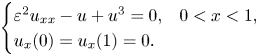
 were established. In this paper, we apply the method developed in the previous paper to our case. We show that all the eigenvalues can be classified into three categories, i.e., near $-3$
 eigenvalues, near $0$
 eigenvalues and the other eigenvalues. We see that the number of the near $-3$
 eigenvalues (resp. the near $0$
 eigenvalues) is equal to the number of the interior and boundary peaks (resp. the interior peaks) of a solution for the nonlinear problem. The main technical tools are various asymptotic formulas for complete elliptic integrals.


Fixed point conditions for non-coprime actions
- Part of:
-
- Published online by Cambridge University Press:
- 11 September 2023, pp. 345-351
-
- Article
-
- You have access
- Open access
- HTML
- Export citation
-
In the setting of finite groups, suppose $J$
 acts on $N$
 via automorphisms so that the induced semidirect product $N\rtimes J$
 acts on some non-empty set $\Omega$
 , with $N$
 acting transitively. Glauberman proved that if the orders of $J$
 and $N$
 are coprime, then $J$
 fixes a point in $\Omega$
 . We consider the non-coprime case and show that if $N$
 is abelian and a Sylow $p$
 -subgroup of $J$
 fixes a point in $\Omega$
 for each prime $p$
 , then $J$
 fixes a point in $\Omega$
 . We also show that if $N$
 is nilpotent, $N\rtimes J$
 is supersoluble, and a Sylow $p$
 -subgroup of $J$
 fixes a point in $\Omega$
 for each prime $p$
 , then $J$
 fixes a point in $\Omega$
 .
.


The non-autonomous Navier–Stokes–Brinkman–Forchheimer equation with Dirichlet boundary conditions: dissipativity, regularity, and attractors
- Part of:
-
- Published online by Cambridge University Press:
- 13 September 2023, pp. 352-393
-
- Article
-
- You have access
- Open access
- HTML
- Export citation