To save content items to your account,
please confirm that you agree to abide by our usage policies.
If this is the first time you use this feature, you will be asked to authorise Cambridge Core to connect with your account.
Find out more about saving content to .
To save content items to your Kindle, first ensure no-reply@cambridge.org
is added to your Approved Personal Document E-mail List under your Personal Document Settings
on the Manage Your Content and Devices page of your Amazon account. Then enter the ‘name’ part
of your Kindle email address below.
Find out more about saving to your Kindle.
Note you can select to save to either the @free.kindle.com or @kindle.com variations.
‘@free.kindle.com’ emails are free but can only be saved to your device when it is connected to wi-fi.
‘@kindle.com’ emails can be delivered even when you are not connected to wi-fi, but note that service fees apply.
Medicine is a highly complex profession which requires students to acquire a broad range of competencies. Apart from knowledge and kinaesthetic skills, they must also become proficient in the art of medicine, learning to communicate effectively in different clinical and social environments. This is not a simple task for the learners, and it requires deep educational competencies from the senior colleagues and peers involved in clinical training. Medical training predominantly occurs in healthcare workplaces, which are socio-culturally diverse. Doctors in training need to balance the need to learn with service obligations, whilst navigating each workplace’s cultural norms and this can be a significant challenge.
Medical educators modify the risks of sexual harassment by leading initiatives around professionalism. This includes developing professionalism curriculum, teaching and assessing professionalism competencies, managing learning environments, and leading teaching teams. In this chapter, we examine the role of medical education in teaching, assessing and remediating interpersonal competencies and attitudes. In doing so, we recognise different forms of power, conscious and unconscious, and propose strategies for understanding and managing risk.
This chapter provides a loose, non-linear history of the term ‘workplace sexual harassment’, exploring the many ways it has been conceptualised, problematised and managed. First, it describes how the term ‘sexual harassment’ developed through advocacy for real-world change, from grassroots activism to legal scholarship. Second, it outlines theories of sexual harassment guiding empirical inquiry and understanding in social sciences. Third, it explores the ways that changing the context in which a term is used can also change its function. The chapter concludes by discussing implications for implementing these critical approaches to bring about change in the context of workplace sexual harassment in medicine.
One is not born, but rather becomes, a woman doctor. This chapter addresses medicine itself as a highly gendered institution, constructed around hegemonic masculinity. How a woman learns to perform gender as it is expected for a doctor involves a complex negotiation regarding her body. She must be both present in and absent from her body - one of the many features placing women doctors at increased sexual risk in the workplace. The chapter delves into the historical context of these challenges and their contemporary implications, highlighting the need for continued efforts to promote gender equity in the medical profession.
This chapter discusses the role of men in abuse of doctors by doctors. The chapter considers the role of men at all levels including victim, bystander, perpetrator, employer or those within the regulatory and legal systems. The chapter helps us to understand and look beneath the obvious drawing on the evidence of men’s roles at all levels. It also speaks to the potential of men to positively influence for change and prevention of abuse, as well as drawing our attention to possible risks of abuse occurring. It raises our awareness of the ‘not so innocent bystander’ and the significant potential of engaging bystanders, colleagues, and system leaders into positive action.
Medicine is a profession built on the pillars of compassion and healing. Paradoxically, the medical community is plagued by a pervasive culture of bullying, harassment, and abuse. Women in medicine face particular challenges, often experiencing gendered forms of harassment that further marginalize them. The fear of retaliation, stigma, and career repercussions deters many from reporting such incidents, perpetuating a culture of silence.
This toxic environment not only harms individuals but also compromises patient care. Early exposure to such behaviors during medical training can have lasting negative effects on professional and personal identity and well-being. To address this pressing issue, it is imperative to foster a supportive and inclusive culture within medical institutions, where individuals feel empowered to speak up and seek help without fear. When organising care, providers need to be aware of the complexity of treating doctors who may themselves be therapists. The complexities of the relationships between doctors and their doctor patients need to be considered, especially when stigma and shame influence care.
The academic training of professionals influences the evolution and future direction of scientific disciplines. However, the training background and demographic composition of weed science faculty have not been systematically characterized. To address this, we conducted an Internet-based survey of weed science faculty at universities in the United States of America that included the academic fields of the degrees these faculty had received, the institutions that granted these degrees, which U.S. states or countries (if outside the United States) the degrees came from, the current academic rank of each faculty member, whether the faculty held leadership positions at their universities, and the gender of each faculty member. We identified 223 faculty at 50 universities. They received their degrees from institutions in 24 countries and 39 U.S. states. Most of their BS degrees were in agronomy and crop science or plant science, physiology, and genetics, with a few weed science and ecology degrees. Weed science and ecology representation increased at the MS level and became the most common doctoral training area. A plurality of the faculty were professors (48.9%), followed by assistant professors (28.7%), associate professors (19.7%), lecturers (0.9%) and unidentified rank (1.8%). Men made up 82.5% of the faculty with women at 17.5%. Men also held more of the leadership positions (84.4%) than women (15.6%). These findings provide the first comprehensive overview of the weed science academic workforce of the United States and establish a baseline for evaluating future trends in training pathways, disciplinary identity, workforce diversity, and potential continental or international comparisons.
Studies on authorship in archaeology have revealed inequalities that influence interpretations of archaeological narratives. Like other countries with rich archaeological heritage, Guatemala has drawn a diverse pool of researchers for decades, owing to its renowned Maya heritage. This study examines how gender and nationality shape knowledge production in Guatemalan archaeology. We analyze publication trends in Guatemala’s most prominent publication venue, the memoirs of the annual archaeology symposium, and two international journals: Latin American Antiquity and Estudios de Cultura Maya. We also incorporate alumni data from Guatemalan universities and responses from an exploratory survey of 103 local archaeologists regarding occupations, identities, and perceptions of inequalities. Our study reveals that although Guatemalan archaeology has been characterized by relative gender parity, the dissemination of academic knowledge has been predominantly led by men, even during periods when there have been more female professional archaeologists. These disparities likely stem from several factors, including occupational variations, traditional gender-role expectations, and institutional barriers. While men have traditionally led the dissemination of academic knowledge, women have achieved leadership in other domains. This study highlights the current state of diversity in Guatemalan archaeology and serves as a first step toward building a more inclusive archaeological community.
A growing number of people around the world identify, in some way, as Lesbian, Gay, Bisexual, Transgender, and Queer (LGBTQ+); yet, these voices are noticeably absent from nonprofit research. To address issues of equity and the historic marginalization of LGBTQ+ people both societally and in the nonprofit sector, this manuscript seeks to answer the following questions: Why is it important to include sexual orientation and gender identity and expression (SOGIE) survey questions in nonprofit surveys? What are best practices for including SOGIE survey questions in nonprofit research? We present LGBTQ+ inclusive research strategies and suggested questions for inclusive SOGIE survey design. Though this article focuses primarily on surveying LGBTQ+ populations, it can also be instructive for general population surveys.
In STEM fields, women tend to leak out of the pipeline to the professoriate. In archaeology, however, robust databases and chronological control reveal that there is no leakage from earning a PhD to tenure-track positions. Nor is there a leak from assistant professor to associate professor. Nevertheless, men get hired as faculty in PhD programs more often than women. This is important because PhD programs are research-intensive and train future leaders. Furthermore, women PhD students have women as advisers more than often men and report advantages to this arrangement. Yet with fewer women faculty in PhD programs, women mentors are in short supply. Potential solutions to these problems target areas where bias can intervene. Specifically, job search committees should (1) wait until late in the process before consulting letters of recommendation, (2) standardize the valorization of coauthorship for both men and women, and (3) prioritize applicants who match the job description when creating long lists. Finally, implicit bias training is critically important, and mentoring should be continuous and enthusiastically positive.
To investigate the associations among income from work, the gender of the reference person, family and food insecurity (FI).
Design:
This quantitative study used nationally representative data from the 2018 Brazilian Family Budget Survey.
Setting:
The analyses estimated levels of food security and insecurity measured by the Brazilian Food Insecurity Scale according to labour income determined by the minimum wage per capita and the sex of the reference person (female/male). The logistic regression model measured the interaction between work income and gender in association with household FI.
Participants:
Brazilian families living in permanent households with at least one resident earning income from employment (n 48 625).
Results:
Households headed by women and with labour income ≤ ¼ minimum wage per capita had the highest percentage of moderate/severe FI (29·7 %). In these families and households with lower levels of employment income headed by men, the highest probabilities of moderate/severe FI were observed, at 10·8 and 9·6, respectively, compared with families with higher levels of employment income headed by men.
Conclusions:
Lower employment income contributes to FI in families, especially those that are headed by women. The socialisation of care work and the reduction in paid labour hours contribute to greater access to the labour market for women and a lower likelihood of FI.
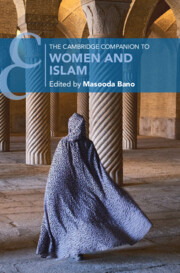
The Cambridge Companion to Women and Islam provides a comprehensive overview of a timely topic that encompasses the fields of Islamic feminist scholarship, anthropology, history, and sociology. Divided into three parts, it makes several key contributions. The volume offers a detailed analysis of textual debates on gender and Islam, highlighting the logic of classical reasoning and its enduring appeal, while emphasizing alternative readings proposed by Islamic feminists. It considers the agency that Muslim women exhibit in relation to their faith as reflected in women's piety movements. Moreover, the volume documents how Muslim women shape socio-political life, presenting real-world examples from across the Muslim world and diaspora communities. Written by an international team of scholars, the Companion also explores theoretical and methodological advances in the field, providing guidance for future research. Surveying Muslim women's experiences across time and place, it also presents debates on gender norms across various genres of Islamic scholarship.
Gender imbalance in the sciences is a problem that affects society as a whole. Attracting more women to science is a matter of welcoming 50% of the intellectual capacity of humankind. As institutions, science museums have the mission of expanding society access to scientific knowledge and encouraging the excitement of discovery. Further, they must also engage diverse audiences and address the many facets of inclusion. Therefore, it is fundamental to reflect on gender issues and adapt the content of exhibits and activities to be inclusive. The Museum of Astronomy and Related Sciences (MAST) has long been aware of its potential to promote social change and empowerment. Since 2015, MAST promotes a series of actions to stimulate discussion, acknowledge the contribution of female researchers to progress as well as encourage girls to explore scientific career paths through astronomy activities. All initiatives are built on theoretical perspectives of social inclusion, gender in sciences and informal science education. This article will review the “Girls in the Museum” action and present its most important results.
Eliminating cervical cancer is about more than just spending money. It requires reckoning with the many intangibles that get in the way of this cause. Widespread adherence to patriarchal value systems, for instance, not only threatens women’s health and well-being, but discourages them from freely pursuing the means to a cure. Persons with cervixes must confrontnot only archaic notions about their worth, but also many other hidden barriers to prevention. These include the fear and superstition that arise from lack of knowledge and medical misinformation, a lack of appreciation for self-care, the burden of unpaid work, and the vulnerability resulting from racial and gender inequality. Challenging these societal factors will increase the volume of women’s voices and ultimately save thousands of lives. But until society is ready to acknowledge and address these barriers – the patriarchal structures thwarting women’s autonomy and decision-making power, the stigma associated with this disease, the religious intolerances and traditional values contrary to its prevention – a cancer that strikes only those with a cervix will continue to kill.
I am pleased to introduce this Symposium Edition of The Journal of Law, Medicine & Ethics, which covers a wide variety of issues central to transgender health equity, including Dr. Jamison Green’s recent history of the impact of health policy on transgender communities, Dr. M. Killian Kinney, Ms. Taylor Pearson, and Prof. Julie Ralston Aoki’s transgender equity tool for legal policy analysis, and Prof. Elizabeth Kukura’s analysis of issues facing transgender, non-binary, and gender expansive people during pregnancy and childbirth.
Transgender and gender diverse (TGD), Black, and Latinx communities have long borne a disproportionate share of the U.S. HIV epidemic, yet these same key demographics are continually underrepresented in national PrEP prescriptions. Black, Latinx, and TGD individuals are also more likely to be uninsured, meaning that a proposed federal program to cover PrEP for people without insurance could provide significant benefit to potential PrEP users from these populations. However, coverage of PrEP costs alone will not end disparities in uptake. This commentary provides additional context and recommendations to maximize effectiveness of a national PrEP program for TGD, Black, and Latinx populations in the US.
Research in cardiac care has identified significant gender-based differences across many outcomes. Women with heart disease are less likely both to be diagnosed and to receive standard care. Gender-based disparities in the prehospital setting are under-researched, but they were found to exist within rates of 12-lead electrocardiogram (ECG) acquisition within one urban Emergency Medical Services (EMS) agency.
Study Objective:
This study evaluates the quality improvement (QI) initiative that was implemented in that agency to raise overall rates of 12-lead ECG acquisition and reduce the gap in acquisition rates between men and women.
Methods:
This QI project included two interventions: revised indications for 12-lead acquisition, and training that highlighted sex- and gender-based differences relevant to patient care. To evaluate this project, a retrospective database review identified all patient contacts that potentially involved cardiac assessment over 18 months. The primary outcome was the rate of 12-lead acquisition among patients with qualifying complaints. This was assessed by mean rates of acquisition in before and after periods, as well as segmented regression in an interrupted time series. Secondary outcomes included differences in rates of 12-lead acquisition, both overall and in individual complaint categories, each compared between men/women and before/after the interventions.
Results:
Among patients with qualifying complaints, the mean rate of 12-lead acquisition in the lead-in period was 22.5% (95% CI, 21.8% - 23.2%) with no discernible trend. The protocol change and training were each associated with a significant absolute level increase in the acquisition rate: 2.09% (95% CI, 0.21% - 4.0%; P = .03) and 3.2% (95% CI, 1.18% - 5.22%; P = .003), respectively. When compared by gender and time period, women received fewer 12-leads than men overall, and more 12-leads were acquired after the interventions than before. There were also significant interactions between gender and period, both overall (2.8%; 95% CI, 1.9% - 3.6%; P < .0001) and in all complaint categories except falls and heart problems.
Conclusion:
This QI project resulted in an increase in 12-leads acquired. Pre-existing gaps in rates of acquisition between men and women were reduced but did not disappear. On-going research is examining the reasons behind these differences from the perspective of prehospital providers.
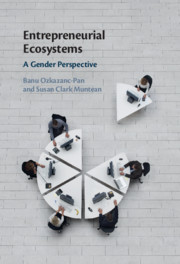
Based on extensive fieldwork, this book demonstrates how gender is an organizing principle of entrepreneurial ecosystems and makes a difference in how ecosystem resources are assembled and how they can be accessed. By bringing visibility to how ecosystem actors are heterogeneous across identities, interactions and experiences, the book highlights the role and complexity of individual, organizational, and institutional factors working in concert to create and maintain gendered inequities. Entrepreneurial Ecosystems provides research-driven insights around effective organizational practices and policies aimed at remedying gendered and intersectional inequalities associated with entrepreneurship activities and economic growth. Proposing a typology of four ecosystem identities, it highlights how some might be more amenable and organized towards gender inclusion and change, while others may be much more difficult to change, reorganize and restructure. It offers scholars, students, practitioners and policymakers insights about gender in relation to analyzing entrepreneurial ecosystems and for fostering inclusive economic development policies.
Suicide is a public health problem which has biopsychosocial aspects. These three compartments function differently for women and men in terms of biology and gender inequality.
Objectives
This study aims to investigate completed suicide rates in Turkey for women and men seperately considering age ranges for each, and their relationship with gender equality.
Methods
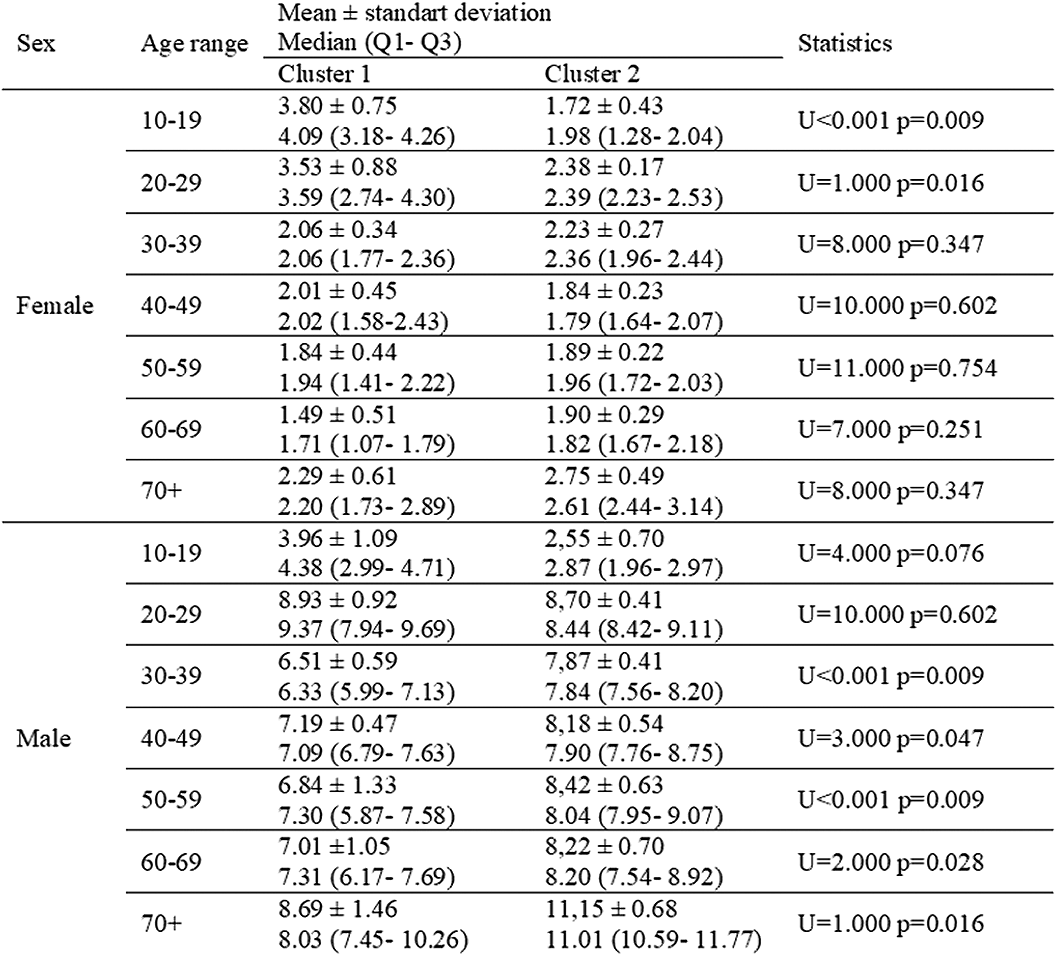
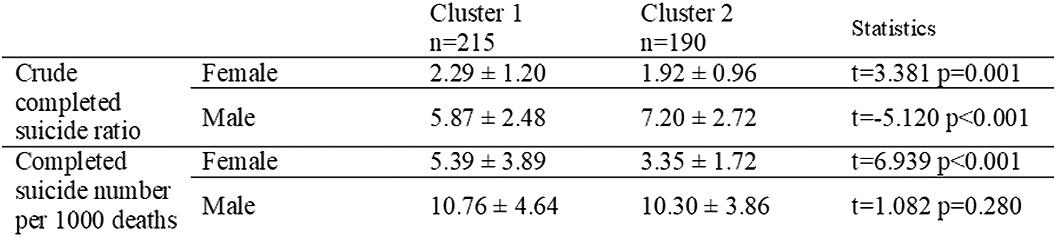
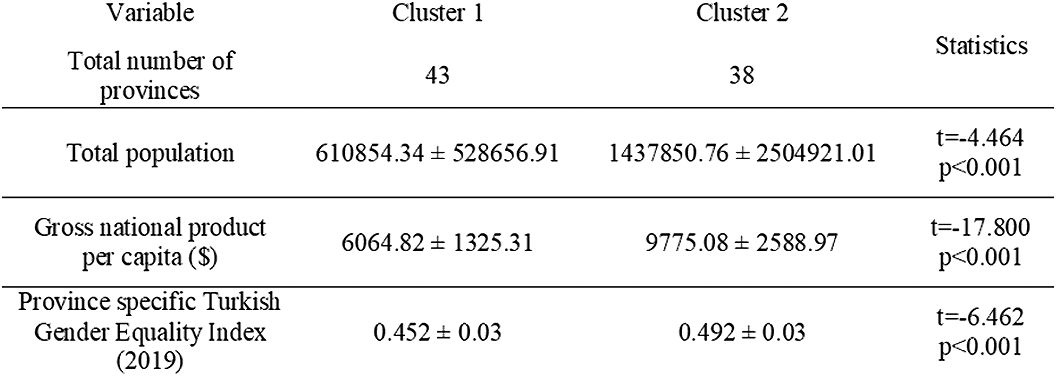
Sex and age specific data between 2015-2019 was derived from Turkish Statistical Institute. Utilizing Bağdatlı Kalkan’s study (2018) and Turkey’s Gender Equality Ratings (2019), 81 cities were seperated into two clusters (Table 1). Mann Whitney U and Independent Samples T Test were applied.
Results
Young women’s (<30 years old) crude completed suicide rates were higher, when crude completed suicide rates for men over the age of 30 were fewer in the cities which equality index is low (Table 2). Regardless of age ranges, in better gender equality cluster, female suicide rates were fewer, male suicide rates were higher. The number of deaths by suicide in 1000 deaths didn’t differ for men, while the rate decreases for women in better gender equality cluster (Table 3).
Conclusions
Gender inequality may negatively effect young women’s mental health in more patriarchal cities in Turkey from the point of completed suicide.
Gender disparities between Emergency Medicine physicians with regards to salary, promotion, and scholarly recognition as national conference speakers have been well-documented. However, little is known if similar gender disparities impact their out-of-hospital Emergency Medical Services (EMS) colleagues. Although there have been improvements in the ratio of women entering the EMS workforce, gender representation has improved at a slower rate for paramedics compared to emergency medical technicians (EMTs). Since recruitment, retention, and advancement of females within a specialty have been associated with the visibility of prominent, respected female leaders, gender disparity of these leaders as national conference speakers may contribute to the “leaky pipeline effect” seen within the EMS profession. Gender representation of these speakers has yet to be described objectively.
Study Objective:
The primary objective of this study was to determine if disparity exists in gender representation of speakers at well-known national EMS conferences and trade shows in the United States (US) from 2016-2020. The secondary objective was to determine if males were more likely than females to return to a conference as a speaker in subsequent years.
Methods:
A cross-sectional analysis of programs from well-known national conferences, specifically for EMS providers, which were held in the US from 2016-2020 was performed. Programs were abstracted for type of conference session (pre-conference, keynote, main conference) and speakers’ names. Speaker gender (male, female) was confirmed via internet search.
Results:
Seventeen conference programs were obtained with 1,709 conference sessions that had a total of 2,731 listed speaker names, of whom 537 (20%) were female. A total of 30 keynote addresses had 39 listed speaker names of whom six (15%) were female. No significant difference was observed in the number of years males returned to present at the same conference as compared to females.
Conclusion:
Gender representation of speakers at national EMS conferences in the US is not reflective of the current best estimate of the US EMS workforce. This disparity exists not only in the overall percent of female names listed as speakers, but also in the percent of individual female speakers, and is most pronounced within keynote speakers. Online lecture platforms, as an unintentional consequent of the COVID-19 pandemic, coupled with intentional speaker development and mentorship initiatives, may reduce barriers to facilitating a new pipeline for more females to become speakers at national EMS conferences.
This paper explores gender mainstreaming in the context of health policy and health variations between women and men. Despite the adoption of gender mainstreaming at international, regional and national scales since the Beijing Platform for Action in 1995, gender inequalities in health persist. The paper argues that the translation of gender mainstreaming as a global policy paradigm across and between policy scales has significance for health policies aiming to address gender. The paper suggests that while gender mainstreaming originated to address women's needs, the paradigm is founded on goals that do not translate in health policy; that the representation of the problem of gender in this global paradigm is problematic in a health context; and that the role of global networks in policy translation as part of this paradigm has led to the replacement of transformative ideals with technocratic solutions which shift the focus away from gender relations of power.