To save content items to your account,
please confirm that you agree to abide by our usage policies.
If this is the first time you use this feature, you will be asked to authorise Cambridge Core to connect with your account.
Find out more about saving content to .
To save content items to your Kindle, first ensure no-reply@cambridge.org
is added to your Approved Personal Document E-mail List under your Personal Document Settings
on the Manage Your Content and Devices page of your Amazon account. Then enter the ‘name’ part
of your Kindle email address below.
Find out more about saving to your Kindle.
Note you can select to save to either the @free.kindle.com or @kindle.com variations.
‘@free.kindle.com’ emails are free but can only be saved to your device when it is connected to wi-fi.
‘@kindle.com’ emails can be delivered even when you are not connected to wi-fi, but note that service fees apply.
Haiti was a remarkably constant presence in Carpentier’s life and its imprint on his narrative fiction and essays has been profound, far-reaching, and indelible. Carpentier’s fascination with Haiti begins with his first novel, ¡Écue-Yamba-Ó! (1933), culminates in The Kingdom of This World (1949) and resurfaces within the transatlantic context of the French Revolution in yet another major work, Explosion in the Cathedral (1962). While traces of Haiti appear in myriad formal and conceptual manifestations throughout Carpentier’s oeuvre, in this essay I suggest that the notion of the Plantationocene, forged by Donna Haraway and Donna Tsing, carries significant critical potential for refocusing Carpentier’s links with Haiti in a manner that is both transdisciplinary and cross-historical.
Anti-Haitian sentiment is so entrenched in the Dominican Republic that it has its own name: antihaitianismo. The long history of discrimination and persecution of Haitians and Dominicans of Haitian descent includes a massacre in 1937, which claimed around 18,000 lives. While such large-scale violence has not been repeated, Haitians and Haitian–Dominicans have experienced ongoing discrimination and human rights violations. Since the 1990s, there have been repeated mass deportations into Haiti, and in the 2010s, over 100,000 Haitian–Dominicans were stripped of their citizenship, rendering them stateless. By the early 2000s, many recognised the presence of risk factors for genocide in the Dominican Republic. Yet despite the risk, such violence did not occur. Moreover, since then multiple risk assessment models have documented decreasing risk. This chapter explores this constructive trajectory. It considers the risk factors and the factors that have promoted resilience over the period in question. Understanding how and why the violence of 1937 has not been repeated, and the gradual amelioration of risk in the Dominican Republic, can help us identify key factors that promote resilience to genocide.
Haiti is experiencing a severe humanitarian crisis characterised by political instability and economic and security hardship. These adversities contribute to significant mental health challenges, which are also exacerbated by poor access to psychological support due to a shortage of specialised professionals. Problem Management Plus (PM+), a scalable and low-intensity intervention developed by the World Health Organization, is based on a task-sharing approach to address the treatment gap by training non-specialist helpers to provide psychosocial support.
Aims
This study aimed to explore the implementation process of PM+ in Haiti, focusing on the barriers and facilitators that influenced its delivery. Specifically, the study focused on understanding the contextual factors affecting intervention accessibility, participant experiences and potential adaptations to enhance its effect.
Method
A qualitative study was conducted across three Haitian cities, where trained helpers delivered PM+. Data were collected through the PSYCHLOPS tool with end-users and via cognitive interviews with stakeholders. Thematic analysis was conducted incorporating Lund’s social determinants of mental health model and Bronfenbrenner’s ecological systems theory to interpret findings.
Results
Sixteen end-users and five stakeholders participated in the study. Key barriers to implementation and its success mainly included economic constraints and safety concerns. Facilitating factors included strong community engagement, adaptive implementation strategies (such as flexible scheduling, remote supervision and culturally responsive adjustments), alongside strong organisational support. End-users described substantial difficulties in managing everyday problems and emotional distress, as reported during pre-intervention qualitative assessments.
Conclusions
PM+ appeared feasible in the Haitian context from an implementation perspective; however, its implementability depends on cultural adaptations, economic considerations and sustained support for facilitators. Addressing systemic barriers and integrating task-sharing interventions within existing health structures could enhance the long-term impact.
This chapter addresses the Black Atlantic threads contained in Pablo Neruda’s corpus, mainly in Canto general (1950) and Canción de gesta (Song of Protest, 1960). The chapter is particularly focused on moments of poetic representation of the Atlantic slave trade and its aftermath. In this vein, it discusses the Caribbean literary influences – and specifically Négritude and Negrismo movements – that impacted Neruda’s writing, including the Martinican poet Aimé Césaire and the Cuban poet Nicolás Guillén. As a result, this essay unveils Neruda’s sociological but also political motivations for including the historiographical context of the Black Caribbean in his work, including Cuba’s Black internationalism in Canción de gesta. This latter part of the chapter, which is informed by a personal interview with Roberto Fernández Retamar, sheds light on the political reasons for the neglect of Neruda’s Black Atlantic in Canción de gesta, and offers considerations for correcting the overlooked dimensions of his work.
Chicago’s Columbian Exposition, or White City, marked the 400th anniversary of Columbus’s “discovery” of the “New World” and showcased Chicago’s ambition to be a modern metropolis. While Chicago’s architecture is often labeled as Beaux-Arts or Roman, this chapter argues that the architecture of its key buildings and central spaces embodied the bricolage of the neo-antique. The White City established neo-antique architecture as the preferred architectural idiom for American world’s fairs. This architecture also demonstrated that the United States was now a cultural, economic, and political powerhouse. The lasting impact of the White City’s architecture is evident in urban planning, especially in the City Beautiful movement and in civil buildings built after the fair. Other buildings at the fair, such as Haiti’s pavilion, also utilized classicizing architecture. For Haiti, the ideals of democracy and the cultural cachet of classical culture informed the choice of classical architecture here. Ancient Egyptian architecture also appeared in the form of a replica of the Temple of Luxor, located in the Midway Plaisance, the fair’s entertainment zone, aiming to educate and entertain visitors. The reception of ancient architecture at the White City reflects the complex and sometimes contradictory relationship between nineteenth-century America and the ancient world.
This study aimed to: (1) identify optimal blended food recipe options using local flours; (2) assess behaviors, attitudes, and practices around the use of blended foods among nutritionally vulnerable groups in Haiti; and (3) evaluate the nutrient composition of prototype blended food product relative to nutrient requirements for vulnerable populations.
Methods
Blended food recipes made from local flours were identified through matrix scoring and stakeholder consensus. Focus groups (n = 7) assessed behaviors and attitudes toward blended foods. Prototype recipes were selected based on matrix scoring, program participant feedback, and feasibility of bringing to scale. Nutrient composition of the final prototype was analyzed for consumer information and compared to requirements for young children and pregnant/lactating women.
Results
Two food prototypes resulted. Only the sweet blended food product could be scaled for testing due to the lack of availability of fish for the savory recipe. Focus groups highlighted positive views on balanced nutrition and healthy eating but raised concerns about costs and safety. Nutrient composition analysis of the final prototype showed varying proportions of requirements attained across nutrients.
Conclusions
Blended foods made from Haitian-grown ingredients and food aid offer promise to improve nutrition for target populations but face challenges in scaling to market.
Chapter 4 explores how the literary collection adapted to audio recording to form a species of sonic cartography. I argue that Zora Neale Hurston’s fieldwork in Jamaica and Haiti presented US borders in stereo, both offset from Caribbean islands and overlapping with them. Hurston’s notion of a sonic boundary is distinct from that heard by Jean Toomer, for whom folksong is a spiritual rejoinder to the violence of agricultural labor. Toomer’s swansong to Georgia’s small-town sugarcane harvest is echoed and distorted by Cuban soundscapes. Poems about cane harvest by Agustin Acosta and Nicolás Guillén document of Cuba’s rather different agricultural identity and pose toward US imperium. In these cartographies, I argue, the line demarcating continental nation from island colony is not just aquatic, but also sonic: heard in stereo, and often out of phase.
This study aims to contribute to enhanced food security in Haiti through proposing targeted local interventions. Employing a spatially explicit tool, the research supports decision-making by relating undernutrition to socio-economic conditions and biophysical factors.
Design:
Georeferenced Demographic and Health Survey (DHS) conducted in 2016–2017 combined with spatial environmental information was used for a multivariate linear regression model to identify factors associated with stunting prevalence. Missing data were imputed through kernel density regression. We converted the structural relationship estimated for the territory of Haiti into a decision support tool by adding fixed effects at communal level. Various policy scenarios were analysed.
Setting:
Haiti, with spatial data across the 134 communes.
Participants:
The analysis included 5623 children under five and their mothers, sourced from DHS data.
Results:
Approximately 22 % of all children were stunted. Implementation of the LimitedIntervention development scenario led to a 2·5 % reduction in stunting, while the ModerateIntervention and FullIntervention scenarios achieved more significant reductions of 6 % and 10 %, respectively. Areas with highest stunting incidence benefit most from interventions.
Conclusions:
This tool supports decisionmakers by assessing the impact of interventions at commune level and selecting areas where interventions exert the most significant effects. The study suggests to apply a strategy that starts in relatively safe communes and then scales to other areas. The flexible approach adopted in this study allows applications in other countries or regions to assess the prevalence of undernutrition among children under five.
Gérants—plantation managers in eighteenth-century Saint-Domingue—occupied a unique position as indispensable intermediaries and agents of a thriving hidden economy. Responsible for overseeing enslaved labour and maximising plantation productivity, they operated within the tensions of absentee ownership and the structural contradictions of the colonial economy. The cases of Binet and Arnaudeau, two gérants under absentee landlords, reveal how their autonomy facilitated fraudulent practices and illicit trade. These activities, driven by economic necessity and personal ambition, expose the complex interplay of trust, delegation, and exploitation at the heart of plantation life. By bringing these hidden economies to light, the role of the gérant emerges as central to both the economic prosperity of Saint-Domingue and the broader dynamics of colonial slavery and economic history.
This chapter links Haiti’s ambivalent place in the Latinx literary imaginary to deep-seated anxieties about race, nation, and belonging entangled in representations of Haiti since the Haitian Revolution and the formation of the Latinx literary canon. It argues that in last thirty years the historical exclusion of Haitian American literature from the Latinx literary canon has come increasingly under pressure due to shifting terminology, the broad turn toward recuperating legacies of the Haitian revolution across academic disciplines, and the institutionalization of Dominican American Studies in the United States. The chapter concludes with close readings of Julia Alvarez’s memoir A Wedding in Haiti (2012), Félix Morisseau-Leroy’s poem “Tourist,” and Loida Maritza Pérez’s novel Geographies of Home (2000) to illustrate both the possible pitfalls and promising potential of transnational approaches linking the literatures of the Dominican Republic, Haiti, and their diasporas.
Despite the decline in mortality rates among children in developing countries, disparities persist between countries, particularly between twins and singletons. This study employed data from nine Demographic and Health Surveys in the Dominican Republic and Haiti to estimate and compare mortality rates for twins and singletons in categories of the under-5 age group (neonatal, postneonatal, and child mortality) and examine the factors associated with excess mortality among twins. From 1996 to 2013, the under-5 mortality rate (U5MR) for singletons in the Dominican Republic declined from 56‰ (95% CI [47, 64) to 30‰ (22–39) and from 108‰ (53–164) to 53‰ (16–89) among twins. In Haiti, between 1994 and 2016, the U5MR declined from 121‰ (109–133) to 77‰ (68–80) for singletons and from 432‰ (327–538) to 204‰ (149–260) among twins. The adjusted risk of neonatal death for twins is 1.4 (1.0–1.9) times higher than for singletons in the Dominican Republic, compared to a risk of 4.3 (3.5–5.3) times higher in Haiti. In the post-neonatal period, the mortality risk for twins in the Dominican Republic was 1.8 (1.0–3.1) times higher than that for singletons, 2.9 (2.3–3.8) in Haiti. The risk of death for twins was not significantly different from that for singletons in both the Dominican Republic and Haiti at ages 1–4 years. Low birth weight, lack of breastfeeding, absence of, or inadequate, antenatal care, noncesarean section birth, and high birth order were associated with excess mortality among twins in both countries.
This article examines the history of Haitian-owned freighters that have been trading between Haiti and the Miami River since the 1970s, how this shipping economy became racialized in ways that marked it and the river with a “threatening” Haitian Blackness, and how local government agencies, real estate developers, and law enforcement officials worked to remake the aesthetics of the river as something other than Haitian and Black. Projects to re-racialize the riverway played with the spurious surface-and-subsurface spatial logic of racial discourses more generally—that is, the mistaken but widely-held belief that visible, physical markers of race reveal hidden capacities and propensities. Policing that pushed Haitian commerce into an economy of containerization—a race- and class-marked shipping technology on the river—allowed the Haiti trade to “pass” as non-Haitian on a gentrifying waterway. Law enforcement programs that seized and sank Haitian freighters to create artificial reefs off the Florida coast bluewashed the river’s surface and its ethnoracially coded, “polluting” vessels by transforming them into subsurface, “White” recreational ecologies. These processes reveal how politically fraught contests over racialization recruit layered material environments as part of larger projects of policing, re-racialization, and urban renewal. In exploring this history, the article pushes against arguments from some quarters for a “post-critical” turn by demonstrating that reflexive critique, with its focus on the hidden and the submerged, remains necessary for grasping the ways racialization processes operate through structures of material and discursive layering.
The declarations of rights issued during the American and French revolutions are the most important outcomes of the eighteenth-century’s debates about natural rights. Concise and clear in their language, these declarations distilled decades of theorizing into easily understood axioms meant to make citizens aware of their rights and of their entitlement to participate in the making of the laws under which they lived. The eighteenth-century declarations on both sides of the Atlantic were drawn up by legislators determined to protect the institution of slavery that so flagrantly contradicted their sweeping statements about natural rights, and they were not intended to grant women equal rights with men. Their expansive language, however, provided a basis for excluded groups to formulate demands that rights be extended to them, even if the authors of the declarations had not intended to do so. The most influential of these documents, the 1789 French Declaration of the Rights of Man and of the Citizen, used sweeping, universal language. Intended as temporary, it was swiftly canonized as the embodiment of the principles of the French Revolution. The more radical French Declaration of 1793 incorporated social rights to welfare, work, and education. Napoleon rejected the idea of including a declaration of rights in the constitution he imposed in France 1799, but the 1948 Universal Declaration of Human Rights showed the lasting power of the tradition inaugurated with the Virginia Declaration of 1776.
As a result of French colonization, Haiti is a nation-state with a predominantly French-speaking written tradition. However, there is also a smaller body of Haitian texts written in Creole, dating back to the eighteenth century. Based on their linguistic and aesthetic characteristics, we can divide the corpus of Haitian Creole letters into two main chronological stages: the great period of emergence that stretches from colonial times to the middle of the twentieth century, and the period of emulation. The first period was dominated by texts of a mainly religious, administrative, and political nature. Written for the most part by high-ranking white settlers, these texts, using the local language, were intended for Creole-speaking slaves with a poor command of French. The second period, that of the autonomy of Creole letters or the beginnings of an authentic Creole literary tradition, began in the mid-twentieth century, in parallel with linguistic work to standardize the written code of the national language. This advance in the standardization of Creole led to a significant development of the language’s written code, particularly in the field of literature.
The focus of this chapter is Francophone Haitian women writers. These are writers who are bound by a common idiom, French and/or Creole, and who share similar concerns. What is to be ascertained is whether they occupy a territory in which literature acquires its full meaning. Given the dominance of male writers in Haitian literature, women writers may appear as marginal figures or minor voices. However, what this chapter demonstrates is that women writers have, over many years, challenged the status quo by simply being present and making their voices heard. They offer a female-centered perspective on the tensions and contradictions of Haitian society and, as such, open new doors to imagination. Dealing with such themes as love, loss, otherness, memory, and empathy, Haitian women writers have effectively affirmed the humanistic value of literature. The term écriture de l’urgence, coined by Yanick Lahens to define Haitian literature in general, acquires a special meaning when considering women authors. Urgency does not equate haste. Rather, it refers to the direct confrontation of the writer with reality, history, and the endless possibilities of language.
Over the past 30 years, scholarship has shifted from viewing the Haitian Revolution as largely an extension of the French Revolution to understanding it as a revolt from the perspective of Africa and Africans. Four related factors contribute to explanations of this change in perspective. First, historians trained in pre-colonial Africa began to study slavery in the Americas. The second factor is the emergence of Atlantic History as a field of study, the third is the Bicentennial commemorations of the start (1991) and the end (2004) of the Haitian Revolution, and the fourth is Michel-Rolph Trouillot's much celebrated, widely circulated, and extremely influential essay “Unthinkable History” (from Silencing the Past: Power and the Production of History; 1995), in which he critiqued the entire historiography of the Haitian Revolution and called for new perspectives. Taken collectively, the confluence of these four factors, all emerging prominently in the 1990s, contributed to the historiographical shift in Haitian scholarship that David Geggus labels “Kongomania.”
The two main points of Geggus's contribution to this issue of The Americas is to challenge this recent understanding of the Haitian Revolution as essentially an African revolt in the Caribbean led by Kongos, and to give scholars reason to focus more attention on the active role of Creoles. Collectively, the responses by John Thornton, James H. Sweet, and Christina Mobley to Geggus's article emphasize that the point of their scholarship was to offer a Kongo perspective on the Haitian Revolution from their training and expertise in African history, not produce a new orthodoxy.
Mental health is a significant public health challenge globally, and one anticipated to increase following the COVID-19 pandemic. In many rural regions of developing nations, little is known about the prevalence of mental health conditions and factors that may help mitigate poor outcomes. This study assessed the impact of the COVID-19 pandemic on mental health and social support for residents of rural Haiti. Data were collected from March to May 2020. The Patient Health Questionnaire subscales for anxiety and depression, and the Perceived Stress Scale were utilized in addition to tailored questions specific to COVID-19 knowledge. Half (51.8%) of the 500 survey respondents reported COVID-19-related anxiety and worrying either daily or across a few days. Half (50.2%) also reported experiencing depression daily or across several days. Most (70.4%) did not have any social support, and 28.0% experienced some stress, with 13.4% indicating high perceived stress. Furthermore, 4.6% had suitable plumbing systems in their homes. The results were immediately actionable, informing the implementation of a mental health counseling program for youth following a loss of social support through school closures. Long-term investments must be made as part of public health responses in rural communities in developing nations, which remain under-studied.
Histories of colonial energy tend to emphasize the development of the steam engine, the rise of electric power, or the beginnings of industrial agriculture, through the rise of cash crops such as indigo, cotton, sugar, and tobacco. Chapter 1, “Powering the Soul: Queer Energies in Haitian Vodou,” argues that any history of colonial energy production must also recognize that nonhuman forms of power were dependent on the human energy of enslaved labor, particularly reproductive labor. Yet far from considering enslaved labor as the flexible, malleable unit of energy desired by capitalist production, this chapter instead argues that Vodou radically disrupted the logics of racial capital and coerced biological reproduction. Vodou personhood is antithetical to the calculus of racial capitalism, and its porosity, I argue, helped reconfigure the plantation’s structures of power to resist imperialist extraction. Through an archive that ranges from colonial treatises to Vodou practices and epistemologies, this chapter highlights the ways in which Haitians expanded the category of gender and reimagined the energies of labor and birthwork under conditions of biocapitalist violence.
In July 2019, in the midst of a record-breaking heat wave, Brooklyn went dark. In 90-degree temperatures, over 55,000 customers in Canarsie, Flatlands, Mill Basin, Bergen Beach, and Georgetown lost electricity in one of the largest power outages in New York’s history. Con Edison, the city’s power company, admitted that it deliberately disconnected these neighborhoods in order to prevent a widespread loss of power that would affect wealthier, whiter areas of the city. Although Black neighborhoods earn the highest scores in New York City’s heat vulnerability index (a ranking system that takes into account the proportion of green space to developed space, access to air conditioning, and the percentage of people living below poverty levels), they are the first on the line when the city’s infrastructure fails.1 What the index does not take into account, however, are the social and political risks to which these neighborhoods are also exposed during a blackout. After the lights went out, 200 police officers flooded Brooklyn, with the nebulous mandate to preserve order. A week earlier, the US Department of Justice had announced that it would not press charges against Daniel Pantaleo, the white police officer who killed Eric Garner on Staten Island in 2014. Now law enforcement roamed the streets of Canarsie, policing Black children for splashing water in 90-degree heat.
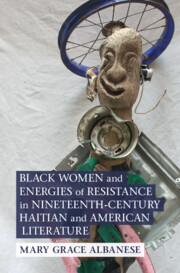
Black Women and Energies of Resistance in Nineteenth-Century Haitian and American Literature intervenes in traditional narratives of 19th-century American modernity by situating Black women at the center of an increasingly connected world. While traditional accounts of modernity have emphasized advancements in communication technologies, animal and fossil fuel extraction, and the rise of urban centers, Mary Grace Albanese proposes that women of African descent combated these often violent regimes through diasporic spiritual beliefs and practices, including spiritual possession, rootwork, midwifery, mesmerism, prophecy, and wandering. It shows how these energetic acts of resistance were carried out on scales large and small: from the constrained corners of the garden plot to the expansive circuits of global migration. By examining the concept of energy from narratives of technological progress, capital accrual and global expansion, this book uncovers new stories that center Black women at the heart of a pulsating, revolutionary world.