To save content items to your account,
please confirm that you agree to abide by our usage policies.
If this is the first time you use this feature, you will be asked to authorise Cambridge Core to connect with your account.
Find out more about saving content to .
To save content items to your Kindle, first ensure no-reply@cambridge.org
is added to your Approved Personal Document E-mail List under your Personal Document Settings
on the Manage Your Content and Devices page of your Amazon account. Then enter the ‘name’ part
of your Kindle email address below.
Find out more about saving to your Kindle.
Note you can select to save to either the @free.kindle.com or @kindle.com variations.
‘@free.kindle.com’ emails are free but can only be saved to your device when it is connected to wi-fi.
‘@kindle.com’ emails can be delivered even when you are not connected to wi-fi, but note that service fees apply.
Chinese analysts have paid close attention to the concept of European strategic autonomy (ESA). This is largely motivated by China’s long-held vision of a multipolar world wherein Europe is defined as one major pillar. To better reveal the Chinese understanding of ESA, this research adopts a combination of bibliometric analysis and documentary analysis of Chinese scholarly literature. Two takeaways can be drawn from this study. Firstly, China’s perception or expectation of ESA in terms of goals, scope, and approaches differs considerably from Europe’s practice. Secondly, China’s attitude toward ESA has evolved over time and across different domains and has grown increasingly ambivalent. Although the overall China-EU relationship is unlikely to experience a sharp turn in the near future, Chinese policymakers should be more realistic and better prepared for major changes because the EU has been readjusting its China policy in its quest for ESA.
Space systems are becoming an ever more important part of international security capabilities and practices. However, problematic interpretations of the Space Age are taking root in practitioner and academic circles along the contours of three sequential Space Ages. This article develops an original critique of these periodisations by applying a large technical systems approach and empirical research. It emphasises the role of space system builders and the prevalence of paradoxes in analysing space infrastructure as a method for critiquing three claims over the sweeping waves of democratisation, commercialisation, and militarisation in outer space that the periodisations make. This article proposes an alternative periodisation of a singular Global Space Age from 1957 that advances the counter-arguments that: first, power remains concentrated to a handful of space system builders rather than democratised to the many; second, that the space economy still relies on the state rather than being transferred to the private sector; and third, that the claims of sanctuary in space today ignore the spectre of space warfare that has long stalked space infrastructure. The infrastructural Global Space Age framing is offered as a useful materialist foundation for building bridges between international security, infrastructural technologies, and space security scholarship.
This Chapter conceptualizes security exceptions under international trade and investment agreements. In particular, it seeks to construct the chain that links trade and security-related issues arising from the application of security measures by clarifying the concept of national security to be used for the book, revisiting the current role of international organizations in balancing free trade and national security, ie the UN and the WTO, and finally contemplating the decision to incorporate security exceptions into international economic agreements or the decision to adopt security measures through the lenses of economic contract theory, the theories of international relations, such as realism, institutionalism, and constructivism, and the concept of securitization.
Why do adversaries sometimes cooperate to restrain their military competition? Why do they design arms control agreements with intrusive verification in some cases but rely on minimal transparency in others? Amidst ongoing international competition, arms control remains rare despite potential mutual benefits, and agreements vary dramatically in their approaches to monitoring. This book reveals how uncertainty from domestic political changes-such as leadership transitions or social unrest- can enable arms control. It identifies two paths to agreement: during periods of uncertainty, states that previously relied on informal understandings hedge by establishing lightly-monitored agreements, while those that anticipated deception take calculated risks through agreements with intensive verification. Through comprehensive data analysis and rich case studies, Jane Vaynman challenges conventional wisdom about uncertainty in international relations while offering insights for policymakers. As states confront challenges from nuclear competition to emerging technologies, understanding when arms control becomes viable is more vital than ever.
International security is an ambiguous concept – it has many meanings to many people. Without an idea of how the world works, or how security is defined and achieved, it is impossible to create effective policies to provide security. This textbook clarifies the concept of security, the debates around it, how it is defined, and how it is pursued. Tracking scholarly approaches within security studies against empirical developments in international affairs, historical and contemporary security issues are examined through various theoretical and conceptual models. Chapters cover a wide range of topics, including war and warfare, political violence and terrorism, cyber security, environmental security, energy security, economic security, and global public health. Students are supported by illustrative vignettes, bolded key terms and an end-of-book glossary, maps, box features, discussion questions, and further reading suggestions, and instructors have access to adaptable lecture slides.
This article introduces the Special Issue ‘South–South Security Cooperation and the (Re)making of Global Security Governance’. The contributions explore security-driven South–South interactions across the globe, assessing empirical, theoretical, and normative aspects. Our aim is to decentre debates on global security governance, traditionally focused on Northern-led cooperation, and to move beyond simplistic and simplifying assessments of South–South engagements. The Special Issue particularly highlights the ambiguities of South–South security cooperation, including varying degrees of global North involvement and differing interpretations of ‘security’ and ‘South–South’ among the involved actors. The contributions examine the practical outlook, normative consequences, and embeddedness of these cooperations within global hierarchies, and their implications for global security governance. This article sets the stage for this endeavor. Unpacking the categories ‘South’, ‘security’, and ‘cooperation’, we first provide a working definition of South–South security cooperation. Next, we offer a historical perspective, emphasising the role of legacy effects, institutional structures, geopolitical junctures, and international hierarchies in shaping South–South security cooperation. The concluding section presents the contributions to the special issue and discusses the implications of South–South security cooperation for understanding contemporary changes in global security governance.
Despite the growing interest in secondary state efforts to avoid choosing sides in great power competition, International Relations scholars have paid scant attention to the question of how great powers respond to secondary state ‘hedging’. We offer a first approximation for this important question by focusing on ‘high-value’ hedgers, i.e. secondary states whose location or capabilities afford them the potential to tip the scales in a great power war. We posit that great powers are likely to accommodate high-value hedgers and refrain from trying to manipulate their alignment choice. This is because the likelihood and costs of losing a high-value hedger are such that competing great powers would rather be safe than sorry. Concretely, we expect established and rising great powers to (re)assure high-value hedgers: the former by demonstrating their commitment to a regional balance of power, and the latter by showing they harbour no ill intent towards the hedging secondary state. To probe our argument, we examine how Great Britain and Germany responded to Dutch hedging in the early 20th century, and how the United States and China are responding to Singapore’s hedging today.
Multilateral diplomacy is defined as the management of relations among three or more nation-states, both within and outside international organizations. The main value of multilateral diplomacy is its ability to reduce the complexity of international relations in everyday life, including traveling, sending mail and solving crimes across borders. It produces agreements that are much more practical and less costly than a web of bilateral arrangements between individual countries, and it sets common standards that enable collaboration among scientists, engineers and businesses around the world. In addition to formal international organizations, multilateral diplomacy is practiced in informal or ad hoc groups and coalitions. There are few things in multilateral diplomacy more important than who writes the rules, who sets the agenda, and who holds the pen during negotiations.
The COVID-19 pandemic highlights a long-known but often neglected aspect of international relations: the ability of disease to challenge and change all aspects of security, as well as the ability of public policies to change the course of disease progression. Diseases, especially mass epidemics like COVID-19, clearly affect political, economic, and social structures, but they can also be ameliorated or exacerbated by political policies, including public health policies. The threat of pandemic disease poses a widespread and increasing threat to international stability. Indeed, the political implications of pandemic disease have become increasingly evident as COVID-19 has precipitated death, economic collapse, and political instability around the globe. Any pandemic disease can precipitate catastrophes, from increasing health care costs to decreased productivity. This theoretical discussion highlights the intertwined interactions between social, political, and economic forces and the emergence and evolution of pandemic disease, with widespread implications for governance and international security.
Coercive institutions' internal structures remain poorly understood. Bureaucratic reorganizations within security institutions cause significant variation in their behavior, however. Intra-agency reforms interact with officers' careerist incentives to cause changes in coercive capacity or repression. In this paper, I test the effects of intra-agency reforms on surveillance capacity. I exploit a rare source of exogenous variation in the structure of the secret police in communist Poland. Difference-in-differences models find that when security headquarters were duplicated through an administrative reform, the proliferation of higher-level posts within the service caused a large and statistically significant increase in the number of informants it employed. Intra-agency reform substantially altered the agency's coercive capacity. Previously overlooked dynamics within coercive institutions have important effects on authoritarian repression.
While numerous studies have examined how the COVID-19 pandemic has affected health care systems, supply chains, and economies, we do not understand how the pandemic has impacted the security of democratic and authoritarian states from a global standpoint. Thus, this study examines how COVID-19 has affected the security of democratic and authoritarian regimes. In conducting a historical, qualitative review of the security effects of the pandemic, we find that COVID-19 significantly affected domestic and international security for democratic and authoritarian states in both similar and varied ways. Additionally, the manner in which states responded to the pandemic was often conditioned by their regime type and by the nature of the governing leadership during the pandemic. These findings have important implications in considering how COVID-19 affected the security of democratic and authoritarian states, how regime type shapes government responses to infectious disease outbreaks, and how democratic and authoritarian states may respond to future pandemics.
Chapter 5 argues that the UN peacekeepers’ efforts to install stability in Cyprus forged a political environment of stagnation, fostering an entrenchment of hostilities between the divided communities. Once on the ground, peacekeepers improvised and favoured palliative solutions, so as to establish stability as quickly as possible, establishing dependence on external sources of relief and increasing displaced populations’ vulnerability to political instrumentalisation. The mission also expanded armed peacekeeping functions to recruit a UNFICYP mediator. However, the Turkish government’s controversial response to the UN mediator’s report exposed the extent of the UN’s powerlessness in the face of member-state criticism. The repercussions of the second mediator’s report highlighted the stagnation of the Cyprus mission and ignited internal discussions about the damage of the mission’s presence and mandate. It also demonstrated the incompatibility of functioning as an active military participant on the ground whilst simultaneously leading diplomatic negotiations for the resolution of the conflict. By 1971, the UN leadership and contributing nations openly questioned the future role of the UN in international conflict response following the organisation’s experience in Cyprus.
Chapter 3 turns to the Congo crisis, examining the imperial continuities and neo-colonial character of the infrastructural support provided by the ONUC mission during the first phase of the intervention. This chapter establishes the obstructive and productive influences of the ongoing presence of Belgian capitalists and colonial officials on the UN mission. It also examines how the UN staff used the access of technical assistance projects, such as the radio station and airport, to control the political future of the nation. This chapter explores how UN officials’ recast their strategies of paternalistic rhetoric, cultural exceptionalism, and anticommunism as international expertise in security and peacebuilding. UN staff’s political interference in the Congolese constitutional crisis in September 1960 was the first in a series of ONUC crises that ignited international controversy and criticism of the UN leadership’s decision-making, damaging the organisation’s relationship with the Afro-Asian bloc and threatening the future of the UN peacekeeping project.
How did the concept of an international military become a popular diplomatic option in the twentieth century? Chapter 1 establishes how international organisations, such as the League of Nations and the UN, disrupted the state monopoly on war thus helping to pave the way towards the armed peacekeeping project. It traces post-war debates on the UN’s role in nuclear disarmament and examines the UN leadership’s experiments in intervening directly in conflict contexts. Inspired by the UN’s observer presence in the Israel/Palestine conflict, the first secretary-general, Trygve Lie, proposed the creation of a UN Guard to protect the organisation’s field-based staff. Although the UN Guard failed to achieve meaningful diplomatic support, the idea of an international force - organised, trained, and uniformed by the UN - demonstrated the UN leadership’s aspirations for the organisation to shift into militarism. The chapter concludes by examining the diplomatic negotiations and logistical construction of the UN Command in Korea, examining how the UN leadership’s efforts to involve the organisation in the field were limited during this period by US hegemony and logistical superiority.
The end of the ’spirit of Bandung’ in the late 1960s coincided with the passing and retirement of most of the key UN officials involved in the development of the peacekeeping project. By 1971, the Cold War obstructed the UN forums from authorising any new armed peacekeeping missions. Weaving together the contributions of previous chapters, the conclusion reiterates the how UN peacekeepers’ racial prejudices and technocratic logic perpetuated international hierarchies of power, colonial structures, and further suppressed the self-determination of peripheral or minority populations. It addresses the role of the UN peacekeeping missions in supporting - if not, openly enabling - the United States’ anticommunist aggression across the Global South during the decolonisation period. Rather than being passive in this process, however, this book has demonstrated how the UN officials agreed that anticommunism was a peacebuilding strategy for global security. Ultimately, peacekeepers’ unique role in the field shaped the formation of the post-colonial international order, embedding uneven hierarchies of race, expertise, and diplomatic power within newly independent nations and populations.
This book models the impact of UN peacekeeping missions, exploring the variety of diplomatic, geopolitical, and legal functions played by the international UN officials whilst deployed to violent conflicts across the Global South. By adopting a comparative approach to the first armed peacekeeping missions – United Nations Emergency Force (UNEF) deployed in Egypt, Opération des Nations Unies (ONUC) in Congo, United Nations Temporary Executive Authority (UNTEA) in West Papua, and United Nations Peacekeeping Force (UNFICYP) in Cyprus – each chapter traces how organisational interests and racial prejudices shifted from mission to mission, unearthing the granular colonial continuities perpetuated by the field-based staff. Drawing on a wide range of archival material, this book transcends UN headquarters-centred approaches that currently dominate the historiography of international organisations to access the role of mid-level peacekeeping bureaucrats in shaping the post-colonial international order. In doing so, this book traces unexplored continuities between late colonial administrations and the dramatic rise in peacekeeping missions from the late twentieth century onwards. This book illuminates these patterns and ruptures in peacekeeping practices during the formative years of UN peacekeeping and highlights the multifaceted functions played by mid-level UN bureaucrats in shaping the formation of the post-colonial international order.
Chapter 4 highlights the long shadow of the Congo mission on the UN’s new operations in West Papua as the organisation weathered financial and reputational crisis throughout 1962. The UN leadership, seeking reputational repair, negotiated a peacekeeping mission to monitor the transfer of West Papua from Dutch administration to Indonesian annexation. Once on the ground, the mission administration actively delegitimised and dismissed Papuans’ political activism and rejection of Indonesian annexation. The UN staff prioritised the stable transfer of the territory over the human rights of the population, choosing to perpetuate and affirm colonial characterisations of the Papuan population as intellectually inferior and politically disconnected. This chapter challenges scholarship that has argued that the UN was manipulated by Indonesian or American governments and was passive in this process of Papuan re-colonisation. Instead, it establishes how the UN peacekeepers were motivated by organisational interests of stability and an embedded racial prejudice, serving to ‘other’ the Papuan population and suffocate Papuan activists’ demands for independence.
Chapter 2 offers a new perspective on the evolution of the first armed peacekeeping mission, the United Nations Emergency Force (UNEF), during a period of geopolitical transformation within the UN Security Council and General Assembly as a number of newly independent nations joined the organisation as member-states. It explores the expansion of the Afro-Asian bloc’s voting weight and the heightened diplomatic engagement of middle-sized states, such as India and Canada, as involvement in peacekeeping became a source of political power within the UN’s international forums. Once on the ground, the UNEF mission shifted international perceptions of the organisation from a simply deliberative forum to an active military participant. Reflecting on this shift in the field, mid-level peacekeepers and participating troops began to cultivate a distinctive peacekeeper identity through a mission magazine, underpinned by their Orientalist understandings of their space of deployment and the liberal cosmopolitan ideals of the UN Charter.
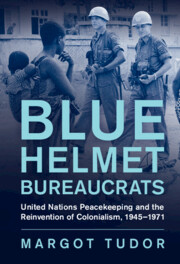
This history of colonial legacies in UN peacekeeping operations from 1945–1971 reveals how United Nations peacekeeping staff reconfigured the functions of global governance and sites of diplomatic power in the post-war world. Despite peacekeeping operations being criticised for their colonial underpinnings, our understanding of the ways in which colonial actors and ideas influenced peacekeeping practices on the ground has been limited and imprecise. In this multi-archival history, Margot Tudor investigates the UN's formative armed missions and uncovers the officials that orchestrated a reinvention of colonial-era hierarchies for Global South populations on the front lines of post-colonial statehood. She demonstrates how these officials exploited their field-based access to perpetuate racial prejudices, plot political interference, and foster protracted inter-communal divisions in post-colonial conflict contexts. Bringing together histories of humanitarianism, decolonisation, and the Cold War, Blue Helmet Bureaucrats sheds new light on the mechanisms through which sovereignty was negotiated and re-negotiated after 1945.
Almost all technology is dual use to some degree: it has both civilian and military applications. This feature creates a dilemma for cooperation. States can design arms control institutions to curtail costly competition over some military technology. But they also do not want to limit valuable civilian uses. How does the dual use nature of technology shape the prospects for cooperation? We argue that the duality of technology presents a challenge not by its very existence but rather through the ways it alters information constraints on the design of arms control institutions. We characterize variation in technology along two dual use dimensions: (1) the ease of distinguishing military from civilian uses; and (2) the degree of integration within military enterprises and the civilian economy. Distinguishability drives the level of monitoring needed to detect violations. When a weapon is indistinguishable from its civilian counterpart, states must improve detection though intelligence collection or intrusive inspections. Integration sharpens the costs of disclosing information to another state. For highly integrated technology, demonstrating compliance could expose information about other capabilities, increasing the security risks from espionage. Together, these dimensions generate expectations about the specific information problems states face as they try to devise agreements over various technologies. We introduce a new qualitative data set to assess both variables and their impact on cooperation across all modern armament technologies. The findings lend strong support for the theory. Efforts to control emerging technologies should consider how variation in the dual use attributes shapes this tension between detection and disclosure.