Refine search
Actions for selected content:
202 results
Variational determination of minimal absorbing zones in incompressible shear flows
-
- Journal:
- Journal of Fluid Mechanics / Volume 1038 / 10 July 2026
- Published online by Cambridge University Press:
- 08 July 2026, A39
-
- Article
- Export citation
Searching for invariant solutions to wall-bounded flows using resolvent-based optimisation
-
- Journal:
- Journal of Fluid Mechanics / Volume 1038 / 10 July 2026
- Published online by Cambridge University Press:
- 29 June 2026, A12
-
- Article
-
- You have access
- Open access
- HTML
- Export citation
Gauss principle in incompressible flow: a unified variational perspective on pressure and projection
-
- Journal:
- Journal of Fluid Mechanics / Volume 1037 / 25 June 2026
- Published online by Cambridge University Press:
- 18 June 2026, R5
-
- Article
- Export citation
-
Following recent work (Gonzalez & Taha 2022 J. Fluid Mech., vol. 941, A58; Peters & Ormiston 2025 AIAA J., vol. 63, pp. 6–20), this manuscript clarifies what the Gauss–Appell principle determines in incompressible, inviscid flow and how it connects to classical projection methods. At a fixed time, freezing the velocity and varying only the material acceleration leads to minimisation of a quadratic subject to acceleration-level constraints. First-order conditions yield a Poisson–Neumann problem for a reaction pressure whose gradient removes the non-solenoidal and wall-normal content of the provisional residual, precisely the well-known Leray–Hodge projection. Thus, Gauss–Appell enforces the instantaneous kinematic constraints and recovers Euler at the instant. Once the impressed physics is specified, for instance via external body forces, the reaction pressure is uniquely determined (up to an additive constant) as the Lagrange multiplier enforcing incompressibility and wall impermeability; it does no work on divergence-free, wall-tangent motions. This is the well-established interpretation of pressure in incompressible flow. The direct, fixed-time application of this principle determines the reaction pressure for an already-specified velocity field and does not, by itself, select circulation or stagnation points, because these are properties of the velocity state, not the instantaneous acceleration correction. The formal decomposition of the pressure into impressed and reaction components admits representational freedom that does not imply physical non-uniqueness of the constraint force. Orthogonality conventions such as Dirichlet orthogonality can fix the representational freedom as an additional modelling choice. This variational viewpoint also yields a simple computational diagnostic: the minimised Appellian equals a $L^2$ norm of the reaction-pressure gradient which vanishes for constraint-compatible updates and grows with the magnitude of divergence and wall-flux mismatch.

Full field reconstruction of turbulent systems from sparse observations
-
- Journal:
- Journal of Fluid Mechanics / Volume 1036 / 10 June 2026
- Published online by Cambridge University Press:
- 01 June 2026, A24
-
- Article
- Export citation
-
We investigate the ability of two data assimilation (DA) methods – ensemble Kalman filter (EnKF) and variational smoother (4D-Var) – to reconstruct the Kuramoto–Sivashinsky and complex Ginzburg–Landau systems from sparse observations. While turbulent systems can reconstruct small scales below a critical resolution by substituting larger scales into governing equations, we examine whether DA methods can accurately recover the full field with observations sparser than this threshold, and consider which method performs better. Our findings show that both methods can accurately reconstruct the full field even with observations much sparser than the substitution-based critical resolution. However, likelihood of successful reconstruction within a fixed assimilation time decreases as sparsity increases. The EnKF method needs smaller assimilation time and lower temporal sampling rate than 4D-Var, but needs ad hoc stabilisation (e.g. inflation) and higher memory for ensemble storage. We validate these results by applying EnKF to turbulent two-dimensional Kolmogorov flows at Reynolds numbers from 200 to 2000, and forcing at wavenumbers 4 and 5. For these flows, we achieve full field reconstruction from observations as sparse as $4\times 4$, outperforming existing 4D-Var and machine learning results where denser observations are required for reconstruction. These findings highlight the strengths and trade-offs of DA methods, offer guidance for reconstructing turbulent flows, and establish benchmarks for evaluating alternative methods.

Optimal bodies in viscoplastic and power-law fluids
-
- Journal:
- Journal of Fluid Mechanics / Volume 1035 / 25 May 2026
- Published online by Cambridge University Press:
- 28 May 2026, A42
-
- Article
-
- You have access
- Open access
- HTML
- Export citation
-
In a seminal paper, Pironneau (1973 J. Fluid Mech., vol. 59, pp. 117–128) showed that the lowest-drag shape of fixed volume in Stokes flow has a surface vorticity with constant magnitude over the entire body. In this paper, the viscoplastic version of the problem is analysed. The first result is that the surface vorticity on the optimal body in a Herschel–Bulkley fluid cannot vanish or become singular (in both two- and three-dimensional geometries). For the special cases of power-law fluids and high-yield-strength fluids, the change in drag following a small change in body shape is directly related to the surface vorticity, which is then shown to be constant on the optimal body. These results inform a local analysis of the flow near the sharp tips at either end of the optimal body, which determines the tip angle in different non-Newtonian fluids. In shear-thinning and viscoplastic fluids, the viscosity decreases with strain rate and so the fluid effectively self-lubricates in regions of high shear allowing for a sharper optimal body. Indeed, in a high-yield-strength fluid, the optimal body is entirely surrounded by a thin viscoplastic boundary layer and in a planar geometry, the interior tip angles converge to $90^\circ$ in the plastic limit (the tip angles are $102.6^\circ$ in a Newtonian fluid). In the other limit of a perfect shear-thickening fluid, any regions of high strain rate are heavily penalised and so the optimal body is much blunter with the two tip angles converging to $150^\circ$.


Enhancing modal synchronisation in wall-bounded turbulence via sequential variational data assimilation
-
- Journal:
- Journal of Fluid Mechanics / Volume 1032 / 10 April 2026
- Published online by Cambridge University Press:
- 06 April 2026, A62
-
- Article
- Export citation
-
This study explores partial synchronisation in turbulent channel flows using sequential variational data assimilation with sparse observations, emphasising the roles of model and observation uncertainties. Unlike previous work that focused on synchronisation using direct numerical simulation, this study considers synchronisation under imperfect models and noisy data. In the first part, a synchronisation map is constructed, revealing invariance with respect to variations in the predictive model, Reynolds number and mesh resolution. Full synchronisation emerges above a critical level of equivalent observation density. At lower observation densities, modal synchronisation is observed, where the energies of dominant modes evolve independently of initial conditions. As data become sparser, the system transitions to a non-synchronisation regime, with assimilated flows exhibiting minimal correlation with the observations. The second part of this study uses the master flow interpolated from down-sampled sparse observations. The delay-coordinate strategy is introduced to enhance the modal synchronisation. Results indicate that the optimal $\sigma$ lies near the threshold between modal synchronisation and non-synchronisation. This demonstrates that the modal synchronisation serves as a critical prerequisite for leveraging historical information in data assimilation to improve the accuracy of turbulence reconstruction. These findings extend the scope of synchronisation theory and provide valuable guidance for advancing data assimilation methodologies.

Normalized solutions for a Hamiltonian elliptic system on $\mathbb{R}^N$
- Part of
-
- Journal:
- Proceedings of the Royal Society of Edinburgh. Section A: Mathematics , First View
- Published online by Cambridge University Press:
- 27 March 2026, pp. 1-22
-
- Article
- Export citation
-
This paper is concerned with the existence of normalized solutions for the following class of Hamiltonian elliptic systems:
where \begin{align*}\left\{\begin{array}{ll}- \Delta u = \lambda u + |v|^{q-2}v \quad \text{in } \mathbb{R}^{N}, \\ - \Delta v = \lambda v + |u|^{p-2}u \quad \text{in } \mathbb{R}^{N}, \\ \displaystyle\int_{\mathbb{R}^N}(|u|^2 + |v|^2) = m,\end{array}\right.\end{align*}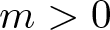 $m \gt 0$ and $2 \lt p,q \lt 2^{*}=2N/(N-2)$. We prove that a normalized solution exists for different ranges of $p,q$. A typical feature of this class of problems is that the associated energy functionals are strongly indefinite; that is, the domain has a saddle-point geometry in which both positive and negative subspaces of the quadratic form are infinite-dimensional. Another difficulty is the lack of the compact embedding $H^{1}(\mathbb{R}^N) \hookrightarrow L^{2}(\mathbb{R}^N)$, which persists also if we restrict ourselves to a radial setting. Our main result is novel for this class of systems.


Drag-minimising bodies in confined Stokes flows
-
- Journal:
- Journal of Fluid Mechanics / Volume 1029 / 25 February 2026
- Published online by Cambridge University Press:
- 24 February 2026, A45
-
- Article
-
- You have access
- Open access
- HTML
- Export citation
-
Slow viscous flow around a fixed body generates a shape-dependent drag. We explore the drag-minimising shapes of bodies centred between two parallel plates in two-dimensional viscous flow. The channel width introduces a length scale so that the optimal profile is area-dependent. We solve the shape optimisation problem numerically over a wide range of areas. We also compute the optimal elliptical shapes and this identifies how these shapes should be slightly altered to reduce the drag with reductions of up to $3.8\,\%$ attained at high areas. More broadly, we derive two properties of general optimal shapes within the confined flow: the magnitude of the surface vorticity is approximately (but not exactly) constant and the noses have sharp angles that are independent of area. For relatively small bodies, the optimal shape becomes identical to that in an unconfined geometry, but the drag is qualitatively different owing to the influence of confinement; within a channel, it is proportional to the inverse of the logarithm of the body area. At relatively large areas, the optimal body becomes long and its surface is approximately parallel to the channel boundaries, except in the vicinity of the noses. Using a lubrication approximation, we recast the optimisation problem as an Euler–Lagrange equation that is solved to determine the drag-minimising shape, finding that the drag is proportional to the body area in this regime.

An objective measure of unsteadiness
-
- Journal:
- Journal of Fluid Mechanics / Volume 1029 / 25 February 2026
- Published online by Cambridge University Press:
- 24 February 2026, A40
-
- Article
-
- You have access
- Open access
- HTML
- Export citation
-
Unsteadiness lies at the heart of turbulent fluid dynamics, eddy formation and instabilities in flows, thus making it central to both understanding and controlling fluid systems. In this work, we present an objective measure for the unsteadiness of a time-dependent velocity field, the deformation unsteadiness, derived from a spatio-temporal variational principle, allowing for a frame-independent assessment of the unsteadiness of a given flow field. Additionally, as an application of our main result, we define an objective analogue of the classical $Q$-criterion based on extremisers of unsteadiness minimisation. We apply our results to several examples of analytical flows as well as simulated flow data sets in two and three dimensions. In particular, we apply our newly derived vortex criterion to several explicit, time-dependent solutions of the Navier–Stokes equation and compare the results with existing vortex criteria. We give a physical interpretation of the deformation unsteadiness and discuss future research directions.

Kinetic theory of binary fluid–surfactant systems: A variational framework
-
- Journal:
- Journal of Fluid Mechanics / Volume 1029 / 25 February 2026
- Published online by Cambridge University Press:
- 23 February 2026, A54
-
- Article
-
- You have access
- Open access
- HTML
- Export citation
-
We derive a self-consistent hydrodynamic theory of coupled binary fluid–surfactant systems from the underlying microscopic physics using Rayleigh’s variational principle. At the microscopic level, surfactant molecules are modelled as dumbbells that exert forces and torques on the fluid and interface while undergoing Brownian motion. We obtain the overdamped stochastic dynamics of these particles from a Rayleighian dissipation functional, which we then coarse-grain to derive a set of continuum equations governing the surfactant concentration, orientation, fluid density and velocity. This approach introduces a polarisation field $\boldsymbol{p}(\boldsymbol{r},t)$, representing the average orientation of surfactants, which plays a central role in suppressing droplet coalescence. The remaining hydrodynamic equations are consistently obtained from a mesoscopic free energy functional. The resulting model accurately captures key surfactant phenomena, including surface tension reduction and droplet stabilisation, as confirmed by both perturbation theory and numerical simulations, and is thermodynamically consistent with both the Gibbs adsorption isotherm and Henry’s law for adsorbed surfactant concentration.

A unified variational framework and lattice Boltzmann method for non-isothermal two-phase flows with phase transitions and wetting effects
-
- Journal:
- Journal of Fluid Mechanics / Volume 1029 / 25 February 2026
- Published online by Cambridge University Press:
- 20 February 2026, A30
-
- Article
- Export citation
Bounds on dissipation in three-dimensional planar shear flows: reduction to two-dimensional problems
-
- Journal:
- Journal of Fluid Mechanics / Volume 1026 / 10 January 2026
- Published online by Cambridge University Press:
- 29 December 2025, A8
-
- Article
-
- You have access
- Open access
- HTML
- Export citation
-
Bounds on turbulent averages in shear flows can be derived from the Navier–Stokes equations by a mathematical approach called the background method. Bounds that are optimal within this method can be computed at each Reynolds number $ \textit{Re}$ by numerically optimising subject to a spectral constraint, which requires a quadratic integral to be non-negative for all possible velocity fields. Past authors have eased computations by enforcing the spectral constraint only for streamwise-invariant (2.5-D) velocity fields, assuming this gives the same result as enforcing it for three-dimensional (3-D) fields. Here, we compute optimal bounds over 2.5-D fields and then verify, without doing computations over 3-D fields, that the bounds indeed apply to 3-D flows. One way is to directly check that an optimiser computed using 2.5-D fields satisfies the spectral constraint for all 3-D fields. A second way uses a criterion we derive that is based on a theorem of Busse (1972 Arch. Ration. Mech. Anal., vol. 47, pp. 28–35) for energy stability analysis of models with certain symmetry. The advantage of checking this criterion, as opposed to directly checking the 3-D constraint, is lower computational cost and natural extrapolation of the criterion to large $ \textit{Re}$. We compute optimal upper bounds on friction coefficients for the wall-bounded Kolmogorov flow known as Waleffe flow and for plane Couette flow. This requires lower bounds on dissipation in the first model and upper bounds in the second. For Waleffe flow, all bounds computed using 2.5-D fields satisfy our criterion, so they hold for 3-D flows. For Couette flow, where bounds have been previously computed using 2.5-D fields by Plasting & Kerswell (2003 J. Fluid Mech., vol. 477, pp. 363–379), our criterion holds only up to moderate $ \textit{Re}$, so at larger $ \textit{Re}$ we directly verify the 3-D spectral constraint. Over the $ \textit{Re}$ range of our computations, this confirms the assumption by Plasting & Kerswell that their bounds hold for 3-D flows.


Back-in-time analysis of vorticity in viscous separated flows over immersed bodies
-
- Journal:
- Journal of Fluid Mechanics / Volume 1024 / 10 December 2025
- Published online by Cambridge University Press:
- 09 December 2025, A46
-
- Article
-
- You have access
- Open access
- HTML
- Export citation
-
We present a back-in-time analysis for the origin of vorticity in viscous separated flows over immersed bodies, using the adjoint-vorticity framework recently introduced by Xiang et al. (2025 J. Fluid Mech. vol. 1011, A33. The solution of the adjoint-vorticity equations yields the volume density of mean deformation, which captures the stretching and tilting of the earlier vorticity that leads to the terminal value. The analysis also takes into account the boundary contributions of vorticity and its flux. Three examples are considered. Steady, axisymmetric separation in the flow over a sphere at Reynolds number $Re=200$ is shown to be established due to wall flux from both upstream and downstream of separation, the latter contribution being absent from the classical description by Lighthill. For unsteady separation at higher $Re=300$, the streamwise vorticity within the wake hairpin vortex is traced back, quantitatively, to the azimuthal vorticity on the sphere. The third configuration is the flow over a prolate spheroid at $Re=3000$. The null vorticity at three-dimensional separation originates from the cancellation of opposite interior contributions adjacent to the separation surface. The contribution from the downstream side migrates across the separation surface into the upstream region due to a tilting effect – a fundamental distinction between two- and three-dimensional separation. We also examine the detached vortical structures. The streamwise vorticity in the primary vortex originates from tilting of near-wall azimuthal vorticity, differing from Lighthill’s conjecture that the origin is streamwise near-wall vorticity that arises due to the reduced Coriolis force. Finally, a necklace vortex in the turbulent wake is traced back in time, and is shown to have contributions from the spheroid trailing-edge shed shear layer and the large-scale counter-rotating primary vortices.


Far field asymptotics of nematic flows around a small spherical particle
-
- Journal:
- Journal of Fluid Mechanics / Volume 1024 / 10 December 2025
- Published online by Cambridge University Press:
- 04 December 2025, A41
-
- Article
-
- You have access
- Open access
- HTML
- Export citation
-
In this paper, we consider the flow of a nematic liquid crystal in the domain exterior to a small spherical particle. We work within the framework of the $\unicode{x1D64C}$-tensor model, taking into account the orientational elasticity of the medium. Under a suitable regime of physical parameters, the governing equations can be reduced to a system of linear partial differential equations. Our focus is on precise far-field asymptotics of the flow velocity with an emphasis on its anisotropic behaviour. We are able to analytically characterize the flow pattern and compare it with that of the classical isotropic Stokes flow. The expression for velocity away from the particle can be computed numerically or symbolically.

On nonlinear transitions, minimal seeds and exact solutions for the geodynamo
-
- Journal:
- Journal of Fluid Mechanics / Volume 1021 / 25 October 2025
- Published online by Cambridge University Press:
- 23 October 2025, A37
-
- Article
-
- You have access
- Open access
- HTML
- Export citation
On the existence of positive solutions to some classes of elliptic problems in Hyperbolic space
- Part of
-
- Journal:
- Proceedings of the Royal Society of Edinburgh. Section A: Mathematics , First View
- Published online by Cambridge University Press:
- 28 July 2025, pp. 1-41
-
- Article
- Export citation
-
We focus on the existence of ground state solutions to the following class of elliptic equations
 \begin{equation*}-\Delta_{\mathbb{B}^N} u+V(x)u=f(u) \quad \hbox{in} \quad \mathbb{B}^N,\end{equation*}
where $\mathbb{B}^N$ is the disc model of the Hyperbolic space and $\Delta_{\mathbb{B}^N}$ denotes the Laplace–Beltrami operator with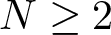 $N \geq 2$, $V:\mathbb{B}^N \to \mathbb{R}$ and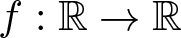 $f:\mathbb{R} \to \mathbb{R}$ are continuous functions that satisfy some technical conditions. With different types of the potential V, by introducing some new tricks handling the hurdle that the Hyperbolic space is not a compact manifold, we are able to obtain at least a positive ground state solution using variational methods.
As some applications for the methods adopted above, we derive the existence of normalized solutions to the elliptic problems
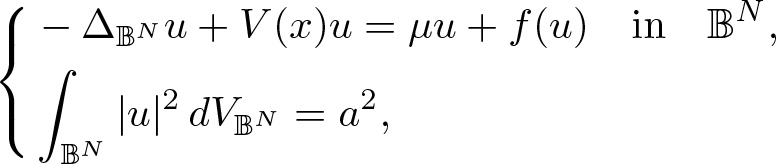 \begin{equation*}\left\{\begin{aligned}&-\Delta_{\mathbb{B}^N} u+V(x)u=\mu u+f(u) \quad \hbox{in} \quad \mathbb{B}^N,\\&\int_{\mathbb{B}^N}|u|^{2}\,dV_{{\mathbb{B}^N}}=a^{2},\end{aligned}\right.\end{equation*}
where a > 0,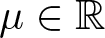 $\mu\in \mathbb{R}$ is an unknown parameter that appears as a Lagrange multiplier and f is a continuous function that fulfils the L2-subcritical or L2-supercritical growth. We do believe that it seems the first results to deal with normalized solutions for the Schrödinger equations in the Hyperbolic space.


Radial and non-radial solutions for a class of (p, q)-Laplace equations involving weights
- Part of
-
- Journal:
- Proceedings of the Royal Society of Edinburgh. Section A: Mathematics , First View
- Published online by Cambridge University Press:
- 25 July 2025, pp. 1-33
-
- Article
- Export citation
Modulation leading to frequency downshifting of water waves in the vicinity of the Benjamin–Feir transition
-
- Journal:
- Journal of Fluid Mechanics / Volume 1014 / 10 July 2025
- Published online by Cambridge University Press:
- 03 July 2025, A23
-
- Article
-
- You have access
- Open access
- HTML
- Export citation
2 - Local Inpainting Methods
-
- Book:
- The Art of Inpainting
- Published online:
- 22 May 2025
- Print publication:
- 22 May 2025, pp 13-51
-
- Chapter
- Export citation
3 - Non-Local Inpainting Methods
-
- Book:
- The Art of Inpainting
- Published online:
- 22 May 2025
- Print publication:
- 22 May 2025, pp 52-114
-
- Chapter
- Export citation
