To save content items to your account,
please confirm that you agree to abide by our usage policies.
If this is the first time you use this feature, you will be asked to authorise Cambridge Core to connect with your account.
Find out more about saving content to .
To save content items to your Kindle, first ensure no-reply@cambridge.org
is added to your Approved Personal Document E-mail List under your Personal Document Settings
on the Manage Your Content and Devices page of your Amazon account. Then enter the ‘name’ part
of your Kindle email address below.
Find out more about saving to your Kindle.
Note you can select to save to either the @free.kindle.com or @kindle.com variations.
‘@free.kindle.com’ emails are free but can only be saved to your device when it is connected to wi-fi.
‘@kindle.com’ emails can be delivered even when you are not connected to wi-fi, but note that service fees apply.
Networks constitute the backbone of complex systems, from the human brain to computer communications, transport infrastructures to online social systems and metabolic reactions to financial markets. Characterising their structure improves our understanding of the physical, biological, economic and social phenomena that shape our world. Rigorous and thorough, this textbook presents a detailed overview of the new theory and methods of network science. Covering algorithms for graph exploration, node ranking and network generation, among others, the book allows students to experiment with network models and real-world data sets, providing them with a deep understanding of the basics of network theory and its practical applications. Systems of growing complexity are examined in detail, challenging students to increase their level of skill. An engaging presentation of the important principles of network science makes this the perfect reference for researchers and undergraduate and graduate students in physics, mathematics, engineering, biology, neuroscience and the social sciences.
Assume that the edges of the complete graph Kn are given independent uniform [0, 1] weights. We consider the expected minimum total weight μk of k ⩽ 2 edge-disjoint spanning trees. When k is large we show that μk ≈ k2. Most of the paper is concerned with the case k = 2. We show that m2 tends to an explicitly defined constant and that μ2 ≈ 4.1704288. . . .
We prove that there is a set F in the plane so that the distance between any two points of F is at least 1, and for any positive ϵ < 1, and every line segment in the plane of length at least ϵ−1−o(1), there is a point of F within distance ϵ of the segment. This is tight up to the o(1)-term in the exponent, improving earlier estimates of Peres, of Solomon and Weiss, and of Adiceam.
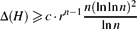
This paper deals with a combinatorial problem concerning colourings of uniform hypergraphs with large girth. We prove that if H is an n-uniform non-r-colourable simple hypergraph then its maximum edge degree Δ(H) satisfies the inequality
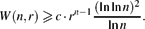
As an application of our probabilistic technique we establish a lower bound for the classical van der Waerden number W(n, r), the minimum natural N such that in an arbitrary colouring of the set of integers {1,. . .,N} with r colours there exists a monochromatic arithmetic progression of length n. We prove that
Finding a hidden partition in a random environment is a general and important problem which contains as subproblems many important questions, such as finding a hidden clique, finding a hidden colouring, finding a hidden bipartition, etc.
In this paper we provide a simple SVD algorithm for this purpose, addressing a question of McSherry. This algorithm is easy to implement and works for sparse graphs under optimal density assumptions. We also consider an approximating algorithm, which on one hand works under very mild assumptions, but on other hand can sometimes be upgraded to give the exact solution.
Two central problems in computer science are P vs NP and the complexity of matrix multiplication. The first is also a leading candidate for the greatest unsolved problem in mathematics. The second is of enormous practical and theoretical importance. Algebraic geometry and representation theory provide fertile ground for advancing work on these problems and others in complexity. This introduction to algebraic complexity theory for graduate students and researchers in computer science and mathematics features concrete examples that demonstrate the application of geometric techniques to real world problems. Written by a noted expert in the field, it offers numerous open questions to motivate future research. Complexity theory has rejuvenated classical geometric questions and brought different areas of mathematics together in new ways. This book will show the beautiful, interesting, and important questions that have arisen as a result.
Centrality measures allow the key elements in a graph to be identified. The concept of centrality and the first related measures were introduced in the context of social network analysis, and more recently have been applied to various other fields. In this chapter we introduce and discuss the centrality measures most commonly used in the literature to characterise and rank the nodes of a network. We will first focus on measures of node centrality based on the node degree, such as the degree centrality, the eigenvector centrality and the α-centrality.We will then consider centrality measures based on shortest paths, such as the closeness centrality which is related to the average distance of a node from all the other nodes, or the betweenness centrality which counts instead the number of shortest paths a node lies on. As only one possible example of the many potential applications, we introduce a large graph describing a real social system, namely the movie actor collaboration network, and we use it to identify the most popular movie stars. In particular, we will rank the nodes according to different types of centralities and we will compare the various centrality rankings obtained. We conclude the chapter with a discussion on how to extend the measures of centrality from single nodes to groups of nodes.
The Importance of Being Central
In addition to the developments in mathematical graph theory, the study of networks has seen important achievements in some specialised contexts, as for instance in the social sciences. Social networks analysis originated in the early 1920s, and focuses on relationships among social entities, such as communication and collaboration between members of a group, trades among nations, or economic transactions between corporations [308, 278]. This discipline is based on representing a social system as a graph whose nodes are the social individuals or entities, and whose edges represent social interactions. In Figure 2.1 we report three examples of graphs representing different types of interactions, namely marriages between prominent families in Florence (Italy), joint presences at the river in a group of primates, and contacts between terrorists of the September 2001 attacks. Notice that very diverse systems, such as those reported here, can all be well described in terms of graphs.
Social systems, the human brain, the Internet and the World Wide Web are all examples of complex networks, i.e. systems composed of a large number of units interconnected through highly non-trivial patterns of interactions. This book is an introduction to the beautiful and multidisciplinary world of complex networks. The readers of the book will be exposed to the fundamental principles, methods and applications of a novel discipline: network science. They will learn how to characterise the architecture of a network and model its growth, and will uncover the principles common to networks from different fields.
The book covers a large variety of topics including elements of graph theory, social networks and centrality measures, random graphs, small-world and scale-free networks, models of growing graphs and degree–degree correlations, as well as more advanced topics such as motif analysis, community structure and weighted networks. Each chapter presents its main ideas together with the related mathematical definitions, models and algorithms, and makes extensive use of network data sets to explore these ideas.
The book contains several practical applications that range from determining the role of an individual in a social network or the importance of a player in a football team, to identifying the sub-areas of a nervous systems or understanding correlations between stocks in a financial market.
Thanks to its colloquial style, the extensive use of examples and the accompanying software tools and network data sets, this book is the ideal university-level textbook for a first module on complex networks. It can also be used as a comprehensive reference for researchers in mathematics, physics, engineering, biology and social sciences, or as a historical introduction to the main findings of one of the most active interdisciplinary research fields of the moment.
This book is fundamentally on the structure of complex networks, and we hope it will be followed soon by a second book on the different types of dynamical processes that can take place over a complex network.
Bollobás and Scott (Random Struct. Alg.21 (2002) 414–430) asked for conditions that guarantee a bisection of a graph with m edges in which each class has at most (1/4+o(1))m edges. We demonstrate that cycles of length 4 play an important role for this question. Let G be a graph with m edges, minimum degree δ, and containing no cycle of length 4. We show that if (i) G is 2-connected, or (ii) δ ⩾ 3, or (iii) δ ⩾ 2 and the girth of G is at least 5, then G admits a bisection in which each class has at most (1/4+o(1))m edges. We show that each of these conditions are best possible. On the other hand, a construction by Alon, Bollobás, Krivelevich and Sudakov shows that for infinitely many m there exists a graph with m edges and girth at least 5 for which any bisection has at least (1/4−o(1))m edges in one of the two classes.
“It's a small world!” This is the typical expression we use many times in our lives when we discover, for example, that we unexpectedly share a common acquaintance with a stranger we've just met far from home. In this chapter, we show that this happens because social networks have a rather small characteristic path length, comparable with that of random graphs with the same number of nodes and links. In addition to this, social networks also have a large clustering coefficient, i.e. they contain a large number of triangles. As an example of a social network, we will experiment on the collaboration graph of movie actors introduced in Chapter 2. We will show that the small-world behaviour also appears in biological systems. For this reason, we will be looking into the neural network of C. elegans, the only nervous system that has been completely mapped to date at the level of neurons and synapses. We will then move our focus to the modelling, by introducing and studying both numerically and, when possible, analytically, the small-world model originally proposed in 1998 by Watts and Strogatz to construct graphs having both the small-world property and also a high clustering coefficient. This model and the various modified versions of it that have been proposed over the years, are all based on the addition of a few long-range connections to a regular lattice and provide a good intuition about the small-world effect in real systems. In the last section we will try to understand how the individuals of a social network actually discover short paths, even if they just have local knowledge of the network.
Six Degrees of Separation
Fred Jones of Peoria, sitting in a sidewalk cafe in Tunis, and needing a light for his cigarette, asks the man at the next table for a match. They fall into conversation; the stranger is an Englishman who, it turns out, spent several months in Detroit studying the operation of an interchangeable-bottlecap factory. “I know it's a foolish question,” says Jones, “but did you ever by any chance run into a fellow named Ben Arkadian? He's an old friend of mine, manages a chain of supermarket in Detroit… Arkadian, Arkadian,” the Englishman mutters.
In the networks studied in the previous chapters, for each pair of nodes we can either have a link or not. In actual fact, real networks can display a large variety in the strength of their connections. Examples are the existence of strong and weak ties between individuals in any type of social system, or unequal capacities in infrastructure networks such as the Internet or a transportation system. When we have access to information about the intensity of interactions in a complex system, the structure of such a system can certainly be better described in terms of a weighted network, i.e. a network in which each link is associated with a numerical value, in general a positive real number, representing the strength of the corresponding connection. In this chapter, we extend and generalise to weighted networks the concepts and methods we have introduced in the previous chapters of the book. We will start introducing some basic measures to characterise and classify a weighted network. Next, we will discuss how to perform a motif analysis and how to detect community structures in weighted networks. The results of our empirical studies will demonstrate that purely topological models are often inadequate to explain the rich and complex properties observed in real systems, and that there is also a need for models to go beyond pure topology. We will then introduce some models of weighted networks which can reproduce the broad scale distributions and the correlations between topology and weights found empirically. Finally, as an application, we will show what we can learn about financial systems by describing correlations among stocks in a financial market in terms of a weighted network.
Tuning the Interactions
There are plenty of cases where (unweighted) graphs are a poor representation of realworld networks. As a concrete example, let us come back to the scientific collaboration networks studied in Chapter 3. When we constructed such graphs in Section 3.5 we linked pairs of scientists who have coauthored at least one paper. However, it is clear that scientists who have written many papers together are expected to know each other better than those who have coauthored only one paper.