To save content items to your account,
please confirm that you agree to abide by our usage policies.
If this is the first time you use this feature, you will be asked to authorise Cambridge Core to connect with your account.
Find out more about saving content to .
To save content items to your Kindle, first ensure no-reply@cambridge.org
is added to your Approved Personal Document E-mail List under your Personal Document Settings
on the Manage Your Content and Devices page of your Amazon account. Then enter the ‘name’ part
of your Kindle email address below.
Find out more about saving to your Kindle.
Note you can select to save to either the @free.kindle.com or @kindle.com variations.
‘@free.kindle.com’ emails are free but can only be saved to your device when it is connected to wi-fi.
‘@kindle.com’ emails can be delivered even when you are not connected to wi-fi, but note that service fees apply.
Describes complexity of ranching for Tribal members on reservations, due to historical removal of Tribes, allotment of their lands, and resulting jurisdictional barriers.
Wetlands are home to several flora and fauna that make up biodiversity in a country or region. International law therefore emphasizes the need for the preservation of wetlands in order to preserve and conserve biodiversity. This chapter examines the need for a nexus and ecosystem approach to the management of wetlands in the context of water share agreements. It examines the nature, scope, and content of the ecosystem approach, barriers to their effective implementation, and innovative legal approaches to promote such strategies.
Legal, financial, and regulatory barriers that may hinder the innovation, establishment, and operationalization of nature-based eco-ventures in the Middle East and North Africa (MENA) region must be carefully examined and addressed. While several studies have examined the importance of eco-entrepreneurship as a tool for halting biodiversity loss, an in-depth examination of the legal and policy barriers that hinder the growth of small and medium eco-enterprises (SMEEs) has remained absent. This chapter fills a gap in this regard. It examines the strategic transformations of biodiversity law and policy that are required to promote these pro-biodiversity, nature-based-SMEEs across the region. After developing a profile of law and governance barriers facing nature-based-SMEEs in the region, it proposes dynamic legal solutions for addressing such barriers.
This chapter examines the legal and institutional framework on access and benefit sharing (ABS) in the Middle East and North Africa (MENA) region. It examines the drivers and dimensions of access and benefit sharing risks in the MENA region, gaps in existing legal frameworks on ABS in the region, and innovative approaches for addressing such gaps. The chapter delves into the challenges of ABS in the MENA region. The Nagoya Protocol’s principles of access to genetic resources and benefit sharing are highlighted, underscoring their significance in the MENA context. Given the fragile nature of global biodiversity, it is crucial to support and innovatively implement these existing regulations, ensuring an effective and efficient approach to ABS.
The extensive thermodynamic variables of a fluid are introduced as the internal energy, volume, and number of molecules. The entropy is defined and also shown to be extensive. Taking the total derivative of the internal energy produces the first law of thermodynamics and defines the intensive parameters of temperature, pressure, and chemical potential. Changing variables from extensive variables to intensive variables is accomplished with the Legendre transform and defines alternative energies such as the Helmholtz free energy, enthalpy, and Gibbs free energy. Thermodynamic equilibrium requires that each element of a system have the same temperature, pressure, and chemical potential. For equilibrium to be stable, the material properties of each element must satisfy certain derived constraints. First-order phase transition are treated for a single-species system. Multispecies systems are treated and a widely used expression for how the chemical potentials of each species depend on the concentration of the species is derived. Chemical reactions are treated as is osmosis. The thermodynamics of solid systems is addressed along with mineral solubility in liquid solutions.
In this chapter, we derive Sturm–Liouville theory that introduces a broad class of eigenfunctions that are convenient to use for representing functions. Sturm–Liouville theory provides the basis of the Fourier-series method of representing functions that is the main focus of the chapter and that also is the foundation of Fourier analysis. We show how to calculate Fourier series and to use Fourier series to obtain the solution of boundary-value problems posed in Cartesian coordinates. It is seen that the main advantage of an eigenfunction approach for solving boundary-value problems is that either the inhomogeneous source term in the differential equation or the boundary values may be time dependent, which they cannot be in the method of separation of variables.
One family’s history of grazing in the Malheur Wildlife Refuge results in a month-long armed occupation and standoff, which ends in the fatal shooting of one rancher organizer.
The increasing size and severity of wildfires across the western United States have generated dangerous levels of PM2.5 concentrations in recent years. In a changing climate, expanding the use of prescribed fires is widely considered to be the most robust fire mitigation strategy. However, reliably forecasting the potential air quality impact from prescribed fires, which is critical in planning the prescribed fires’ location and time, at hourly to daily time scales remains a challenging problem. In this paper, we introduce a spatio-temporal graph neural network (GNN)-based forecasting model for hourly PM2.5 predictions across California. Utilizing a two-step approach, we use our forecasting model to predict the net and ambient PM2.5 concentrations, which are used to estimate wildfire contributions. Integrating the GNN-based PM2.5 forecasting model with simulations of historically prescribed fires, we propose a novel framework to forecast their air quality impact. This framework determines that March is the optimal month for implementing prescribed fires in California and quantifies the potential air quality trade-offs involved in conducting more prescribed fires outside the peak of the fire season.
Phylogenetic analysis demonstrates that Kuamaia lata, a helmetiid euarthropod from the lower Cambrian (Series 2, Stage 3) Chengjiang Konservat-Lagerstätte, nests robustly within Artiopoda, the euarthropod clade including trilobitomorphs. Microtomography of new specimens of K. lata reveals details of morphology, notably a six-segmented head and raptorial frontal appendages, the latter contrasting with filiform antennae considered to be a diagnostic character of Artiopoda. Phylogenetic analyses demonstrate that a raptorial frontal appendage is a symplesiomorphy for upper stem-group euarthropods, retained across a swathe of tree space, but evolved secondarily in K. lata from an antenna within Artiopoda. The phylogenetic position of K. lata adds support to a six-segmented head being an ancestral state for upper stem- and crown-group euarthropods.
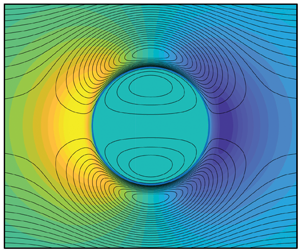
Electrophoretic characterization of nano- and micro-metre scaled bubbles and drops is increasingly important in environmental and health sciences. Despite more than a hundred years of study, the interpretation of bubble electrophoresis data remains an unresolved fundamental problem that bridges fluid mechanics and interfacial science. This paper examines, from a theoretical perspective, how the electrophoretic mobility of small drops and bubbles responds to the interfacial kinetic-exchange rate and interfacial-charge mobility: factors that have been largely overlooked, but which provide new insights on the interpretation of $\zeta$-potentials, which are routinely used to assess surface charge density. A variety of outcomes are demonstrated, each reflecting subtle balances of hydrodynamic and electrical forces, modulated by interfacial thermodynamics and transport. Among the findings is that irreversibly bound charge with low interfacial mobility furnishes rigid-sphere behaviour; whereas interfacial charge with high mobility produces the characteristically high electrophoretic mobilities of non-conducting, uniformly charged fluid spheres. Outcomes are more complex when drops and bubbles have interfacial charge that seeks local equilibrium with the immediately adjacent electrolyte. For example, the present model shows that interfacial-charge mobility regularizes the singular behaviour predicted by theories for fluid spheres bearing high, perfectly uniform surface charge.
Cosmetics, including makeup, perfumes, and facial care products, have a significant impact on the environment and society, particularly as they are used by many consumers daily. The industry's continued growth further contributes to this impact. This paper reviews 365 articles on existing research on sustainable cosmetics. Findings of this review showed that Italy, Brazil, and Spain are the countries with the highest number of research articles. It was also noted that many studies were from chemical and pharmaceutical disciplines, whereas there is minimal research through a social science lens. These insights provide avenues for future sustainability research in the cosmetics industry.
Technical summary
Cosmetics have become an essential part of daily life, but their impact on the environment and society cannot be ignored. With the cosmetics industry experiencing almost continuous growth, it is imperative to ensure its sustainability. While several studies have examined various aspects of cosmetics and sustainability, there is no comprehensive overview of the literature in this field. To address this gap, this review aims to categorize the extant literature thematically and identify areas that require further research. A systematic review of 365 selected journal articles published from 1992 to 2022 revealed several insights. Firstly, the number of publications in this area has increased significantly over the years. Secondly, Italy has the highest number of publications, and Sustainability is the most popular publication outlet. Thirdly, research output from chemistry, chemical engineering, and pharmacy disciplines is abundant, while social science disciplines have comparatively few studies. Fourthly, experimental procedures are the most commonly used research methods. Finally, ‘process and technology’ is the most studied area, while ‘stakeholder behavior’ is the least studied area. These findings highlight research gaps and suggest future research directions to promote sustainability in the cosmetics industry.
Social media summary
This review looks at 30 years of research on sustainable cosmetics and identifies areas that need to be explored.
Through compositional inclusion or exclusion, the photograph can assert and communicate what belongs in a picture, in a landscape, in an ecosystem. It can illuminate what we deem conservation-worthy, or, on a larger scale, which extinctions are attention-worthy. Photographic practice helps to illuminate the active nature of extinction, and our choices as actors and witnesses within that process. Here, researchers from the University of Leeds’ Extinction Studies Doctoral Training Programme present individual reflections on interdisciplinary practice-led research in the Scottish Small Isles. We consider how photography, as a form of praxis, can generate new forms of knowledge surrounding extinction: its meanings, representations, and legacies, particularly through visual representation. We offer seven perspectives on contemporary image-making, from disciplines including philosophy, conservation biology, literature, sociology, geology, cultural anthropology, and palaeontology. Researchers gathered experiential, ethical, even biological meanings from considering what to include or exclude in images: from the micro to the macro, the visible to the invisible, the aesthetic to the ecological. We draw conclusions around meaning-making through the process of photography itself, and the tensions encountered through framing and decision-making in a time of mass ecological decline.
Understanding the population structure and genetic diversity of green turtles is crucial for effective conservation. This study investigated the occurrence, genetic composition, and potential origins of green turtles (Chelonia mydas) in the Potiguar Basin, northeastern Brazil, based on stranding data from 2010 to 2019. Analysis revealed that 87.36% of the population consisted of juveniles, primarily females with a curved carapace length (CCL) between 30 and 59.9 cm. Genetic analysis of the mtDNA control region (481 bp, n = 39) revealed eight haplotypes, with CM-A8 (48.7%) and CM-A5 (30.8%) being the most common. This may be related to the geographic position of the Potiguar Basin, located in the ‘corner’ of the South American continent. High haplotype diversity and low nucleotide diversity were observed, consistent with other Brazilian foraging grounds. Mixed stock analysis identified Ascension Island as the primary source population, followed by Guinea-Bissau and Surinam. The results highlight the importance of the Potiguar Basin as a foraging area for green turtles and emphasize the need for comprehensive conservation strategies to protect this vulnerable population.
The fortune jack (Seriola peruana), a pelagic fish typically found along the Tropical Eastern Pacific, has been recorded in the northernmost Gulf of California (GC) region. The first record in the Upper Gulf and habitat expansion of S. peruana is reported based on the meristic, morphometric, and biological data of three specimens caught by local artisanal fishermen in April 2024. The lack of commercial value likely explains the region's absence of records for this species. The increased presence of S. peruana distribution in the Upper GC could have significant ecological implications, which warrants further fish habitat use and climate change research.
Simulated data from the Coupled Model Intercomparison Project Phase 6 (CMIP6) has been very important for climate science research, as they can provide wide spatio-temporal coverage to address data deficiencies in both present and future scenarios. However, these physics-based models require a huge amount of high-performance computing (HPC) resources. As an alternative approach, researchers are exploring if such simulated data can be generated by Generative Machine Learning models. In this work, we develop a model based on Pix2Pix conditional Generative Adversarial Network (cGAN), which can generate high-resolution spatial maps of global sea surface temperature (SST) using comparatively less computing power and time. We have shown that the maps generated by these models have similar statistical characteristics as the CMIP6 model simulations. Notably, we trained and validated our cGAN model on completely distinct time periods across all ensemble members of the EC-Earth3-CC and CMCC-CM2-SR5 CMIP6 models, demonstrating satisfactory results and confirming the generalizability of our proposed model.
Hydraulic fracturing generates large volumes of flowback and produced water, composed of complex mixtures of organic and inorganic constituents. The solids associated with these fluids are Fe-rich and can contain toxic organics, heavy metals and naturally occurring radioactive materials (NORMs). Despite this, only a few studies have analysed their composition and there is a lack of understanding about their interactions with microbial communities and their long-term fate in the environment. In this study, we analysed the solids associated with flowback water derived from a hydraulically fractured well in the Bowland Shale, UK. We also investigated the microbial reduction of these Fe(III)-rich materials under anaerobic conditions using anthraquinone-2.6-disulfonate (AQDS) as an electron shuttle and identified the resulting bioreduced mineral phases. XRD characterization indicated that the solids contained akaganeite (β-FeOOH, Cl) and Ba-bearing celestine (SrSO4). These Fe(III)-containing solids served as an electron acceptor for Shewanella frigidimarina and a flowback-derived Fe(III)-reducing enrichment culture. The bioreduced Fe(II)-bearing mineral phase was identified as ankerite [Ca(Fe,Mg,Mn)(CO3)2]; however, the presence of amorphous mineral phases is not ruled out. Microbial community composition was analysed using 16S rRNA gene sequencing. Amplicon sequence variants (ASVs) most closely related to Chromohalobacter, Caminicella and putative Fe(III)-reducing genera were dominant across treatments. Our findings highlight the potential of these Fe(III)-bearing sludges to be harnessed for the development of wastewater treatment strategies; for example, coupling the oxidation of toxic organics with Fe(III) reduction through either the introduction of microbial inocula or biostimulation of the native microbial communities. Furthermore, microbial processing can also be optimized to transform the Fe(III) sludges into denser materials, which are easier to handle and can immobilize toxic metals, thereby reducing the toxicity of this waste.
Foraging traces associated with the web-footed avian footprint ichnotaxon Presbyornithiformipes feduccii are described. Four new ichnospecies in three new ichnogenera are established to identify and describe the traces that resulted from foraging behaviors. All four ichnotaxa are, in places, overprinted by P. feduccii footprints and occur either laterally to, or sinuously woven between, P. feduccii trackways and therefore were clearly emplaced by the P. feduccii tracemaker.
Erevnoichnus blochi new ichnogenus new ichnospecies is established for a series of pits, joined by a marginal groove, that are associated with web-footed bird trackways. This ichnotaxon is interpreted to record regular probing/gaping as a waterbird swept its head from side to side searching for food. Erevnoichnus strimmena n. igen. new ichnospecies is established for en-echelon, gently arcuate grooves produced through forward probing by a waterbird searching for food. Ravdosichnus guntheri new ichnogenus new ichnospecies is established for simple grooves with u-shaped profiles produced when a waterbird dragged its bill backwards through the sediment. Aptosichnus diatarachi new ichnogenus new ichnospecies is established for a broad, shallow groove/trough characterized by sinuous margins and a complex, irregular fill. It is interpreted to record thorough bill stirring in an area with common prey.
All four ichnotaxa named herein are interpreted to record tactile feeding behavior by a marginal lacustrine waterbird searching for prey. Their association with Presbyornithiformipes feduccii suggests that the purported tracemaker, Presbyornis pervetus, did not forage solely through filter-feeding but was also capable of tactile foraging for larger prey.
The knowledge on decapod crustaceans considerably increased in recent years, including that of the glypheid lobsters, known from the Early Jurassic to the present. On the basis of known occurrences worldwide, we analyze the spatial and temporal distribution of 86 species of the family Glypheidae and provide a general description of their history since the Early Jurassic. The first records are from low- to mid-paleolatitude localities of central Europe, around the margins of northern Tethys. During the Early Jurassic they diversified fast, and by Pliensbachian/Toarcian times they already had a wide paleolatitudinal range in both hemispheres. After a short decline in late Toarcian–Aalenian, they reached the highest diversity of their history during Oxfordian times and can be regarded as Jurassic cosmopolitans. After a diversity decline and occurrence gap during the earliest Cretaceous, they recovered again in the Barremian, but they were clearly beginning to be less diverse than before in the Tethys, to the point that by the Campanian their known occurrences were confined to high paleolatitudes. They survived the Cretaceous/Paleogene crisis but in Paleocene and Eocene times remained restricted to cold waters, being seemingly absent from low paleolatitudes. For a long time, the group was thought to be extinct about 50 million years ago, until two extant species were discovered in the deep Pacific. We also add to the knowledge of the only South American Jurassic Glypheidae known so far, the Toarcian Paraglyphea eureka (Damborenea and Manceñido, 1987) on the basis of newly collected material, discussing its significance and taphonomy.
Two diving beetle species (Coleoptera, Dytiscidae) from the extant genus Copelatus Erichson are documented from early Miocene Mexican amber. Copelatus chiapas new species is described based on a series of specimens of both sexes. Copelatus chiapas n. sp. is the third species of the subfamily Copelatinae described from amber and the first fossil diving beetle for which distinct sexual dimorphism is documented. The other species remains identified to genus level only, due to poor structural visibility. Key morphological characters of the species are illustrated.