Refine search
Actions for selected content:
212758 results in Engineering
Fragmentation from inertial detachment of a sessile droplet: implications for pathogen transport
-
- Journal:
- Journal of Fluid Mechanics / Volume 1002 / 10 January 2025
- Published online by Cambridge University Press:
- 26 December 2024, A6
-
- Article
- Export citation
-
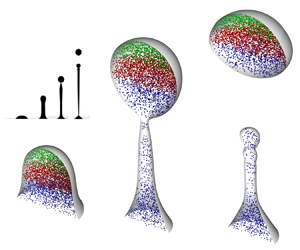
Fragmentation of a fluid body into droplets underlies many contamination and disease transmission processes where pathogens are transported in a liquid phase. An important class of such processes involves formation of a fluid ligament and its destabilization into droplets. Inertial detachment (Gilet & Bourouiba, J. R. Soc. Interface, vol. 12, 2015, 20141092) is one of these modes: upon impact on a sufficiently compliant substrate, the substrate's motion can transfer its impulse to a contaminated sessile drop residing on it. The fragmentation of the sessile drop is efficient at producing contaminated ejected droplets with little dilution. Inertial detachment, particularly from substrates of intermediate wetting, is also interesting as a fundamental fragmentation process on its own merit, involving the asymmetric stretching of the sessile drop under impulsive axial forcing with one-sided pinning due to the substrate's intermediate wetting. Our experiments show that the radius, $R_{tip}$, of the tip drop ejected become insensitive to the Bond number value for $Bo>1$. Here, $Bo$ quantifies the inertial effects via the relative axial impulsive acceleration compared with capillarity. The time, $t_{tip}$, of tip-drop breakup is also insensitive to $Bo$. Combining experiments, theory and validated numerics, we decipher the selection of $R_{tip}$ and its sensitivity to the surface-wetting and substrate foot dynamics. Using asymptotic theory in the large $Bo$ limit for which the thin-film/slender-jet approximations hold, we derive a reduced physical model that predicts $R_{tip}$ consistent with our experiments. Finally, we discuss how pathogen physical properties (e.g. wetting and buoyancy) within the sessile drop determine their distribution in the tip and secondary fragmentation droplets.


Asymptotic matching modal model on Richtmyer–Meshkov instability
-
- Journal:
- Journal of Fluid Mechanics / Volume 1002 / 10 January 2025
- Published online by Cambridge University Press:
- 26 December 2024, A16
-
- Article
- Export citation

Droplet impact on a flexible disk
-
- Journal:
- Journal of Fluid Mechanics / Volume 1002 / 10 January 2025
- Published online by Cambridge University Press:
- 26 December 2024, A8
-
- Article
- Export citation
Generation of multi-watt sub-50 fs pulses in Mamyshev oscillators: influence of the central wavelength in the grating filter
-
- Journal:
- High Power Laser Science and Engineering / Volume 12 / 2024
- Published online by Cambridge University Press:
- 26 December 2024, e83
-
- Article
-
- You have access
- Open access
- HTML
- Export citation

Wall-damped Faraday waves in horizontally oscillating two-layer fluid flows
-
- Journal:
- Journal of Fluid Mechanics / Volume 1002 / 10 January 2025
- Published online by Cambridge University Press:
- 26 December 2024, R1
-
- Article
-
- You have access
- Open access
- HTML
- Export citation
-
We study experimentally the onset of Faraday waves near the end walls of a rectangular vessel containing two stably stratified fluid layers, subject to horizontal oscillations. These subharmonic waves (SWs) are excited, because the horizontal inertial forcing drives a harmonic propagating wave which displaces the interface in the vertical direction at the end walls. We find that the onset of SWs is regulated by a balance between capillary and viscous forces, where the rate of damping is set by the Stokes layer thickness at the wall rather than the wavelength of the SWs. We model the onset of SWs with a weakly damped Mathieu equation and find that the dimensional critical acceleration scales as $\nu _m^{1/2} \omega ^{3/2}$, where $\nu _m$ is the mean viscosity and $\omega$ is the frequency of forcing, in excellent agreement with the experiment over a wide range of parameters.


The impact of natural convection and turbulent mixing on mechanical ventilation
-
- Journal:
- Journal of Fluid Mechanics / Volume 1002 / 10 January 2025
- Published online by Cambridge University Press:
- 26 December 2024, A7
-
- Article
-
- You have access
- Open access
- HTML
- Export citation
Scaling analysis for the frequency of Ostwaldian and Newtonian bead-on-fibre flows
-
- Journal:
- Journal of Fluid Mechanics / Volume 1002 / 10 January 2025
- Published online by Cambridge University Press:
- 26 December 2024, A12
-
- Article
-
- You have access
- Open access
- HTML
- Export citation
-
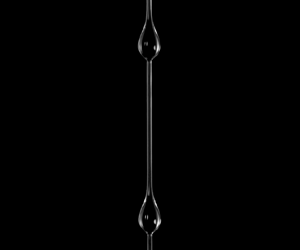
Liquid flowing down a fibre readily destabilises into a train of beads, commonly called a bead-on-fibre pattern. Bead formation results from capillary-driven instability and gives rise to patterns with constant velocity and time-invariant bead frequency $f$ whenever the instability is absolute. In this study, we develop a scaling law for $f$ that relates the Strouhal number $St$ and capillary number $Ca$ for Ostwaldian power-law liquids with Newtonian liquids recovered as a limiting case. We validate our proposed scaling law by comparing it with prior experimental data and new experimental data using xanthan gum solutions to produce a low capillary number $Ca \leq 10^{-2}$ regime. The experimental data encompasses both Ostwaldian and Newtonian flow, as well as symmetric and asymmetric patterns, and we find the data collapses along the predicted trend across seven orders of magnitude in $Ca$. Our proposed scaling law is a powerful tool for studying and applying bead-on-fibre flows where $f$ is critical, such as heat and mass transfer systems.


The effect of active exoskeleton support with different lumbar-to-hip support ratios on spinal musculoskeletal loading and lumbar kinematics during lifting
-
- Journal:
- Wearable Technologies / Volume 5 / 2024
- Published online by Cambridge University Press:
- 23 December 2024, e25
-
- Article
-
- You have access
- Open access
- HTML
- Export citation
High-power, ultra-low-noise cascaded diamond Raman lasers with spectrum compression
-
- Journal:
- High Power Laser Science and Engineering / Volume 12 / 2024
- Published online by Cambridge University Press:
- 23 December 2024, e82
-
- Article
-
- You have access
- Open access
- HTML
- Export citation
Optimisation and modelling of eddy viscosity in the resolvent analysis of turbulent channel flows
-
- Journal:
- Journal of Fluid Mechanics / Volume 1001 / 25 December 2024
- Published online by Cambridge University Press:
- 23 December 2024, A20
-
- Article
-
- You have access
- Open access
- HTML
- Export citation
-
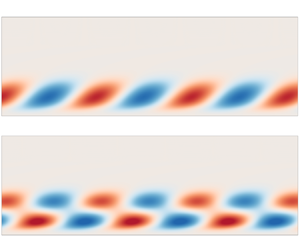
The eddy-viscosity model, as initially used to model the mean Reynolds stress, has been widely used in the linear analysis of turbulence recently by direct extension. In this study, the mechanism of the eddy viscosity in improving the prediction of fluctuation structures with linear analysis is clarified by investigating the statistical properties of forcing, eddy-viscosity term and their correlations. From the direct numerical simulation (DNS) results of turbulent channel flows with $Re_{\tau }=186$– $2003$, the spatial correlation of forcing is partially cancelled due to its interaction with eddy-viscosity terms. The stochastic forcing after excluding the eddy-viscosity term is nearly uncorrelated spatially, which better matches the condition where the resolvent modes are consistent with the spectral proper orthogonal decomposition (SPOD) modes from DNS. With the above findings, an optimisation framework is developed by minimising the spatial correlations of the stochastic forcing. The optimised eddy-viscosity profiles nearly overlap with the mean-quantity-based model in the near-wall region, but have different maximum values. Compared with the mean-quantity-based model, the optimised results enhance the consistency between the resolvent and DNS results significantly. Based on the optimised results, a new modelling framework is further abstracted, leaving only one to-be-modelled parameter of the maximum value of the eddy-viscosity profile. This parameter follows distinctive rules with spanwise flow scales, based on which a simplified predictive model is constructed. The resolvent modes predicted by the new model exhibit high consistency with SPOD modes, which are essentially comparable to the optimised results for wide ranges of streamwise and spanwise scales.


How interfacial tension enhances drag in turbulent Taylor–Couette flow with neutrally buoyant and equally viscous droplets
-
- Journal:
- Journal of Fluid Mechanics / Volume 1002 / 10 January 2025
- Published online by Cambridge University Press:
- 23 December 2024, A2
-
- Article
- Export citation
-
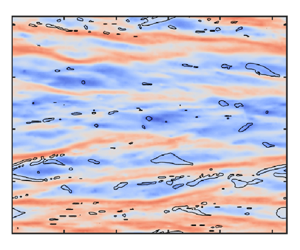
The presence of dispersed-phase droplets can result in a notable increase in a system's drag. However, our understanding of the mechanism underlying this phenomenon remains limited. In this study, we use three-dimensional direct numerical simulations with a modified multi-marker volume-of-fluid method to investigate liquid–liquid two-phase turbulence in a Taylor–Couette geometry. The dispersed phase has the same density and viscosity as the continuous phase. The Reynolds number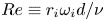 $Re\equiv r_i\omega _i d/\nu$ is fixed at 5200, the volume fraction of the dispersed phase is up to $40\,\%$, and the Weber number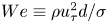 $We\equiv \rho u^2_\tau d/\sigma$ is approximately 8. It is found that the increase in the system's drag originates from the contribution of interfacial tension. Specifically, droplets experience significant deformation and stretching in the streamwise direction due to shear near the inner cylinder. Consequently, the rear end of the droplets lags behind the fore head. This causes opposing interfacial tension effects on the fore head and rear end of the droplets. For the fore head of the droplets, the effect of interfacial tension appears to act against the flow direction. For the rear end, the effect appears to act in the flow direction. The increase in the system's drag is attributed primarily to the effect of interfacial tension on the fore head of the droplets which leads to the hindering effect of the droplets on the surrounding continuous phase. This hindering effect disrupts the formation of high-speed streaks, favouring the formation of low-speed ones, which are generally associated with higher viscous stress and drag of the system. This study provides new insights into the mechanism of drag enhancement reported in our previous experiments.

High-flux angularly uniform proton beams from multiple laser interaction with wire-hemisphere targets
-
- Journal:
- High Power Laser Science and Engineering / Volume 12 / 2024
- Published online by Cambridge University Press:
- 23 December 2024, e79
-
- Article
-
- You have access
- Open access
- HTML
- Export citation
On aerobreakup in the stagnation region of high-Mach-number flow over a bluff body
-
- Journal:
- Journal of Fluid Mechanics / Volume 1002 / 10 January 2025
- Published online by Cambridge University Press:
- 23 December 2024, A1
-
- Article
- Export citation
-
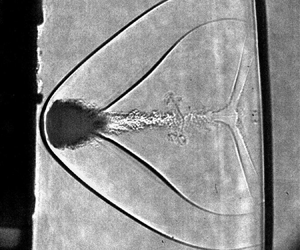
In this paper, aerobreakup in the stagnation region of high-Mach-number flow over a bluff body is studied with experiments and computations. Water drops of diameter 0.51–2.30 mm were acoustically levitated at sea level along the flight path of a rectangular $100\ {\rm mm} \times 150\ {\rm mm}$ rail-gun launched projectile. This enabled the study of aerobreakup at high Mach (3.03–5.12), post-shock Mach (1.5–1.9), Weber $(5 \times 10^4\unicode{x2013}4 \times 10^5)$ and Reynolds $(6 \times 10^4\unicode{x2013}3 \times 10^5)$ numbers. High-speed backlit shadowgraphy is used to record the flow structure. Computations are made for two cases, and it was found that the drop behaviour is not dominated by viscous or surface-tension effects and can be adequately captured by treating the gas as calorically perfect with the ratio of specific heats set to 1.3 to account for thermochemical effects. To assess drop surface stability at early breakup times, results from Newton's inclination method are used to determine the flow along the drop surface and input to a linear-stability analysis; from this, it was found that viscosity and surface tension can be neglected. Moreover, the acceleration term dominates the shear term at the stagnation point, a point accentuated as a drop flattens; this relation inverts closer to the drop equator. Linear-stability analysis was insufficient for modelling late-stage aerobreakup because the predicted wavelengths were too small and the expected aerobreakup times were non-physically short. To address this discrepancy, a nonlinear instability model with constant-rate growth is used that treats the accelerated drop surface as analogous to bubbles rising through a liquid; agreement with computations is good.
Method of fault prediction for avionics components based on stacking regression
-
- Journal:
- The Aeronautical Journal / Volume 129 / Issue 1336 / June 2025
- Published online by Cambridge University Press:
- 23 December 2024, pp. 1448-1467
-
- Article
- Export citation
Local transition indicator and modelling of turbulent mixing based on the mixing state
-
- Journal:
- Journal of Fluid Mechanics / Volume 1002 / 10 January 2025
- Published online by Cambridge University Press:
- 23 December 2024, A4
-
- Article
- Export citation
Design of polarization reconfigurable Koch fractal antenna for S-and C-band applications
-
- Journal:
- International Journal of Microwave and Wireless Technologies / Volume 16 / Issue 10 / December 2024
- Published online by Cambridge University Press:
- 23 December 2024, pp. 1772-1785
-
- Article
- Export citation
A wall model for separated flows: embedded learning to improve a posteriori performance
-
- Journal:
- Journal of Fluid Mechanics / Volume 1002 / 10 January 2025
- Published online by Cambridge University Press:
- 23 December 2024, A3
-
- Article
- Export citation

Convective flows near a solid embedded in a fluid-saturated porous medium heated from above
-
- Journal:
- Journal of Fluid Mechanics / Volume 1002 / 10 January 2025
- Published online by Cambridge University Press:
- 23 December 2024, A5
-
- Article
- Export citation
Bit efficiency of distributed- and collocated-massive MIMO base station systems in OTA measurement and simulation
-
- Journal:
- International Journal of Microwave and Wireless Technologies / Volume 17 / Issue 2 / March 2025
- Published online by Cambridge University Press:
- 23 December 2024, pp. 234-245
-
- Article
-
- You have access
- Open access
- HTML
- Export citation
Cooperative midcourse guidance law with target changing and communication topology switching
-
- Journal:
- The Aeronautical Journal / Volume 129 / Issue 1334 / April 2025
- Published online by Cambridge University Press:
- 23 December 2024, pp. 1096-1124
-
- Article
- Export citation
