Refine search
Actions for selected content:
212897 results in Engineering
Crystal structure of racemic benserazide hydrochloride Form I, C10H16N3O5Cl
-
- Journal:
- Powder Diffraction / Volume 40 / Issue 1 / March 2025
- Published online by Cambridge University Press:
- 21 October 2024, pp. 65-71
-
- Article
-
- You have access
- Open access
- HTML
- Export citation

Representing turbulent statistics with partitions of state space. Part 1. Theory and methodology
-
- Journal:
- Journal of Fluid Mechanics / Volume 997 / 25 October 2024
- Published online by Cambridge University Press:
- 21 October 2024, A1
-
- Article
-
- You have access
- Open access
- HTML
- Export citation
Design of dual-band filtering patch antenna based on SIR multimode resonator
-
- Journal:
- International Journal of Microwave and Wireless Technologies / Volume 16 / Issue 8 / October 2024
- Published online by Cambridge University Press:
- 21 October 2024, pp. 1283-1290
-
- Article
- Export citation
Effect of laser drilling process on combustor liner effusion hole quality
-
- Journal:
- The Aeronautical Journal / Volume 128 / Issue 1330 / December 2024
- Published online by Cambridge University Press:
- 21 October 2024, pp. 2964-2979
-
- Article
- Export citation

Representing turbulent statistics with partitions of state space. Part 2. The compressible Euler equations
-
- Journal:
- Journal of Fluid Mechanics / Volume 997 / 25 October 2024
- Published online by Cambridge University Press:
- 21 October 2024, A2
-
- Article
-
- You have access
- Open access
- HTML
- Export citation

Limiting regimes of turbulent horizontal convection. Part 2. Large Prandtl numbers
-
- Journal:
- Journal of Fluid Mechanics / Volume 997 / 25 October 2024
- Published online by Cambridge University Press:
- 21 October 2024, A6
-
- Article
-
- You have access
- Open access
- HTML
- Export citation
-
Horizontal convection at large Rayleigh and Prandtl numbers is studied experimentally in a regime up to seven orders of magnitude larger in terms of Rayleigh numbers than previously achieved. To reach Rayleigh numbers up to $10^{17}$, the horizontal density gradient is generated using differential solutal convection by a differential input of salt and fresh water controlled by diffusion in a novel experiment in which the zero-net mass flux of water is ensured through permeable membranes. This set-up allows us to accurately measure the Nusselt number in solutal convection by carefully controlling the amount of salt water exchanged through the membranes. Combined measurements of density and velocity across more than five orders of magnitude in Rayleigh numbers show that the flow transitions from the Beardsley & Festa (J. Phys. Oceanogr., vol. 2, issue 4, 1972, pp. 444–455), Shishkina & Wagner (Phys. Rev. Lett., vol. 116, issue 2, 2016, 024302) regime to the Chiu-Webster et al. (J. Fluid Mech., vol. 611, 2008, pp. 395–426) regime and frames the present results within the scope of Shishkina et al. (Geophys. Res. Lett., vol. 43, issue 3, 2016, pp. 1219–1225), and the theory of Part 1 (Passaggia & Scotti, vol. 997, 2024, J. Fluid Mech., A5). In particular, we show that, even for large Prandtl numbers, the circulation eventually clusters underneath the forcing horizontal boundary, leaving a stratified core without motion. Finally, the previous regime diagrams (Hughes & Griffiths, Annu. Rev. Fluid Mech., vol. 40, 2008, pp. 185–208; Shishkina et al., Geophys. Res. Lett., vol. 43, issue 3, 2016, pp. 1219–1225) are extended by combining the present results at high Prandtl numbers, the results at low Prandtl numbers of Part 1, together with previous results from the literature. This work sets a new picture of the transition landscape of horizontal convection over six orders of magnitude in Prandtl number and sixteen orders of magnitude in Rayleigh number.

Reset controller synthesis: a correct-by-construction way to the design of CPS
-
- Journal:
- Research Directions: Cyber-Physical Systems / Volume 2 / 2024
- Published online by Cambridge University Press:
- 18 October 2024, e7
-
- Article
-
- You have access
- Open access
- HTML
- Export citation

Influence of large-scale free-stream turbulence on bypass transition in air and organic vapour flows
-
- Journal:
- Journal of Fluid Mechanics / Volume 997 / 25 October 2024
- Published online by Cambridge University Press:
- 18 October 2024, A56
-
- Article
- Export citation
-
The free-stream turbulence (FST) induced transition in perfect and non-ideal gas zero-pressure-gradient flat-plate boundary layers is investigated by means of large-eddy simulations. The study focuses on the influence of large incoming disturbances over the laminar-to-turbulent transition, by comparing two different integral length scales $L_f$, which differ by a factor of seven, at different FST intensities $T_u$. High-subsonic dense-gas boundary layers of the organic vapour Novec649, representative of organic Rankine cycle applications, are compared with air flows at Mach numbers 0.1 and 0.9. Compressibility and non-ideal gas effects are shown to be of minor importance in comparison to the influence of the FST integral length scale $L_f$. An increase of the inlet turbulent intensity always promotes transition, whereas an increase of $L_f$ has a double effect on the transition onset. At $T_u=2.5\,\%$, increasing $L_f$ promotes the transition, while it tends to delay transition for an FST intensity of 4 %. Larger FST integral scales tend to increase the spanwise distance between laminar streaks generated in the boundary layer. Two competing transition scenarios are observed. When the incoming turbulence intensity and length scale are moderate, the classical bypass route consists in the linear non-modal growth of streaks, which then experience secondary instabilities (sinuous or varicose) and lead to the generation of turbulent spots. The second scenario is characterized by the appearance of $\Lambda$-shaped structures near the inlet, which are further stretched to hairpin vortices before breaking down to turbulence. Spot inceptions can therefore occur at earlier locations than the streak growth. We are then faced with a competition between the classical bypass transition and nonlinear response mechanisms that ‘bypass’ this route. The present case at high $L_f$ and low $T_u$ is an example of a competing scenario, but even for the higher $T_u$ and $L_f$ conditions, only approximately one-third of turbulent spots are due to the $\Lambda$-shaped events. The nonlinear alternative route has strong similarities with scenarios described previously in the literature in the presence of leading edge effects or due to passing wakes. Such a path is governed by the turbulence intensity, but also by the integral length scale, with both parameters playing a critical role in the generation of the $\Lambda$-shaped structures near the inlet. This alternative mechanism is found to be robust under varying flow and thermodynamic conditions.


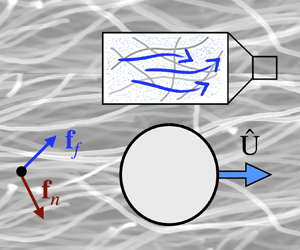
A reciprocal theorem for biphasic poro-viscoelastic materials
-
- Journal:
- Journal of Fluid Mechanics / Volume 997 / 25 October 2024
- Published online by Cambridge University Press:
- 17 October 2024, A62
-
- Article
- Export citation

Oscillation migration of a neutrally buoyant oblate spheroid in the elasto-inertial duct flow
-
- Journal:
- Journal of Fluid Mechanics / Volume 997 / 25 October 2024
- Published online by Cambridge University Press:
- 17 October 2024, A57
-
- Article
-
- You have access
- Open access
- HTML
- Export citation
-
The peculiar migration and rotational dynamics of non-spherical particles in non-Newtonian flows stem from the interplay between fluid rheology and fluid inertial effects. In this paper, the cross-flow migration of a neutrally buoyant oblate spheroid (aspect ratio $AR = 0.5$) immersed in the elasto-inertial duct flow is investigated by particle-resolved simulations with the immersed boundary method. Different from spherical particles, due to the orientation-dependent lift force, the oblate spheroid migrates in an oscillating manner in the duct. The travelling period for particles reaching the duct centreline undergoes a non-monotonic change with elastic number, revealing the existence of a critical elastic number governing the migrating efficiency of oblate particles within the present flow system. For the particle rotation and orientation, the present results indicate that the particle rotation rate and orbit drifting rate are both hindered by the fluid elasticity. With increasing the fluid elasticity, three different orientation modes – log-rolling mode, kayaking-like mode and longside-flow alignment mode – are observed successively during the elasto-inertial migration of the oblate spheroid. Potentially, the present results could be used to design the rheology-based controlling strategy for guiding particles to achieve optimal focusing and orientation in microfluidic applications without the need for external forcing fields.


The flow within the head of a gravity current
-
- Journal:
- Journal of Fluid Mechanics / Volume 997 / 25 October 2024
- Published online by Cambridge University Press:
- 17 October 2024, A42
-
- Article
-
- You have access
- Open access
- HTML
- Export citation
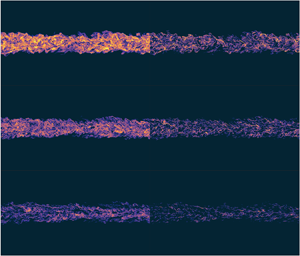
Mixing in a strongly stratified turbulent wake quantified by bulk and conditional statistics
-
- Journal:
- Journal of Fluid Mechanics / Volume 997 / 25 October 2024
- Published online by Cambridge University Press:
- 17 October 2024, A41
-
- Article
-
- You have access
- Open access
- HTML
- Export citation
-
We analyze a dataset from a numerically simulated, temporally evolving turbulent wake (Zhou, Phys. Rev. Fluids, vol. 7, 2022, 104802) that exhibits spontaneous anisotropic layering under strong stratification, alongside significant spatiotemporal variability within the flow. This analysis focuses on the irreversible flux coefficient, $\varGamma$, defined as the ratio between turbulent potential and kinetic energy dissipation rates. We find that the volume-averaged $\varGamma$ initially rises, reaches a plateau between 0.45 and 0.49 when the layering dynamics become dominant, and then decreases as viscosity plays a larger role. These peak $\varGamma$ values are consistent with those from prior simulations under strongly stratified conditions. Such efficient mixing occurs when the Ozmidov to Thorpe length scale ratio is between 0.37 and 0.52, consistent with numerical and field data reported by Mashayek et al. (J. Fluid Mech., vol. 826, 2017, pp. 522–552). To account for the coexistence of dynamically distinct regions within the flow, we perform conditional sampling of $\varGamma$ against a locally defined gradient Richardson number, ${\textit {Ri}}$. This reveals a flux-gradient relation between $\varGamma$ and ${\textit {Ri}}$ that remains largely consistent over time. This relation features a large, approximately constant value of $\varGamma$ for ${\textit {Ri}}$ values greater than one, echoing the ‘constant-power’ scenario postulated by Balmforth et al. (J. Fluid Mech., vol. 355, 1998, pp. 329–358).


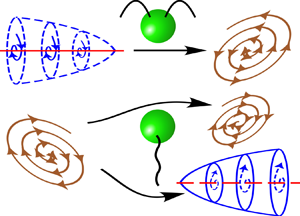
Harnessing wall slip towards tunable microswimming in Poiseuille flow
-
- Journal:
- Journal of Fluid Mechanics / Volume 997 / 25 October 2024
- Published online by Cambridge University Press:
- 17 October 2024, A59
-
- Article
- Export citation

Equilibrium of fluid fluxes in the wake of a three-dimensional flat-back bluff body
-
- Journal:
- Journal of Fluid Mechanics / Volume 997 / 25 October 2024
- Published online by Cambridge University Press:
- 17 October 2024, A60
-
- Article
-
- You have access
- Open access
- HTML
- Export citation
-
The turbulent wake behind a flat-back Ahmed body is investigated using stacked stereoscopic particle image velocimetry. The wake is disturbed by a steady jet from the centre of the base and the effects are quantified for key blowing rates. The unactuated wake exhibits bistable dynamics in the horizontal plane that are completely subdued for the optimal blowing case, yielding a base drag reduction of 9 %. The three-dimensional mean wake is reconstructed and used to evaluate the wake mass fluxes whose equilibrium determines the recirculation length. The results for the unactuated wake show that up to 80 % of replenishment fluid flux entering the recirculation bubble from the free-stream flow is provided through the low-pressure side of the base, where the symmetry-breaking shear layer roll-up occurs near the base. For the optimal blowing configuration, where the wake becomes symmetric, the flux of wake replenishment is severely reduced. This flow configuration results in elongated shear layers on all sides, which terminate the bubble with a roll-up of reduced intensity at a further downstream location. The dominant cause of bubble growth and the accompanying drag reduction is attributed to the momentum of the base blowing, and the new regime is referred to as the ‘favourable momentum regime’. Similar trends are observed when the model is at $5^{\circ }$ yaw where a reduction of drag and yaw-induced asymmetry are obtained. Proper orthogonal decomposition of the wake reveals the coherent structures related to the bistable flow and the symmetric wake under optimal blowing coefficient.

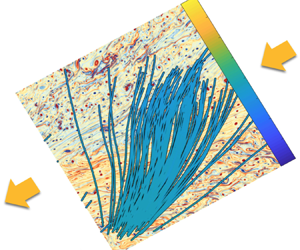
Wave propagation in random two-dimensional turbulence: a multiscale approach
-
- Journal:
- Journal of Fluid Mechanics / Volume 997 / 25 October 2024
- Published online by Cambridge University Press:
- 17 October 2024, A51
-
- Article
-
- You have access
- Open access
- HTML
- Export citation

Leveraging biotechnology design principles to advance brain understanding and improve biotechnological device efficiency and scalability
-
- Journal:
- Research Directions: Biotechnology Design / Volume 2 / 2024
- Published online by Cambridge University Press:
- 17 October 2024, e14
-
- Article
-
- You have access
- Open access
- HTML
- Export citation

Trapped free surface waves for a Lamb–Oseen vortex flow
-
- Journal:
- Journal of Fluid Mechanics / Volume 997 / 25 October 2024
- Published online by Cambridge University Press:
- 17 October 2024, A40
-
- Article
-
- You have access
- Open access
- HTML
- Export citation
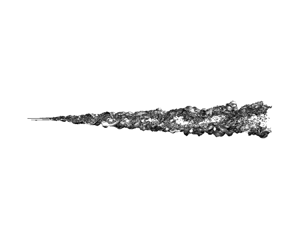
Organised large structure in the post-transition mixing layer. Part 3. Dynamics of the spatial growth
-
- Journal:
- Journal of Fluid Mechanics / Volume 997 / 25 October 2024
- Published online by Cambridge University Press:
- 17 October 2024, A63
-
- Article
-
- You have access
- Open access
- HTML
- Export citation
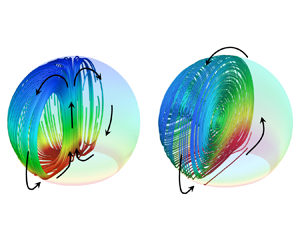
Transition of buoyancy-driven flow from an axisymmetric to non-axisymmetric vortex inside an evaporating sessile droplet
-
- Journal:
- Journal of Fluid Mechanics / Volume 997 / 25 October 2024
- Published online by Cambridge University Press:
- 17 October 2024, A47
-
- Article
- Export citation
Developing and characterizing a typology of soil fabrics
-
- Journal:
- Research Directions: Biotechnology Design / Volume 2 / 2024
- Published online by Cambridge University Press:
- 17 October 2024, e15
-
- Article
-
- You have access
- Open access
- HTML
- Export citation
