Refine search
Actions for selected content:
212899 results in Engineering
Crystal structure of decoquinate, C24H35NO5
-
- Journal:
- Powder Diffraction / Volume 40 / Issue 1 / March 2025
- Published online by Cambridge University Press:
- 16 October 2024, pp. 57-64
-
- Article
-
- You have access
- Open access
- HTML
- Export citation
FINDS: an ImageJ script for rapid non-matrix diffraction spot identification in selected area electron diffraction patterns
-
- Journal:
- Powder Diffraction / Volume 40 / Issue 1 / March 2025
- Published online by Cambridge University Press:
- 16 October 2024, pp. 36-43
-
- Article
- Export citation
FLM volume 996 Cover and Front matter
-
- Journal:
- Journal of Fluid Mechanics / Volume 996 / 10 October 2024
- Published online by Cambridge University Press:
- 15 October 2024, p. f1
-
- Article
-
- You have access
- Export citation
Impact of operator characteristics on landing gear ground manoeuvre occurrences
-
- Journal:
- The Aeronautical Journal / Volume 128 / Issue 1329 / November 2024
- Published online by Cambridge University Press:
- 15 October 2024, pp. 2604-2633
-
- Article
-
- You have access
- Open access
- HTML
- Export citation
Design of compact signal source with reduced phase noise for airborne pulse Doppler RF sensor
-
- Journal:
- International Journal of Microwave and Wireless Technologies / Volume 16 / Issue 6 / July 2024
- Published online by Cambridge University Press:
- 15 October 2024, pp. 955-965
-
- Article
- Export citation
Of other reefs: designing habitats in blasted seascapes
-
- Journal:
- Research Directions: Biotechnology Design / Volume 2 / 2024
- Published online by Cambridge University Press:
- 15 October 2024, e13
-
- Article
-
- You have access
- Open access
- HTML
- Export citation
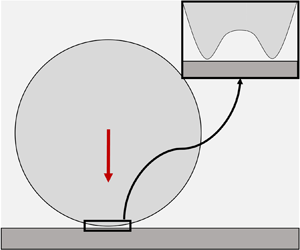
Fluid-mediated impact of soft solids
-
- Journal:
- Journal of Fluid Mechanics / Volume 997 / 25 October 2024
- Published online by Cambridge University Press:
- 14 October 2024, A35
-
- Article
-
- You have access
- Open access
- HTML
- Export citation
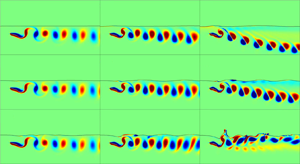
Free-surface-induced ground effect for flapping swimmers
-
- Journal:
- Journal of Fluid Mechanics / Volume 997 / 25 October 2024
- Published online by Cambridge University Press:
- 14 October 2024, A36
-
- Article
-
- You have access
- Open access
- HTML
- Export citation
-
Numerous flying and swimming creatures use the ground effect to boost their propulsive performance, with the ‘ground’ referring to either a solid boundary or a free surface. While our knowledge of how a solid boundary affects biolocomotion is relatively comprehensive, the ground effect of a free surface is not fully understood. To address this limitation, we conduct a numerical investigation on the propulsion performance of a flapping plate under a free surface, subject to a range of control parameters. When the Froude number ( $Fr$) is very low (i.e. little surface deformation), the effects of a free surface are similar to those of a solid boundary, with enhanced thrust and input power but little change in efficiency. However, as $Fr$ increases (i.e. more surface deformation), our results reveal an optimal $Fr$ of approximately 0.6, where the free surface induces a more streamlined flow around the flapping plate, effectively reducing the added mass. This results in a significant decrease in input power and greatly enhanced efficiency.


Bacteria–fungi interaction for material formation
-
- Journal:
- Research Directions: Biotechnology Design / Volume 2 / 2024
- Published online by Cambridge University Press:
- 14 October 2024, e12
-
- Article
-
- You have access
- Open access
- HTML
- Export citation
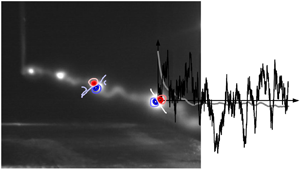
On the linear response theory of vortex meandering and its statistical verification in experiments
-
- Journal:
- Journal of Fluid Mechanics / Volume 997 / 25 October 2024
- Published online by Cambridge University Press:
- 14 October 2024, A38
-
- Article
-
- You have access
- Open access
- HTML
- Export citation

A singularly altered streamline topology allows faster transport from deformed drops
-
- Journal:
- Journal of Fluid Mechanics / Volume 997 / 25 October 2024
- Published online by Cambridge University Press:
- 14 October 2024, A39
-
- Article
- Export citation
-
We analyse the effect of drop-deformation-induced change in streamline topology on the scalar transport rate (the Nusselt number $Nu$) in an ambient planar linear flow. The drop-phase resistance is assumed dominant, and the drop deformation is characterised by the capillary number ( $Ca$). For a spherical drop ( $Ca = 0$) in an ambient planar extension, closed streamlines lead to $Nu$ increasing with the Péclet number ( $Pe$), from $Nu_0$, corresponding to purely diffusive transport, to $4.1Nu_0$, corresponding to a large- $Pe$ diffusion-limited plateau. For non-zero $Ca$, we show that the flow field consists of spiralling streamlines densely wound around nested tori foliating the deformed drop interior. Now $Nu$ increases beyond the aforementioned primary plateau, saturating in a secondary one that approaches $22.3Nu_0$ for $Ca \rightarrow 0$, $Pe\,Ca \rightarrow \infty$. The enhancement appears independent of the drop-to-medium viscosity ratio. We further show that this singular dependence, of the transport rate on drop deformation, is generic across planar linear flows; chaotically wandering streamlines in some of these cases may even lead to a tertiary enhancement regime.


Elasto-inertial focusing and rotating characteristics of ellipsoidal particles in a square channel flow of Oldroyd-B viscoelastic fluids
-
- Journal:
- Journal of Fluid Mechanics / Volume 997 / 25 October 2024
- Published online by Cambridge University Press:
- 14 October 2024, A32
-
- Article
- Export citation
Synthesis and structural characterization of new perovskite phases, Ba2Bi0.572TeO6±δ and SrLa2NiFeNbO9
-
- Journal:
- Powder Diffraction / Volume 39 / Issue 4 / December 2024
- Published online by Cambridge University Press:
- 14 October 2024, pp. 235-244
-
- Article
-
- You have access
- Open access
- HTML
- Export citation
Graph theoretic methods for assessing the effects of a background shear current on internal solitary waves
-
- Journal:
- Journal of Fluid Mechanics / Volume 997 / 25 October 2024
- Published online by Cambridge University Press:
- 14 October 2024, A37
-
- Article
-
- You have access
- Open access
- HTML
- Export citation
The dynamics of shock wave propagation far downstream of an abrupt area expansion
-
- Journal:
- Journal of Fluid Mechanics / Volume 997 / 25 October 2024
- Published online by Cambridge University Press:
- 14 October 2024, A30
-
- Article
-
- You have access
- Open access
- HTML
- Export citation
Field investigation of 3-D snow settling dynamics under weak atmospheric turbulence
-
- Journal:
- Journal of Fluid Mechanics / Volume 997 / 25 October 2024
- Published online by Cambridge University Press:
- 11 October 2024, A33
-
- Article
-
- You have access
- Open access
- HTML
- Export citation
Crystal structure of gepirone, C19H29N5O2
-
- Journal:
- Powder Diffraction / Volume 40 / Issue 1 / March 2025
- Published online by Cambridge University Press:
- 11 October 2024, pp. 76-81
-
- Article
-
- You have access
- Open access
- HTML
- Export citation
Zigzag instability of columnar Taylor–Green vortices in a strongly stratified fluid
-
- Journal:
- Journal of Fluid Mechanics / Volume 997 / 25 October 2024
- Published online by Cambridge University Press:
- 11 October 2024, A34
-
- Article
-
- You have access
- Open access
- HTML
- Export citation
-
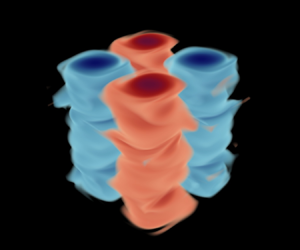
We investigate the dynamics of a columnar Taylor–Green vortex array under strong stratification, focusing on Froude numbers $0.125\leq Fr \leq 1.0$, with the aim of identifying and understanding the primary instabilities that lead to the vortices’ breakdown. Linear stability analysis reveals that the fastest-growing vertical wavenumber scales with $Fr^{-1}$, while the dimensionless growth rate remains approximately constant. The most unstable eigenmode, identified as the mixed hyperbolic mode by Hattori et al. (J. Fluid Mech., vol. 909, 2021, A4), bears significant similarities to the zigzag instability, first discovered by Billant & Chomaz (J. Fluid Mech., vol. 418, 2000, pp. 167–188). Direct numerical simulations further confirm that the zigzag instability is crucial in amplifying initial random perturbations to finite amplitude, with the flow structure and modal growth rate consistent with the linear stability analysis. In particular, the characteristic vertical length scale of turbulence matches that of the fastest-growing linear mode. These findings underscore the broader relevance of the zigzag instability mechanism beyond its initial discovery in vortex pairs, demonstrating its role in facilitating direct energy transfer from vertically uniform vortical motions to a characteristic vertical length scale proportional to $Fr$ in strongly stratified flows.


FLM volume 993 Cover and Front matter
-
- Journal:
- Journal of Fluid Mechanics / Volume 993 / 25 August 2024
- Published online by Cambridge University Press:
- 10 October 2024, p. f1
-
- Article
-
- You have access
- Export citation
A sufficient condition for inviscid shear instability: hurdle theorem and its application to alternating jets
-
- Journal:
- Journal of Fluid Mechanics / Volume 997 / 25 October 2024
- Published online by Cambridge University Press:
- 10 October 2024, A25
-
- Article
-
- You have access
- Open access
- HTML
- Export citation
