Refine search
Actions for selected content:
212907 results in Engineering
How surface modifications enhance vertical falling film evaporation
-
- Journal:
- Journal of Fluid Mechanics / Volume 997 / 25 October 2024
- Published online by Cambridge University Press:
- 10 October 2024, A17
-
- Article
-
- You have access
- Open access
- HTML
- Export citation
-
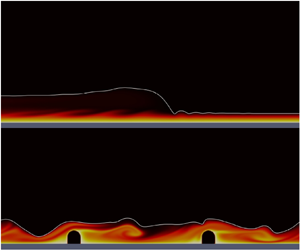
We use multiphase direct numerical simulations to identify, analyse and quantify components of wall-normal heat flux distributions in evaporative vertical falling films with surface modifications at industrially relevant conditions. Previous experiments showed a potential increase of the heat transfer rate through the film by up to 100 % using various types of modifications. We show that the modifications induce significant advective heat transport and hypothesise that four synergistic mixing mechanisms are behind the heat transfer rate improvement. Additionally, we examine how the important surface topology parameters, pitch $\hat {p}$ (distance between modifications), height $\hat {h}$ and the liquid Prandtl number $\mathit {Pr}_l$, influence the mode of heat transport and the Nusselt number $\mathit {Nu}$. We show that $\hat {p}/\hat {h} \approx 10$ maximises $\mathit {Nu}$ and that the optimal pitch is related to the recirculation zone length $L_r$ behind the modification. We find that $L_r/\hat {h} \approx 3.5$ and that $\mathit {Nu} \propto \mathit {Pr}_l^{0.42}$ in the investigated parameter ranges. We also show that all our cases on both smooth and modified surfaces have $\mathit {Pe}_l \gg 1$ and collapse well on a line $\mathit {Nu} \propto (\mathit {Pe}_l/\mathit {Re})^{0.35}$. This relation suggests that $\mathit {Nu}$ is governed by the balance of film mixing, thermal resistance and diffusivity, and that the ratio $\mathit {Pe}_l/\mathit {Re}$ can be used to estimate $\mathit {Nu}$. Our methodology and findings extend the knowledge concerning the mechanisms behind the heat transfer improvement due to surface modifications and facilitate guidelines for designing more efficient modified surfaces in industrial evaporators.


The effect of end conditions on the body motion and near-wake flow structure of a circular cylinder under vortex-induced vibration
-
- Journal:
- Journal of Fluid Mechanics / Volume 997 / 25 October 2024
- Published online by Cambridge University Press:
- 10 October 2024, A22
-
- Article
-
- You have access
- Open access
- HTML
- Export citation
-
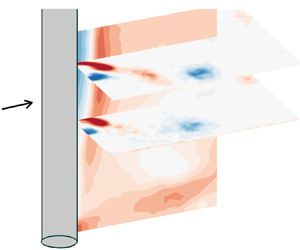
Free transverse oscillations of an elastically mounted circular cylinder with low mass-damping are studied with a focus on the effects of the cylinder end condition on structural oscillations and vortex shedding. While the top end of the cylinder pierces the free surface of a water channel, the lower end is changed to have three end conditions: an attached endplate, an endplate unattached from the cylinder at varying gaps and no endplate. All three response branches are examined, with the reduced velocity sweeping $2 \le {U^\ast } \le 15$ (corresponding to a Reynolds number range of $2000 \le Re \le 14\;700$). Although the cylinder oscillations are unaffected by the end condition in the initial and upper branches, they show significant dependency on the end condition in the lower branch. When the endplate is attached or unattached with a small gap, the upper-to-lower branch transition occurs with a sudden decrease in oscillation amplitude, after which the lower branch maintains a near-constant amplitude. For larger gaps or no endplate, with increasing reduced velocity, the oscillation amplitude decreases gradually from its peak without any discernible sign of transition between the upper and lower branches. The three-dimensional effects of the gap are the basis for these differences in oscillation. Atop the strong tip vortex, a low-magnitude streamwise velocity region develops downstream of the cylinder, which delays upper-to-lower branch transition over the cylinder span that sees this low-velocity region. With increasing gap, this low-velocity region and the delay in transition spread over larger spanwise extents, forcing the overall body to oscillate at larger amplitudes.

Periodic morphing of a NACA6409 aerofoil in ground effect, its wake mechanisms and thrust generation
-
- Journal:
- The Aeronautical Journal / Volume 128 / Issue 1330 / December 2024
- Published online by Cambridge University Press:
- 09 October 2024, pp. 2924-2944
-
- Article
-
- You have access
- Open access
- HTML
- Export citation
Tracing the origins of mode coupling for beam quality optimization in high-power fiber laser delivery systems
- Part of
-
- Journal:
- High Power Laser Science and Engineering / Volume 12 / 2024
- Published online by Cambridge University Press:
- 09 October 2024, e54
-
- Article
-
- You have access
- Open access
- HTML
- Export citation
Analysis of the impact of key similarity criteria numbers of TBCC inlet during the mode transition
-
- Journal:
- The Aeronautical Journal / Volume 129 / Issue 1332 / February 2025
- Published online by Cambridge University Press:
- 09 October 2024, pp. 395-410
-
- Article
- Export citation
Scale dependence of local shearing motion in decaying turbulence generated by multiple-jet interaction
-
- Journal:
- Journal of Fluid Mechanics / Volume 997 / 25 October 2024
- Published online by Cambridge University Press:
- 08 October 2024, A14
-
- Article
- Export citation
Streamwise energy-transfer mechanisms in zero- and adverse-pressure-gradient turbulent boundary layers
-
- Journal:
- Journal of Fluid Mechanics / Volume 997 / 25 October 2024
- Published online by Cambridge University Press:
- 08 October 2024, A16
-
- Article
-
- You have access
- Open access
- HTML
- Export citation
-
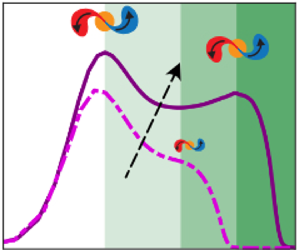
The present study investigates streamwise ( $\overline {u^2}$) energy-transfer mechanisms in the inner and outer regions of turbulent boundary layers (TBLs). Particular focus is placed on the $\overline {u^2}$ production, its inter-component and wall-normal transport as well as dissipation, all of which become statistically significant in the outer region with increasing friction Reynolds number ( $Re_{\tau }$). These properties are analysed using published data sets of zero, weak and moderately strong adverse-pressure-gradient (APG) TBLs across a decade of $Re_{\tau }$, revealing similarity in energy-transfer pathways for all these TBLs. It is found that both the inner and outer peaks of $\overline {u^2}$ are always associated with local maxima in the $\overline {u^2}$ production and its inter-component transport, and the regions below/above each of these peaks are always dominated by wall-ward/away-from-wall transport of $\overline {u^2}$, thereby classifying the $\overline {u^2}$ profiles into four distinct regimes. This classification reveals existence of phenomenologically similar energy-transfer mechanisms in the ‘inner’ and ‘outer’ regions of moderately strong APG TBLs, which meet at an intermediate location coinciding with the minimum in $\overline {u^2}$ profiles. Conditional averaging suggests existence of similar phenomena even in low $Re_{\tau }$ canonical and/or weak APG TBLs, albeit with the outer-region mechanisms weaker than those in the inner region. This explains the absence of their $\overline {u^2}$ outer peak and the dominance of $\overline {u^2}$ wall-normal transport away from the wall, which potentially originates from the inner region. Given that the wall-ward/away-from-wall transport of $\overline {u^2}$ is governed by the $Q_4$(sweeps)/ $Q_2$(ejections) quadrants of the Reynolds shear stress, it is argued that the emergence of the $\overline {u^2}$ outer peak corresponds with the statistical dominance of $Q_4$ events in the outer region. Besides unravelling the dynamical significance of $Q_2$ and $Q_4$ events in the outer region of TBLs, the present analysis also proposes new phenomenological arguments for testing on canonical wall-turbulence data at very high $Re_{\tau }$.


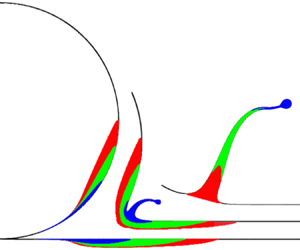
Mass transfer during drop impact on a thin film
-
- Journal:
- Journal of Fluid Mechanics / Volume 997 / 25 October 2024
- Published online by Cambridge University Press:
- 08 October 2024, A15
-
- Article
-
- You have access
- Open access
- HTML
- Export citation
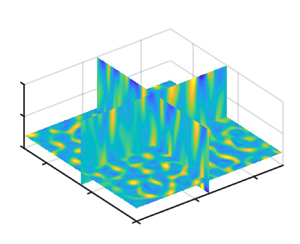
Vorticity skewness of finite-amplitude rapidly rotating Rayleigh–Bénard convection
-
- Journal:
- Journal of Fluid Mechanics / Volume 997 / 25 October 2024
- Published online by Cambridge University Press:
- 08 October 2024, A3
-
- Article
-
- You have access
- Open access
- HTML
- Export citation
-
Rotating Rayleigh–Bénard convection denotes the convection between a warm plate and a cold plate in a rotating environment. It is a classic model for understanding convective vortices in the atmosphere and ocean. The influence of background rotation on fluid inertia breaks the symmetry between cyclones and anticyclones. Such a symmetry breaking could be represented by vorticity skewness, which still lacks a systematic theory. Rapidly rotating convection with stress-free boundaries and unit Prandtl number is a convenient starting point. The investigation starts from the convective onset stage, where the vortices grow stationarily. Asymptotic analysis shows that the volumetric vorticity skewness $S$ is produced by the interaction between the $n=0,1$ and $n=1,2$ vertical eigenmodes. The $n=0$ (barotropic) mode contributes positively to $S$ mainly by stretching the vertical relative vorticity, an ageostrophic effect. The $n=2$ mode makes a minor negative contribution to $S$ by preferentially intensifying the outflow over the inflow, a non-hydrostatic effect. The theory predicts $S$ to be proportional to the global Rossby number defined with the volumetric standard deviation of vorticity, ${Ro_g}$. The proportional factor does not depend on the Rayleigh and Ekman numbers, agreeing with direct numerical simulations. Then the system enters the equilibrium stage. The stretching of vertical vorticity still contributes to $S$ dominantly. At ${Ro_g}\gtrsim 0.5$, the emergent unsteady flow significantly suppresses the asymmetry between the inflow and outflow strength, and weakens its influence on $S$.
$S$.


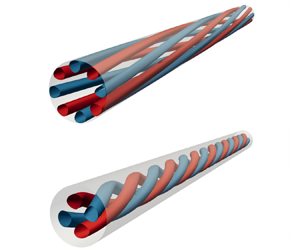
Energy-based characterisation of large-scale coherent structures in turbulent pipe flows
-
- Journal:
- Journal of Fluid Mechanics / Volume 996 / 10 October 2024
- Published online by Cambridge University Press:
- 08 October 2024, A45
-
- Article
-
- You have access
- Open access
- HTML
- Export citation
-
Large-scale coherent structures in incompressible turbulent pipe flow are studied for a wide range of Reynolds numbers ( $Re_\tau =180, 550, 1000, 2000$ and $5200$). Employing the Karhunen–Loève decomposition and a novel approach based on the Voronoi diagram, we identify and classify statistically coherent structures based on their location, dimensions and $Re_{\tau }$. With increasing $Re_{\tau }$, two distinct classes of structures become more energetic, namely wall-attached and detached eddies. The Voronoi methodology is shown to delineate these two classes without the need for specific criteria or thresholds. At the highest $Re_{\tau }$, the attached eddies scale linearly with the wall-normal distance with a slope of approximately $l_y\sim 1.2y/R$, while the detached eddies remain constant at the size of $l_y \approx 0.26R$, with a progressive shift towards the pipe centre. We extract these two classes of structures and describe their spatial characteristics, including radial size, helix angle and azimuthal self-similarity. The spatial distribution could help explain the differences in mean velocity between pipe and channel flows, as well as in modelling large and very-large-scale motions (LSM and VLSM). In addition, a comprehensive description is provided for both wall-attached and detached structures in terms of LSM and VLSM.


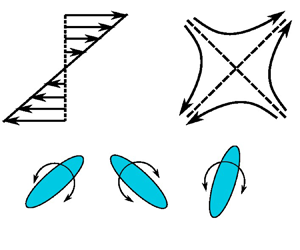
Rotational Taylor dispersion in linear flows
-
- Journal:
- Journal of Fluid Mechanics / Volume 997 / 25 October 2024
- Published online by Cambridge University Press:
- 08 October 2024, A10
-
- Article
- Export citation
On the reduction of flow rate losses using thermal waves
-
- Journal:
- Journal of Fluid Mechanics / Volume 997 / 25 October 2024
- Published online by Cambridge University Press:
- 08 October 2024, A12
-
- Article
-
- You have access
- Open access
- HTML
- Export citation
Sensitivity of flows over three-dimensional swept wings at low Reynolds number
-
- Journal:
- Journal of Fluid Mechanics / Volume 997 / 25 October 2024
- Published online by Cambridge University Press:
- 08 October 2024, A11
-
- Article
-
- You have access
- Open access
- HTML
- Export citation
FLM volume 995 Cover and Front matter
-
- Journal:
- Journal of Fluid Mechanics / Volume 995 / 25 September 2024
- Published online by Cambridge University Press:
- 08 October 2024, p. f1
-
- Article
-
- You have access
- Export citation
Aspect-ratio-dependent heat transport by baroclinic acoustic streaming
-
- Journal:
- Journal of Fluid Mechanics / Volume 997 / 25 October 2024
- Published online by Cambridge University Press:
- 08 October 2024, A7
-
- Article
-
- You have access
- Open access
- HTML
- Export citation
-
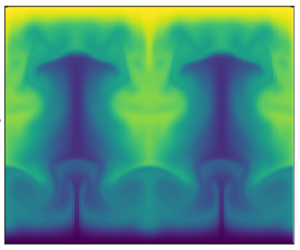
Standing acoustic waves have been known to generate Eulerian time-mean ‘streaming’ flows at least since the seminal investigation of Lord Rayleigh in the 1880s. Nevertheless, a recent body of numerical and experimental evidence has shown that inhomogeneities in the ambient density distribution lead to much faster flows than arise in classical Rayleigh streaming. The emergence of these unusually strong flows creates new opportunities to enhance heat transfer in systems in which convective cooling cannot otherwise be easily achieved. To assess this possibility, a theoretical study of acoustic streaming in an ideal gas confined in a rectangular channel with top and bottom walls maintained at fixed but differing temperatures is performed. A two time scale system of equations is utilized to efficiently capture the coupling between the fast acoustic waves and the slowly evolving streaming flow, enabling strongly nonlinear regimes to be accessed. A large suite of numerical simulations is carried out to probe the streaming dynamics, to highlight the critical role played by baroclinically generated wave vorticity and to quantify the additional heat flux induced by the standing acoustic wave. Proper treatment of the two-way coupling between the waves and mean flow is found to be essential for convergence to a self-consistent steady state, and the variation of the resulting acoustically enhanced steady-state heat flux with both the amplitude of the acoustic wave and the $O(1)$ aspect ratio of the channel is documented. For certain parameters, heat fluxes almost two orders of magnitude larger than those realizable by conduction alone can be attained.

Impact of laterally mobile surface charge on diffusiophoresis of hydrophobic rigid colloids
-
- Journal:
- Journal of Fluid Mechanics / Volume 997 / 25 October 2024
- Published online by Cambridge University Press:
- 08 October 2024, A8
-
- Article
-
- You have access
- Open access
- HTML
- Export citation
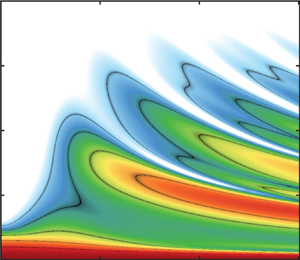
Self-induced transparency of long water waves over bathymetry: the dispersive shock mechanism
-
- Journal:
- Journal of Fluid Mechanics / Volume 997 / 25 October 2024
- Published online by Cambridge University Press:
- 08 October 2024, A9
-
- Article
-
- You have access
- Open access
- HTML
- Export citation
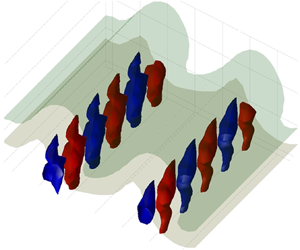
Plasma-based base flow modification on swept-wing boundary layers: dependence on flow parameters
-
- Journal:
- Journal of Fluid Mechanics / Volume 997 / 25 October 2024
- Published online by Cambridge University Press:
- 08 October 2024, A13
-
- Article
-
- You have access
- Open access
- HTML
- Export citation
The asymptotic-numerical method for the post-buckling response of curvilinearly stiffened panels
-
- Journal:
- The Aeronautical Journal / Volume 128 / Issue 1330 / December 2024
- Published online by Cambridge University Press:
- 07 October 2024, pp. 2879-2905
-
- Article
- Export citation
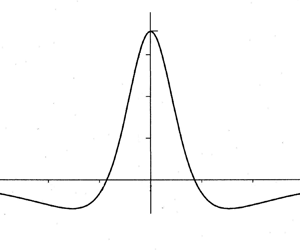
Inviscid jets driven by pressure maxima
-
- Journal:
- Journal of Fluid Mechanics / Volume 996 / 10 October 2024
- Published online by Cambridge University Press:
- 04 October 2024, A17
-
- Article
-
- You have access
- Open access
- HTML
- Export citation
