Refine search
Actions for selected content:
212907 results in Engineering
Propagation of underwater wave groups in a compressible ocean coupled with an elastic seafloor
-
- Journal:
- Journal of Fluid Mechanics / Volume 996 / 10 October 2024
- Published online by Cambridge University Press:
- 02 October 2024, A18
-
- Article
-
- You have access
- Open access
- HTML
- Export citation
Drag reduction utilizing a wall-attached ferrofluid film in turbulent channel flow
-
- Journal:
- Journal of Fluid Mechanics / Volume 996 / 10 October 2024
- Published online by Cambridge University Press:
- 02 October 2024, A35
-
- Article
-
- You have access
- Open access
- HTML
- Export citation
-
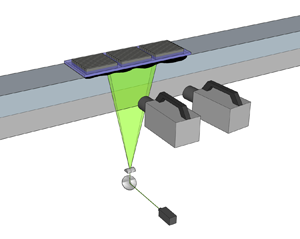
This study explores the application of a wall-attached ferrofluid film to decrease skin-friction drag in turbulent channel flow. We conduct experiments using water as a working fluid in a turbulent channel flow set-up, where one wall is coated with a ferrofluid layer held in place by external permanent magnets. Depending on the flow conditions, the interface between the two fluids is observed to form unstable travelling waves. While ferrofluid coating has been previously employed in laminar and moderately turbulent flows (Reynolds number $Re<4000$) to reduce drag by creating a slip condition at the fluid interface, its effectiveness in fully developed turbulent conditions, particularly when the interface exhibits instability, remains uncertain. Our primary objective is to assess the effectiveness of ferrofluid coating in reducing turbulent drag with particular focus on scenarios when the ferrofluid layer forms unstable waves. To achieve this, we measure flow velocity using two-dimensional particle tracking velocimetry (2D-PTV), and the interface contour between the fluids is determined using an interface tracking algorithm. Our results reveal the significant potential of ferrofluid coating for drag reduction, even in scenarios where the interface between the surrounding fluid and ferrofluid exhibits instability, with observed drag reduction rates up to 95 %. In particular, waves with an amplitude significantly smaller than a viscous length scale positively contribute to drag reduction, while larger waves are detrimental, because of induced turbulent fluctuations. However, for the latter case, slip outcompetes the extra turbulence so that drag is still reduced.

Coupled Richtmyer–Meshkov and Kelvin–Helmholtz instability on a shock-accelerated inclined single-mode interface
-
- Journal:
- Journal of Fluid Mechanics / Volume 996 / 10 October 2024
- Published online by Cambridge University Press:
- 02 October 2024, A37
-
- Article
- Export citation
-
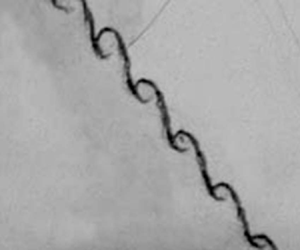
The coupling of Richtmyer–Meshkov instability (RMI) and Kelvin–Helmholtz instability (KHI), referred to as RM-KHI, on a shock-accelerated inclined single-mode air–SF $_6$ interface is studied through shock-tube experiments, focusing on the evolution of the perturbation distributed along the inclined interface. To clearly capture the linear (overall linear to nonlinear) evolution of RM-KHI, a series of experiments with a weak (relatively strong) incident shock is conducted. For each series of experiments, various $\theta _{i}$ (angle between incident shock and equilibrium position of the initial interface) are considered. The nonlinear flow features manifest earlier and develop faster when $\theta _{i}$ is larger and/or shock is stronger. In addition, the interface with $\theta _{i}>0^{\circ }$ evolves obliquely along its equilibrium position under the effect of KHI. RMI dominates the early-time amplitude evolution regardless of $\theta _{i}$ and shock intensity, which arises from the discrepancy in the evolution laws between RMI and KHI. KHI promotes the post-early-stage amplitude growth and its contribution is related positively to $\theta _{i}$. An evident exponential-like amplitude evolution behaviour emerges in RM-KHI with a relatively strong shock and large $\theta _{i}$. The linear model proposed by Mikaelian (Phys. Fluids, vol. 6, 1994, pp. 1943–1945) is valid for RM-KHI within the linear period. In contrast, the adaptive vortex model (Sohn et al., Phys. Rev. E, vol. 82, 2010, p. 046711) can effectively predict both the interface morphology and overall amplitude evolutions from the linear to nonlinear regimes.


Enhanced bubble growth near an advancing solidification front
-
- Journal:
- Journal of Fluid Mechanics / Volume 996 / 10 October 2024
- Published online by Cambridge University Press:
- 02 October 2024, A22
-
- Article
-
- You have access
- Open access
- HTML
- Export citation
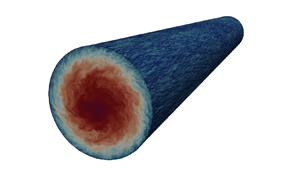
Direct numerical simulation of drag reduction in rotating pipe flow up to $\boldsymbol{Re_\tau \approx 3000}$
-
- Journal:
- Journal of Fluid Mechanics / Volume 996 / 10 October 2024
- Published online by Cambridge University Press:
- 02 October 2024, A24
-
- Article
-
- You have access
- Open access
- HTML
- Export citation
-
Direct numerical simulation (DNS) of rotating pipe flows up to $Re_\tau \approx 3000$ is carried out to investigate drag reduction effects associated with axial rotation, extending previous studies carried out at a modest Reynolds number (Orlandi & Fatica, J. Fluid Mech., vol. 343, 1997, pp. 43–72; Orlandi & Ebstein, Intl J. Heat Fluid Flow, vol. 21, 2000, pp. 499–505). The results show that the drag reduction, which we theoretically show to be equivalent to net power saving assuming no mechanical losses, monotonically increases as either the Reynolds number or the rotation number increases, proportionally to the inner-scaled rotational speed. Net drag reduction up to approximately $70\,\%$ is observed, while being far from flow relaminarisation. Scaling laws for the mean axial and azimuthal velocity are proposed, from which a predictive formula for the friction factor is derived. The formula can correctly represent the dependency of the friction factor on the Reynolds and rotation numbers, maintaining good accuracy for low-to-moderate rotation numbers. Examination of the turbulent structures highlights the role of rotation in widening and elongating the small-scale streaks, with subsequent suppression of sweeps and ejections. In the core part of the flow, clear weakening of large-scale turbulent motions is observed at high Reynolds numbers, with subsequent suppression of the outer-layer peak in the pre-multiplied spectra. The Fukagata–Iwamoto–Kasagi decomposition indicates that, consistent with a theoretically derived formula, the outer layer yields the largest contribution to drag reduction at increasingly high Reynolds numbers. In contrast, both the inner and the outer layers contribute to drag reduction as the rotation number increases.


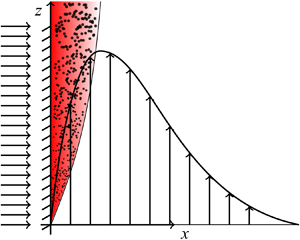
Self-similar solution for laminar bubbly flow evolving from a vertical plate
-
- Journal:
- Journal of Fluid Mechanics / Volume 996 / 10 October 2024
- Published online by Cambridge University Press:
- 02 October 2024, A38
-
- Article
-
- You have access
- Open access
- HTML
- Export citation
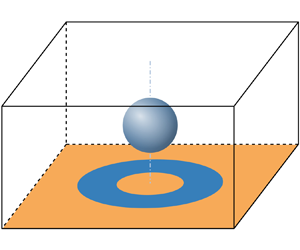
Droplet impact on a superhydrophobic solid substrate with a superhydrophilic annulus
-
- Journal:
- Journal of Fluid Mechanics / Volume 996 / 10 October 2024
- Published online by Cambridge University Press:
- 02 October 2024, A20
-
- Article
- Export citation
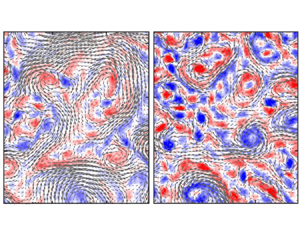
Flow patterns and energy spectra in forced quasi-two-dimensional turbulence: effect of system size and damping rate
-
- Journal:
- Journal of Fluid Mechanics / Volume 996 / 10 October 2024
- Published online by Cambridge University Press:
- 02 October 2024, A39
-
- Article
- Export citation
-
An experimental investigation is conducted to study the flow patterns, spectral properties and energy fluxes in thin-layer turbulence with varying system sizes and damping rates. It is found that although a system-size vortex (an indicator of spectral condensation) occurs for small system sizes and does not for large ones, the spectra for different system sizes consistently exhibit a scaling close to $k^{-3}$ in inverse cascade (another indicator of spectral condensation). On the other hand, under a fixed system size larger than the friction-dominated length scale, the energy spectrum in the inverse cascade range changes from $k^{-3}$ to $k^{-5/3}$ as the damping rate increases, suggesting that the friction-dominated length scale may not be a suitable parameter for predicting spectral transition. At lower damping rates and large system sizes, turbulent structures grow larger via inverse cascade, manifesting as long streamers, and the small-scale vortices are suppressed. This suppression leads to a reduction of energy flux at intermediate scales and a change in the spectral shape. The dimensionless Taylor microscale is found to exhibit a monotonic dependence on the damping rate. With the reduction in the damping rate, the Taylor microscale increases to become comparable with the forcing scale, and the spectrum in inverse cascade transits to a steeper scaling, $k^{-3}$, indicating that the dimensionless Taylor microscale may be used as a diagnostic parameter for spectral transition.


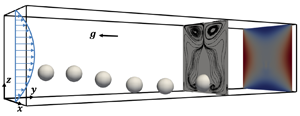
Lateral migration of a deformable fluid particle in a square channel flow of viscoelastic fluid
-
- Journal:
- Journal of Fluid Mechanics / Volume 996 / 10 October 2024
- Published online by Cambridge University Press:
- 02 October 2024, A31
-
- Article
-
- You have access
- Open access
- HTML
- Export citation
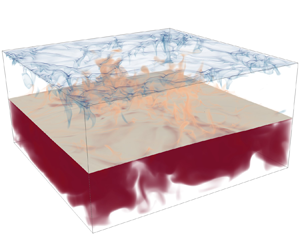
Effects of Rayleigh and Weber numbers on two-layer turbulent Rayleigh–Bénard convection
-
- Journal:
- Journal of Fluid Mechanics / Volume 996 / 10 October 2024
- Published online by Cambridge University Press:
- 02 October 2024, A23
-
- Article
- Export citation
-
This study presents direct numerical simulation results of two-layer Rayleigh–Bénard convection, investigating the previously unexplored Rayleigh–Weber parameter space $10^6\leq Ra\leq 10^8$ and $10^2\leq We\leq 10^3$. Global properties, such as the Nusselt and Reynolds numbers, are compared against the extended Grossmann–Lohse theory for two fluid layers, confirming a weak Weber number dependence for all global quantities and considerably larger Reynolds numbers in the lighter fluid. Statistics of the flow reveal that the interface fluctuates more intensely for larger Weber and smaller Rayleigh numbers, something also reflected in the increased temperature root mean square values next to the interface. The dynamics of the deformed two-fluid interface is further investigated using spectral analysis. Temporal and spatial spectrum distributions reveal a capillary wave range at small Weber and large Rayleigh numbers, and a secondary energy peak at smaller Rayleigh numbers. Furthermore, the maxima of the space–time spectra lie in an intermediate dispersion regime, between the theoretical predictions for capillary and gravity-capillary waves, showing that the gravitational energy of the interfacial waves is strongly altered by temperature gradients.
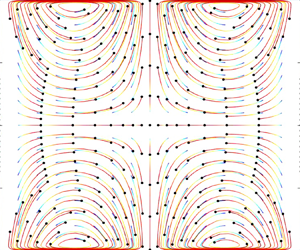
Linear instability of viscous parallel shear flows: revisiting the perturbation no-slip condition
-
- Journal:
- Journal of Fluid Mechanics / Volume 996 / 10 October 2024
- Published online by Cambridge University Press:
- 02 October 2024, A47
-
- Article
-
- You have access
- Open access
- HTML
- Export citation
Uncertainty quantification and sensitivity analysis of blade geometric deviation on compressor performance
-
- Journal:
- The Aeronautical Journal / Volume 128 / Issue 1330 / December 2024
- Published online by Cambridge University Press:
- 01 October 2024, pp. 2945-2963
-
- Article
- Export citation
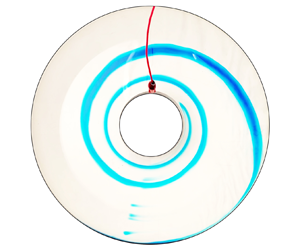
Magneto-Stokes flow in a shallow free-surface annulus
-
- Journal:
- Journal of Fluid Mechanics / Volume 996 / 10 October 2024
- Published online by Cambridge University Press:
- 01 October 2024, A33
-
- Article
-
- You have access
- Open access
- HTML
- Export citation
Threshold transient growth as a criterion for turbulent mean profiles
-
- Journal:
- Journal of Fluid Mechanics / Volume 996 / 10 October 2024
- Published online by Cambridge University Press:
- 01 October 2024, A32
-
- Article
-
- You have access
- Open access
- HTML
- Export citation
-
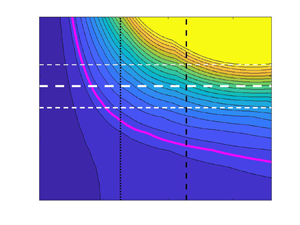
Lozano-Duran et al. (J. Fluid Mech., vol. 914, 2021, p. A8) have recently identified the ability of streamwise-averaged turbulent streak fields ${\mathcal {U}}(y,z,t)\hat {\boldsymbol {x}}$ in minimal channels to produce short-term transient growth as the key linear mechanism needed to sustain turbulence at $Re_{\tau }=180$. Here, in an attempt to extend this result to larger domains and higher $Re_{\tau }$, we model this streak transient growth as a two-stage linear process by first selecting the dominant streak structure expected to emerge over the eddy turnover time on the turbulent mean profile $U(y)\hat {\boldsymbol {x}}$, and then examining the secondary growth on this (frozen) streak field ${\mathcal {U}}(y,z)\hat {\boldsymbol {x}}$. Choosing the mean streak amplitude and eddy turnover time consistent with simulations captures the growth thresholds found by Lozano-Duran et al. (2021) for sustained turbulence. In a larger domain at $Re_{\tau }=180$, the most energetic near-wall streaks observed in simulations are close to the predicted optimal streaks. This most energetic streak spacing, approaches the optimal streak at $Re_{\tau }=550$ where the secondary growth possible on each also comes together. A key prediction from the model is that the threshold transient growth required to sustain turbulence decreases with increasing $Re_{\tau }$. More fundamentally, the work of Lozano-Duran et al. (2021) and our results suggest a subtle but significant revision of Malkus's (J. Fluid Mech., vol. 1, 1956, pp. 521–539) classic hypothesis concerning realisable turbulent mean profiles. The key property for a realisable turbulent mean profile could be the ability to generate sufficient short-term transient growth rather than dependence on its (long-term) linear stability characteristics, which was Malkus's original idea.


Drawing of fibres composed of shear-thinning or shear-thickening fluid with internal holes
-
- Journal:
- Journal of Fluid Mechanics / Volume 996 / 10 October 2024
- Published online by Cambridge University Press:
- 01 October 2024, A36
-
- Article
-
- You have access
- Open access
- HTML
- Export citation
-
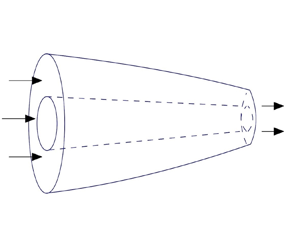
We explore the drawing of a shear-thinning or shear-thickening thread with an axisymmetric hole that evolves due to axial drawing, inertia and surface tension effects. The stress is assumed to be proportional to the shear rate raised to the $n$th power. The presence of non-Newtonian rheology and surface tension forces acting on the hole introduces radial pressure gradients that make the derivation of long-wavelength equations significantly more challenging than either a Newtonian thread with a hole or shear-thinning and shear-thickening threads without a hole. In the case of weak surface tension, we determine the steady-state profiles. Our results show that for negligible inertia the hole size at the exit becomes smaller as $n$ is decreased (i.e. strong shear-thinning effects) above a critical draw ratio, but surprisingly the opposite is true below this critical draw ratio. We determine an accurate estimate of the critical draw ratio and also discuss how inertia affects this process. We further show that the dynamics of hole closure is dominated by a different limit, and we determine the asymptotic forms of the hole closure process for shear-thinning and shear-thickening fluids with inertia. A linear instability analysis is conducted to predict the onset of draw resonance. We show that increased shear thinning, surface tension and inlet hole size all act to destabilise the flow. We also show that increasing shear-thinning effects reduce the critical Reynolds number required for unconditional stability. Our study provides valuable insights into the drawing process and its dependence on the physical effects.


Asymmetric instability of flow-induced vibration for elastically mounted cube at moderate Reynolds numbers
-
- Journal:
- Journal of Fluid Mechanics / Volume 996 / 10 October 2024
- Published online by Cambridge University Press:
- 01 October 2024, A34
-
- Article
-
- You have access
- Open access
- HTML
- Export citation
Actuation manifold from snapshot data
-
- Journal:
- Journal of Fluid Mechanics / Volume 996 / 10 October 2024
- Published online by Cambridge University Press:
- 30 September 2024, A26
-
- Article
-
- You have access
- Open access
- HTML
- Export citation
-
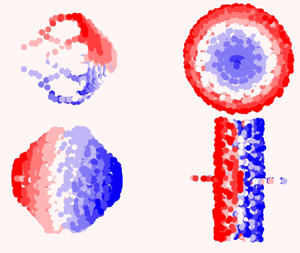
We propose a data-driven methodology to learn a low-dimensional manifold of controlled flows. The starting point is resolving snapshot flow data for a representative ensemble of actuations. Key enablers for the actuation manifold are isometric mapping as encoder, and a combination of a neural network and a $k$-nearest-neighbour interpolation as decoder. This methodology is tested for the fluidic pinball, a cluster of three parallel cylinders perpendicular to the oncoming uniform flow. The centres of these cylinders are the vertices of an equilateral triangle pointing upstream. The flow is manipulated by constant rotation of the cylinders, i.e. described by three actuation parameters. The Reynolds number based on a cylinder diameter is chosen to be $30$. The unforced flow yields statistically symmetric periodic shedding represented by a one-dimensional limit cycle. The proposed methodology yields a five-dimensional manifold describing a wide range of dynamics with small representation error. Interestingly, the manifold coordinates automatically unveil physically meaningful parameters. Two of them describe the downstream periodic vortex shedding. The other three describe the near-field actuation, i.e. the strength of boat-tailing, the Magnus effect and forward stagnation point. The manifold is shown to be a key enabler for control-oriented flow estimation.


A generalized wall-pressure spectral model for non-equilibrium boundary layers
-
- Journal:
- Journal of Fluid Mechanics / Volume 996 / 10 October 2024
- Published online by Cambridge University Press:
- 30 September 2024, A27
-
- Article
-
- You have access
- Open access
- HTML
- Export citation
-
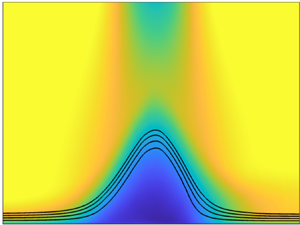
This study uses high-fidelity simulations (direct numerical simulation or large-eddy simulation) and experimental datasets to analyse the effect of non-equilibrium streamwise mean pressure gradients (adverse or favourable), including attached and separated flows, on the statistics of boundary-layer wall-pressure fluctuations. The datasets collected span a wide range of Reynolds numbers ( $Re_\theta$ from 300 to 23 400) and pressure gradients (Clauser parameter from $-0.5$ to 200). The datasets are used to identify an optimal set of variables to scale the wall-pressure spectrum: edge velocity, boundary layer thickness and the peak magnitude of Reynolds shear stress. Using the present datasets, existing semi-empirical models of the wall-pressure spectrum are shown unable to capture effects of strong, non-equilibrium adverse pressure gradients, due to inappropriate scaling of the wall pressure using the wall shear stress, calibration with limited types of flows and dependency on model parameters based on the friction velocity, which reduces to zero at the detachment point. To address these shortcomings, a generalized wall-pressure spectral model is developed with parameters that characterize the extent of the logarithmic layer and the strength of the wake. Derived from the local mean streamwise velocity profile, these two parameters inherently carry the effect of the Reynolds number, as well as those of the non-equilibrium pressure gradient and its history. Comparison with existing models shows that the proposed model behaves well and is more accurate in strong-pressure-gradient flows and in separated-flow regions.


Scale dependence and non-isochoric effects on the thermohydrodynamics of rarefied Poiseuille flow
-
- Journal:
- Journal of Fluid Mechanics / Volume 996 / 10 October 2024
- Published online by Cambridge University Press:
- 30 September 2024, A30
-
- Article
- Export citation
-
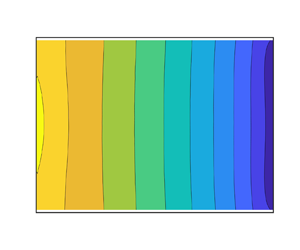
The plane Poiseuille flow of a rarefied gas in a finite length channel, driven by an axial pressure gradient, is analysed numerically to probe (i) the role of ‘dilatation’ ( $\varDelta ={\boldsymbol \nabla }\boldsymbol {\cdot }{\boldsymbol u}\neq 0$) on its thermohydrodynamics as well as to clarify (ii) the possible equivalence with its well-studied ‘dilatation-free’ or ‘isochoric’ ( ${\rm D}\rho /{\rm D}t=0$) counterpart driven by a constant acceleration. Focussing on the mass flow rate ${\mathcal {M}}({Kn})$, which is an invariant quantity for both pressure-driven and acceleration-driven Poiseuille flows, it is shown that while ${\mathcal {M}}\sim \log {{Kn}}$ at ${Kn}\gg 1$ in the acceleration-driven case, the mass flow saturates to a constant value ${\mathcal {M}}\sim {{Kn}}^0$ at ${Kn}\gg 1$ in the pressure-driven case due to the finite length ( $L_x<\infty$) of the channel. The latter result agrees with prior theory and recent experiments, and holds irrespective of the magnitude of the axial pressure gradient ( $G_p$). The pressure-dilatation cooling ( $\varPhi _p=-p\varDelta <0$) is shown to be responsible for the absence of the bimodal shape of the temperature profile in the pressure-driven Poiseuille flow. The dilatation-driven reduction of the shear viscosity and the odd signs of two normal stress differences ( ${\mathcal {N}}_1$ and ${\mathcal {N}}_2$) in the pressure-driven flow in comparison with those in its acceleration-driven counterpart are explained from the Burnett-order constitutive relations for the stress tensor. While both ${\mathcal {N}}_1$ and ${\mathcal {N}}_2$ appear at the Burnett order $O({{Kn}}^2)$ in the acceleration-driven flow, the leading term in ${\mathcal N}_1$ scales as $(\mu/p)\varDelta$ due to the non-zero dilatation in the pressure-driven Poiseuille flow which confirms that the two flows are not equivalent even at the Navier–Stokes–Fourier order $O({{Kn}})$. The heat-flow rate ( ${{\mathcal {Q}}_q}_x=\int q_x(x,y) \,{{\rm d} y}$) of the tangential heat flux is found to be negative (i.e. directed against the axial pressure gradient), in contrast to its positive asymptotic value (at ${Kn}\gg 1$) in the acceleration-driven flow. Similar to the scale-dependence of the mass flow rate, ${{\mathcal {Q}}_q}_x({{Kn}}, L_x)$ is found to saturate to a constant value at ${Kn}\gg 1$ in finite length channels. The double-well shape of the $q_x(y)$-profile in the near-continuum limit agrees well with predictions from a generalized Fourier law. On the whole, the dilatation-driven signatures (such as the pressure-dilatation work and the ‘normal’ shear-rate differences) are shown to be the progenitor for the observed differences between the two flows with regard to (i) the hydrodynamic fields, (ii) the rheology and (iii) the flow-induced heat transfer.


Multistability of a long droplet in a capillary tube under transverse body force
-
- Journal:
- Journal of Fluid Mechanics / Volume 996 / 10 October 2024
- Published online by Cambridge University Press:
- 30 September 2024, A28
-
- Article
- Export citation
