Refine search
Actions for selected content:
212908 results in Engineering
Chapter 1 - Electrostatics I
-
- Book:
- Electromagnetic Fields for Engineers
- Published online:
- 09 January 2025
- Print publication:
- 26 September 2024, pp 1-80
-
- Chapter
- Export citation
References
-
- Book:
- Electromagnetic Fields for Engineers
- Published online:
- 09 January 2025
- Print publication:
- 26 September 2024, pp 678-686
-
- Chapter
- Export citation
Chapter 3 - Current and Resistance
-
- Book:
- Electromagnetic Fields for Engineers
- Published online:
- 09 January 2025
- Print publication:
- 26 September 2024, pp 135-161
-
- Chapter
- Export citation
Chapter 6 - Magnetostatics II
-
- Book:
- Electromagnetic Fields for Engineers
- Published online:
- 09 January 2025
- Print publication:
- 26 September 2024, pp 255-295
-
- Chapter
- Export citation
Appendices
-
- Book:
- Electromagnetic Fields for Engineers
- Published online:
- 09 January 2025
- Print publication:
- 26 September 2024, pp 584-673
-
- Chapter
- Export citation

Spreading of a viscous drop after impact onto a spherical target
-
- Journal:
- Journal of Fluid Mechanics / Volume 996 / 10 October 2024
- Published online by Cambridge University Press:
- 26 September 2024, A10
-
- Article
-
- You have access
- Open access
- HTML
- Export citation
Appendix G - Integral Tables
-
- Book:
- Electromagnetic Fields for Engineers
- Published online:
- 09 January 2025
- Print publication:
- 26 September 2024, pp 654-655
-
- Chapter
- Export citation
Appendix H - Several Useful Taylor Expansions
-
- Book:
- Electromagnetic Fields for Engineers
- Published online:
- 09 January 2025
- Print publication:
- 26 September 2024, pp 656-656
-
- Chapter
- Export citation
Evanescent and inertial-like waves in rigidly rotating odd viscous liquids
-
- Journal:
- Journal of Fluid Mechanics / Volume 996 / 10 October 2024
- Published online by Cambridge University Press:
- 26 September 2024, A13
-
- Article
-
- You have access
- Open access
- HTML
- Export citation
-
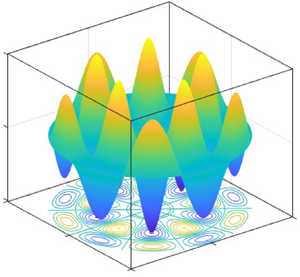
Three-dimensional non-rotating odd viscous liquids give rise to Taylor columns and support axisymmetric inertial-like waves (J. Fluid Mech., vol. 973, 2023, A30). When an odd viscous liquid is subjected to rigid-body rotation however, there arise in addition a plethora of other phenomena that need to be clarified. In this paper, we show that three-dimensional incompressible or two-dimensional compressible odd viscous liquids, rotating rigidly with angular velocity $\varOmega$, give rise to both oscillatory and evanescent inertial-like waves or a combination thereof (which we call of mixed type) that can be non-axisymmetric. By evanescent, we mean that along the radial direction, typically when moving away from a solid boundary, the velocity field decreases exponentially. These waves precess in a prograde or retrograde manner with respect to the rotating frame. The oscillatory and evanescent waves resemble respectively the body and wall-modes observed in (non-odd) rotating Rayleigh–Bénard convection (J. Fluid Mech., vol. 248, 1993, pp. 583–604). We show that the three types of waves (wall, body or mixed) can be classified with respect to pairs of planar wavenumbers $\kappa$ which are complex, real or a combination, respectively. Experimentally, by observing the precession rate of the patterns, it would be possible to determine the largely unknown values of the odd viscosity coefficients. This formulation recovers as special cases recent studies of equatorial or topological waves in two-dimensional odd viscous liquids which provided examples of the bulk–interface correspondence at frequencies $\omega <2\varOmega$. We finally point out that the two- and three-dimensional problems are formally equivalent. Their difference then lies in the way data propagate along characteristic rays in three dimensions, which we demonstrate by classifying the resulting Poincaré–Cartan equations.


Index
-
- Book:
- Electromagnetic Fields for Engineers
- Published online:
- 09 January 2025
- Print publication:
- 26 September 2024, pp 687-690
-
- Chapter
- Export citation
Modifying Prefixes
-
- Book:
- Electromagnetic Fields for Engineers
- Published online:
- 09 January 2025
- Print publication:
- 26 September 2024, pp xxiv-xxvi
-
- Chapter
- Export citation
Chapter 4 - Magnetostatics I
-
- Book:
- Electromagnetic Fields for Engineers
- Published online:
- 09 January 2025
- Print publication:
- 26 September 2024, pp 162-227
-
- Chapter
- Export citation
Appendix I - Review of Complex Numbers
-
- Book:
- Electromagnetic Fields for Engineers
- Published online:
- 09 January 2025
- Print publication:
- 26 September 2024, pp 657-660
-
- Chapter
- Export citation
Image Credits
-
- Book:
- Electromagnetic Fields for Engineers
- Published online:
- 09 January 2025
- Print publication:
- 26 September 2024, pp 674-677
-
- Chapter
- Export citation
Chapter 2 - Electrostatics II
-
- Book:
- Electromagnetic Fields for Engineers
- Published online:
- 09 January 2025
- Print publication:
- 26 September 2024, pp 81-134
-
- Chapter
- Export citation
Two-dimensional turbulence on the ellipsoid
-
- Journal:
- Journal of Fluid Mechanics / Volume 996 / 10 October 2024
- Published online by Cambridge University Press:
- 26 September 2024, A9
-
- Article
-
- You have access
- Open access
- HTML
- Export citation
-
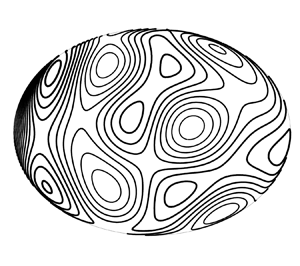
Two-dimensional turbulence transfers its energy towards the lowest mode in the domain, but domain geometry exerts a powerful control. On the sphere, with its three axes of rotational symmetry, angular momentum conservation prevents energy from entering the three lowest modes – those corresponding to the spherical harmonics $Y_1^0$ and $Y_1^{\pm 1}$ – because the amplitudes of these three modes are proportional to the three conserved components of the angular momentum vector. Non-spherical ellipsoids partly or completely break the rotational symmetry corresponding to angular momentum conservation. The flow on spheroids, which have only one axis of rotational symmetry, conserves only a single component of angular momentum. If the axis of symmetry is taken to be the $z$-axis, then only the $z$-component of angular momentum is conserved. Energy can flow into the other two lowest modes. The general triaxial ellipsoid breaks all rotational symmetries, thus angular momentum is not conserved, and energy can flow into any mode. We describe numerical experiments that confirm these predictions.


Chapter 7 - Maxwell’s Equations
-
- Book:
- Electromagnetic Fields for Engineers
- Published online:
- 09 January 2025
- Print publication:
- 26 September 2024, pp 296-308
-
- Chapter
- Export citation
Key factors affecting overexpanded flow separation in design of large expansion ratio single expansion ramp nozzle
-
- Journal:
- The Aeronautical Journal / Volume 129 / Issue 1333 / March 2025
- Published online by Cambridge University Press:
- 25 September 2024, pp. 717-736
-
- Article
- Export citation

The use of patterned heating in controlling pressure losses within sloping channels
-
- Journal:
- Journal of Fluid Mechanics / Volume 996 / 10 October 2024
- Published online by Cambridge University Press:
- 25 September 2024, A5
-
- Article
-
- You have access
- Open access
- HTML
- Export citation
Scaling of vertical coherence and logarithmic energy profile for wall-attached eddies during sand and dust storms
-
- Journal:
- Journal of Fluid Mechanics / Volume 996 / 10 October 2024
- Published online by Cambridge University Press:
- 25 September 2024, A7
-
- Article
- Export citation
-
High-frequency observation data, including all three components of instantaneous fluctuating velocity, temperature, as well as particulate matter 10 ( $PM_{10}$), collected from the unstable atmospheric surface layer at $z/L = -0.11$ and $-$0.12, $L$ being the Obukhov length, during sand and dust storms (SDS), were used to explore the scaling of vertical coherence and the logarithmic energy profile for wall-attached eddies. The present results demonstrate good agreement with the self-similar range of the wall-attached features for velocity and temperature components, as well as for $PM_{10}$ at lower heights ( $z<15$ m) during SDS. Following the idea depicted by Davenport (Q. J. R. Meteorol., vol. 372, 1961, pp. 194–211), an empirically derived transfer kernel comprises implicit filtering via a scale-dependent gain and phase, parametrically defined as $|H_L^2(f)|=\exp (c_1-c_2\delta /\lambda _x)$, where $c_1$ and $c_2$ are parameters, $\delta$ is the boundary layer thickness and $\lambda _x$ is the streamwise wavelength. Linear coherence spectrum analysis is applied as a filter to separate the coherent and incoherent portions. After this separation procedure, the turbulence intensity decay for wall-attached eddies is described in a log–linear manner, which also identifies how the scaling parameter differs between the measured components. These findings present abundant features of wall-attached eddies during SDS which further are used to improve/enrich existing near-wall models.


