Refine search
Actions for selected content:
212908 results in Engineering

Evolution of water wave packets by wind in shallow water
-
- Journal:
- Journal of Fluid Mechanics / Volume 996 / 10 October 2024
- Published online by Cambridge University Press:
- 25 September 2024, A4
-
- Article
- Export citation

Mechanism of enhanced impulse and entrainment of a pulsed jet through a flexible nozzle
- Part of
-
- Journal:
- Journal of Fluid Mechanics / Volume 996 / 10 October 2024
- Published online by Cambridge University Press:
- 25 September 2024, A6
-
- Article
-
- You have access
- Open access
- HTML
- Export citation
-
The present experimental study shows that a nozzle with optimal flexibility can enhance the impulse and entrainment of a pulsed jet. Near the nozzle exit, vortex rings emanating from the flexible nozzle move faster because of the timely release of the elastic energy (stored during the expansion) to the jet, which is maximized at the structural stiffness that needs to be optimally tuned to the jet acceleration. The total circulation, hydrodynamic impulse and entrained fluid volume are enhanced substantially. Interestingly, we find that the same condition for optimal flexibility to maximize the hydrodynamic impulse and circulation of the primary vortex ring of the continuous jet (Choi & Park, J. Fluid Mech., vol. 949, 2022, A39) holds universally for the pulsed jet, indicating that abrupt jet termination is irrelevant to the impulse augmentation mechanism. Compared to the rigid counterpart, increments of the impulse ( ${\sim }400\,\%$) and entrainment ( ${\sim }220\,\%$) of a pulsed jet in the present study are considerably larger than those ( $200\,\%$ and $50\,\%$, respectively) in a continuous jet from previous studies, which is attributed to the significant suppression of negative pressure at the nozzle exit by the collapsing motion of the flexible nozzle in the phase with the jet-driven upstream propagation of the surface wave on the nozzle. This universal mechanism provides a guideline for a novel jet propulsor using a flexible nozzle, for example, for small-scale underwater robots.


Bubble-induced convection and flow instability in liquid vessels
-
- Journal:
- Journal of Fluid Mechanics / Volume 996 / 10 October 2024
- Published online by Cambridge University Press:
- 24 September 2024, A2
-
- Article
-
- You have access
- Open access
- HTML
- Export citation
-
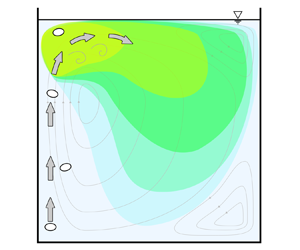
Buoyancy-driven bubbly flows play pivotal roles in various scenarios, such as the oxygenation and mixing in the upper ocean and the reaction kinetics in chemical and bio-reactors. This work focuses on the convective flow induced by the localised release of large air bubbles ( $D_b=3.7$ mm, ${Re}_b=950$) in a water tank, exploring the resulting flow and the transition from laminar to disturbed states as a function of the Rayleigh number ranging from $3\times 10^3$ to $2\times 10^5$. At low ${Ra}$ the flow is smooth and laminar with weak temporal oscillations, while a highly disturbed state appears above a critical value ${Ra}_c$. A theoretical analysis is presented that links the mean flow circulation to the Rayleigh number. Through an experimental investigation, utilising three-dimensional particle tracking velocimetry and flow visualisation, we confirm the theory presented, and characterise the laminar to disturbed transition in the system. These findings not only enhance our fundamental understanding of buoyancy-driven convective flows but also hold significant implications for practical applications, particularly in the optimisation of bio-reactor design and other industrial processes reliant on controlled convective dynamics.


Settling of two rigidly connected spheres
-
- Journal:
- Journal of Fluid Mechanics / Volume 995 / 25 September 2024
- Published online by Cambridge University Press:
- 24 September 2024, A15
-
- Article
-
- You have access
- Open access
- HTML
- Export citation
-
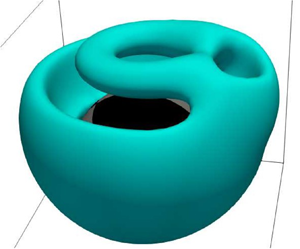
Laboratory experiments and particle-resolved simulations are employed to investigate the settling dynamics of a pair of rigidly connected spherical particles of unequal size. They yield a detailed picture of the transient evolution and the terminal values of the aggregate's orientation angle and its settling and drift velocities as functions of the aspect ratio and the Galileo number $Ga$, which denotes the ratio of buoyancy and viscous forces acting on the aggregate. At low to moderate values of $Ga$, the aggregate's orientation and velocity converge to their terminal values monotonically, whereas for higher $Ga$-values the aggregate tends to undergo a more complex motion. If the aggregate assumes an asymmetric terminal orientation, it displays a non-zero terminal drift velocity. For diameter ratios much larger than one and small $Ga$, the terminal orientation of the aggregate becomes approximately vertical, whereas when $Ga$ is sufficiently large for flow separation to occur, the aggregate orients itself such that the smaller sphere is located at the separation line. Empirical scaling laws are obtained for the terminal settling velocity and orientation angle as functions of the aspect ratio and $Ga$ for diameter ratios from 1 to 4 and particle-to-fluid density ratios from 1.3 to 5. An analysis of the accompanying flow field shows the formation of vortical structures exhibiting complex topologies in the aggregate's wake, and indicates the formation of a horizontal pressure gradient across the larger sphere, which represents the main reason for the emergence of the drift velocity.


FLM volume 992 Cover and Front matter
-
- Journal:
- Journal of Fluid Mechanics / Volume 992 / 10 August 2024
- Published online by Cambridge University Press:
- 24 September 2024, p. f1
-
- Article
-
- You have access
- Export citation
Influence of thermal buoyancy on the wake dynamics of a heated square cylinder
-
- Journal:
- Journal of Fluid Mechanics / Volume 996 / 10 October 2024
- Published online by Cambridge University Press:
- 24 September 2024, A3
-
- Article
-
- You have access
- Open access
- HTML
- Export citation
-
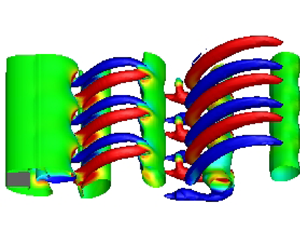
Direct numerical simulation of the three-dimensional (3-D) wake transition of a heated square cylinder subjected to horizontal cross-flow is performed in the presence of buoyancy. In order to capture the effects of large-scale heating, a non-Oberbeck–Boussinesq model is utilized, which includes the governing equations for compressible gas flow. All computations are performed at low free stream Mach number $M=0.1$ using air (free stream Prandtl number, $Pr=0.71$) as the working fluid. The 3-D instability modes A and B, which correspond to free stream Reynolds numbers of 180 and 250, are observed with longer and shorter spanwise wavelengths, respectively, and the onset of three-dimensionality is triggered at a Reynolds number of 173. In the presence of buoyancy, baroclinic vorticity production in the near-wake plays an important role for streamwise vorticity generation. The chaotic wake of the Mode-A instability bifurcates into periodic and quasiperiodic wakes at various heating levels, expressed by the overheat ratio, $\varepsilon =(T_w-T_\infty )/T_\infty$, where $T_w$ and $T_\infty$ are the temperature of the cylinder surface and the ambient air, respectively. At low heating ( $\varepsilon =0.2$), the 3-D Mode-A instability is suppressed leading to a two-dimensional wake flow. Further increase in heating, again brings back the three-dimensionality in the wake through Mode-E instability. The variation of thermophysical properties and the effective Reynolds number with increase in heating level around the cylinder is examined. It is shown that the effect of thermophysical properties competes with the baroclinic streamwise vorticity generation at higher levels of heating ( $\varepsilon \geqslant 0.4$) to control the 3-D modes and wake dynamics.


A novel stochastic matheuristic approach for the dynamic utilisation of arrival route structures: modelling of Istanbul Airport point merge system
-
- Journal:
- The Aeronautical Journal / Volume 129 / Issue 1331 / January 2025
- Published online by Cambridge University Press:
- 24 September 2024, pp. 240-259
-
- Article
- Export citation
An analytical model for the slip velocity of particles in turbulence
-
- Journal:
- Journal of Fluid Mechanics / Volume 996 / 10 October 2024
- Published online by Cambridge University Press:
- 24 September 2024, A1
-
- Article
-
- You have access
- Open access
- HTML
- Export citation
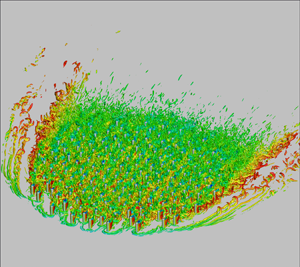
Flow and coherent structures generated by a circular array of rigid, emerged cylinders in a shallow channel
-
- Journal:
- Journal of Fluid Mechanics / Volume 995 / 25 September 2024
- Published online by Cambridge University Press:
- 23 September 2024, A9
-
- Article
-
- You have access
- Open access
- HTML
- Export citation
-
The study investigates the flow structure, dynamics of the large-scale coherent structures, drag forces and sediment entrainment mechanisms generated by a circular array of diameter D containing rigid emerged circular cylinders of diameter d placed in a smooth-bed channel of depth h under strong shallow flow conditions (D/h = 20, d/D = 0.0125 and 0.025). Eddy resolving simulations are conducted with different values of the solid volume fraction 0.025 ≤ SVF ≤ 0.1 and non-dimensional frontal area per unit volume (2.56 ≤ aD ≤ 10.2, where for the present configuration, a = SVF(1/d)4/ ${\rm \pi}$) and a fixed channel Reynolds number (Reh = 10 000). The flow conditions are such that a vortex street (VS)-type of shallow wake is expected to form for a solid cylinder of diameter D. Findings are compared with previous results obtained for cases with moderately shallow conditions 2.5 ≤ D/h ≤ 3.5 and with the limiting case of flow past a solid cylinder with D/h = 20. For moderately shallow conditions, the core of the main horseshoe vortex (HV) forming around the array occupies a small fraction of the water column and its coherence is the largest in front of the array. By contrast, for very shallow conditions, multiple HVs form around the array and their cores occupy a large fraction of the water column. Moreover, the coherence of most of these HVs peaks close to the sides of the array. Only for relatively large aD values, the main HV extends over the whole upstream face of the array, similar to the limiting case of a solid cylinder. For sufficiently high aD, a secondary instability is present inside the near wake that leads to the formation of parallel horizontal vortices in the vicinity of the wake roller vortices. The changes in the wake structure with decreasing SVF and aD are qualitatively similar to those observed for cases with moderately shallow flow conditions, with the antisymmetric wake shedding mode being suppressed for aD ≤ 2.5. However, the Strouhal number associated with the shedding of wake rollers, which is still close to 0.2 for a solid cylinder with D/h = 20, can be as high as 0.4 for aD = 2.5. The paper also discusses how the steady wake and total wake lengths and the strength of the bleeding flow vary with the SVF. Simulation results show that the capacity of the flow to entrain sediment inside and around the array peaks for SVF = 0.05 and aD = 5.2, with sediment entrainment monotonically increasing with the SVF outside the array and monotonically decreasing inside the array. Despite the differences in the flow structure next to and inside the array, the variation of the mean, time-averaged streamwise drag coefficient of the solid cylinders ${\bar{C}_d}$ with aD is close to that observed for arrays with moderately shallow flow conditions. The combined drag coefficient for the array decreases with increasing flow shallowness, with the decay being stronger for relatively large values of aD.


Investigations on ancient bronze drums from Majiang, Guangxi, P. R. China
-
- Journal:
- Powder Diffraction / Volume 39 / Issue 4 / December 2024
- Published online by Cambridge University Press:
- 23 September 2024, pp. 217-223
-
- Article
- Export citation
Spontaneous locomotion of a symmetric squirmer – CORRIGENDUM
-
- Journal:
- Journal of Fluid Mechanics / Volume 995 / 25 September 2024
- Published online by Cambridge University Press:
- 23 September 2024, E1
-
- Article
-
- You have access
- Open access
- HTML
- Export citation
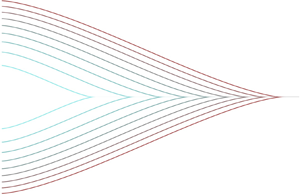
Hydraulic fractures of the cusp shape in a Hele-Shaw cell
-
- Journal:
- Journal of Fluid Mechanics / Volume 995 / 25 September 2024
- Published online by Cambridge University Press:
- 23 September 2024, A17
-
- Article
- Export citation
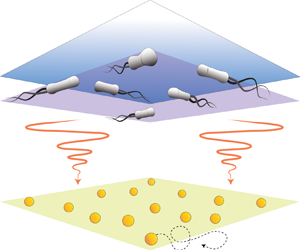
Floating active carpets drive transport and aggregation in aquatic ecosystems
-
- Journal:
- Journal of Fluid Mechanics / Volume 995 / 25 September 2024
- Published online by Cambridge University Press:
- 23 September 2024, A16
-
- Article
-
- You have access
- Open access
- HTML
- Export citation
PDJ volume 39 issue 2 Cover and Back matter
-
- Journal:
- Powder Diffraction / Volume 39 / Issue 2 / June 2024
- Published online by Cambridge University Press:
- 22 September 2024, pp. b1-b2
-
- Article
-
- You have access
- Export citation
Calendar of Short Courses and Workshops: (Occurring after 1 July 2024)
-
- Journal:
- Powder Diffraction / Volume 39 / Issue 2 / June 2024
- Published online by Cambridge University Press:
- 22 September 2024, pp. 117-118
-
- Article
-
- You have access
- HTML
- Export citation
PDJ volume 39 issue 2 Cover and Front matter
-
- Journal:
- Powder Diffraction / Volume 39 / Issue 2 / June 2024
- Published online by Cambridge University Press:
- 22 September 2024, pp. f1-f4
-
- Article
-
- You have access
- Export citation

Triglobal resolvent-analysis-based control of separated flows around low-aspect-ratio wings
-
- Journal:
- Journal of Fluid Mechanics / Volume 995 / 25 September 2024
- Published online by Cambridge University Press:
- 20 September 2024, A13
-
- Article
-
- You have access
- Open access
- HTML
- Export citation
-
We perform direct numerical simulations of actively controlled laminar separated wakes around low-aspect-ratio wings with two primary goals: (i) reducing the size of the separation bubble and (ii) attenuating the wing tip vortex. Instead of preventing separation, we modify the three-dimensional (3-D) dynamics to exploit wake vortices for aerodynamic enhancements. A direct wake modification is considered using optimal harmonic forcing modes from triglobal resolvent analysis. For this study, we consider wings at angles of attack of $14^\circ$ and $22^\circ$, taper ratios $0.27$ and $1$, and leading edge sweep angles of $0^\circ$ and $30^\circ$, at a mean-chord-based Reynolds number of $600$. The wakes behind these wings exhibit 3-D reversed-flow bubble and large-scale vortical structures. For tapered swept wings, the diversity of wake vortices increases substantially, posing a challenge for flow control. To achieve the first control objective for an untapered unswept wing, root-based actuation at the shedding frequency is introduced to reduce the reversed-flow bubble size by taking advantage of the wake vortices to significantly enhance the aerodynamic performance of the wing. For both untapered and tapered swept wings, root-based actuation modifies the stalled flow, reduces the reversed-flow region and enhances aerodynamic performance by increasing the root contribution to lift. For the goal of controlling the tip vortex, we demonstrate the effectiveness of actuation with high-frequency perturbations near the tip. This study shows how insights from resolvent analysis for unsteady actuation can enable global modification of 3-D separated wakes and achieve improved aerodynamics of wings.


Linear stability analysis of generalized Couette–Poiseuille flow: the neutral surface and critical properties
-
- Journal:
- Journal of Fluid Mechanics / Volume 995 / 25 September 2024
- Published online by Cambridge University Press:
- 20 September 2024, R3
-
- Article
- Export citation
-
We discuss the modal, linear stability analysis of generalized Couette–Poiseuille (GCP) flow between two parallel plates moving with relative speed in the presence of an applied pressure gradient vector inclined at an angle $0\leqslant \phi \leqslant 90^\circ$ to the plate relative velocity vector. All possible GCP flows can be described by a global Reynolds number $Re$,
$Re$,  $\phi$ and an angle $0\leqslant \theta \leqslant 90^\circ$, where $\cos \theta$ is a measure of the relative weighting of Couette flow to the composite GCP flow. This provides a novel and uncommon group of generally three-dimensional base velocity fields with wall-normal twist, for which Squire's theorem does not generally apply, requiring study of oblique perturbations with wavenumbers $(\alpha,\beta )$. With $(\theta,\phi )$ fixed, the neutral surface $f(\theta,\phi ;Re,\alpha,\beta )=0$ in $(Re, \alpha,\beta )$ space is discussed. A mapping from GCP to plane Couette–Poiseuille flow stability is found that suggests a scaling relation $Re^*\alpha /k = H(\theta ^*)$ that collapses all critical parameters, where ${Re}^*= Re\,({\alpha _1}/{\alpha })\,({\sin \theta }/{\sin {\theta }^*})$ and $\tan \theta ^*=({\alpha _{1}}/\alpha )\tan \theta$, with $\alpha _1=\alpha \cos \phi +\beta \sin \phi$. This analysis does not, however, directly reveal global critical properties for GCP flow. The global $Re_{cr}(\theta,\phi )$ shows continuous variation, while $\alpha _{cr}(\theta,\phi )$ and $\beta _{cr}(\theta,\phi )$ show complex behaviour, including discontinuities owing to jumping of critical states across neighbouring local valleys (in $Re$) or lobes of the neutral surface. The discontinuity behaviour exists for all low $\phi$. For $\phi \gtrsim 21^\circ$, variations of $\alpha _{cr}(\theta )$ and $\beta _{cr}(\theta )$ are generally smooth and monotonic.


Advancing digital healthcare engineering for aging ships and offshore structures: an in-depth review and feasibility analysis – ERRATUM
-
- Journal:
- Data-Centric Engineering / Volume 5 / 2024
- Published online by Cambridge University Press:
- 20 September 2024, e21
-
- Article
-
- You have access
- Open access
- HTML
- Export citation

Entrainment in variable-density jets
-
- Journal:
- Journal of Fluid Mechanics / Volume 995 / 25 September 2024
- Published online by Cambridge University Press:
- 20 September 2024, A11
-
- Article
- Export citation
-
The entrainment of ambient fluid into a variable-density jet is typically quantified using an entrainment coefficient $\alpha$. Here, we investigate the dependence of $\alpha$ on the ratio of the jet's density $\rho _m$ and that of the ambient fluid $\rho _0$. Current parametrisations of $\alpha$ rely on a scaling inferred from early laboratory experiments (Ricou & Spalding, J. Fluid Mech., vol. 11, 1961, pp. 21–32). We demonstrate analytically that the experiments preclude definitive conclusions regarding the dependence of $\alpha$ on $\rho _m / \rho _0$ and that the underlying physical processes therefore warrant closer attention. To investigate the physics behind the dependence of entrainment on the density ratio we use a Favre-averaged entrainment decomposition. The decomposition is applied to data from large-eddy simulations of jets characterised by density ratios $\rho _m / \rho _0$ spanning over two orders of magnitude that have been verified against experimental data. Changes in the shape of the velocity profile are a significant contributor to entrainment in the near field due to the breakdown of the potential core, and persist over larger streamwise distances in heavy releases than in light releases. Therefore, to focus exclusively on the effects of density ratio, we study the region where the shape changes have become small but the density ratio is still significant. We show that the dimensionless turbulent kinetic energy production and mean kinetic energy flux depend strongly on the density ratio, both for our large-eddy simulation data and for recent experiments. Despite this, the entrainment coefficient is practically constant in this region and has value $\alpha \approx 0.07$ for all simulations.


