Refine search
Actions for selected content:
212908 results in Engineering

Heat-transfer effects in compressible turbulent boundary layers – a regime diagram
-
- Journal:
- Journal of Fluid Mechanics / Volume 995 / 25 September 2024
- Published online by Cambridge University Press:
- 20 September 2024, A14
-
- Article
-
- You have access
- Open access
- HTML
- Export citation
-
As shown by Wenzel et al. (J. Fluid Mech., vol. 930, 2022, A1), the Eckert number $Ec$ defined using the difference between recovery temperature $\bar{T}_r$ and wall temperature $\bar{T}_w$ can be understood as a meaningful quantity to compare heat-transfer effects inside compressible turbulent boundary layers (for a calorically perfect gas), no matter whether these are caused by different Mach-number or wall-temperature conditions. While the named study deduced this comparative behaviour of $Ec$ from an integral perspective in a strict sense, Cogo et al. (J. Fluid Mech., vol. 974, 2023, A10) performed a systematic parameter study based on the previous findings to look at wall-normal profiles. They have shown that the diabatic parameter $\varTheta$, being equivalent to $Ec$, is capable of categorizing heat-transfer effects for cases at different Mach numbers, even to some extent for some of the wall-normal profiles. Building on this progress, the present paper provides a comprehensive classification of both existing and newly computed super- and hypersonic direct numerical simulation data at various wall temperature conditions into heated cases, adiabatic cases or weakly/moderately/strongly/quasi-incompressibly cooled cases. Hereby, the classification is largely based on the wall-normal position of the temperature peak occurring in cooled boundary-layer cases, which is one of the determining factors for the topological characteristics of diabatic boundary-layer profiles. Integrating high-enthalpy data into the analysis allowed us to confirm the reliability of the proposed classification also in more complex scenarios, where the calorically perfect gas assumption no longer applies and additional heat-transfer mechanisms come into play. While the Eckert number is shown to well characterize heat-transfer effects on most important temperature-related quantities for a wide range of Mach numbers and $\bar {T}_w/\bar {T}_r$ conditions, also the local Reynolds number $Re_{\tau }$ is shown to notably affect the strength of heat-transfer effects. Since both $Ec$ and $Re_{\tau }$ can be determined in advance – or estimated to a reasonable extent – a key advantage of the classification scheme is to allow for an effective a priori estimation of the extent to which heat-transfer effects are to be expected for a given compressible turbulent boundary-layer configuration.


Instability dynamics of viscous fingering interaction on dual displacement fronts
-
- Journal:
- Journal of Fluid Mechanics / Volume 995 / 25 September 2024
- Published online by Cambridge University Press:
- 20 September 2024, A5
-
- Article
-
- You have access
- Open access
- HTML
- Export citation

Revisiting Brenner's method for Stokes resistance of a deformed sphere
-
- Journal:
- Journal of Fluid Mechanics / Volume 994 / 10 September 2024
- Published online by Cambridge University Press:
- 20 September 2024, A17
-
- Article
-
- You have access
- Open access
- HTML
- Export citation
From concrete mixture to structural design—a holistic optimization procedure in the presence of uncertainties
-
- Journal:
- Data-Centric Engineering / Volume 5 / 2024
- Published online by Cambridge University Press:
- 20 September 2024, e20
-
- Article
-
- You have access
- Open access
- HTML
- Export citation

Effect of degassing on bubble populations in air-entraining free-surface turbulent flows
-
- Journal:
- Journal of Fluid Mechanics / Volume 995 / 25 September 2024
- Published online by Cambridge University Press:
- 20 September 2024, A12
-
- Article
- Export citation
-
We investigate air-entraining flows where degassing, rather than fragmentation, plays a significant role. Of interest is the power-law slope $\beta$ of the bulk bubble size distribution $N(a)$ during the air-generating period, when the total volume of bubbles is increasing. We study a canonical air-entraining flow created by strong underlying free-surface turbulence. We perform analysis using the population balance equation (PBE) and computations using direct numerical simulations (DNS) with bubble tracking. We quantify the importance of degassing by the ratio of degassing flux ( $Q_D$) to entrainment flux ( $Q_I$), $\mathcal {D}=Q_D/Q_I$, and the ratio of degassing rate ( $\varLambda (a)$) to fragmentation rate ( $\varOmega (a)$) for a bubble of radius $a$,
$a$,  $\varLambda (a)/\varOmega (a)$. For a broad range of large Froude numbers ${{Fr}}=U/\sqrt {L g}$, DNS give $\mathcal {D}=\operatorname {O}(1)$ (independent of ${{Fr}}$), showing that degassing is relevant, and $\varLambda (a) \gg \varOmega (a)$, showing that the bubble population is degassing-dominated. In contrast to fragmentation-dominated populations, such as those due to wave breaking, where $\beta =-10/3$, degassing-dominated populations have qualitatively different $N(a)$ during air entrainment. Analysis using the PBE shows that degassing-dominated $\beta$ is a function of $\varLambda (a)$, which has a turbulence-driven regime ( $a< a_\varLambda$) and a buoyancy-driven regime ( $a>a_\varLambda$). Here, $a_\varLambda$ is the bubble radius where terminal buoyant rise velocity equals $u_{rms}$. Consequently, $N(a)$ exhibits a split power with $\beta (a< a_\varLambda )=-4.\bar {3}$ and $\beta (a>a_\varLambda )=-5.8\bar {3}$ for moderate bubble Reynolds numbers ${{Re}}_b$. For large ${{Re}}_b$, $\beta (a>a_\varLambda )=-4.8\bar {3}$. The DNS strongly confirm these findings for moderate ${{Re}}_b$. By identifying and describing degassing-dominated bubble populations, this work contributes to the understanding and interpretation of broad types of air-entraining problems where degassing plays a relevant role.


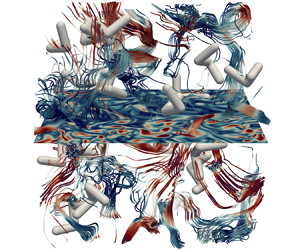
Particle chirality does not matter in the large-scale features of strong turbulence
-
- Journal:
- Journal of Fluid Mechanics / Volume 995 / 25 September 2024
- Published online by Cambridge University Press:
- 20 September 2024, A10
-
- Article
-
- You have access
- Open access
- HTML
- Export citation
Post Nubes Lux
- Part of
-
- Journal:
- The Aeronautical Journal / Volume 128 / Issue 1325 / July 2024
- Published online by Cambridge University Press:
- 20 September 2024, pp. 1323-1324
-
- Article
-
- You have access
- HTML
- Export citation
A sensitivity study on the starting simulations of turbojet engines
-
- Journal:
- The Aeronautical Journal / Volume 128 / Issue 1329 / November 2024
- Published online by Cambridge University Press:
- 19 September 2024, pp. 2545-2560
-
- Article
- Export citation
Valorization and biorefinery of local agricultural and textile wastes through mycelium composites for structural applications
-
- Journal:
- Research Directions: Biotechnology Design / Volume 2 / 2024
- Published online by Cambridge University Press:
- 19 September 2024, e10
-
- Article
-
- You have access
- Open access
- HTML
- Export citation
Aerodynamic and aeroacoustic sensitivities of contra-rotating open rotors to operational parameters
-
- Journal:
- The Aeronautical Journal / Volume 128 / Issue 1330 / December 2024
- Published online by Cambridge University Press:
- 19 September 2024, pp. 2832-2855
-
- Article
-
- You have access
- Open access
- HTML
- Export citation
Bio-futures for transplanetary habitats: a summary and key outcomes from the 2022 symposium
-
- Journal:
- Research Directions: Biotechnology Design / Volume 2 / 2024
- Published online by Cambridge University Press:
- 19 September 2024, e9
-
- Article
-
- You have access
- Open access
- HTML
- Export citation
Recreating an Amazonian Ancestral Biodesign Technique
-
- Journal:
- Research Directions: Biotechnology Design / Volume 2 / 2024
- Published online by Cambridge University Press:
- 19 September 2024, e8
-
- Article
-
- You have access
- Open access
- HTML
- Export citation

Parametric oscillations of the sessile drop
-
- Journal:
- Journal of Fluid Mechanics / Volume 995 / 25 September 2024
- Published online by Cambridge University Press:
- 19 September 2024, A3
-
- Article
-
- You have access
- Open access
- HTML
- Export citation
-
Waves are formed on the surface of a sessile drop driven through substrate vibrations oriented at a slanting angle from the normal. A mathematical model is derived, which leads to an infinite system of coupled Mathieu equations governing the wave dynamics that are solved using Floquet theory. The spatial structure of the waves is described by the mode number pair $[\ell,m]$, where $\ell$ and $m$ are the polar and azimuthal mode numbers, respectively. Limiting cases corresponding to horizontal and vertical vibrations are discussed with predictions agreeing well with prior literature. We focus our results on three drop motions – (1) harmonic $[1,1]$ rocking mode, (2) harmonic $[2,0]$ pumping mode, and (3) subharmonic rocking $[1,1]$ mode – as they depend upon the slanting angle, static contact angle, and contact-line conditions, which we assume to be either pinned or freely moving with fixed contact angle. New theoretical predictions are tested through experiments over a range of parameters, showing good agreement.


Self-similarity and the direct (enstrophy) cascade in forced two-dimensional fluid turbulence
-
- Journal:
- Journal of Fluid Mechanics / Volume 995 / 25 September 2024
- Published online by Cambridge University Press:
- 19 September 2024, A4
-
- Article
-
- You have access
- Open access
- HTML
- Export citation
-
In the absence of large-scale coherent structures, a widely used statistical theory of two-dimensional turbulence developed by Kraichnan, Leith, and Batchelor (KLB) predicts a power-law scaling for the energy, $E(k)\propto k^\alpha$ with an integral exponent $\alpha ={-3}$, in the inertial range associated with the direct cascade. A power-law scaling is also observed in the presence of coherent structures, but the scaling exponent becomes fractal and often differs substantially from the value predicted by the KLB theory. Here we present a dynamical theory that sheds new light on the relationship between the spatial and temporal structure of the large-scale flow and the scaling of small-scale structures representing filamentary vorticity. Specifically, we find hyperbolic regions of the large-scale flow to play a key role in the flux of enstrophy between scales. Small-scale vorticity in these regions can be described by dynamically self-similar solutions of the Euler equation, which explains the power-law scaling. Furthermore, we find that correlations between different hyperbolic regions are responsible for the emergence of fractal scaling exponents.


Instabilities and particle-induced patterns in co-rotating suspension Taylor–Couette flow
-
- Journal:
- Journal of Fluid Mechanics / Volume 995 / 25 September 2024
- Published online by Cambridge University Press:
- 19 September 2024, R4
-
- Article
- Export citation
-
The first experimental results on pattern transitions in the co-rotation regime (i.e. the rotation ratio $\varOmega = \omega _o/\omega _i > 0$, where $\omega _i$ and $\omega _o$ are the angular speeds of the inner and outer cylinders, respectively) of the Taylor–Couette flow (TCF) are reported for a neutrally buoyant suspension of non-colloidal particles, up to a particle volume fraction of $\phi = 0.3$. While the stationary Taylor vortex flow (TVF) is the primary bifurcating state in dilute suspensions ( $\phi \leq ~0.05$), the non-axisymmetric oscillatory states, such as the spiral vortex flow (SVF) and the ribbon (RIB), appear as primary bifurcations with increasing particle loading, with an overall de-stabilization of the primary bifurcating states (TVF/SVF/RIB) being found with increasing $\phi$ for all $\varOmega \geq ~0$. At small co-rotations ( $\varOmega \sim 0$), the particles play the dual role of stabilization ( $\phi < 0.1$) and destabilization ( $\phi \geq ~0.1$) on the secondary/tertiary oscillatory states. The distinctive features of the ‘particle-induced’ spiral vortices are identified and contrasted with those of the ‘fluid-induced’ spirals that operate in the counter-rotation regime.


Swirling electrolyte. Part 2. Secondary circulation and its stability
-
- Journal:
- Journal of Fluid Mechanics / Volume 995 / 25 September 2024
- Published online by Cambridge University Press:
- 19 September 2024, A8
-
- Article
-
- You have access
- Open access
- HTML
- Export citation
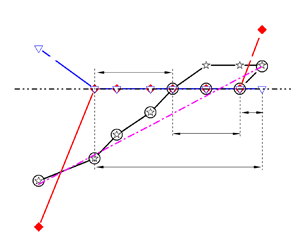
Fluid–acoustic–structure resonance mechanism of a plane cascade via a low-speed wind tunnel test
-
- Journal:
- Journal of Fluid Mechanics / Volume 995 / 25 September 2024
- Published online by Cambridge University Press:
- 19 September 2024, A7
-
- Article
-
- You have access
- Open access
- HTML
- Export citation

Detachment of leading-edge vortex enhances wake capture force production
-
- Journal:
- Journal of Fluid Mechanics / Volume 995 / 25 September 2024
- Published online by Cambridge University Press:
- 19 September 2024, A6
-
- Article
-
- You have access
- Open access
- HTML
- Export citation
-
During stroke reversals, insect wings interact with their own wake flow from the preceding half-stroke, resulting in an unsteady aerodynamic mechanism known as ‘wing–wake interaction’ or ‘wake capture’. To better elucidate this mechanism, we numerically solved the incompressible Navier–Stokes equations at Reynolds numbers $10^2$ and $10^3$. Simulations were conducted for wing planforms defined using the beta function distribution with varying aspect ratios ( $AR=2\unicode{x2013}6$) and radial centroid locations ( $\hat {r}_1=0.4\unicode{x2013}0.6$), whilst employing representative normal hovering kinematics. The wake development from the considered flapping wing planforms was investigated, and the wake capture contribution to aerodynamic force production was quantified by comparing the force generation between the fifth and first stroke cycles at multiple sections along the wingspan. Our results revealed that on the inboard wing region experiencing an attached leading-edge vortex (LEV) structure, wing–wake interaction is dominated by an unsteady downwash effect, resulting in a reduction in local force production. However, in regions closer to the wingtip experiencing detachment of the LEV, wing–wake interaction is dominated by an unsteady upwash effect, leading to an increase in local force production. Consequently, the global wake capture force production is controlled by the extent of LEV detachment, which primarily increases with the increase of wing aspect ratio. This suggests that for normal hovering flapping wings, the typical loss in translational force production due to wingtip stall is partially mitigated by wake capture effects.


Self-similarity and recurrence in stability spectra of near-extreme Stokes waves
-
- Journal:
- Journal of Fluid Mechanics / Volume 995 / 25 September 2024
- Published online by Cambridge University Press:
- 19 September 2024, A2
-
- Article
-
- You have access
- Open access
- HTML
- Export citation
-
We consider steady surface waves in an infinitely deep two-dimensional ideal fluid with potential flow, focusing on high-amplitude waves near the steepest wave with a 120 $^{\circ }$ corner at the crest. The stability of these solutions with respect to coperiodic and subharmonic perturbations is studied, using new matrix-free numerical methods. We provide evidence for a plethora of conjectures on the nature of the instabilities as the steepest wave is approached, especially with regards to the self-similar recurrence of the stability spectrum near the origin of the spectral plane.

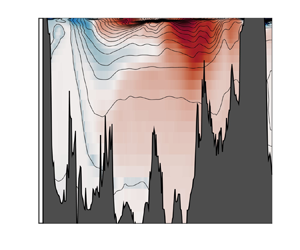
Negative available potential energy dissipation as the fundamental criterion for double diffusive instabilities
-
- Journal:
- Journal of Fluid Mechanics / Volume 994 / 10 September 2024
- Published online by Cambridge University Press:
- 18 September 2024, A5
-
- Article
-
- You have access
- Open access
- HTML
- Export citation
