Refine search
Actions for selected content:
212908 results in Engineering

Dynamics of turbulent energy and dissipation in channel flow
-
- Journal:
- Journal of Fluid Mechanics / Volume 996 / 10 October 2024
- Published online by Cambridge University Press:
- 26 September 2024, A12
-
- Article
- Export citation
-
The dynamics of turbulent kinetic energy (TKE), turbulence dissipation rate (TDR) and turbulence production rate (TPR) are explored in fully developed turbulent channel flow using direct numerical simulations up to $\textit {Re}_\tau \approx 2000$ with minimal computational box for large-scale structures. Time correlation analysis based on volume-averaged TKE and TDR shows a well-defined average time lag, as in periodic/homogeneous turbulence, which, unlike periodic/homogeneous turbulence, appears to be Reynolds-number-dependent. On the basis of a spatio-temporal correlation analysis, we show that plane-averaged TKE fluctuations in the near-equilibrium region are transported towards both the core and near-wall regions, and are positively correlated with plane-averaged TDR fluctuations there with combined wall-distance and time lags. In the path towards the core region, the wall-distance lag is very close to the time lag multiplied by the friction velocity. The path towards the near-wall region has a wide spread of time lags, which increases with Reynolds number. The spatio-temporal correlation paths both towards the core and towards the wall are reproduced when the reference plane TKE is conditionally averaged on either ejections or sweeps, and are in fact stronger in correlation values in the case of ejections, which are better organised than sweeps. While volume-averaged TPR evidently precedes volume-averaged TKE, a more complex picture of non-local space–time correlations between reference plane TKE and TPR is revealed. A mechanistic model is proposed to elucidate these correlations between TKE and TPR through the interaction between the mean shear and the Reynolds shear stress.

Chapter 8 - Propagation of Waves
-
- Book:
- Electromagnetic Fields for Engineers
- Published online:
- 09 January 2025
- Print publication:
- 26 September 2024, pp 309-414
-
- Chapter
- Export citation
Appendix A - Scalars and Vectors
-
- Book:
- Electromagnetic Fields for Engineers
- Published online:
- 09 January 2025
- Print publication:
- 26 September 2024, pp 584-595
-
- Chapter
- Export citation
Appendix L - Symbols and Unit Conversions
-
- Book:
- Electromagnetic Fields for Engineers
- Published online:
- 09 January 2025
- Print publication:
- 26 September 2024, pp 664-666
-
- Chapter
- Export citation
Chapter 10 - Waveguides
-
- Book:
- Electromagnetic Fields for Engineers
- Published online:
- 09 January 2025
- Print publication:
- 26 September 2024, pp 479-552
-
- Chapter
- Export citation
-
Summary
In the previous chapter we introduced transmission lines, structures consisting of a pair of conductors that guide a high-frequency electromagnetic wave in the space between the conductors from a source to a load. We considered a number of different geometries (parallel plate, twin-lead, co-axial), each with a uniform cross-section, that guide the wave in the
-direction, and we discussed the properties of signals carried by the transmission lines, largely in terms of the potential difference
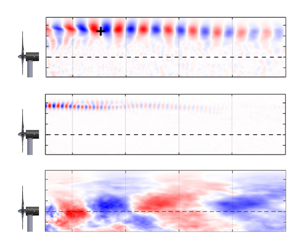
Energy exchanges between coherent modes in the near wake of a wind turbine model at different tip speed ratios
-
- Journal:
- Journal of Fluid Mechanics / Volume 996 / 10 October 2024
- Published online by Cambridge University Press:
- 26 September 2024, A8
-
- Article
-
- You have access
- Open access
- HTML
- Export citation
-
In this work we investigate the spatio-temporal nature of various coherent modes present in a wind turbine wake using a combination of new particle image velocimetry experiments and data from Biswas & Buxton (J. Fluid Mech., vol. 979, 2024, A34). A multiscale triple decomposition of the acquired velocity field is sought to extract the coherent modes and, thereafter, the energy exchanges to and from them are studied using the multiscale triple decomposed coherent kinetic energy budgets developed by Baj & Buxton (Phys. Rev. Fluids, vol. 2, 2017, 114607). Different frequencies forming the tip vortex system (such as the blade passing frequency, turbine's rotational frequency and their harmonics) are found to be energised by different sources such as production from the mean flow or nonlinear triadic interaction or both, similar to the primary, secondary or the mixed modes discussed in Biswas et al. (J. Fluid Mech., vol. 941, 2022, A36). The tip vortex system forms a complex network of nonlinear triadic energy transfers, the nature and the magnitudes of which depend on the tip speed ratio ( $\lambda$). Contrastingly, the modes associated with the sheddings from the nacelle or tower and wake meandering are found to be primarily energised by the mean flow. We show that the tip vortex system exchanges energy with the mean flow primarily through the turbine's rotational frequency. In fact, the system transfers energy back to the mean flow through the turbine's rotational frequency at some distance downstream marking the onset location of wake recovery ( $x_{wr}$). Here $x_{wr}$ is shown to reduce with $\lambda$ due to stronger interaction and earlier merging of the tip vortices at a higher $\lambda$.


Chapter 9 - Transmission Lines
-
- Book:
- Electromagnetic Fields for Engineers
- Published online:
- 09 January 2025
- Print publication:
- 26 September 2024, pp 415-478
-
- Chapter
- Export citation
Reviews
-
- Book:
- Electromagnetic Fields for Engineers
- Published online:
- 09 January 2025
- Print publication:
- 26 September 2024, pp ii-ii
-
- Chapter
- Export citation
Appendix F - Summary of Vector Identities
-
- Book:
- Electromagnetic Fields for Engineers
- Published online:
- 09 January 2025
- Print publication:
- 26 September 2024, pp 651-653
-
- Chapter
- Export citation
Detailed Contents
-
- Book:
- Electromagnetic Fields for Engineers
- Published online:
- 09 January 2025
- Print publication:
- 26 September 2024, pp vii-xiv
-
- Chapter
- Export citation
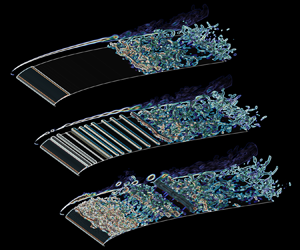
Criteria for dynamic stall onset and vortex shedding in low-Reynolds-number flows
-
- Journal:
- Journal of Fluid Mechanics / Volume 996 / 10 October 2024
- Published online by Cambridge University Press:
- 26 September 2024, A11
-
- Article
-
- You have access
- Open access
- HTML
- Export citation
-
Dynamic stall at low Reynolds numbers, $Re \sim O(10^4)$, exhibits complex flow physics with co-existing laminar, transitional and turbulent flow regions. Current state-of-the-art stall onset criteria use parameters that rely on flow properties integrated around the leading edge. These include the leading edge suction parameter or $LESP$ (Ramesh et al., J. Fluid Mech., vol. 751, 2014, pp. 500–538) and boundary enstrophy flux or $BEF$ (Sudharsan et al., J. Fluid Mech., vol. 935, 2022, A10), which have been found to be effective for predicting stall onset at moderate to high $Re$. However, low- $Re$ flows feature strong vortex-shedding events occurring across the entire airfoil surface, including regions away from the leading edge, altering the flow field and influencing the onset of stall. In the present work, the ability of these stall criteria to effectively capture and localize these vortex shedding events in space and time is investigated. High-resolution large-eddy simulations for an SD7003 airfoil undergoing a constant-rate, pitch-up motion at two $Re$ (10 000 and 60 000) and two pitch rates reveal a rich variety of unsteady flow phenomena, including instabilities, transition, vortex formation, merging and shedding, which are described in detail. While stall onset is reflected in both $LESP$ and $BEF$, local vortex-shedding events are identified only by the $BEF$. Therefore, $BEF$ can be used to identify both dynamic stall onset and local vortex-shedding events in space and time.


Appendix E - Additional Vector Properties
-
- Book:
- Electromagnetic Fields for Engineers
- Published online:
- 09 January 2025
- Print publication:
- 26 September 2024, pp 636-650
-
- Chapter
- Export citation
Appendix J - Hyperbolic Trigonometric Functions
-
- Book:
- Electromagnetic Fields for Engineers
- Published online:
- 09 January 2025
- Print publication:
- 26 September 2024, pp 661-662
-
- Chapter
- Export citation
Contents
-
- Book:
- Electromagnetic Fields for Engineers
- Published online:
- 09 January 2025
- Print publication:
- 26 September 2024, pp v-vi
-
- Chapter
- Export citation
Multiplexed pseudo-deterministic photon source with asymmetric switching elements
-
- Journal:
- Research Directions: Quantum Technologies / Volume 2 / 2024
- Published online by Cambridge University Press:
- 26 September 2024, e3
-
- Article
-
- You have access
- Open access
- HTML
- Export citation
Appendix B - Coordinate Systems
-
- Book:
- Electromagnetic Fields for Engineers
- Published online:
- 09 January 2025
- Print publication:
- 26 September 2024, pp 596-603
-
- Chapter
- Export citation
Preface
-
- Book:
- Electromagnetic Fields for Engineers
- Published online:
- 09 January 2025
- Print publication:
- 26 September 2024, pp xv-xvii
-
- Chapter
- Export citation
To the Student
-
- Book:
- Electromagnetic Fields for Engineers
- Published online:
- 09 January 2025
- Print publication:
- 26 September 2024, pp xviii-xx
-
- Chapter
- Export citation
Copyright page
-
- Book:
- Electromagnetic Fields for Engineers
- Published online:
- 09 January 2025
- Print publication:
- 26 September 2024, pp iv-iv
-
- Chapter
- Export citation
Appendix M - Answers to Selected Problems
-
- Book:
- Electromagnetic Fields for Engineers
- Published online:
- 09 January 2025
- Print publication:
- 26 September 2024, pp 667-673
-
- Chapter
- Export citation
