Refine search
Actions for selected content:
212907 results in Engineering
Trapping and extreme clustering of finitely dense inertial particles near a rotating vortex pair
-
- Journal:
- Journal of Fluid Mechanics / Volume 996 / 10 October 2024
- Published online by Cambridge University Press:
- 04 October 2024, A44
-
- Article
- Export citation
-
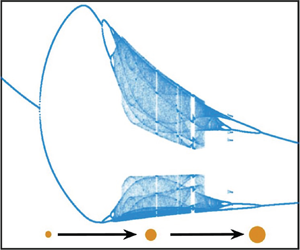
Small heavy particles cannot be attracted into a region of closed streamlines in a non-accelerating frame (Sapsis & Haller, Chaos, vol. 20, issue 1, 2010, 017515). In a rotating system of vortices, however, particles can get trapped (Angilella, Physica D, vol. 239, issue 18, 2010, pp. 1789–1797) in the vicinity of vortices. We perform numerical simulations to examine trapping of inertial particles in a prototypical rotating flow described by a rotating pair of Lamb–Oseen vortices of identical strength, in the absence of gravity. Our parameter space includes the particle Stokes number $St$, which is a measure of the particle's inertia, and a density parameter $R$, which measures the particle's density relative to the fluid. In particular, we study the regime $0< R<1$ and $0< St<1$, which corresponds to an inertial particle that is finitely denser than the fluid. We show that in this regime, a significant fraction of particles can be trapped indefinitely close to the vortices, and display extreme clustering into objects of smaller dimension: attracting fixed points and limit cycles of different periods including chaotic attractors. As $St$ increases for a given $R$, we may have an incomplete or complete period-doubling route to chaos, as well as an unusual period-halving route back to a fixed point attractor. The fraction of trapped particles can be a non-monotonic function of $St$, and we may even have windows in $St$ for which no particle trapping occurs. At $St$ larger than a critical value, beyond which trapping ceases to exist, significant fractions of particles can spend long but finite times in the vortex vicinity. The inclusion of the Basset–Boussinesq history (BBH) force is imperative in our study due to the finite density of the particle. We observe that the BBH force significantly increases the basin of attraction over which trapping occurs, and also widens the range of $St$ for which trapping can be realised. Extreme clustering can be of significance in a host of physical applications, including planetesimal formation by aggregation of dust in protoplanetary discs, and aggregation of phytoplankton in the ocean. Our findings in the prototypical model provide impetus to conduct experiments and further numerical investigations to understand clustering of inertial particles.


Concurrent validity of inertial measurement units in range of motion measurements of upper extremity: A systematic review and meta-analysis
-
- Journal:
- Wearable Technologies / Volume 5 / 2024
- Published online by Cambridge University Press:
- 04 October 2024, e11
-
- Article
-
- You have access
- Open access
- HTML
- Export citation
Study and derivation of closures in the volume-filtered framework for particle-laden flows
-
- Journal:
- Journal of Fluid Mechanics / Volume 996 / 10 October 2024
- Published online by Cambridge University Press:
- 04 October 2024, A41
-
- Article
-
- You have access
- Open access
- HTML
- Export citation
PDJ volume 39 issue 3 Cover and Front matter
-
- Journal:
- Powder Diffraction / Volume 39 / Issue 3 / September 2024
- Published online by Cambridge University Press:
- 03 October 2024, pp. f1-f4
-
- Article
-
- You have access
- Export citation
No sustained mean velocity in the boundary region of plane thermal convection
-
- Journal:
- Journal of Fluid Mechanics / Volume 996 / 10 October 2024
- Published online by Cambridge University Press:
- 03 October 2024, A49
-
- Article
-
- You have access
- Open access
- HTML
- Export citation
-
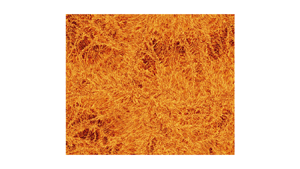
We study the dynamics of thermal and momentum boundary regions in three-dimensional direct numerical simulations of Rayleigh–Bénard convection for the Rayleigh-number range $10^5\leq Ra \leq 10^{11}$ and $Pr=0.7$. Using a Cartesian slab with horizontal periodic boundary conditions and an aspect ratio of 4, we obtain statistical homogeneity in the horizontal $x$- and $y$-directions, thus approximating best an extended convection layer relevant for most geo- and astrophysical flow applications. We observe upon canonical use of combined long-time and area averages, with averaging periods of at least 100 free-fall times, that a global coherent mean flow is practically absent and that the magnitude of the velocity fluctuations is larger than the mean by up to 2 orders of magnitude. The velocity field close to the wall is a collection of differently oriented local shear-dominated flow patches interspersed by extensive shear-free incoherent regions which can be as large as the whole cross-section, unlike for a closed cylindrical convection cell of aspect ratio of the order 1. The incoherent regions occupy a 60 % area fraction for all Rayleigh numbers investigated here. Rather than resulting in a pronounced mean flow with small fluctuations about such a mean, as found in small-aspect-ratio convection, the velocity field is dominated by strong fluctuations of all three components around a non-existent or weak mean. We discuss the consequences of these observations for convection layers with larger aspect ratios, including boundary layer instabilities and the resulting turbulent heat transport.


2024 ICDD® Annual Spring Meetings: a hybrid event 11–15 March 2024
-
- Journal:
- Powder Diffraction / Volume 39 / Issue 3 / September 2024
- Published online by Cambridge University Press:
- 03 October 2024, pp. 182-187
-
- Article
- Export citation
Relative fluid stretching and rotation for sparse trajectory observations
-
- Journal:
- Journal of Fluid Mechanics / Volume 996 / 10 October 2024
- Published online by Cambridge University Press:
- 03 October 2024, A40
-
- Article
-
- You have access
- Open access
- HTML
- Export citation
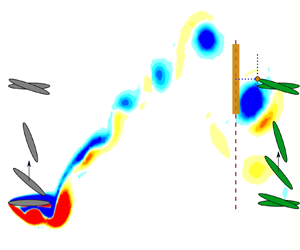
Prediction of energy harvesting efficiency through a wake–foil interaction model for oscillating foil arrays
-
- Journal:
- Journal of Fluid Mechanics / Volume 996 / 10 October 2024
- Published online by Cambridge University Press:
- 03 October 2024, A46
-
- Article
-
- You have access
- Open access
- HTML
- Export citation

Laboratory study of the effect of mean water current on the evolution of young wind waves
-
- Journal:
- Journal of Fluid Mechanics / Volume 996 / 10 October 2024
- Published online by Cambridge University Press:
- 03 October 2024, A21
-
- Article
-
- You have access
- Open access
- HTML
- Export citation
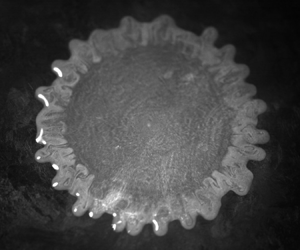
Role of melting and solidification in the spreading of an impacting water drop
-
- Journal:
- Journal of Fluid Mechanics / Volume 996 / 10 October 2024
- Published online by Cambridge University Press:
- 03 October 2024, A14
-
- Article
- Export citation
-
The present study reports experiments of water droplets impacting on ice or on a cold metal substrate, with the aim of understanding the effects of liquid solidification or substrate melting on the impingement process. Both liquid and substrate temperatures are varied, as well as the height of fall of the droplet. The dimensionless maximum spreading diameter, $\beta _m$, is found to increase with both temperatures as well as with the impact velocity. Here $\beta _m$ is reduced when liquid solidification, which enhances dissipation, is present, whereas fusion, i.e. substrate melting, favours the spreading of the impacting droplet. These observations are rationalized by extending an existing model of effective viscosity, in which phase change alters the size and shape of the developing viscous boundary layer, thereby modifying the value of $\beta _m$. The use of this correction allows us to adapt a scaling recently developed in the context of isothermal drop impacts to propose a law giving the maximum diameter of an impacting water droplet in the presence of melting or solidification. Finally, additional experiments of dimethyl sulfoxide drop impacts onto a cold brass substrate have been performed and are also captured by the proposed modelling, generalizing our results to other fluids.


Calendar of Short Courses and Workshops: (Occurring after 1 October 2024)
-
- Journal:
- Powder Diffraction / Volume 39 / Issue 3 / September 2024
- Published online by Cambridge University Press:
- 03 October 2024, p. 189
-
- Article
-
- You have access
- HTML
- Export citation
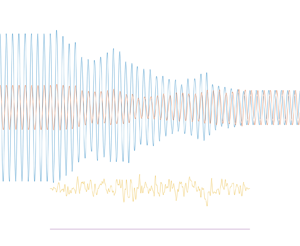
Attenuation of long waves through regions of irregular floating ice and bathymetry
-
- Journal:
- Journal of Fluid Mechanics / Volume 996 / 10 October 2024
- Published online by Cambridge University Press:
- 03 October 2024, A43
-
- Article
-
- You have access
- Open access
- HTML
- Export citation
Calendar of Forthcoming Meetings: (Occurring after 1 October 2024)
-
- Journal:
- Powder Diffraction / Volume 39 / Issue 3 / September 2024
- Published online by Cambridge University Press:
- 03 October 2024, p. 188
-
- Article
-
- You have access
- HTML
- Export citation
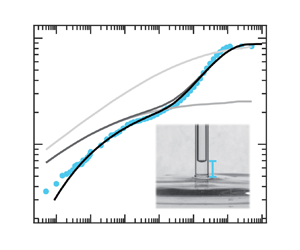
Yield stress fluids solidifying in capillary imbibition
-
- Journal:
- Journal of Fluid Mechanics / Volume 996 / 10 October 2024
- Published online by Cambridge University Press:
- 03 October 2024, A48
-
- Article
-
- You have access
- Open access
- HTML
- Export citation
-
When subjected to external stress exceeding their yield stress ( $\sigma _{Y}$), yield stress fluids (YSFs) undergo transition from solid to liquid. While the flow dynamics of capillary flows – including wetting, coating, spreading, and wicking – can be predicted accurately for fluids without yield stress, only a few asymptotic solutions have been validated against experiments for YSFs. In this study, we explore experimentally and theoretically the entire dynamics and solidifying process during capillary imbibition of YSFs, representing the fundamental aspect of capillarity-driven flow. We observe that during the gradual deceleration of capillary rise, YSFs exhibit apparent flow below $\sigma _{Y}$. This unexpected behaviour is linked to wall slip, manifested as plug flow in particle image velocimetry analyses. We introduce a model with numerical solutions, grounded in the rheological properties of YSFs and slip mechanisms, to accurately describe this liquid–solid transitional behaviour.


PDJ volume 39 issue 3 Cover and Back matter
-
- Journal:
- Powder Diffraction / Volume 39 / Issue 3 / September 2024
- Published online by Cambridge University Press:
- 03 October 2024, pp. b1-b2
-
- Article
-
- You have access
- Export citation
The spatial Whitham equation
-
- Journal:
- Journal of Fluid Mechanics / Volume 996 / 10 October 2024
- Published online by Cambridge University Press:
- 03 October 2024, A42
-
- Article
- Export citation
The ‘hangar of the future’ for sustainable aviation
-
- Journal:
- The Aeronautical Journal / Volume 128 / Issue 1329 / November 2024
- Published online by Cambridge University Press:
- 03 October 2024, pp. 2429-2450
-
- Article
-
- You have access
- Open access
- HTML
- Export citation
Elasto-inertial rectification of oscillatory flow in an elastic tube
-
- Journal:
- Journal of Fluid Mechanics / Volume 996 / 10 October 2024
- Published online by Cambridge University Press:
- 03 October 2024, A16
-
- Article
-
- You have access
- Open access
- HTML
- Export citation
Learning fluid physics from highly turbulent data using sparse physics-informed discovery of empirical relations (SPIDER)
-
- Journal:
- Journal of Fluid Mechanics / Volume 996 / 10 October 2024
- Published online by Cambridge University Press:
- 02 October 2024, A25
-
- Article
-
- You have access
- Open access
- HTML
- Export citation
Linear stability theory and molecular simulations of nanofilm dewetting with disjoining pressure, strong liquid–solid slip and thermal fluctuations
-
- Journal:
- Journal of Fluid Mechanics / Volume 996 / 10 October 2024
- Published online by Cambridge University Press:
- 02 October 2024, A19
-
- Article
-
- You have access
- Open access
- HTML
- Export citation
-
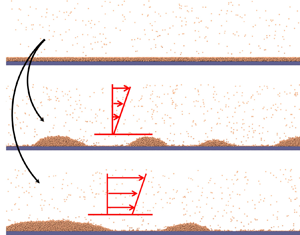
The dewetting of thin nanofilms is significantly affected by thermal fluctuations, liquid–solid slip and disjoining pressure, which can be described by lubrication equations augmented by appropriately scaled noise terms, known as stochastic lubrication equations. Here molecular dynamics simulations along with a newly proposed slip-generating method are adopted to study the instability of nanofilms with arbitrary slip. These simulations show that strong-slip dewetting is distinct from weak-slip dewetting by faster growth of perturbations and fewer droplets after dewetting, which cannot be predicted by the existing stochastic lubrication equation. A new stochastic lubrication equation considering the strong-slip boundary condition is thus derived using a long-wave approximation to the equations of fluctuating hydrodynamics. The linear stability analysis of this equation, i.e. surface spectrum, agrees well with molecular simulations. Interestingly, strong slip can break down the usual Stokes limits adopted in weak-slip dewetting and bring the inertia into effect. The evolution of the standard deviation of the film height $W^2(t)={\overline {h^2}-{\bar {h}}^2}$ at the initial stage of the strong-slip dewetting is found to be $W\sim t^{1/4}$ in contrast to $W\sim t^{1/8}$ for the weak-slip dewetting.


