Refine search
Actions for selected content:
212899 results in Engineering
Global stability analysis of hydrodynamic focusing in the presence of a soluble surfactant
-
- Journal:
- Journal of Fluid Mechanics / Volume 997 / 25 October 2024
- Published online by Cambridge University Press:
- 10 October 2024, A23
-
- Article
-
- You have access
- Open access
- HTML
- Export citation
Large-scale coherent structures in turbulent channel flow: a detuned instability of wall streaks
-
- Journal:
- Journal of Fluid Mechanics / Volume 997 / 25 October 2024
- Published online by Cambridge University Press:
- 10 October 2024, A18
-
- Article
- Export citation
-
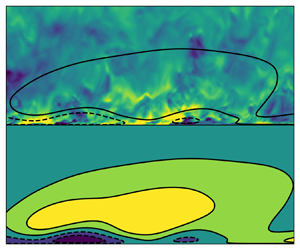
In this paper it is shown that a modal detuned instability of periodic near-wall streaks originates a large-scale structure in the bulk of the turbulent channel flow. The effect of incoherent turbulent fluctuations is included in the linear operator by means of an eddy viscosity. The base flow is an array of periodic two-dimensional streaks, extracted from numerical simulations in small domains, superposed to the turbulent mean profile. The stability problem for a large number of periodic units is efficiently solved using the block-circulant matrix method proposed by Schmid et al. (Phys. Rev. Fluids, vol. 2, 2017, 113902). For friction Reynolds numbers equal or higher than $590$, it is shown that an unstable branch is present in the eigenspectra. The most unstable eigenmodes display large-scale modulations whose characteristic wavelengths are compatible with the large-scale end of the premultiplied velocity fluctuation spectra reported in previous computational studies. The wall-normal location of the large-wavelength near-wall peak in the spanwise spectrum of the eigenmode exhibits a power-law dependence on the friction Reynolds number, similarly to that found in experiments of pipes and boundary layers. Lastly, the shape of the eigenmode in the streamwise-wall-normal plane is reminiscent of the superstructures reported in the recent experiments of Deshpande et al. (J. Fluid Mech., vol. 969, 2023, A10). Therefore, there is evidence that such large-wavelength instabilities generate large-scale motions in wall-bounded turbulent flows.

Hypersonic boundary layer theory in the symmetry plane of blunt bodies
-
- Journal:
- Journal of Fluid Mechanics / Volume 997 / 25 October 2024
- Published online by Cambridge University Press:
- 10 October 2024, A21
-
- Article
-
- You have access
- Open access
- HTML
- Export citation
Transient Joule–Thomson cooling during CO2 injection in depleted reservoirs
-
- Journal:
- Journal of Fluid Mechanics / Volume 997 / 25 October 2024
- Published online by Cambridge University Press:
- 10 October 2024, A31
-
- Article
-
- You have access
- Open access
- HTML
- Export citation
-
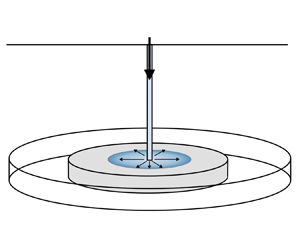
The injection of ${\rm CO}_2$ into depleted reservoirs carries the potential for significant Joule–Thomson cooling, when dense, supercritical ${\rm CO}_2$ is injected into a strongly under-pressured reservoir. The resulting low temperatures around the wellbore risk causing thermal fracturing of the well/near-well region or causing freezing of pore waters or formation of gas hydrates which would reduce injectivity and jeopardise well and reservoir integrity. These risks are particularly acute during injection start-up when ${\rm CO}_2$ is in the gas stability field. In this paper we present a model of non-isothermal single-phase flow in the near-wellbore region. We show that during radial injection, with fixed mass injection rate, transient Joule–Thomson cooling can be described by similarity solutions at early times. The positions of the ${\rm CO}_2$ and thermal fronts are described by self-similar scaling relations. We show that, in contrast to steady-state flow, transient flow causes slight heating of ${\rm CO}_2$ and reservoir gas either side of the thermal front, as pressure diffuses into the reservoir. The scaling analysis here identifies the parametric dependence of Joule–Thomson cooling. We present a sensitivity analysis which demonstrates that the primary controls on the degree of cooling are reservoir permeability, reservoir thickness, injection rate and Joule–Thomson coefficient. The analysis presented provides a computationally efficient approach for assessing the degree of Joule–Thomson cooling expected during injection start-up, providing a complement to complex, fully resolved numerical simulations.


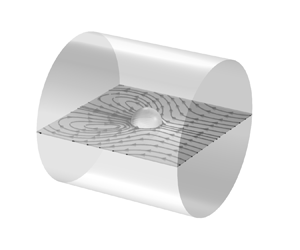
Net flow of charge-asymmetric electrolytes through uncharged channels and over uncharged spheres due to direct-current electroosmosis
-
- Journal:
- Journal of Fluid Mechanics / Volume 997 / 25 October 2024
- Published online by Cambridge University Press:
- 10 October 2024, A28
-
- Article
-
- You have access
- Open access
- HTML
- Export citation
FLM volume 994 Cover and Front matter
-
- Journal:
- Journal of Fluid Mechanics / Volume 994 / 10 September 2024
- Published online by Cambridge University Press:
- 10 October 2024, p. f1
-
- Article
-
- You have access
- Export citation
Vortex shedding and induced forces in unsteady flow
-
- Journal:
- The Aeronautical Journal / Volume 128 / Issue 1328 / October 2024
- Published online by Cambridge University Press:
- 10 October 2024, pp. 2149-2190
-
- Article
-
- You have access
- Open access
- HTML
- Export citation
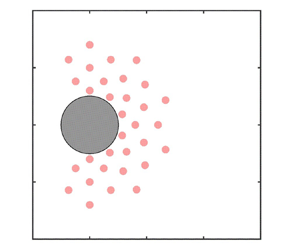
Active control of the flow past a circular cylinder using online dynamic mode decomposition
-
- Journal:
- Journal of Fluid Mechanics / Volume 997 / 25 October 2024
- Published online by Cambridge University Press:
- 10 October 2024, A26
-
- Article
- Export citation
-
This study explores the implementation of an online control strategy based on dynamic mode decomposition in the context of flow control. The investigation is conducted mainly with a fixed Reynolds number of $Re = 100$, focusing on the flow past a circular cylinder constrained between two walls to mitigate vortex shedding. The control approach involves the activation of two synthetic jets on the cylinder through blowing and suction. Velocity fluctuations in the wake, specifically in the $x$-direction, are harnessed to ascertain the mass flow rate of the jets using the linear quadratic regulator and online dynamic mode decomposition. The study systematically assesses the control performance across various configurations, including different values of the input penalty factor ${\boldsymbol {R}}$, varying numbers of probes and distinct probe arrangement methods. The synthetic jets prove effective in stabilising the separation bubble, and their interaction with the unsteady wake leads to a notable reduction in drag force, its fluctuations and the amplitude of the lift force. Specifically, the mean and standard deviation of the drag coefficient witness reductions of $7.44\,\%$ and $96.67\,\%$, respectively, and the standard deviation of the lift coefficient experiences an impressive reduction of $85.18\,\%$. The robustness of the proposed control method has also been tested on two more complicated cases, involving unsteady incoming flows with multiple frequency components. Comparatively, the methodology employed in this paper yields results akin to those obtained through deep reinforcement learning in terms of control effectiveness. However, a noteworthy advantage lies in the substantial reduction of computational resource consumption, highlighting the efficiency of the proposed approach.


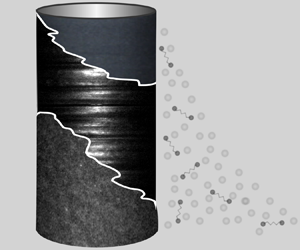
Elasto-inertial dissipation in particle-laden viscoelastic Taylor–Couette flow
-
- Journal:
- Journal of Fluid Mechanics / Volume 997 / 25 October 2024
- Published online by Cambridge University Press:
- 10 October 2024, A19
-
- Article
- Export citation
-
Many natural and industrial processes involve the flow of fluids made of solid particles suspended in non-Newtonian liquid matrices, which are challenging to control due to the fluid's nonlinear rheology. In the present work, a Taylor–Couette canonical system is used to investigate the flow of dilute to semi-dilute suspensions of neutrally buoyant spherical particles in highly elastic base polymer solutions. Friction measurement synchronized with direct flow visualization are combined to characterize the critical conditions for the onset of elasto-inertial instabilities, expected here as a direct transition to elasto-inertial turbulence (EIT). Adding a low particle volume fraction ( ${\leq }2\,\%$, dilute regime) does not affect the nature of the primary transition and reduces the critical Weissenberg number for the onset of EIT, despite a significant decrease in the apparent fluid elasticity. However, for particle volume fractions ${\geq }6\,\%$ (semi-dilute regime), EIT is no longer observed in the explored Reynolds range, suggesting an apparent relaminarization with yet not further decrease in fluid elasticity. Instead, a new regime, termed here elasto-inertial dissipative (EID), was uncovered. It originates from particle–particle interactions altering particle–polymer interactions and occurring under elasto-inertial conditions comparable to those of EIT. Increasing particle volume fraction in the semi-dilute regime and, in so, the particle contribution to the overall viscosity, delays the onset of EID similarly to what was observed previously for EIT in lower elasticity fluids. After this onset, a decrease in the pseudo-Nusselt number observed with increasing inertia and particle-to-polymer concentration ratio confirms a particle-induced alteration of energy transfer in the flow.


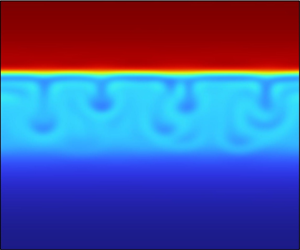
Phase segregation of a partially miscible binary mixture subjected to an external force field
-
- Journal:
- Journal of Fluid Mechanics / Volume 997 / 25 October 2024
- Published online by Cambridge University Press:
- 10 October 2024, A29
-
- Article
-
- You have access
- Open access
- HTML
- Export citation
Steady solutions of quasi-geostrophic flows in basins, gulfs and channels on a β-plane
-
- Journal:
- Journal of Fluid Mechanics / Volume 997 / 25 October 2024
- Published online by Cambridge University Press:
- 10 October 2024, A24
-
- Article
- Export citation
-
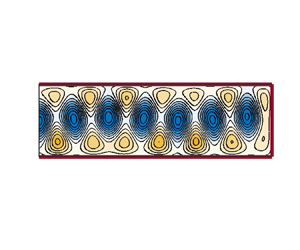
Nonlinear steady solutions of the barotropic quasi-geostrophic equation in basins, gulfs and channels on a $\beta$-plane are presented. The domains are rectangular with arbitrary aspect ratios. The two-dimensional solutions assume a linear relationship between the potential vorticity $q$ and the stream function $\psi$. The sign of the slope in the linear $q\unicode{x2013}\psi$ relationship defines two broad sets of solutions. For a positive slope, the solutions in a closed basin correspond to the inertial gyres derived by Fofonoff in 1954. The negative slope solutions consist of normal modes that can be resonant. For gulfs and channels, the conditions at the open boundaries are almost arbitrary flows entering or leaving the domain. Such conditions allow a great variety of solutions in the interior, characterised mainly by arrays of vortices with alternate signs. Several examples are presented and discussed.


Toward ab initio molecular simulation of reacting air: Mach 15 air flow over a blunt wedge
-
- Journal:
- Journal of Fluid Mechanics / Volume 997 / 25 October 2024
- Published online by Cambridge University Press:
- 10 October 2024, A27
-
- Article
- Export citation
-
We present a Mach 15 air flow over a blunt two-dimensional wedge simulated using the direct molecular simulation method. As electronically excited states are not modelled, the resulting air mixture around the wedge contains the electronic ground states only, namely ${\rm N}_2(\text {X}^1 \varSigma _g^{+})$, ${\rm O}_2(\text {X}^3 \varSigma _g^{-})$, ${\rm NO}(\text {X}^2\varPi _r)$, ${\rm N}(^4{\rm S})$ and ${\rm O}(^3{\rm P})$. All the potential energy surfaces (PESs) that are used to model the various interactions between air particles are ab initio, with two notable exceptions, namely ${\rm N}_2+{\rm NO}$ and ${\rm O}_2+{\rm NO}$. At the selected free-stream conditions, strong vibrational non-equilibrium is observed in the shock layer. The flow is characterized by significant chemical activity, with near-complete oxygen dissociation, considerable formation of NO and minimal molecular nitrogen dissociation. Complex mass diffusion kinetics, driven by composition, temperature and pressure gradients, are identified in the shock layer. All these physical phenomena are directly coupled to, and responsible for, the mechanics of the gas flow and are all solely traceable to the PESs’ inputs, without the need for any thermochemical models, mixing rules or constitutive laws for transport properties. Because the flow is entirely at near-continuum conditions, it is a gas-phase thermophysics benchmark that is useful to enhance the fidelity of continuum models used in computational fluid dynamics of hypersonic flows.


How surface modifications enhance vertical falling film evaporation
-
- Journal:
- Journal of Fluid Mechanics / Volume 997 / 25 October 2024
- Published online by Cambridge University Press:
- 10 October 2024, A17
-
- Article
-
- You have access
- Open access
- HTML
- Export citation
-
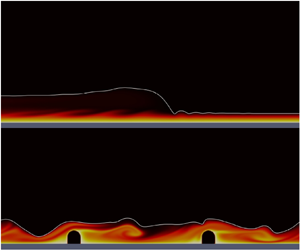
We use multiphase direct numerical simulations to identify, analyse and quantify components of wall-normal heat flux distributions in evaporative vertical falling films with surface modifications at industrially relevant conditions. Previous experiments showed a potential increase of the heat transfer rate through the film by up to 100 % using various types of modifications. We show that the modifications induce significant advective heat transport and hypothesise that four synergistic mixing mechanisms are behind the heat transfer rate improvement. Additionally, we examine how the important surface topology parameters, pitch $\hat {p}$ (distance between modifications), height $\hat {h}$ and the liquid Prandtl number $\mathit {Pr}_l$, influence the mode of heat transport and the Nusselt number $\mathit {Nu}$. We show that $\hat {p}/\hat {h} \approx 10$ maximises $\mathit {Nu}$ and that the optimal pitch is related to the recirculation zone length $L_r$ behind the modification. We find that $L_r/\hat {h} \approx 3.5$ and that $\mathit {Nu} \propto \mathit {Pr}_l^{0.42}$ in the investigated parameter ranges. We also show that all our cases on both smooth and modified surfaces have $\mathit {Pe}_l \gg 1$ and collapse well on a line $\mathit {Nu} \propto (\mathit {Pe}_l/\mathit {Re})^{0.35}$. This relation suggests that $\mathit {Nu}$ is governed by the balance of film mixing, thermal resistance and diffusivity, and that the ratio $\mathit {Pe}_l/\mathit {Re}$ can be used to estimate $\mathit {Nu}$. Our methodology and findings extend the knowledge concerning the mechanisms behind the heat transfer improvement due to surface modifications and facilitate guidelines for designing more efficient modified surfaces in industrial evaporators.


The effect of end conditions on the body motion and near-wake flow structure of a circular cylinder under vortex-induced vibration
-
- Journal:
- Journal of Fluid Mechanics / Volume 997 / 25 October 2024
- Published online by Cambridge University Press:
- 10 October 2024, A22
-
- Article
-
- You have access
- Open access
- HTML
- Export citation
-
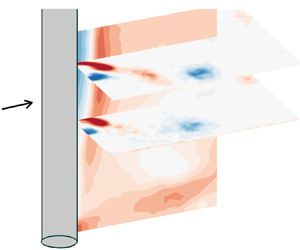
Free transverse oscillations of an elastically mounted circular cylinder with low mass-damping are studied with a focus on the effects of the cylinder end condition on structural oscillations and vortex shedding. While the top end of the cylinder pierces the free surface of a water channel, the lower end is changed to have three end conditions: an attached endplate, an endplate unattached from the cylinder at varying gaps and no endplate. All three response branches are examined, with the reduced velocity sweeping $2 \le {U^\ast } \le 15$ (corresponding to a Reynolds number range of $2000 \le Re \le 14\;700$). Although the cylinder oscillations are unaffected by the end condition in the initial and upper branches, they show significant dependency on the end condition in the lower branch. When the endplate is attached or unattached with a small gap, the upper-to-lower branch transition occurs with a sudden decrease in oscillation amplitude, after which the lower branch maintains a near-constant amplitude. For larger gaps or no endplate, with increasing reduced velocity, the oscillation amplitude decreases gradually from its peak without any discernible sign of transition between the upper and lower branches. The three-dimensional effects of the gap are the basis for these differences in oscillation. Atop the strong tip vortex, a low-magnitude streamwise velocity region develops downstream of the cylinder, which delays upper-to-lower branch transition over the cylinder span that sees this low-velocity region. With increasing gap, this low-velocity region and the delay in transition spread over larger spanwise extents, forcing the overall body to oscillate at larger amplitudes.

Periodic morphing of a NACA6409 aerofoil in ground effect, its wake mechanisms and thrust generation
-
- Journal:
- The Aeronautical Journal / Volume 128 / Issue 1330 / December 2024
- Published online by Cambridge University Press:
- 09 October 2024, pp. 2924-2944
-
- Article
-
- You have access
- Open access
- HTML
- Export citation
Tracing the origins of mode coupling for beam quality optimization in high-power fiber laser delivery systems
- Part of
-
- Journal:
- High Power Laser Science and Engineering / Volume 12 / 2024
- Published online by Cambridge University Press:
- 09 October 2024, e54
-
- Article
-
- You have access
- Open access
- HTML
- Export citation
Analysis of the impact of key similarity criteria numbers of TBCC inlet during the mode transition
-
- Journal:
- The Aeronautical Journal / Volume 129 / Issue 1332 / February 2025
- Published online by Cambridge University Press:
- 09 October 2024, pp. 395-410
-
- Article
- Export citation
Scale dependence of local shearing motion in decaying turbulence generated by multiple-jet interaction
-
- Journal:
- Journal of Fluid Mechanics / Volume 997 / 25 October 2024
- Published online by Cambridge University Press:
- 08 October 2024, A14
-
- Article
- Export citation
Streamwise energy-transfer mechanisms in zero- and adverse-pressure-gradient turbulent boundary layers
-
- Journal:
- Journal of Fluid Mechanics / Volume 997 / 25 October 2024
- Published online by Cambridge University Press:
- 08 October 2024, A16
-
- Article
-
- You have access
- Open access
- HTML
- Export citation
-
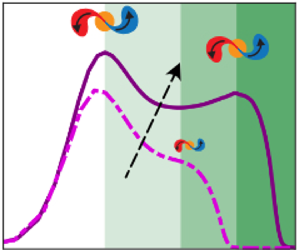
The present study investigates streamwise ( $\overline {u^2}$) energy-transfer mechanisms in the inner and outer regions of turbulent boundary layers (TBLs). Particular focus is placed on the $\overline {u^2}$ production, its inter-component and wall-normal transport as well as dissipation, all of which become statistically significant in the outer region with increasing friction Reynolds number ( $Re_{\tau }$). These properties are analysed using published data sets of zero, weak and moderately strong adverse-pressure-gradient (APG) TBLs across a decade of $Re_{\tau }$, revealing similarity in energy-transfer pathways for all these TBLs. It is found that both the inner and outer peaks of $\overline {u^2}$ are always associated with local maxima in the $\overline {u^2}$ production and its inter-component transport, and the regions below/above each of these peaks are always dominated by wall-ward/away-from-wall transport of $\overline {u^2}$, thereby classifying the $\overline {u^2}$ profiles into four distinct regimes. This classification reveals existence of phenomenologically similar energy-transfer mechanisms in the ‘inner’ and ‘outer’ regions of moderately strong APG TBLs, which meet at an intermediate location coinciding with the minimum in $\overline {u^2}$ profiles. Conditional averaging suggests existence of similar phenomena even in low $Re_{\tau }$ canonical and/or weak APG TBLs, albeit with the outer-region mechanisms weaker than those in the inner region. This explains the absence of their $\overline {u^2}$ outer peak and the dominance of $\overline {u^2}$ wall-normal transport away from the wall, which potentially originates from the inner region. Given that the wall-ward/away-from-wall transport of $\overline {u^2}$ is governed by the $Q_4$(sweeps)/ $Q_2$(ejections) quadrants of the Reynolds shear stress, it is argued that the emergence of the $\overline {u^2}$ outer peak corresponds with the statistical dominance of $Q_4$ events in the outer region. Besides unravelling the dynamical significance of $Q_2$ and $Q_4$ events in the outer region of TBLs, the present analysis also proposes new phenomenological arguments for testing on canonical wall-turbulence data at very high $Re_{\tau }$.


Mass transfer during drop impact on a thin film
-
- Journal:
- Journal of Fluid Mechanics / Volume 997 / 25 October 2024
- Published online by Cambridge University Press:
- 08 October 2024, A15
-
- Article
-
- You have access
- Open access
- HTML
- Export citation
