Refine search
Actions for selected content:
212908 results in Engineering
FLM volume 991 Cover and Front matter
-
- Journal:
- Journal of Fluid Mechanics / Volume 991 / 25 July 2024
- Published online by Cambridge University Press:
- 18 September 2024, p. f1
-
- Article
-
- You have access
- Export citation

Subcritical transitional flow in two-dimensional plane Poiseuille flow
-
- Journal:
- Journal of Fluid Mechanics / Volume 994 / 10 September 2024
- Published online by Cambridge University Press:
- 18 September 2024, A6
-
- Article
- Export citation
-
Recently, subcritical transition to turbulence in the quasi-two-dimensional (quasi-2-D) shear flow with strong linear friction (Camobreco et al., J. Fluid Mech., vol. 963, 2023, R2) has been demonstrated by the 2-D mechanism at $Re = 71\,211$, and the nonlinear Tollmien–Schlichting (TS) waves related to the edge state were approached independently of initial optimal disturbances. For 2-D plane Poiseuille flow, transition to the fully developed turbulence requires that the Reynolds number is several times larger than the critical Reynolds number $Re_c$ (Markeviciute & Kerswell, J. Fluid Mech., vol. 917, 2021, A57). In this paper, we observed the subcritical transitional flow in 2-D plane Poiseuille flow driven by the nonlinear TS waves by both linear and nonlinear optimal disturbances ( $Re < Re_c$) with different quantitative edge states. The nonlinear optimal disturbances could trigger the sustained subcritical transitional flow for $Re \geqslant 2400$. The initial energy for nonlinear optimal disturbance is more efficient than the linear optimal disturbance in reaching the subcritical transitional flow for $2400 \leqslant Re \leqslant 5000$. Moreover, the initial energy of linear optimal disturbance is larger than the energy of its edge state. The nonlinear TS waves along the edge state are formed by the nonlinear optimal disturbances to trigger transitional flow, which agrees well with the main conclusions of Camobreco et al. (J. Fluid Mech., vol. 963, 2023, R2), while the required $Re$ of 2-D plane Poiseuille flow is much smaller.


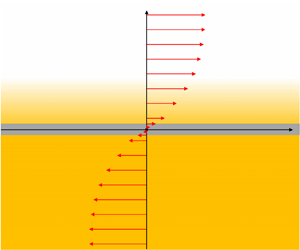
Stratified Resistive Tearing Instability
-
- Journal:
- Journal of Fluid Mechanics / Volume 994 / 10 September 2024
- Published online by Cambridge University Press:
- 18 September 2024, A3
-
- Article
-
- You have access
- Open access
- HTML
- Export citation
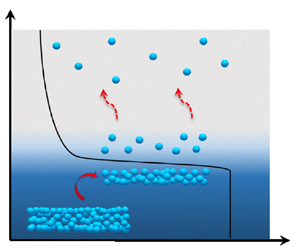
Molecular kinetic modelling of non-equilibrium evaporative flows
-
- Journal:
- Journal of Fluid Mechanics / Volume 994 / 10 September 2024
- Published online by Cambridge University Press:
- 18 September 2024, A16
-
- Article
-
- You have access
- Open access
- HTML
- Export citation

Collision of liquid drops: bounce or merge?
-
- Journal:
- Journal of Fluid Mechanics / Volume 995 / 25 September 2024
- Published online by Cambridge University Press:
- 18 September 2024, A1
-
- Article
-
- You have access
- Open access
- HTML
- Export citation
X-ray powder diffraction data for mosapride dihydrogen citrate dihydrate
-
- Journal:
- Powder Diffraction / Volume 39 / Issue 4 / December 2024
- Published online by Cambridge University Press:
- 18 September 2024, pp. 245-249
-
- Article
-
- You have access
- Open access
- HTML
- Export citation
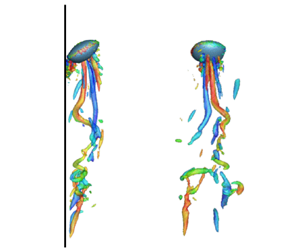
A numerical study on the turbulence characteristics in an air–water upward bubbly pipe flow
-
- Journal:
- Journal of Fluid Mechanics / Volume 994 / 10 September 2024
- Published online by Cambridge University Press:
- 18 September 2024, A10
-
- Article
-
- You have access
- Open access
- HTML
- Export citation
-
A high-resolution numerical simulation of an air–water turbulent upward bubbly flow in a pipe is performed to investigate the turbulence characteristics and bubble interaction with the wall. We consider three bubble equivalent diameters and three total bubble volume fractions. The bulk and bubble Reynolds numbers are $Re_{bulk}= u_{bulk} D/\nu _w = 5300$ and $Re_{bub}= (\langle u_{bub}\rangle - u_{bulk}) d_{eq}/\nu _w = 533\unicode{x2013}1000$, respectively, where $u_{bulk}$ is the water bulk velocity, $\langle u_{bub}\rangle$ is the overall bubble mean velocity, $D$ is the pipe diameter and $\nu _w$ is the water kinematic viscosity. The mean water velocity near the wall significantly increases due to bubble interaction with the wall, and the root-mean-square water velocity fluctuations are proportional to $\bar {\psi }(r)^{0.4}$, where $\bar {\psi } (r)$ is the mean bubble volume fraction. For the cases considered, the bubble-induced turbulence suppresses the shear-induced turbulence and becomes the dominant flow characteristic at all radial locations including near the wall. Rising bubbles near the wall mostly bounce against the wall rather than slide along the wall or hang around the wall without collision. Low-speed streaks observed in the near-wall region in the absence of bubbles nearly disappear due to the bouncing bubbles. These bouncing bubbles generate counter-rotating vortices in their wake, and increase the skin friction by sweeping high-speed water towards the wall. We also suggest an algebraic Reynolds-averaged Navier–Stokes model considering the interaction between shear-induced and bubble-induced turbulence. This model provides accurate predictions for a wide range of liquid bulk Reynolds numbers.


FLM volume 989 Cover and Front matter
-
- Journal:
- Journal of Fluid Mechanics / Volume 989 / 25 June 2024
- Published online by Cambridge University Press:
- 18 September 2024, p. f1
-
- Article
-
- You have access
- Export citation
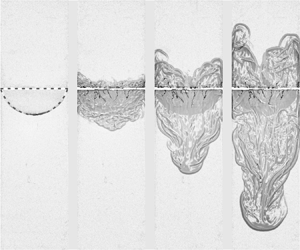
Experimental investigation of three-dimensional Rayleigh–Taylor instability of a gaseous interface
-
- Journal:
- Journal of Fluid Mechanics / Volume 994 / 10 September 2024
- Published online by Cambridge University Press:
- 18 September 2024, A7
-
- Article
-
- You have access
- Open access
- HTML
- Export citation
-
Validating the theoretical work on Rayleigh–Taylor instability (RTI) through experiments with an exceptionally clean and well-characterized initial condition has been a long-standing challenge. Experiments were conducted to study the three-dimensional RTI of an SF $_6$–air interface at moderate Atwood numbers. A novel soap film technique was developed to create a discontinuous gaseous interface with controllable initial conditions. Spectrum analysis revealed that the initial perturbation of the soap film interface is half the size of an entire single-mode perturbation. The correlation between the initial interface perturbation and Atwood numbers was determined. Due to the steep and highly curved feature of the initial soap film interface, the early-time evolution of RTI exhibits significant nonlinearity. In the quasi-steady regime, various potential flow models accurately predict the late-time bubble velocities by considering the channel width as the perturbation wavelength. Differently, the late-time spike velocities are described by these potential flow models using the wavelength of the entire single-mode perturbation. These findings indicate that the bubble evolution is influenced primarily by the spatial constraint imposed by walls, while the spike evolution is influenced mainly by the initial curvature of the spike tip. Consequently, a recent potential flow model was adopted to describe the time-varying amplitude growth induced by RTI. Furthermore, the self-similar growth factors for bubbles and spikes were determined from experiments and compared with existing studies, revealing that a large amplitude in the initial soap film interface promotes the spike development.


Modon solutions in an N-layer quasi-geostrophic model
-
- Journal:
- Journal of Fluid Mechanics / Volume 994 / 10 September 2024
- Published online by Cambridge University Press:
- 18 September 2024, R1
-
- Article
-
- You have access
- Open access
- HTML
- Export citation

Coupled unsteady actuator disc and linear theory of an oscillating foil propulsor
-
- Journal:
- Journal of Fluid Mechanics / Volume 995 / 25 September 2024
- Published online by Cambridge University Press:
- 18 September 2024, R1
-
- Article
-
- You have access
- Open access
- HTML
- Export citation
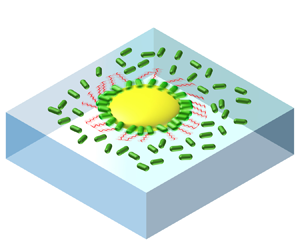
Crowding accelerates the rotation of a bacterial rotor
-
- Journal:
- Journal of Fluid Mechanics / Volume 994 / 10 September 2024
- Published online by Cambridge University Press:
- 18 September 2024, A12
-
- Article
- Export citation
Crystal structure of perfluorononanoic acid, C9HF17O2
-
- Journal:
- Powder Diffraction / Volume 39 / Issue 4 / December 2024
- Published online by Cambridge University Press:
- 18 September 2024, pp. 263-269
-
- Article
-
- You have access
- Open access
- HTML
- Export citation
A non-linear unsteady vortex-lattice method for rotorcraft applications
-
- Journal:
- The Aeronautical Journal / Volume 128 / Issue 1328 / October 2024
- Published online by Cambridge University Press:
- 18 September 2024, pp. 2308-2330
-
- Article
- Export citation

Resurrection of a superhydrophobic cylinder impacting onto liquid bath
-
- Journal:
- Journal of Fluid Mechanics / Volume 994 / 10 September 2024
- Published online by Cambridge University Press:
- 18 September 2024, A11
-
- Article
- Export citation

Influence of outer large-scale motions on near-wall structures in compressible turbulent channel flows
-
- Journal:
- Journal of Fluid Mechanics / Volume 994 / 10 September 2024
- Published online by Cambridge University Press:
- 18 September 2024, A14
-
- Article
- Export citation
-
The influence of outer large-scale motions (LSMs) on near-wall structures in compressible turbulent channel flows is investigated. To separate the compressibility effects, velocity fluctuations are decomposed into solenoidal and dilatational components using the Helmholtz decomposition method. Solenoidal velocity fluctuations manifest as near-wall streaks and outer large-scale structures. The spanwise drifting of near-wall solenoidal streaks is found to be driven by the outer LSMs, while LSMs have a trivial influence on the spanwise density of solenoidal streaks, consistent with the outer LSM impacts found in incompressible flows (Zhou et al., J. Fluid Mech., vol. 940, 2022, p. A23). Dilatational motions are characterized by the near-wall small-scale travelling-wave packets and the large-scale parts in the outer region. The streamwise advection velocity of the near-wall structures remains at $16 \sim 18u_{\tau }$, hardly influenced by Mach numbers, Reynolds numbers and wall temperatures. The spanwise drifting of near-wall dilatational structures, quantified by the particle image velocimetry method, follows a mechanism distinct from solenoidal streaks. This drifting velocity is notably larger than those of the solenoidal streaks, and the influence of outer LSMs is not the primary trigger for this drifting.


Reactive experimental control of turbulent jets
-
- Journal:
- Journal of Fluid Mechanics / Volume 994 / 10 September 2024
- Published online by Cambridge University Press:
- 18 September 2024, A15
-
- Article
- Export citation
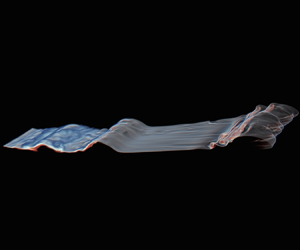
On the three-dimensional structure of instabilities beneath shallow-shoaling internal waves
-
- Journal:
- Journal of Fluid Mechanics / Volume 995 / 25 September 2024
- Published online by Cambridge University Press:
- 18 September 2024, R2
-
- Article
-
- You have access
- Open access
- HTML
- Export citation
Optimal avoidance strategy based on nonlinear approximate analytic solution of non-cooperative differential game
-
- Journal:
- The Aeronautical Journal / Volume 128 / Issue 1330 / December 2024
- Published online by Cambridge University Press:
- 18 September 2024, pp. 2906-2923
-
- Article
- Export citation

Attracting dynamical modes of highly elastic fibres settling under gravity in a viscous fluid
-
- Journal:
- Journal of Fluid Mechanics / Volume 994 / 10 September 2024
- Published online by Cambridge University Press:
- 18 September 2024, A13
-
- Article
-
- You have access
- Open access
- HTML
- Export citation
