Refine search
Actions for selected content:
212932 results in Engineering
Algebraic constraints and algorithms for common lines in cryo-EM
-
- Journal:
- Biological Imaging / Volume 4 / 2024
- Published online by Cambridge University Press:
- 16 May 2024, e9
-
- Article
-
- You have access
- Open access
- HTML
- Export citation
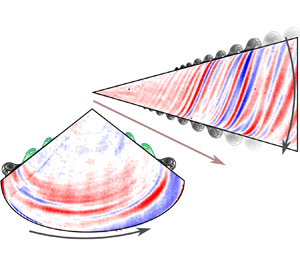
Görtler-number-based scaling of boundary-layer transition on rotating cones in axial inflow
-
- Journal:
- Journal of Fluid Mechanics / Volume 987 / 25 May 2024
- Published online by Cambridge University Press:
- 16 May 2024, R3
-
- Article
-
- You have access
- Open access
- HTML
- Export citation
-
This paper reports on the efficacy of the Görtler number in scaling the laminar-turbulent boundary-layer transition on rotating cones facing axial inflow. Depending on the half-cone angle $\psi$ and axial flow strength, the competing centrifugal and cross-flow instabilities dominate the transition. Traditionally, the flow is evaluated by using two parameters: the local meridional Reynolds number $Re_l$ comparing the inertial versus viscous effects and the local rotational speed ratio $S$ accounting for the boundary-layer skew. We focus on the centrifugal effects, and evaluate the flow fields and reported transition points using Görtler number based on the azimuthal momentum thickness of the similarity solution and local cone radius. The results show that Görtler number alone dominates the late stages of transition (maximum amplification and turbulence onset phases) for a wide range of investigated $S$ and half-cone angle ( $15^{\circ } \leq \psi \leq 50^{\circ }$), although the early stage (critical phase) seems to be not determined by the Görtler number alone on the broader cones ( $\psi =30^{\circ }$ and $50^{\circ }$) where the primary cross-flow instability dominates the flow. Overall, this indicates that the centrifugal effects play an important role in the boundary-layer transition on rotating cones in axial inflow.


Three-dimensional flow around and through a porous screen
-
- Journal:
- Journal of Fluid Mechanics / Volume 987 / 25 May 2024
- Published online by Cambridge University Press:
- 16 May 2024, A20
-
- Article
- Export citation
-
We investigate the three-dimensional (3-D) flow around and through a porous screen for various porosities at high Reynolds number $Re = {O}(10^4)$. Historically, the study of this problem has been focused on two-dimensional cases and for screens spanning completely or partially a channel. Since many recent problems have involved a porous object in a 3-D free flow, we present a 3-D model initially based on Koo & James (J. Fluid Mech., vol. 60, 1973, pp. 513–538) and Steiros & Hultmark (J. Fluid Mech., vol. 853, 2018 pp. 1–11) for screens of arbitrary shapes. In addition, we include an empirical viscous correction factor accounting for viscous effects in the vicinity of the screen. We characterize experimentally the aerodynamic drag coefficient for a porous square screen composed of fibres, immersed in a laminar air flow with various solidities and different angles of attack. We test various fibre diameters to explore the effect of the space between the pores on the drag force. Using PIV and hot wire probe measurements, we visualize the flow around and through the screen, and in particular measure the proportion of fluid that is deviated around the screen. The predictions from the model for drag coefficient, flow velocities and streamlines are in good agreement with our experimental results. In particular, we show that local viscous effects are important: at the same solidity and with the same air flow, the drag coefficient and the flow deviations strongly depend on the Reynolds number based on the fibre diameter. The model, taking into account 3-D effects and the shape of the porous screen, and including an empirical viscous correction factor that is valid for fibrous screens may have many applications including the prediction of water collection efficiency for fog harvesters.

7 - Low-Rank Approximation and Multidimensional Scaling
-
- Book:
- Linear Algebra for Data Science, Machine Learning, and Signal Processing
- Published online:
- 01 November 2024
- Print publication:
- 16 May 2024, pp 238-282
-
- Chapter
- Export citation
Contents
-
- Book:
- Linear Algebra for Data Science, Machine Learning, and Signal Processing
- Published online:
- 01 November 2024
- Print publication:
- 16 May 2024, pp vii-xiv
-
- Chapter
- Export citation

Boundary-layer instability on a highly swept fin on a cone at Mach 6
-
- Journal:
- Journal of Fluid Mechanics / Volume 987 / 25 May 2024
- Published online by Cambridge University Press:
- 16 May 2024, A13
-
- Article
-
- You have access
- Open access
- HTML
- Export citation
-
The growth and characteristics of linear, oblique instabilities on a highly swept fin on a straight cone in Mach 6 flow are examined. Large streamwise pressure gradients cause doubly inflected cross-flow profiles and reversed flow near the wall, which necessitates using the harmonic linearized Navier–Stokes equations. The cross-flow instability is responsible for the most-amplified disturbances, however, not all disturbances show typical cross-flow characteristics. Distinct differences in perturbation structure are shown between small ( $\sim$3–5 mm) and large ( $\sim$10 mm) wavelength disturbances at the unit Reynolds number $Re' = 11 \times 10^6$ m $^{-1}$. As a result, amplification measurements based solely on wall quantities bias a most-amplified disturbance assessment towards larger wavelengths and lower frequencies than would otherwise be determined by an off-wall total-energy approach. A spatial-amplification energy-budget analysis demonstrates (i) that wall-normal Reynolds-flux terms dictate the local growth rate, despite other terms having a locally larger magnitude and (ii) that the Reynolds-stress terms are responsible for large-wavelength disturbances propagating closer to the wall compared with small-wavelength disturbances. Additionally, the effect of free-stream unit Reynolds number and small yaw angles on the perturbation amplification and energy budget is considered. At a higher Reynolds number ( $Re' = 22 \times 10^6$ m $^{-1}$), the most-amplified wavelength shrinks. Perturbations do not behave self-similarly in the thinner boundary layer, and the shift in most-amplified wavelength is due to decreased dissipation relative to the lower-Reynolds-number case. Small yaw angles produce a streamwise shift in the boundary layer and disturbance amplification. The yaw results quantify a potential uncertainty source in experiments and flight.


References
-
- Book:
- Linear Algebra for Data Science, Machine Learning, and Signal Processing
- Published online:
- 01 November 2024
- Print publication:
- 16 May 2024, pp 405-422
-
- Chapter
- Export citation
Reviews
-
- Book:
- Linear Algebra for Data Science, Machine Learning, and Signal Processing
- Published online:
- 01 November 2024
- Print publication:
- 16 May 2024, pp ii-ii
-
- Chapter
- Export citation
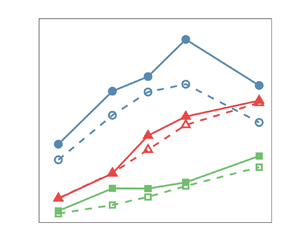
Investigating the parametric dependence of the impact of two-way coupling on inertial particle settling in turbulence
-
- Journal:
- Journal of Fluid Mechanics / Volume 987 / 25 May 2024
- Published online by Cambridge University Press:
- 16 May 2024, A17
-
- Article
-
- You have access
- Open access
- HTML
- Export citation
-
Tom et al. (J. Fluid Mech., vol. 947, 2022, p. A7) investigated the impact of two-way coupling (2WC) on particle settling velocities in turbulence. For the limited parameter choices explored, it was found that (i) 2WC substantially enhances particle settling compared with the one-way coupled case, even at low mass loading $\varPhi _m$ and (ii) preferential sweeping remains the mechanism responsible for the particles settling faster than the Stokes settling velocity in 2WC flows. However, significant alterations to the flow structure that can occur at higher mass loadings mean that the conclusions from Tom et al. (J. Fluid Mech., vol. 947, 2022, p. A7) may not generalise. Indeed, even under very low mass loadings, the influence of 2WC on particle settling might persist, challenging the conventional assumption. We therefore explore a much broader portion of the parameter space, with simulations covering cases where the impact of 2WC on the global fluid statistics ranges from negligible to strong. We find that, even for $\varPhi _m=7.5\times 10^{-3}$, 2WC can noticeably increase the settling for some choices of the Stokes and Froude numbers. When $\varPhi _m$ is large enough for the global fluid statistics to be strongly affected, we show that preferential sweeping continues to be the mechanism that enhances particle settling rates. Finally, we compare our results with previous numerical and experimental studies. While in some cases there is reasonable agreement, discrepancies exist even between different numerical studies and between different experiments. Future studies must seek to understand this before the discrepancies between numerical and experimental results can be adequately addressed.


4 - Subspaces, Rank, and Nearest-Subspace Classification
-
- Book:
- Linear Algebra for Data Science, Machine Learning, and Signal Processing
- Published online:
- 01 November 2024
- Print publication:
- 16 May 2024, pp 96-142
-
- Chapter
- Export citation
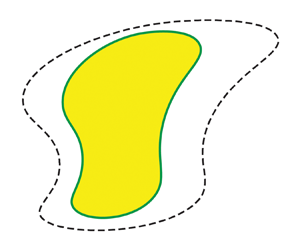
The viscous force and torque on a closed irrotational surface
-
- Journal:
- Journal of Fluid Mechanics / Volume 987 / 25 May 2024
- Published online by Cambridge University Press:
- 16 May 2024, A19
-
- Article
- Export citation
8 - Special Matrices, Markov Chains, and PageRank
-
- Book:
- Linear Algebra for Data Science, Machine Learning, and Signal Processing
- Published online:
- 01 November 2024
- Print publication:
- 16 May 2024, pp 283-334
-
- Chapter
- Export citation

Fragmentation of colliding liquid rims
-
- Journal:
- Journal of Fluid Mechanics / Volume 987 / 25 May 2024
- Published online by Cambridge University Press:
- 16 May 2024, A18
-
- Article
-
- You have access
- Open access
- HTML
- Export citation
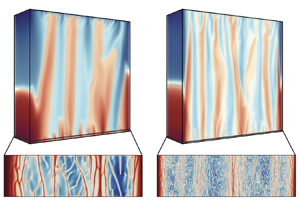
Unifying constitutive law of vibroconvective turbulence in microgravity
-
- Journal:
- Journal of Fluid Mechanics / Volume 987 / 25 May 2024
- Published online by Cambridge University Press:
- 16 May 2024, A14
-
- Article
- Export citation
-
We report the unified constitutive law of vibroconvective turbulence in microgravity, i.e. $Nu \sim a^{-1} Re_{os}^\beta$ where the Nusselt number $Nu$ measures the global heat transport, $a$ is the dimensionless vibration amplitude, $Re_{os}$ is the oscillational Reynolds number and $\beta$ is the universal exponent. We find that the dynamics of boundary layers plays an essential role in vibroconvective heat transport and the $Nu$-scaling exponent $\beta$ is determined by the competition between the thermal boundary layer (TBL) and vibration-induced oscillating boundary layer (OBL). Then a physical model is proposed to explain the change of scaling exponent from $\beta =2$ in the TBL-dominant regime to $\beta = 4/3$ in the OBL-dominant regime. Our finding elucidates the emergence of universal constitutive laws in vibroconvective turbulence, and opens up a new avenue for generating a controllable effective heat transport under microgravity or even microfluidic environment in which the gravity effect is nearly absent.


Divergent Richtmyer–Meshkov instability under different shock strengths
-
- Journal:
- Journal of Fluid Mechanics / Volume 987 / 25 May 2024
- Published online by Cambridge University Press:
- 16 May 2024, R5
-
- Article
- Export citation
9 - Optimization Basics and Logistic Regression
-
- Book:
- Linear Algebra for Data Science, Machine Learning, and Signal Processing
- Published online:
- 01 November 2024
- Print publication:
- 16 May 2024, pp 335-364
-
- Chapter
- Export citation
3 - Matrix Factorization: Eigendecomposition and SVD
-
- Book:
- Linear Algebra for Data Science, Machine Learning, and Signal Processing
- Published online:
- 01 November 2024
- Print publication:
- 16 May 2024, pp 63-95
-
- Chapter
- Export citation
Jetting enhancement from wall-proximal cavitation bubbles by a distant wall
-
- Journal:
- Journal of Fluid Mechanics / Volume 987 / 25 May 2024
- Published online by Cambridge University Press:
- 16 May 2024, R2
-
- Article
-
- You have access
- Open access
- HTML
- Export citation
-
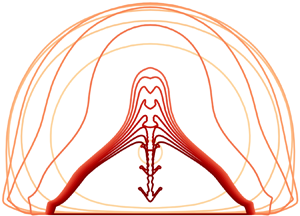
An additional distant wall is known to highly alter the jetting scenarios of wall-proximal bubbles. Here, we combine high-speed photography and axisymmetric volume of fluid (VoF) simulations to quantitatively describe its role in enhancing the micro-jet dynamics within the directed jet regime (Zeng et al., J. Fluid Mech., vol. 896, 2020, A28). Upon a favourable agreement on the bubble and micro-jet dynamics, both experimental and simulation results indicate that the micro-jet velocity increases dramatically as $\eta$ decreases, where $\eta =H/R_{max}$ is the distance between two walls $H$ normalized by the maximum bubble radius $R_{max}$. The mechanism is related to the collapsing flow, which is constrained by the distant wall into a reverse stagnation-point flow that builds up pressure near the bubble's top surface and accelerates it into micro-jets. We further derive an equation expressing the micro-jet velocity $U_{jet}=87.94\gamma ^{0.5}(1+(1/3)(\eta -\lambda ^{1.2})^{-2})$, where ${\gamma =d/R_{max}}$ is the stand-off distance to the proximal wall with $d$ the distance between the initial bubble centre and the wall, $\lambda =R_{y,m}/R_{max}$ with $R_{y,m}$ the distance between the top surface and the proximal wall at the bubble's maximum expansion. Viscosity has a minimal impact on the jet velocity for small $\gamma$, where the pressure buildup is predominantly influenced by geometry.


FLM volume 986 Cover and Front matter
-
- Journal:
- Journal of Fluid Mechanics / Volume 986 / 10 May 2024
- Published online by Cambridge University Press:
- 16 May 2024, p. f1
-
- Article
-
- You have access
- Export citation
Preface
-
- Book:
- Linear Algebra for Data Science, Machine Learning, and Signal Processing
- Published online:
- 01 November 2024
- Print publication:
- 16 May 2024, pp xv-xviii
-
- Chapter
- Export citation
