Refine search
Actions for selected content:
212936 results in Engineering

Starting vortices generated by an arbitrary solid body with any number of edges
-
- Journal:
- Journal of Fluid Mechanics / Volume 987 / 25 May 2024
- Published online by Cambridge University Press:
- 14 May 2024, A11
-
- Article
- Export citation
-
The starting vortex generated at the trailing edge of a flat plate, that is impulsively translated at fixed angle of attack, is a widely studied canonical problem. Recent work that examined the effect of plate rotation on this starting vortex found that two new and distinct vortex sheet types can arise. We generalise this work to study the starting vortex generated at any sharp and straight edge of an arbitrary body under a general time-dependent two-dimensional motion. The dimensionless velocity field of the attached flow near any sharp edge is assumed to take the form, $\hat {z}^{-1/2} f(T) + g(T) + o (1)$, where $\hat {z}$ is the dimensionless position referenced to the edge, $f(T)$ and $g(T)$ are functions of dimensionless time, $T$, associated with the local flow perpendicular and parallel to the edge, respectively. This enables starting vortices to be generally calculated and their types related by simply inspecting the forms of $f(T)$ and $g(T)$. We elucidate the physics underlying all three vortex types and show that these vortices are generated by pure translation of the sharp edge. Several case studies are explored, including the leading/trailing edge vortices of a flat plate which can simultaneously be of different type (relevant to low-speed aircraft), the vortex formed by translation of a semi-infinite flat plate and the trailing-edge vortex of Joukowski aerofoils. With the ability to calculate the vortices at all edges, the theory is used to develop a general formula for the lift force of a flat plate which can find application in practice.


Reconstruction of nanoparticle size distribution in laser-shocked matter from small-angle X-ray scattering via neural networks
-
- Journal:
- High Power Laser Science and Engineering / Volume 12 / 2024
- Published online by Cambridge University Press:
- 14 May 2024, e46
-
- Article
-
- You have access
- Open access
- HTML
- Export citation
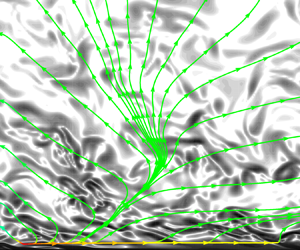
Spatially evolving cascades in wall turbulence with and without interface
-
- Journal:
- Journal of Fluid Mechanics / Volume 987 / 25 May 2024
- Published online by Cambridge University Press:
- 13 May 2024, A4
-
- Article
-
- You have access
- Open access
- HTML
- Export citation
-
Direct numerical simulations of channel flow and temporal boundary layer at a Reynolds number $Re_{\tau } = 1500$ are used to assess the scale-by-scale mechanisms of wall turbulence. From the peak of turbulence production embedded at the small scales of the near-wall region, spatially ascending reverse cascades are generated that move through self-similar eddies growing in size with the wall distance. These fluxes are followed by spatially ascending forward cascades through detached eddies thus reaching sufficiently small scales where eventually scale energy is dissipated. This phenomenology is shared by both boundary layer and channel flow and is recognized as a robust physical feature characterizing wall turbulence in general. Specific features related to the flow configuration are indeed identified in the outer region. In particular, the central region of channels is characterized by a generalized Richardson energy cascade where large scales are in equilibrium with small scales at different wall distances through a combined forward cascade and spatial flux. On the contrary, the interface region of boundary layers is characterized by an almost two-dimensional physics where spatially ascending reverse cascades sustain long and wide interface structures with a forward cascade that survives only in the wall-normal scales. The overall scenario consists in a variety of scale motions that while protruding from the turbulent core towards the external region, squeeze at the interface thus sustaining vertical shear in a thin layer. The observed multidimensional physics sheds light on the complex interactions between outer entrainment and near-wall self-sustaining mechanisms with possible repercussions for theories.

Rao-Blackwellized particle smoothing for simultaneous localization and mapping
-
- Journal:
- Data-Centric Engineering / Volume 5 / 2024
- Published online by Cambridge University Press:
- 13 May 2024, e15
-
- Article
-
- You have access
- Open access
- HTML
- Export citation
An ultra-wideband power amplifier designed through a bandwidth expansion strategy
-
- Journal:
- International Journal of Microwave and Wireless Technologies / Volume 16 / Issue 7 / September 2024
- Published online by Cambridge University Press:
- 13 May 2024, pp. 1138-1143
-
- Article
- Export citation
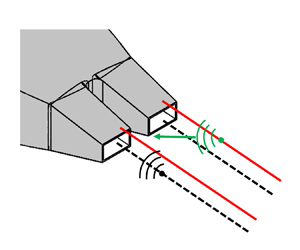
A closure mechanism for screech coupling in rectangular twin jets
-
- Journal:
- Journal of Fluid Mechanics / Volume 987 / 25 May 2024
- Published online by Cambridge University Press:
- 13 May 2024, A5
-
- Article
-
- You have access
- Open access
- HTML
- Export citation
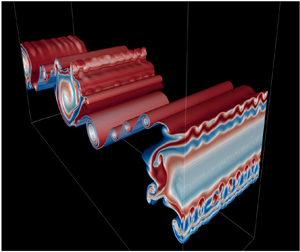
Turbulence and mixing from neighbouring stratified shear layers
-
- Journal:
- Journal of Fluid Mechanics / Volume 987 / 25 May 2024
- Published online by Cambridge University Press:
- 13 May 2024, A8
-
- Article
- Export citation
-
Studies of Kelvin–Helmholtz (KH) instability have typically modelled the initial mean flow as an isolated stratified shear layer. However, geophysical flows frequently exhibit multiple layers. As a step towards understanding these flows, we examine the case of two adjacent stratified shear layers using both linear stability analysis and direct numerical simulations. With sufficiently large layer separation, the characteristics of instability and mixing converge towards the familiar KH turbulence, and similarly when the separation is near zero and the layers add to make a single layer, albeit with a reduced Richardson number. Here, our focus is on intermediate separations, which produce new and complex phenomena. As the separation distance $D$ increases from zero to a critical value $D_c$, approximately half the thickness of the shear layer, the growth rate and wavenumber both decrease monotonically. The minimum Richardson number is relatively low, potentially inducing pairing, and shear-aligned convective instability (SCI) is the primary mechanism for transition. Consequently, mixing is relatively strong and efficient. When $D\sim D_c$, billow length is increased but growth is slowed. Despite the modest growth rate, mixing is strong and efficient, engendered primarily by secondary shear instability manifested on the braids, and by SCI occurring on the eyelids. Shear-aligned vortices are driven in part by buoyancy production; however, shear production and vortex stretching are equally important mechanisms. When $D>D_c$, neighbouring billow interactions suppress the growth of both KH instability and SCI. Strength and efficiency of mixing decrease abruptly as $D_c$ is exceeded. As turbulence decays, layers of marginal instability may arise.


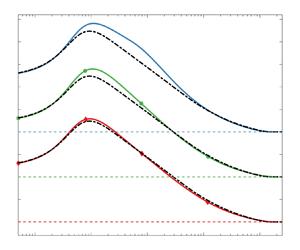
An improved Baldwin–Lomax algebraic wall model for high-speed canonical turbulent boundary layers using established scalings
-
- Journal:
- Journal of Fluid Mechanics / Volume 987 / 25 May 2024
- Published online by Cambridge University Press:
- 13 May 2024, A7
-
- Article
-
- You have access
- Open access
- HTML
- Export citation
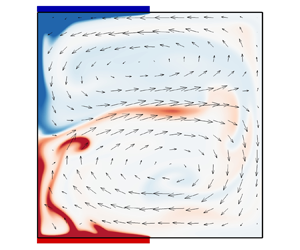
Flow reversal and multiple states in turbulent Rayleigh–Bénard convection with partially isothermal plates
-
- Journal:
- Journal of Fluid Mechanics / Volume 987 / 25 May 2024
- Published online by Cambridge University Press:
- 13 May 2024, A9
-
- Article
- Export citation
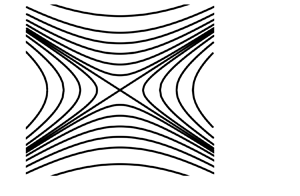
On the use of the Astarita flow field for viscoelastic fluids to develop a generalised Newtonian fluid model incorporating flow type (GNFFTy)
-
- Journal:
- Journal of Fluid Mechanics / Volume 987 / 25 May 2024
- Published online by Cambridge University Press:
- 13 May 2024, A2
-
- Article
-
- You have access
- Open access
- HTML
- Export citation
-
The two-dimensional, steady, homogeneous flow field proposed by Astarita (J. Rheol., vol. 35, 1991, pp. 687–689) is studied for a range of viscoelastic constitutive equations of differential form including the models due to Oldroyd (the upper and lower convected Maxwell; UCM/LCM), Phan-Thien and Tanner (simplified, linear form; sPTT) and Giesekus. As the flow is steady and homogeneous, the sPTT model results also give the FENE-P model solutions via a simple transformation of parameters. The flow field has the interesting feature that a scalar parameter may be used to vary the flow ‘type’ continuously from solid-body rotation to simple shearing to planar extension whilst the rate of deformation tensor $\boldsymbol{\mathsf{D}}$ remains constant (i.e. independent of flow type). The response of the models is probed in order to determine how a scalar ‘viscosity’ function may be rigorously constructed which includes flow-type dependence. We show that for most of these models – the Giesekus being the exception – the first and second invariants of the resulting extra stress tensor are linearly related, and for models based on the upper convected derivative, this link is simply via a material property, i.e. half the modulus. By defining a frame-invariant coordinate system with respect to the eigenvectors of $\boldsymbol{\mathsf{D}}$, we associate a ‘viscosity’ for each of the flows to a deviatoric stress component and show how this quantity varies with the flow-type parameter. For elliptical motions, rate thinning is always observed and all models give essentially the UCM response. For strong flows, i.e. flow types containing at least some extension, thickening occurs and only a small element of extension is required to remove any shear thinning inherent in the model (e.g. as occurs in steady simple shearing for the sPTT/Giesekus models). Finally, a functional form of a viscosity equation which could incorporate flow type, but be otherwise inelastic, the so-called GNFFTy (generalised Newtonian fluid model incorporating flow type, pronounced ‘nifty’), is proposed. In the frame-invariant coordinate system proposed, this model is also capable of capturing normal-stress differences.


High-efficiency tandem Ho:YAG single-crystal fiber laser delivering more than 100 W output power
-
- Journal:
- High Power Laser Science and Engineering / Volume 12 / 2024
- Published online by Cambridge University Press:
- 13 May 2024, e41
-
- Article
-
- You have access
- Open access
- HTML
- Export citation
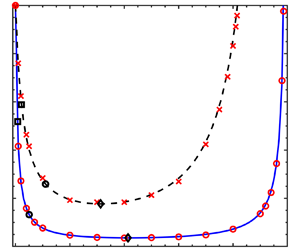
On the efficacy of surface-attached air bubbles as thermal insulators for pressure-driven internal flow
-
- Journal:
- Journal of Fluid Mechanics / Volume 987 / 25 May 2024
- Published online by Cambridge University Press:
- 13 May 2024, A6
-
- Article
-
- You have access
- Open access
- HTML
- Export citation
Freeze-out of perturbation growth for shocked heavy fluid layers by eliminating reverberating waves
-
- Journal:
- Journal of Fluid Mechanics / Volume 987 / 25 May 2024
- Published online by Cambridge University Press:
- 13 May 2024, A10
-
- Article
- Export citation
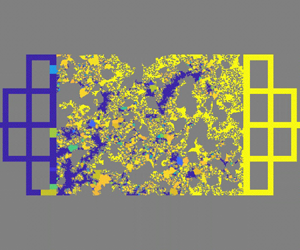
Fluid entrapment during forced imbibition in a multidepth microfluidic chip with complex porous geometry
-
- Journal:
- Journal of Fluid Mechanics / Volume 987 / 25 May 2024
- Published online by Cambridge University Press:
- 13 May 2024, A3
-
- Article
- Export citation
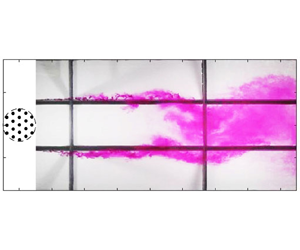
Wake structure of an array of cylinders in shallow flow
-
- Journal:
- Journal of Fluid Mechanics / Volume 986 / 10 May 2024
- Published online by Cambridge University Press:
- 10 May 2024, A30
-
- Article
-
- You have access
- Open access
- HTML
- Export citation
Asymptotic predictions on the velocity gradient statistics in low-Reynolds-number random flows: onset of skewness, intermittency and alignments
-
- Journal:
- Journal of Fluid Mechanics / Volume 986 / 10 May 2024
- Published online by Cambridge University Press:
- 10 May 2024, A25
-
- Article
-
- You have access
- Open access
- HTML
- Export citation
Semantic agent framework for automated flood assessment using dynamic knowledge graphs
-
- Journal:
- Data-Centric Engineering / Volume 5 / 2024
- Published online by Cambridge University Press:
- 10 May 2024, e14
-
- Article
-
- You have access
- Open access
- HTML
- Export citation
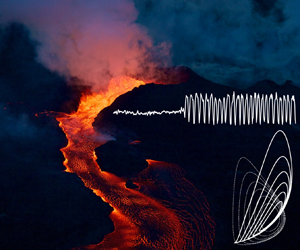
Pulsing in the Ahu‘ail $\bar{{\textbf{a}}}$‘au pond–spillway system during the 2018 K $\unicode{x012B}$lauea eruption: a dynamical systems perspective
-
- Journal:
- Journal of Fluid Mechanics / Volume 986 / 10 May 2024
- Published online by Cambridge University Press:
- 10 May 2024, A37
-
- Article
- Export citation
-
During the 2018 K
$\unicode{x012B}$lauea lower East Rift Zone eruption, lava from 24 fissures inundated more than 8000 acres of land, destroying more than 700 structures over three months. Eruptive activity eventually focused at a single vent characterized by a continuously fed lava pond that was drained by a narrow spillway into a much wider, slower channelized flow. The spillway exhibited intervals of ‘pulsing’ behaviour in which the lava depth and velocity were observed to oscillate on time scales of several minutes. At the time, this was attributed to variations in vesiculation originating at depth. Here, we construct a toy fluid dynamical model of the pond–spillway system, and present an alternative hypothesis in which pulsing is generated at the surface, within this system. We posit that the appearance of pulsing is due to a supercritical Hopf bifurcation driven by an increase in the Reynolds number. Asymptotics for the limit cycle near the bifurcation point are derived with averaging methods and compare favourably with the cycle periodicity. Because oscillations in the pond were not observable directly due to the elevation of the cone rim and an obscuring volcanic plume, we model the observations using a spatially averaged Saint-Venant model of the spillway forced by the pond oscillator. The predicted spillway cycle periodicity and waveforms compare favourably with observations made during the eruption. The unusually well-documented nature of this eruption enables estimation of the viscosity of the erupting lava.


Numerical modelling of supersonic boundary-layer receptivity to solid particulates – CORRIGENDUM
-
- Journal:
- Journal of Fluid Mechanics / Volume 986 / 10 May 2024
- Published online by Cambridge University Press:
- 10 May 2024, E1
-
- Article
-
- You have access
- HTML
- Export citation
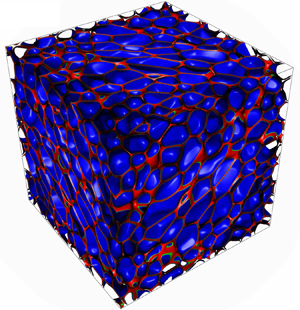
Lagrangian statistics of concentrated emulsions
-
- Journal:
- Journal of Fluid Mechanics / Volume 986 / 10 May 2024
- Published online by Cambridge University Press:
- 10 May 2024, A33
-
- Article
-
- You have access
- Open access
- HTML
- Export citation
