Refine search
Actions for selected content:
212932 results in Engineering
Turbulent drag reduction with streamwise-travelling waves in the compressible regime
-
- Journal:
- Journal of Fluid Mechanics / Volume 987 / 25 May 2024
- Published online by Cambridge University Press:
- 21 May 2024, A30
-
- Article
- Export citation
Data-driven modelling of the regular and chaotic dynamics of an inverted flag from experiments
-
- Journal:
- Journal of Fluid Mechanics / Volume 987 / 25 May 2024
- Published online by Cambridge University Press:
- 21 May 2024, R7
-
- Article
-
- You have access
- Open access
- HTML
- Export citation
Added mass of oscillating bodies in stratified fluids
-
- Journal:
- Journal of Fluid Mechanics / Volume 987 / 25 May 2024
- Published online by Cambridge University Press:
- 20 May 2024, A27
-
- Article
- Export citation
-
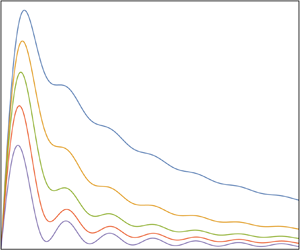
The concept of added mass is generalized to stratified fluids, accounting for the presence of internal waves. Once the added mass of a moving body is known, so is the hydrodynamic force exerted on it by the fluid, and the energy imparted by it to the fluid. As a function of frequency, added mass is complex. Its real part is associated with inertia and its imaginary part, only present in the frequency range of propagating waves, with wave damping. Owing to causality, these two parts satisfy Kramers–Kronig relations. The added masses of an elliptic cylinder of horizontal axis, typical of two-dimensional bodies, and a spheroid of vertical axis, typical of three-dimensional bodies, are deduced from their dipole strengths, themselves deduced from their representations as single layers. The wave power is shown to be a maximum, for fixed oscillation amplitude, at approximately $0.8$ times the buoyancy frequency. In the temporal domain, added mass appears as a new memory force taking the form of a convolution integral. The kernel of this integral combines algebraically decaying oscillations at the buoyancy frequency on the one hand; and an exponentially damped oscillation for the horizontal motion of the spheroid, implying short-term memory, an aperiodic algebraic decay for its vertical motion, implying long-term memory, and a constant for the motion of the cylinder, implying everlasting memory, on the other hand. A limitation of the study is its restriction to translational motion.

Design of TE-polarized resonant Bessel-beam launchers for wireless power transfer links in the radiative near-field region
-
- Journal:
- International Journal of Microwave and Wireless Technologies / Volume 16 / Issue 5 / June 2024
- Published online by Cambridge University Press:
- 20 May 2024, pp. 828-837
-
- Article
-
- You have access
- Open access
- HTML
- Export citation
A novel approach to runway overrun risk assessment using FRAM and flight data monitoring
-
- Journal:
- The Aeronautical Journal / Volume 128 / Issue 1327 / September 2024
- Published online by Cambridge University Press:
- 20 May 2024, pp. 2054-2072
-
- Article
- Export citation
Bubble-induced entrainment at viscoplastic–Newtonian interfaces
-
- Journal:
- Journal of Fluid Mechanics / Volume 987 / 25 May 2024
- Published online by Cambridge University Press:
- 20 May 2024, A28
-
- Article
-
- You have access
- Open access
- HTML
- Export citation
-
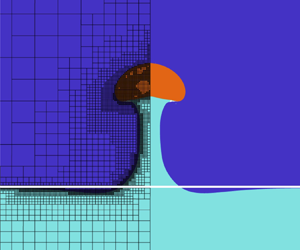
The passage of single air bubbles through the horizontal interface between viscoplastic and Newtonian fluids, considering various combinations of densities and viscosities for the fluid layers, is studied computationally. The primary focus is on the quantity of liquid transferred from the lower layer (viscoplastic fluid) to the upper layer (Newtonian fluid) as a result of the bubble's ascent, a factor with significant implications for the turbidity of methane-emitting lakes and water bodies. The entrainment characteristics are observed to vary considerably with the bubble shape, within the lower layer and as the bubble approaches the interface. The results show that at Bond number $(Bo)>1$ and moderate Archimedes ( $Ar$), prolate-shaped bubbles crossing the interface undergo elongation in the direction of their poles. This elongation is further accentuated when the viscosity of upper layer is less than the plastic viscosity of the lower layer. The bubble is found to break up when leaving the lower layer, of a critical capillary number, $Ca_c \approx 5$. The results show a significant reduction in the volume of entrainment compared with the Newtonian counterpart. This suggests disturbances caused by the rising bubble at the interface dissipate over a smaller region. Four distinct entrainment regimes are identified, mainly indicating the height to which the entrained fluid can be transported away from the interface. In contrast to Newtonian fluids, the volume of entrainment increases by decreasing the viscosity of the upper layer. Interestingly, the heavy viscoplastic fluid that has been dragged up into the light Newtonian fluid does not recede with time.


Perspectives for extraordinary elastic-wave control in non-Hermitian meta-structures
- Part of
-
- Journal:
- Programmable Materials / Volume 2 / 2024
- Published online by Cambridge University Press:
- 20 May 2024, e4
-
- Article
-
- You have access
- Open access
- HTML
- Export citation
Crystal structure of alectinib hydrochloride Type I, C30H35N4O2Cl
-
- Journal:
- Powder Diffraction / Volume 39 / Issue 3 / September 2024
- Published online by Cambridge University Press:
- 20 May 2024, pp. 170-175
-
- Article
-
- You have access
- Open access
- HTML
- Export citation
Crystal structure of rilpivirine hydrochloride, N6H19C22Cl
-
- Journal:
- Powder Diffraction / Volume 39 / Issue 3 / September 2024
- Published online by Cambridge University Press:
- 20 May 2024, pp. 151-158
-
- Article
- Export citation

Turbulent kinetic energy budget of sediment-laden open-channel flows: bedload-induced wall-roughness similarity
-
- Journal:
- Journal of Fluid Mechanics / Volume 987 / 25 May 2024
- Published online by Cambridge University Press:
- 20 May 2024, A25
-
- Article
-
- You have access
- Open access
- HTML
- Export citation
-
New experiments in highly turbulent, steady, subcritical and uniform water open-channel flows have been carried out to measure the mean turbulent kinetic energy (TKE) budget of sediment-laden boundary layer flows with two sizes (dp = 3 mm and 1 mm) of Plexiglas particles $({\rm relative\ density}\ = 1.192)$. The experiments covered energetic sediment transport conditions (Shields number of $0.35 < \theta < 1.2$) ranging from non-capacity to full-capacity flows in bedload-to-suspension-dominated transport modes (suspension number of $0.5 < {w_s}/{u_\ast } < 1.3$ where ${w_s}$ is the settling velocity and $u_*$ is the friction velocity) and for weakly to highly inertial, finite size turbulence-particle conditions (Stokes number of 0.1 < St < 3.5 and dp/η > 10 where $\eta$ is the Kolmogorov length scale). It was shown that the effects of sediments on the TKE budget are very pronounced in all large particle experiments for which a bedload layer of several grain diameter thickness is developed above the channel bed. When compared with the corresponding reference clear-water flows, the TKE shear-production rate for the 3 mm particle flows is strongly reduced in the wall region corresponding to the bedload layer. This turbulence damping is seen to increase with sediment load until full capacity for flows with constant Shields value, as well as with Shields number value. Inside this damped TKE shear-production zone, a distinct peak of maximal turbulence production appears to coincide with the upper edge of the bedload layer delimited by a sharp gradient in mean sediment concentration. This vertically upshifted peak of TKE production is accompanied by an enhanced net downward oriented TKE flux when compared with the reference clear-water flows. The downward diffused TKE is found to act in the bedload layer as a local energy source in reasonable balance with the sediment transport term. The mechanism behind this downward TKE transport was further analysed on the basis of coherent flow structure dynamics controlled by ejection- and sweep-type events. The agreement between the height of downward directed mean TKE flux and the height below which sweep-type events dominate the Reynolds shear-stress contribution over ejections, revealed the leading role played by sweeps in mean TKE transport. This agreement holds for all reference clear-water flows supporting the well-known wall-roughness-induced dominance of the sweep contribution in turbulent, rough clear-water boundary layer flows. Furthermore, for all 3 mm particle flows, the two referred to transition levels were significantly and similarly upshifted to the upper edge of the bedload layer. Only for these sediment-laden flows, the bedload layer thickness is seen to exceed the wall-roughness sublayer of the reference clear-water flows. This supports a strong analogy between wall-roughness effects in clear-water flows and bedload layer effects in sediment-laden flows, on the mean TKE budget induced by a similarly modified coherent flow structure dynamics. The bedload layer-controlled wall roughness is finally confirmed by the good prediction of the wall-roughness parameter ks of the logarithmic velocity distribution. An empirical formulation fitting the presented measurements is presented, valid over the range of Shields number values covered herein.


The RAeS 2023 written paper prizes
-
- Journal:
- The Aeronautical Journal / Volume 128 / Issue 1326 / August 2024
- Published online by Cambridge University Press:
- 20 May 2024, pp. 1611-1612
-
- Article
-
- You have access
- HTML
- Export citation
A study of streamline geometries in subsonic and supersonic regions of compressible flow fields
-
- Journal:
- Journal of Fluid Mechanics / Volume 987 / 25 May 2024
- Published online by Cambridge University Press:
- 20 May 2024, A26
-
- Article
- Export citation
Modelling the far-field effect of drag-induced dissipation in wave–structure interaction: a numerical and experimental study
-
- Journal:
- Journal of Fluid Mechanics / Volume 987 / 25 May 2024
- Published online by Cambridge University Press:
- 17 May 2024, A24
-
- Article
-
- You have access
- Open access
- HTML
- Export citation

Surface tension and wetting at free surfaces in smoothed particle hydrodynamics
-
- Journal:
- Journal of Fluid Mechanics / Volume 987 / 25 May 2024
- Published online by Cambridge University Press:
- 17 May 2024, A23
-
- Article
-
- You have access
- Open access
- HTML
- Export citation

Impedance spectra of soft ionics
-
- Journal:
- Journal of Fluid Mechanics / Volume 987 / 25 May 2024
- Published online by Cambridge University Press:
- 17 May 2024, A21
-
- Article
-
- You have access
- Open access
- HTML
- Export citation
Role of volatility and thermal properties in droplet spreading: a generalisation to Tanner's law
-
- Journal:
- Journal of Fluid Mechanics / Volume 987 / 25 May 2024
- Published online by Cambridge University Press:
- 17 May 2024, A15
-
- Article
-
- You have access
- Open access
- HTML
- Export citation
-
Droplet spreading is ubiquitous and plays a significant role in liquid-based energy systems, thermal management devices and microfluidics. While the spreading of non-volatile droplets is quantitatively understood, the spreading and flow transition in volatile droplets remains elusive due to the complexity added by interfacial phase change and non-equilibrium thermal transport. Here we show, using both mathematical modelling and experiments, that the wetting dynamics of volatile droplets can be scaled by the spatial–temporal interplay between capillary, evaporation and thermal Marangoni effects. We elucidate and quantify these complex interactions using phase diagrams based on systematic theoretical and experimental investigations. A spreading law of evaporative droplets is derived by extending Tanner's law (valid for non-volatile liquids) to a full range of liquids with saturation vapour pressure spanning from $10^1$ to $10^4$ Pa and on substrates with thermal conductivity from $10^{-1}$ to $10^3\ {\rm W}\ {\rm m}^{-1}\ {\rm K}^{-1}$. In addition to its importance in fluid-based industries, the conclusions also enable a unifying explanation to a series of individual works including the criterion of flow reversal and the state of dynamic wetting, making it possible to control liquid transport in diverse application scenarios.


Peristaltic pumping down a porous conduit
-
- Journal:
- Journal of Fluid Mechanics / Volume 987 / 25 May 2024
- Published online by Cambridge University Press:
- 17 May 2024, A22
-
- Article
-
- You have access
- Open access
- HTML
- Export citation
Index
-
- Book:
- Linear Algebra for Data Science, Machine Learning, and Signal Processing
- Published online:
- 01 November 2024
- Print publication:
- 16 May 2024, pp 423-431
-
- Chapter
- Export citation

Towards the understanding of convective dissolution in confined porous media: thin bead pack experiments, two-dimensional direct numerical simulations and physical models
-
- Journal:
- Journal of Fluid Mechanics / Volume 987 / 25 May 2024
- Published online by Cambridge University Press:
- 16 May 2024, A1
-
- Article
-
- You have access
- Open access
- HTML
- Export citation
Crystal structures and X-ray powder diffraction data for AAlGe2O6 synthetic leucite analogs (A = K, Rb, Cs)
-
- Journal:
- Powder Diffraction / Volume 39 / Issue 3 / September 2024
- Published online by Cambridge University Press:
- 16 May 2024, pp. 162-169
-
- Article
-
- You have access
- Open access
- HTML
- Export citation
-
Leucites are tetrahedrally coordinated silicate framework structures with some of the silicon framework cations that are partially replaced by divalent or trivalent cations. These structures have general formulae A2BSi5O12 and ACSi2O6, where A is a monovalent alkali metal cation, B is a divalent cation, and C is a trivalent cation. There are also leucite analogs with analogous tetrahedrally coordinated germanate framework structures. These have general formulae A2BGe5O12 and ACGe2O6. In this paper, the Rietveld refinements of three synthetic Ge-leucite analogs with stoichiometries of AAlGe2O6 (A = K, Rb, Cs) are discussed. KAlGe2O6 is I41/a tetragonal and is isostructural with KAlSi2O6. RbAlGe2O6 and CsAlGe2O6 are $I\bar{4}3d$ cubic and are isostructural with KBSi2O6.

