Refine search
Actions for selected content:
212937 results in Engineering
References
-
- Book:
- Flow Control
- Published online:
- 04 April 2024
- Print publication:
- 11 April 2024, pp 432-462
-
- Chapter
- Export citation
Aerothermal and aerodynamic characteristics of reusable hypersonic vehicles with heat transfer minimised sweepback
-
- Journal:
- The Aeronautical Journal / Volume 128 / Issue 1327 / September 2024
- Published online by Cambridge University Press:
- 11 April 2024, pp. 2003-2022
-
- Article
-
- You have access
- Open access
- HTML
- Export citation
-
Establishing aerothermal criteria for swept leading-edge hypersonic vehicle design is the predominant purpose of this work. This study is focused on two different configurations of vehicles based on the swept-back angle ( $\varLambda$) viz. minimum drag ( $\varLambda$Drag-min), and minimum heat transfer to vehicle ( $\varLambda$HT-min). Maximum wall temperatures obtained from the simulation performed in ANSYS 2020 with the k-epsilon turbulence model are 1,013 and 970K for $\varLambda$Drag-min and $\varLambda$HT-min, respectively. These temperatures are used to obtain the corresponding thicknesses of thermal protection systems to maintain inner wall temperature at 323K. Further study is divided into two cases depending on the direction of thickness of thermal protection system with respect to vehicle body. For constant payload capacity, the direction of thickness is outside; whereas for constant overall volume case, direction of thickness is inside. For constant payload volume case, the percentage weight reduction of thermal protection system is 4.8%. For constant overall volume case, the percentage payload capacity increases with design at $\varLambda$HT-min by 4.04% in addition to thermal protection system weight reduction. The lift-induced drag on vehicles with design at $\varLambda$HT-min is significantly reduced for both cases, by 47.68% (for constant payload volume) and 45.27% (for constant overall volume).


6 - Measurement Uncertainty
-
- Book:
- Measurement in Fluid Mechanics
- Published online:
- 25 April 2024
- Print publication:
- 11 April 2024, pp 194-232
-
- Chapter
- Export citation
6 - Two-Dimensional Laminar Boundary Layers
-
- Book:
- Flow Control
- Published online:
- 04 April 2024
- Print publication:
- 11 April 2024, pp 220-277
-
- Chapter
- Export citation
14 - Measurement of Temperature
-
- Book:
- Measurement in Fluid Mechanics
- Published online:
- 25 April 2024
- Print publication:
- 11 April 2024, pp 541-570
-
- Chapter
- Export citation
5 - Frequency Analysis of Signals
-
- Book:
- Measurement in Fluid Mechanics
- Published online:
- 25 April 2024
- Print publication:
- 11 April 2024, pp 168-193
-
- Chapter
- Export citation
Part II - Measurement Techniques
-
- Book:
- Measurement in Fluid Mechanics
- Published online:
- 25 April 2024
- Print publication:
- 11 April 2024, pp 345-346
-
- Chapter
- Export citation
Frontmatter
-
- Book:
- Measurement in Fluid Mechanics
- Published online:
- 25 April 2024
- Print publication:
- 11 April 2024, pp i-iv
-
- Chapter
- Export citation
Preface
-
- Book:
- Measurement in Fluid Mechanics
- Published online:
- 25 April 2024
- Print publication:
- 11 April 2024, pp xvii-xviii
-
- Chapter
- Export citation
Dedication
-
- Book:
- Measurement in Fluid Mechanics
- Published online:
- 25 April 2024
- Print publication:
- 11 April 2024, pp v-vi
-
- Chapter
- Export citation
15 - Composition Determination
-
- Book:
- Measurement in Fluid Mechanics
- Published online:
- 25 April 2024
- Print publication:
- 11 April 2024, pp 571-594
-
- Chapter
- Export citation
1 - Introduction
-
- Book:
- Flow Control
- Published online:
- 04 April 2024
- Print publication:
- 11 April 2024, pp 1-24
-
- Chapter
- Export citation
Contents
-
- Book:
- Measurement in Fluid Mechanics
- Published online:
- 25 April 2024
- Print publication:
- 11 April 2024, pp vii-xvi
-
- Chapter
- Export citation
Index
-
- Book:
- Flow Control
- Published online:
- 04 April 2024
- Print publication:
- 11 April 2024, pp 463-466
-
- Chapter
- Export citation
3 - Bluff Body Wakes
-
- Book:
- Flow Control
- Published online:
- 04 April 2024
- Print publication:
- 11 April 2024, pp 92-135
-
- Chapter
- Export citation
7 - Background for Optical Experimentation
-
- Book:
- Measurement in Fluid Mechanics
- Published online:
- 25 April 2024
- Print publication:
- 11 April 2024, pp 233-295
-
- Chapter
- Export citation
9 - Measurement of Flow Pressure
-
- Book:
- Measurement in Fluid Mechanics
- Published online:
- 25 April 2024
- Print publication:
- 11 April 2024, pp 347-380
-
- Chapter
- Export citation
4 - Statistical Analysis of Measurements
-
- Book:
- Measurement in Fluid Mechanics
- Published online:
- 25 April 2024
- Print publication:
- 11 April 2024, pp 129-167
-
- Chapter
- Export citation
3 - Signal Conditioning and Discretisation
-
- Book:
- Measurement in Fluid Mechanics
- Published online:
- 25 April 2024
- Print publication:
- 11 April 2024, pp 96-128
-
- Chapter
- Export citation
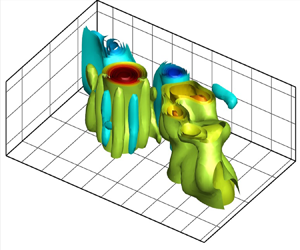
Fluid–structure–surface interaction of a flexibly mounted pitching and plunging flat plate in proximity to the free surface
-
- Journal:
- Journal of Fluid Mechanics / Volume 984 / 10 April 2024
- Published online by Cambridge University Press:
- 11 April 2024, A62
-
- Article
- Export citation
-
This experimental study investigates the fluid–structure–surface interactions of a flexibly mounted rigid plate in axial flow, focusing on flow-induced vibration (FIV) response and vortex dynamics of the system within a reduced velocity range of $U^*=0.29\unicode{x2013}8.73$, corresponding to a Reynolds number range of $Re=518\unicode{x2013}15\,331$. The plate, with one and two degrees of freedom (DoFs) for pitching and plunging oscillations, is examined at various submerged heights near the free surface. Results show that the plate exhibits divergence instability at low reduced velocities in both 1DoF and 2DoF systems. As the flow velocity surpasses a critical reduced velocity, periodic limit-cycle oscillations (LCOs) occur, increasing in amplitude until a second critical reduced velocity is reached. Beyond this point, LCOs are suppressed, and the plate experiences an increased static divergence angle with further flow velocity increase. The proximity to the free surface significantly influences the FIV response, with decreasing submerged heights leading to reduced LCO amplitudes and a shift of instabilities to higher reduced velocities. Vortex dynamics are analysed using time-resolved volumetric particle tracking velocimetry and hydrogen bubble flow visualisation. The analysis reveals disruptions in the symmetric flow field near the free surface, causing elongation and fragmentation of vortices in the wake of the plate, as well as vortex coupling. Proper orthogonal decomposition (POD) identifies dominant coherent structures, including leading-edge and trailing-edge vortices, captured in the first and second paired modes. On the other hand, higher POD modes capture the interaction of vortices in the wake and near the free surface.
