To save content items to your account,
please confirm that you agree to abide by our usage policies.
If this is the first time you use this feature, you will be asked to authorise Cambridge Core to connect with your account.
Find out more about saving content to .
To save content items to your Kindle, first ensure no-reply@cambridge.org
is added to your Approved Personal Document E-mail List under your Personal Document Settings
on the Manage Your Content and Devices page of your Amazon account. Then enter the ‘name’ part
of your Kindle email address below.
Find out more about saving to your Kindle.
Note you can select to save to either the @free.kindle.com or @kindle.com variations.
‘@free.kindle.com’ emails are free but can only be saved to your device when it is connected to wi-fi.
‘@kindle.com’ emails can be delivered even when you are not connected to wi-fi, but note that service fees apply.
Chapter 4 focuses on separated flows that occur in a variety of applications involving external flows, particularly related to aircraft, and internal flows, such as within turbomachines. Flow separation results when the flow does not have sufficient momentum to overcome an adverse pressure gradient, or when viscous dissipation occurs along the flow path. It is almost always associated with some form of aerodynamic penalty, including a loss of lift, an increase in drag, a loss of pressure recovery, and an increase in entropy. This chapter presents both passive and active methods to control these adverse effects.
Chapter 7 deals with 3-D laminar boundary-layer instabilities and their control. It covers the full range of Mach numbers from incompressible to hypersonic. A practical example of a 3-D boundary layer is the flow over a swept wing, which is susceptible to four types of instabilities that can lead to turbulence onset. Of these, cross-flow instability is the most dominant and therefore the most studied 3-D boundary-layer instability mechanism. A fundamental understanding of the instability has led to methods of control that have been successfully demonstrated at incompressible to hypersonic Mach numbers. These and other methods of control are presented.
Thoroughly revised and expanded, the new edition of this established textbook equips readers with a robust and practical understanding of experimental fluid mechanics. Enhanced features include improved support for students with emphasis on pedagogical instruction and self-learning, end-of-chapter summaries, 127 examples, 165 problems, refined illustrations, as well as new coverage of techniques in digital photography, frequency analysis of signals and the measurement of forces. It describes comprehensively classical and modern methods for flow visualisation and measuring flow rate, pressure, velocity, temperature, concentration, forces and wall shear stress, alongside supporting material on system response, measurement uncertainty, signal analysis, data analysis, optics, laboratory apparatus and laboratory practice. With enhanced instructor resources, including lecture slides, additional problems, laboratory support materials and online solutions, this is the ideal textbook for senior undergraduate and graduate students studying experimental fluid mechanics and is also suitable for an introductory measurements laboratory. Moreover, it is a valuable resource for practising engineers and scientists in this area.
Chapter 2 provides background on the types of flow sensors and actuators that are frequently used in fluid dynamics. The sensors are used to measure the mean (basic) flow that determines the relevant fluid instabilities. In addition, the sensors are used to document the flow conditions before and after flow control. Both passive and active flow control actuators are presented. These are demonstrated for different flow fields in subsequent chapters.
The Internet of Things (IoT) and wearable computing are crucial elements of modern information systems and applications in which advanced features for user interactivity and monitoring are required. However, in the fields of pervasive gaming, IoT has had limited real-world applications. In this work, we present a prototype of a wearable platform for pervasive games that combines IoT with wearable computing to enable the real-time monitoring of physical activity. The main objective of the solution is to promote the utilization of gamification techniques to enhance the physical activity of users through challenges and quests. This aims to create a symbolic link between the virtual gameplay and the real-world environment without the requirement of a smartphone. With the integration of sensors and wearable devices by design, the platform has the capability of real-time monitoring the users’ physical activity during the game. The system performance results highlight the efficiency and attractiveness of the wearable platform for gamifying physical activity.
This paper investigates the operational patterns and techniques of aerial fire fighting. It is demonstrated that manoeuvrability and endurance are the main characteristics when choosing air tactical aircraft; focus is on load capability for helicopters and air tankers. Water tank filling and deployment techniques are evaluated. Aircraft using pressure deployment systems are found to produce more uniform and heavy coverage in comparison with gravity systems. ADS-B open source data of flight operations and performance was collected. Operational patterns are found to be independent on the size of particular aircraft category (non-amphibious and amphibious air tanker, helicopter, air-tactical aircraft). Effectiveness and cost are modelled using the retardant dropped per operation and the average number of daily missions. The largest aircraft, Type-I helicopters and very large air tankers (VLAT) are found to be the most effective water- and retardant-dropping aircraft. The best cost-to-litre-dropped ratio for water-dropping aircraft is attributed to Type-III helicopters and amphibious Type-III aircraft; for retardant-dropping aircraft, VLAT are most effective. To maximise fire fighting effectiveness, Type-I helicopters and VLAT should be used as far as possible, with pressure deployment systems.
Chapter 10 considers a broad approach in which the application geometry that dictates the flow field is designed from the beginning, to enhance flow control. Examples include airfoil lift control without moving surfaces. This chapter presents a number of approaches. These range from a simple modification of a geometry to rigorous approaches that utilize an adjoint formulation of the Navier–Stokes equations that identifies sensitivity to changes in geometry and seeks those that maximize flow control authority.
Thoroughly revised and expanded, the new edition of this established textbook equips readers with a robust and practical understanding of experimental fluid mechanics. Enhanced features include improved support for students with emphasis on pedagogical instruction and self-learning, end-of-chapter summaries, 127 examples, 165 problems, refined illustrations, as well as new coverage of techniques in digital photography, frequency analysis of signals and the measurement of forces. It describes comprehensively classical and modern methods for flow visualisation and measuring flow rate, pressure, velocity, temperature, concentration, forces and wall shear stress, alongside supporting material on system response, measurement uncertainty, signal analysis, data analysis, optics, laboratory apparatus and laboratory practice. With enhanced instructor resources, including lecture slides, additional problems, laboratory support materials and online solutions, this is the ideal textbook for senior undergraduate and graduate students studying experimental fluid mechanics and is also suitable for an introductory measurements laboratory. Moreover, it is a valuable resource for practising engineers and scientists in this area.
This paper presents a two-dimensional (2D) metasurface antenna array composed of mushroom cells coupled by thin slots in the top metallization. The antenna is fed through power dividers designed in substrate-integrated waveguide technology. The antenna structure is therefore designed in a fully up-to-date integrated version. The array shows beam steering in the azimuthal plane controlled by signal amplitudes fed into particular ports at the edges of the matrix. The main advantage of this antenna is no need to use phase shifters applied in standard 2D antenna arrays. Two antenna versions have been designed, fabricated, and experimentally tested. The beam can be steered within 360° (90°) in azimuth. The steering of the beam in elevation from backward to forward directions within 40° is done by changing frequency from 21 up to 23.8 GHz. This interval is reduced to 30° by exciting the antenna simultaneously at two adjacent ports at the same amplitude.
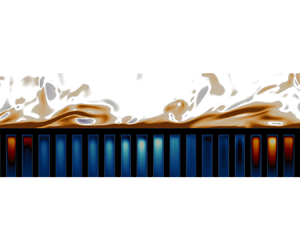
Turbulent flows over porous lattices consisting of rectangular cuboid pores are investigated using scale-resolving direct numerical simulations. Beyond a certain threshold which is primarily determined by the wall-normal Darcy permeability, ${{\mathsf{K}}_y}$, near-wall turbulence transitions from its canonical regime, marked by the presence of streak-like structures, to another marked by the presence of Kelvin–Helmholtz-like (K–H-like) spanwise-coherent structures. The threshold agrees well with that previously established in studies where permeable-wall boundary conditions had been used as surrogates for a porous substrate (Gómez-de Segura & García-Mayoral, J. Fluid Mech., vol. 875, 2019, pp. 124–172). In the smooth-wall-like regime, none of the investigated substrates demonstrate any reduction in drag relative to a smooth-wall flow. At the permeable surface, a notable component of the flow is that which adheres to the pore geometry and undergoes modulation by the turbulent scales of motions due to the interaction mechanism described by Abderrahaman-Elena et al. (J. Fluid Mech., vol. 865, 2019, pp. 1042–1071). Its resulting effect can be quantified in terms of an amplitude modulation (AM) using the approach of Mathis et al. (J. Fluid Mech., vol. 628, 2009, pp. 311–337). This pore-coherent flow component persists throughout the porous substrate, highlighting the importance of a given substrate's microstructure in the presence of an overlying turbulent flow. This geometry-related aspect of the flow is not accounted for when continuum-based models for a porous medium or effective representations of them, such as wall boundary conditions, are used. The intensity of the AM effect is enhanced in the K–H-like regime and becomes strengthened with larger permeability. As a result, structured porous materials may be designed to exploit or mitigate these flow features depending upon the intended application.
Thoroughly revised and expanded, the new edition of this established textbook equips readers with a robust and practical understanding of experimental fluid mechanics. Enhanced features include improved support for students with emphasis on pedagogical instruction and self-learning, end-of-chapter summaries, 127 examples, 165 problems, refined illustrations, as well as new coverage of techniques in digital photography, frequency analysis of signals and the measurement of forces. It describes comprehensively classical and modern methods for flow visualisation and measuring flow rate, pressure, velocity, temperature, concentration, forces and wall shear stress, alongside supporting material on system response, measurement uncertainty, signal analysis, data analysis, optics, laboratory apparatus and laboratory practice. With enhanced instructor resources, including lecture slides, additional problems, laboratory support materials and online solutions, this is the ideal textbook for senior undergraduate and graduate students studying experimental fluid mechanics and is also suitable for an introductory measurements laboratory. Moreover, it is a valuable resource for practising engineers and scientists in this area.
Chapter 8 focuses on turbulent boundary layers. This considers a proposed autonomous cycle for turbulence production that results from an instability of a distorted mean flow near the wall surface that is produced by a spanwise array of coherent longitudinal vortices whose spacing scales with the viscous shear stress. The instability results in a lift-up and break-up of the longitudinal vortices that are linked to increased turbulence production and increased viscous drag. This and other mechanisms of turbulence production and viscous drag generation are presented. Methods of flow control that key on these specific mechanisms are presented along with significant results.
Compressible anisothermal flows, which are commonly found in industrial settings such as combustion chambers and heat exchangers, are characterized by significant variations in density, viscosity, and heat conductivity with temperature. These variations lead to a strong interaction between the temperature and velocity fields that impacts the near-wall profiles of both quantities. Wall-modeled large-eddy simulations (LESs) rely on a wall model to provide a boundary condition, for example, the shear stress and the heat flux that accurately represents this interaction despite the use of coarse cells near the wall, and thereby achieve a good balance between computational cost and accuracy. In this article, the use of graph neural networks for wall modeling in LES is assessed for compressible anisothermal flow. Graph neural networks are a type of machine learning model that can learn from data and operate directly on complex unstructured meshes. Previous work has shown the effectiveness of graph neural network wall modeling for isothermal incompressible flows. This article develops the graph neural network architecture and training to extend their applicability to compressible anisothermal flows. The model is trained and tested a priori using a database of both incompressible isothermal and compressible anisothermal flows. The model is finally tested a posteriori for the wall-modeled LES of a channel flow and a turbine blade, both of which were not seen during training.
Aiming at alleviating the adverse influence of coupling unmodeled dynamics, actuator faults and external disturbances in the attitude tracking control system of tilt tri-rotor unmanned aerial vehicle (UAVs), a neural network (NN)-based robust adaptive super-twisting sliding mode fault-tolerant control scheme is designed in this paper. Firstly, in order to suppress the unmodeled dynamics coupled with the system states, a dynamic auxiliary signal, exponentially input-to-state practically stability and some special mathematical tools are used. Secondly, benefiting from adaptive control and super-twisting sliding mode control (STSMC), the influence of the unexpected chattering phenomenon of sliding mode control (SMC) and the unknown system parameters can be handled well. Moreover, NNs are employed to estimate and compensate some unknown nonlinear terms decomposed from the system model. Based on a decomposed quadratic Lyapunov function, both the bounded convergence of all signals of the closed-loop system and the stability of the system are proved. Numerical simulations are conducted to demonstrate the effectiveness of the proposed control method for the tilt tri-rotor UAVs.
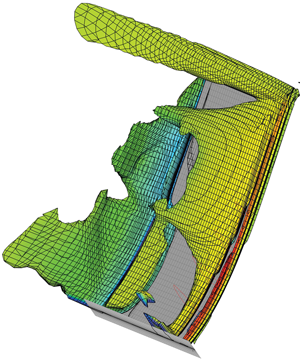
This work is a numerical and experimental study of a rectangular thin plate undergoing stall flutter at Mach 0.8. This constitutes one of the first studies of this kind where three-dimensionality is fully implemented in a numerical simulation including the test-section effects characterizing wind-tunnel experiments. In order to break down the fluid–structure interaction to its main driving phenomena, an aerodynamic model is proposed that is based on computationally inexpensive steady-state simulations. Two types of dynamic instability are observed in the numerical simulations; Flutter by mode coalescence is promoted at zero flow incidence, however, high bending precludes this from happening for higher values of angle of attack. Stall flutter is instead a nonlinear one-degree type of instability. Both of these instability mechanisms can be explained in terms of hysteretic behaviour of the pressure distribution, which becomes more pronounced at high angles of attack, when a large separation region is formed. Tests were conducted employing titanium alloy plates in order to survive the aerodynamic loads characterizing the wind-tunnel initial transient. However, due to wall interference, high bending was promoted so that the internal stress exceeded the yield values before flutter could be measured. Numerical simulations were in general agreement with the experiment in terms of both amplitude and oscillation frequency.