Refine search
Actions for selected content:
212937 results in Engineering
Enhanced recovery caused by nonlinear dynamics in the wake of a floating offshore wind turbine
-
- Journal:
- Journal of Fluid Mechanics / Volume 984 / 10 April 2024
- Published online by Cambridge University Press:
- 16 April 2024, A66
-
- Article
-
- You have access
- Open access
- HTML
- Export citation
-
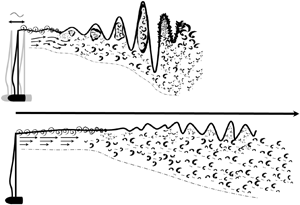
An experimental study in a wind tunnel is presented to explore the wake of a floating wind turbine subjected to harmonic side-to-side and fore–aft motions under laminar inflow conditions. The wake recovery is analysed as a function of the frequency of motion $f_p$, expressed by the rotor-based Strouhal number, $St = f_p D / U_{\infty }$ ( $D$ is the rotor diameter, $U_{\infty }$ the inflow wind speed). Our findings indicate that both directions of motion accelerate the transition to the far-wake compared with the fixed turbine. The experimental outcomes confirm the computational fluid dynamics results of Li et al. (J. Fluid Mech., vol. 934, 2022, p. A29) showing that sideways motions lead to faster wake recovery, especially for $St \in [0.2, 0.6]$. Additionally, we find that fore–aft motions also lead to better recovery for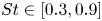 $St \in [0.3, 0.9]$. The recovery is closely linked to nonlinear spatiotemporal dynamics found in the shear layer region of the wake. For both directions of motion and $St \in [0.2, 0.55]$, the noisy wake dynamics lock in to the frequency of the motion. In this synchronised-like state, sideways motions result in large coherent structures of meandering, and fore–aft movements induce coherent pulsing of the wake. For fore–aft motion and $St \in [0.55, 0.9]$, the wake shows a more complex quasiperiodic dynamic, namely, a self-generated meandering mode emerges, which interacts nonlinearly with the excitation frequency $St$, as evidenced by the occurrence of mixing components. The coherent structures grow nonlinearly, enhance wake mixing and accelerate the transition to the far-wake, which, once reached, exhibits universal behaviour.


Mechanism for axial pattern formation of concentrated suspension in a horizontal rotating cylinder
-
- Journal:
- Journal of Fluid Mechanics / Volume 985 / 25 April 2024
- Published online by Cambridge University Press:
- 16 April 2024, A8
-
- Article
-
- You have access
- Open access
- HTML
- Export citation
-
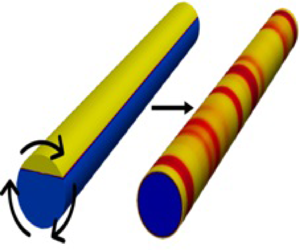
We have performed numerical simulations to investigate the phenomenon of axial pattern formation exhibited by a non-neutrally buoyant concentrated suspension. Continuum modelling of the concentrated suspension is done using the suspension balance model to identify the underlying mechanism of the phenomenon. We demonstrate that axial concentration variations become amplified to axial bands owing to the influence of the second normal stress difference ( $N_2$), and the first normal difference ( $N_1$) accentuates the effect of $N_2$. We demonstrate that the end walls of the rotating cylinder are necessary to prevent the smearing out of axial bands but are not a direct cause of the phenomenon.


Langmuir turbulence in suspended kelp farms
-
- Journal:
- Journal of Fluid Mechanics / Volume 985 / 25 April 2024
- Published online by Cambridge University Press:
- 16 April 2024, A11
-
- Article
-
- You have access
- Open access
- HTML
- Export citation
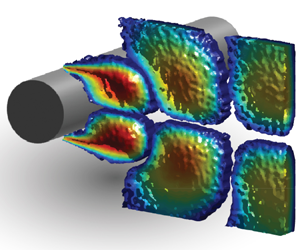
Cylinder flow and noise control by active base blowing
-
- Journal:
- Journal of Fluid Mechanics / Volume 985 / 25 April 2024
- Published online by Cambridge University Press:
- 16 April 2024, A10
-
- Article
- Export citation
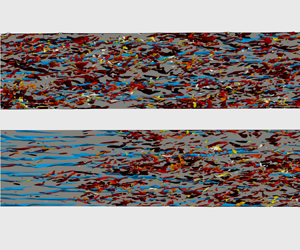
Interplay of scales during the spatial evolution of energy-containing motions in wall-bounded turbulent flows
-
- Journal:
- Journal of Fluid Mechanics / Volume 985 / 25 April 2024
- Published online by Cambridge University Press:
- 16 April 2024, A6
-
- Article
-
- You have access
- Open access
- HTML
- Export citation
-
This article extends the previous investigation of the spatial evolution of energy-containing motions in wall-bounded turbulent flows (Kannadasan et al., J. Fluid Mech., vol. 955, 2023, R1) by examining their scale-interactions through spectral analysis based on the spanwise scale decomposition of turbulent kinetic energy and the Reynolds stress transport equation. The energy-containing motions located at the inflow of a turbulent channel flow are artificially removed and the interscale transport mechanisms involved in their spatial evolution are studied. This scale interaction analysis reveals the presence of a significant inverse transfer of streamwise Reynolds stress from the near-wall streaks to larger scales in the spatial evolution of energy-containing motions. This transfer is due to the spanwise variation of streamwise velocity fluctuations, represented by $\partial u'/\partial z$, which is the primary mechanism of streak instability. The analysis presented in this study also shows that the inverse cascade of spanwise energy may correspond to the regeneration of streamwise vortices in the process of reactivating the self-sustaining mechanism in the spatial evolution of energy-containing motions.

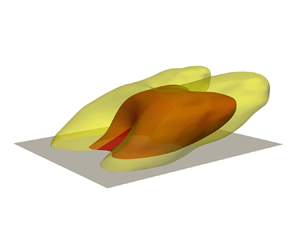
The structure of turbulence in unsteady flow over urban canopies
-
- Journal:
- Journal of Fluid Mechanics / Volume 985 / 25 April 2024
- Published online by Cambridge University Press:
- 16 April 2024, A5
-
- Article
-
- You have access
- Open access
- HTML
- Export citation
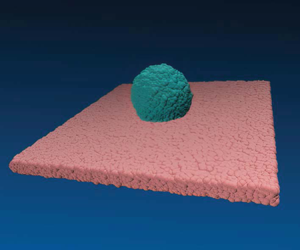
Characterization of partial wetting by CMAS droplets using multiphase many-body dissipative particle dynamics and data-driven discovery based on PINNs
-
- Journal:
- Journal of Fluid Mechanics / Volume 985 / 25 April 2024
- Published online by Cambridge University Press:
- 16 April 2024, A7
-
- Article
-
- You have access
- Open access
- HTML
- Export citation
On the dynamics and wakes of a freely settling Platonic polyhedron in a quiescent Newtonian fluid
-
- Journal:
- Journal of Fluid Mechanics / Volume 985 / 25 April 2024
- Published online by Cambridge University Press:
- 15 April 2024, A3
-
- Article
-
- You have access
- Open access
- HTML
- Export citation
-
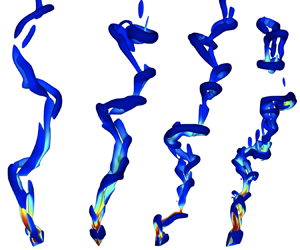
We investigate systematically the free settling of a single Platonic polyhedron in an unbounded domain filled with an otherwise quiescent Newtonian fluid. We consider a particle–fluid density mimicking a rock in water. Five Platonic polyhedrons of increasing sphericity are studied for a range of Galileo numbers $10 \leqslant \mathcal {G}a \leqslant 300$. We construct a regime map in the parameter space of Galileo number and particle volume fraction ( $\mathcal {G}a, \phi$), highlighting how the angularity of the Platonic polyhedron impacts its settling path and the onset of instabilities. We find that the initial angular position solely affects the transient settling process. All the Platonic polyhedrons maintain a stable settling angular position at low $\mathcal {G}a$. Higher angularity leads to path unsteadiness at lower $\mathcal {G}a$. Path instability progresses from steady vertical to unsteady vertical, followed by oblique settling observed for highly spherical particles, but helical settling (HS) for more angular particles. The particle autorotation is found to be the pivotal factor influencing path instability and the regime transition of angular particles. Beginning in the unsteady oblique and helical regimes, particle autorotation becomes more prevalent, escalating further in the chaotic regime as $\mathcal {G}a$ increases. The particle angular velocity vector is shown to be predominantly situated in the horizontal plane. A thorough force balance in the horizontal plane reveals that the Magnus force is the primary driving force of the HS regime. Additionally, we establish two new empirical correlations to predict the particle settling velocity and the disturbed wake length that solely require the physical properties of the system ( $\mathcal {G}a$ and $\phi$). Our numerical results suggest that an increase of the density ratio from $2$ to $3$ exerts only a marginal impact on the path instability of the most angular particle, the settling tetrahedron.


PDF-5+: a comprehensive Powder Diffraction File™ for materials characterization
-
- Journal:
- Powder Diffraction / Volume 39 / Issue 2 / June 2024
- Published online by Cambridge University Press:
- 15 April 2024, pp. 47-59
-
- Article
-
- You have access
- Open access
- HTML
- Export citation
Distributed digital twins for health monitoring: resource constrained aero-engine fleet management
- Part of
-
- Journal:
- The Aeronautical Journal / Volume 128 / Issue 1325 / July 2024
- Published online by Cambridge University Press:
- 15 April 2024, pp. 1556-1575
-
- Article
-
- You have access
- Open access
- HTML
- Export citation
Aeroacoustics of a ducted fan ingesting an adverse pressure gradient boundary layer
-
- Journal:
- Journal of Fluid Mechanics / Volume 985 / 25 April 2024
- Published online by Cambridge University Press:
- 15 April 2024, R1
-
- Article
-
- You have access
- Open access
- HTML
- Export citation
Low-order modelling of three-dimensional surface waves in liquid film flow on a rotating disk
-
- Journal:
- Journal of Fluid Mechanics / Volume 985 / 25 April 2024
- Published online by Cambridge University Press:
- 15 April 2024, A4
-
- Article
-
- You have access
- Open access
- HTML
- Export citation
Simulating the rheology of dense suspensions using pairwise formulation of contact, lubrication and Brownian forces
-
- Journal:
- Journal of Fluid Mechanics / Volume 984 / 10 April 2024
- Published online by Cambridge University Press:
- 15 April 2024, A67
-
- Article
-
- You have access
- Open access
- HTML
- Export citation
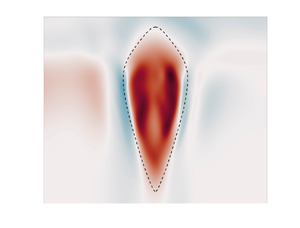
Stable three-dimensional vortex families consistent with Jovian observations including the Great Red Spot
-
- Journal:
- Journal of Fluid Mechanics / Volume 984 / 10 April 2024
- Published online by Cambridge University Press:
- 12 April 2024, A61
-
- Article
-
- You have access
- Open access
- HTML
- Export citation
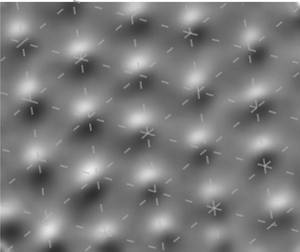
Emergence of a hexagonal pattern in shear-thickening suspensions under orbital oscillations
-
- Journal:
- Journal of Fluid Mechanics / Volume 984 / 10 April 2024
- Published online by Cambridge University Press:
- 12 April 2024, A69
-
- Article
- Export citation
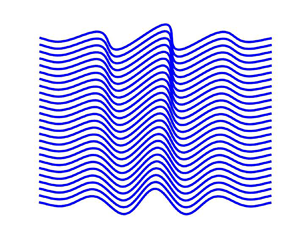
Evolution of wind-induced wave groups in water of finite depth
-
- Journal:
- Journal of Fluid Mechanics / Volume 985 / 25 April 2024
- Published online by Cambridge University Press:
- 12 April 2024, A2
-
- Article
- Export citation
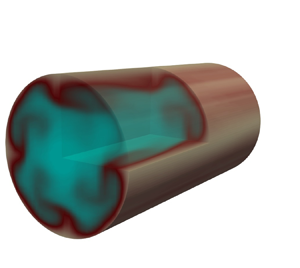
Data-driven state-space and Koopman operator models of coherent state dynamics on invariant manifolds
-
- Journal:
- Journal of Fluid Mechanics / Volume 984 / 10 April 2024
- Published online by Cambridge University Press:
- 12 April 2024, R9
-
- Article
-
- You have access
- Open access
- HTML
- Export citation
-
The accurate simulation of complex dynamics in fluid flows demands a substantial number of degrees of freedom, i.e. a high-dimensional state space. Nevertheless, the swift attenuation of small-scale perturbations due to viscous diffusion permits in principle the representation of these flows using a significantly reduced dimensionality. Over time, the dynamics of such flows evolves towards a finite-dimensional invariant manifold. Using only data from direct numerical simulations, in the present work we identify the manifold and determine evolution equations for the dynamics on it. We use an advanced autoencoder framework to automatically estimate the intrinsic dimension of the manifold and provide an orthogonal coordinate system. Then, we learn the dynamics by determining an equation on the manifold by using both a function-space approach (approximating the Koopman operator) and a state-space approach (approximating the vector field on the manifold). We apply this method to exact coherent states for Kolmogorov flow and minimal flow unit pipe flow. Fully resolved simulations for these cases require $O(10^3)$ and $O(10^5)$ degrees of freedom, respectively, and we build models with two or three degrees of freedom that faithfully capture the dynamics of these flows. For these examples, both the state-space and function-space time evaluations provide highly accurate predictions of the long-time dynamics in manifold coordinates.


Inertial coalescence of drops with some viscosity
-
- Journal:
- Journal of Fluid Mechanics / Volume 984 / 10 April 2024
- Published online by Cambridge University Press:
- 12 April 2024, A77
-
- Article
-
- You have access
- Open access
- HTML
- Export citation
-
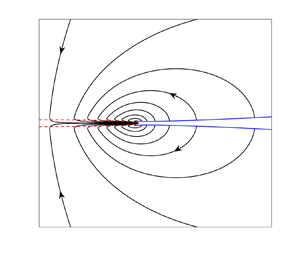
When two fluid drops touch, they coalesce due to surface tension. At early times, there is only a relatively small fluid bridge joining the drops. An asymptotic solution is presented for an inertial regime of early-time coalescence, in which inertial forces balance surface tension at leading order. It is demonstrated that viscosity nevertheless has a leading-order effect. Radial momentum is created at the tightly curved edge of the fluid bridge by the net force $2\gamma$ (per unit length) due to surface tension. This momentum is left behind the radially expanding bridge edge in a thin viscous wake. The divergent volume flux in the wake entrains fluid from above and below the bridge, and drives an inviscid irrotational flow in the drops on the scale of the bridge radius. This flow widens the gap between the drops ahead of the bridge, and the larger gap width results in a lower rate of coalescence. Including viscosity in this way improves the agreement between theory and the available experimental and numerical data.

Electromagnetically driven flow in unsupported electrolyte layers: lubrication theory and linear stability of annular flow
-
- Journal:
- Journal of Fluid Mechanics / Volume 984 / 10 April 2024
- Published online by Cambridge University Press:
- 12 April 2024, A75
-
- Article
-
- You have access
- Open access
- HTML
- Export citation
A comprehensive study on the roles of viscosity and heat conduction in shock waves
-
- Journal:
- Journal of Fluid Mechanics / Volume 984 / 10 April 2024
- Published online by Cambridge University Press:
- 12 April 2024, A74
-
- Article
- Export citation
