Refine search
Actions for selected content:
212937 results in Engineering
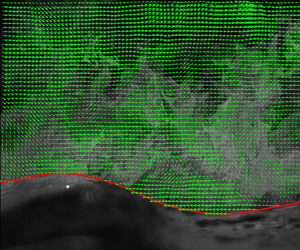
Turbulence over young wind waves dominated by capillaries and micro-breakers
-
- Journal:
- Journal of Fluid Mechanics / Volume 985 / 25 April 2024
- Published online by Cambridge University Press:
- 19 April 2024, A22
-
- Article
-
- You have access
- Open access
- HTML
- Export citation
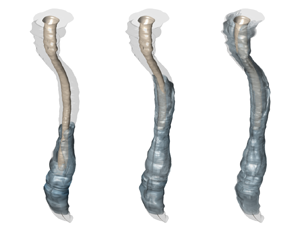
Effects of buoyancy on the dispersion of drugs released intrathecally in the spinal canal
-
- Journal:
- Journal of Fluid Mechanics / Volume 985 / 25 April 2024
- Published online by Cambridge University Press:
- 19 April 2024, A20
-
- Article
-
- You have access
- Open access
- HTML
- Export citation
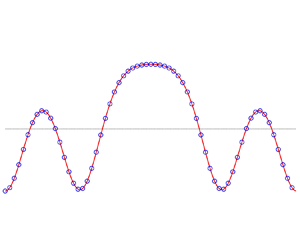
Steady water waves with arbitrary surface pressure: their recovery from bottom-pressure measurements
-
- Journal:
- Journal of Fluid Mechanics / Volume 985 / 25 April 2024
- Published online by Cambridge University Press:
- 19 April 2024, R2
-
- Article
- Export citation
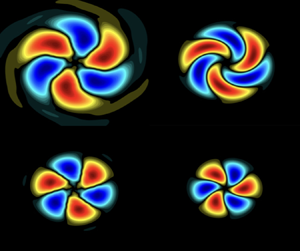
The effect of flight on a turbulent jet: coherent structure eduction and resolvent analysis
-
- Journal:
- Journal of Fluid Mechanics / Volume 985 / 25 April 2024
- Published online by Cambridge University Press:
- 19 April 2024, A21
-
- Article
- Export citation
Prediction of wrinkle patterns in tensioned thin-film structures containing rigid elements
-
- Journal:
- The Aeronautical Journal / Volume 128 / Issue 1327 / September 2024
- Published online by Cambridge University Press:
- 19 April 2024, pp. 1924-1934
-
- Article
- Export citation
Propagation of a viscous gravity current beneath a granular mush
-
- Journal:
- Journal of Fluid Mechanics / Volume 985 / 25 April 2024
- Published online by Cambridge University Press:
- 18 April 2024, A18
-
- Article
-
- You have access
- Open access
- HTML
- Export citation
-
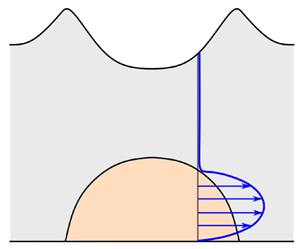
The two-dimensional gravity-driven motion of a relatively dense viscous liquid at the base of a granular mush is investigated using a model that exploits the relative shallowness of the flow. The granular mush obeys a $\mu (I)$-rheology, and we assume that the two phases are segregated throughout the motion. The viscous liquid spreads under gravity, carrying the granular mush above and transporting it outwards as levees at either end of the flow. The accumulation of granular material away from the centre of the deposit produces hydrostatic pressure gradients that retard the viscous gravity current. At later times, the granular mush is quasi-static relative to the moving liquid owing to the balance of outward granular transfer by the liquid and inward hydrostatic pressure gradients associated with the granular free surface. The viscous liquid exhibits a Poiseuille-like flow structure with negligible velocity at both the base and the granular interface. The flow of a fixed volume of viscous liquid becomes self-similar with the effective viscosity quadrupled relative to a classical viscous gravity current owing to the retarding effects of the granular mush. The case of constant input flux of viscous liquid is also analysed. The qualitative features are akin to the fixed volume case with the granular mush forming levees and slowing the viscous spreading. The case in which the upper medium is a Bingham material rather than a granular mush is also discussed, and the same features are observed, demonstrating the importance of the yield criterion in the upper medium.

Altering flight stability characteristics of a high-performance aircraft through wing strake modification
-
- Journal:
- The Aeronautical Journal / Volume 128 / Issue 1327 / September 2024
- Published online by Cambridge University Press:
- 18 April 2024, pp. 2105-2125
-
- Article
-
- You have access
- Open access
- HTML
- Export citation
Excitation and evolution of radiating modes in supersonic boundary layers. Part 1. Fundamental resonance with impinging sound waves
-
- Journal:
- Journal of Fluid Mechanics / Volume 985 / 25 April 2024
- Published online by Cambridge University Press:
- 18 April 2024, A13
-
- Article
-
- You have access
- Open access
- HTML
- Export citation
Excitation and evolution of radiating modes in supersonic boundary layers. Part 2. Back effect of spontaneously radiated Mach waves
-
- Journal:
- Journal of Fluid Mechanics / Volume 985 / 25 April 2024
- Published online by Cambridge University Press:
- 18 April 2024, A14
-
- Article
-
- You have access
- Open access
- HTML
- Export citation
Equilibrium distributions under advection–diffusion in laminar channel flow with partially absorbing boundaries
-
- Journal:
- Journal of Fluid Mechanics / Volume 985 / 25 April 2024
- Published online by Cambridge University Press:
- 18 April 2024, A16
-
- Article
-
- You have access
- Open access
- HTML
- Export citation
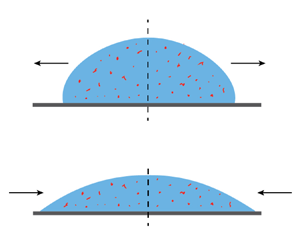
Viscoelastic wetting: Cox–Voinov theory with normal stress effects
-
- Journal:
- Journal of Fluid Mechanics / Volume 985 / 25 April 2024
- Published online by Cambridge University Press:
- 18 April 2024, A17
-
- Article
-
- You have access
- Open access
- HTML
- Export citation
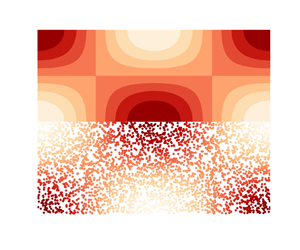
Dimensional homogeneity constrained gene expression programming for discovering governing equations
-
- Journal:
- Journal of Fluid Mechanics / Volume 985 / 25 April 2024
- Published online by Cambridge University Press:
- 18 April 2024, A12
-
- Article
- Export citation

Enhancing ASEAN's Role in Critical Mineral Supply Chains
-
- Published by:
- ISEAS–Yusof Ishak Institute
- Published online:
- 17 April 2024
- Print publication:
- 08 February 2024
SICL based Ka-band series SPDT switch for duplexer application
-
- Journal:
- International Journal of Microwave and Wireless Technologies / Volume 16 / Issue 8 / October 2024
- Published online by Cambridge University Press:
- 17 April 2024, pp. 1342-1348
-
- Article
- Export citation
-
This paper presents a Ka-band series single-pole double-throw (SPDT) switch circuit realized in substrate-integrated coaxial line (SICL) environment for time division duplex operation. It is designed with a low-cost printed circuit board (PCB) technique. The size of the proposed circuit is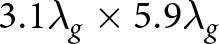 $3.1\lambda_{g} \times 5.9\lambda_{g}$, where λg is the guided wavelength at the center frequency of 27.75 GHz. In this circuit, a SICL-based SPDT switching circuit is proposed with radio frequency (RF) isolation network where the shunt connection of butterfly stubs is in an asymmetric stripline environment. The proposed circuit exhibits less than 2 dB insertion loss at 27–27.9 GHz and less than 2.5 dB insertion loss at 27–28.5 GHz. The design offers good impedance matching in the Transmit (Tx) and Receive (Rx) channels from the common Tx/Rx input channel, along with more than 24 dB isolation between ON and OFF state output channels. The proposed circuit is suitable for millimeter-wave communication systems.
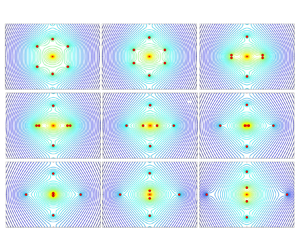
Interaction between a uniform current and a submerged cylinder in a marginal ice zone
-
- Journal:
- Journal of Fluid Mechanics / Volume 984 / 10 April 2024
- Published online by Cambridge University Press:
- 17 April 2024, A50
-
- Article
-
- You have access
- Open access
- HTML
- Export citation
FLM volume 984 Cover and Front matter
-
- Journal:
- Journal of Fluid Mechanics / Volume 984 / 10 April 2024
- Published online by Cambridge University Press:
- 17 April 2024, p. f1
-
- Article
-
- You have access
- Export citation

Warplane 06
- Convair B-58 Hustler
-
- Published by:
- Amsterdam University Press
- Published online:
- 16 April 2024
- Print publication:
- 14 November 2013
-
- Book
- Export citation
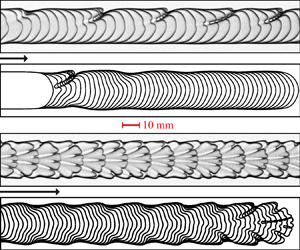
Peeling fingers in an elastic Hele-Shaw channel
-
- Journal:
- Journal of Fluid Mechanics / Volume 985 / 25 April 2024
- Published online by Cambridge University Press:
- 16 April 2024, A1
-
- Article
-
- You have access
- Open access
- HTML
- Export citation
-
Using experiments and a depth-averaged numerical model, we study instabilities of two-phase flows in a Hele-Shaw channel with an elastic upper boundary and a non-uniform cross-section prescribed by initial collapse. Experimentally, we find increasingly complex and unsteady modes of air-finger propagation as the dimensionless bubble speed $Ca$ and level of collapse are increased, including pointed fingers, indented fingers and the feathered modes first identified by Cuttle et al. (J. Fluid Mech., vol. 886, 2020, A20). By introducing a measure of the viscous contribution to finger propagation, we identify a $Ca$ threshold beyond which viscous forces are superseded by elastic effects. Quantitative prediction of this transition between ‘viscous’ and ‘elastic’ reopening regimes across levels of collapse establishes the fidelity of the numerical model. In the viscous regime, we recover the non-monotonic dependence on $Ca$ of the finger pressure, which is characteristic of benchtop models of airway reopening. To explore the elastic regime numerically, we extend the depth-averaged model introduced by Fontana et al. (J. Fluid Mech., vol. 916, 2021, A27) to include an artificial disjoining pressure that prevents the unphysical self-intersection of the interface. Using time simulations, we capture for the first time the majority of experimental finger dynamics, including feathered modes. We show that these disordered states evolve continually, with no evidence of convergence to steady or periodic states. We find that the steady bifurcation structure satisfactorily predicts the bubble pressure as a function of $Ca$, but that it does not provide sufficient information to predict the transition to unsteady dynamics that appears strongly nonlinear.


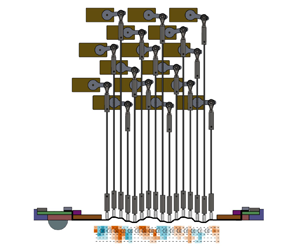
Reactive control of velocity fluctuations using an active deformable surface and real-time PIV
-
- Journal:
- Journal of Fluid Mechanics / Volume 985 / 25 April 2024
- Published online by Cambridge University Press:
- 16 April 2024, A9
-
- Article
-
- You have access
- Open access
- HTML
- Export citation
Aerodynamic characteristics of different configurations of mechanically deployable aerodynamic decelerator in subsonic region
-
- Journal:
- The Aeronautical Journal / Volume 128 / Issue 1327 / September 2024
- Published online by Cambridge University Press:
- 16 April 2024, pp. 2092-2104
-
- Article
- Export citation
