Refine search
Actions for selected content:
212937 results in Engineering
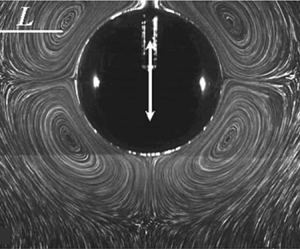
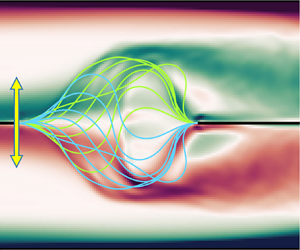
Large vortices from soft vibrations
-
- Journal:
- Journal of Fluid Mechanics / Volume 986 / 10 May 2024
- Published online by Cambridge University Press:
- 30 April 2024, F1
-
- Article
-
- You have access
- HTML
- Export citation
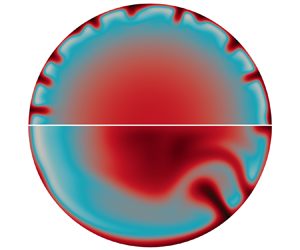
Thin film modelling of magnetic soap films
-
- Journal:
- Journal of Fluid Mechanics / Volume 986 / 10 May 2024
- Published online by Cambridge University Press:
- 30 April 2024, A7
-
- Article
-
- You have access
- Open access
- HTML
- Export citation
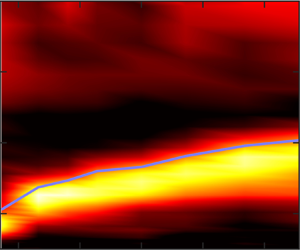
Statistical properties of neutrally and stably stratified boundary layers in response to an abrupt change in surface roughness
-
- Journal:
- Journal of Fluid Mechanics / Volume 986 / 10 May 2024
- Published online by Cambridge University Press:
- 30 April 2024, A4
-
- Article
-
- You have access
- Open access
- HTML
- Export citation
-
We conducted experimental investigations on the effect of stable thermal conditions on rough-wall boundary layers, with a specific focus on their response to abrupt increases in surface roughness. For stably stratified boundary layers, a new analytical relation between the skin-friction coefficient, $C_f$, and the displacement thickness was proposed. Following the sharp roughness change, the overshoot in $C_f$ is slightly enhanced in stably stratified layers when compared with that of neutral boundary layers. Regarding the velocity defect law, we found that the displacement thickness multiplied by $\sqrt{2/C_f}$, performs better than the boundary layer thickness alone when describing the similarity within internal boundary layers for both neutral and stable cases. A non-adjusted region located just beneath the upper edge of the internal boundary layer was observed, with large magnitudes of skewness and kurtosis of streamwise and wall-normal velocity fluctuations for both neutral and stable cases. At a fixed wall-normal location, the greater the thermal stratification, the greater the magnitudes of skewness and kurtosis. Quadrant analysis revealed that the non-adjusted region is characterised by an enhancement/reduction of ejection/sweep events, particularly for stably stratified boundary layers. Spatially, these ejections correspond well with peaks of kurtosis, exhibit stronger intensity and occur more frequently following the abrupt change in surface conditions.


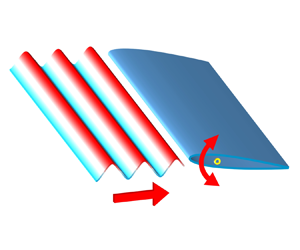
Combined Theodorsen and Sears theory: experimental validation and modification
-
- Journal:
- Journal of Fluid Mechanics / Volume 986 / 10 May 2024
- Published online by Cambridge University Press:
- 30 April 2024, A1
-
- Article
- Export citation
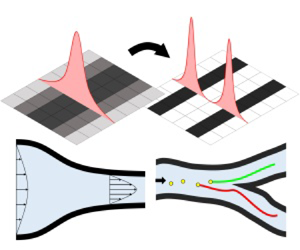
A new density filter for pipes for fluid topology optimization
-
- Journal:
- Journal of Fluid Mechanics / Volume 986 / 10 May 2024
- Published online by Cambridge University Press:
- 30 April 2024, A9
-
- Article
- Export citation
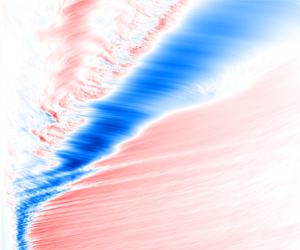
Direct numerical simulations of an airfoil undergoing dynamic stall at different background disturbance levels
-
- Journal:
- Journal of Fluid Mechanics / Volume 986 / 10 May 2024
- Published online by Cambridge University Press:
- 30 April 2024, A3
-
- Article
-
- You have access
- Open access
- HTML
- Export citation
-
Thin airfoil dynamic stall at moderate Reynolds numbers is typically linked to the sudden bursting of a small laminar separation bubble close to the leading edge. Given the strong sensitivity of laminar separation bubbles to external disturbances, the onset of dynamic stall on a NACA0009 airfoil section subject to different levels of low-amplitude free stream disturbances is investigated using direct numerical simulations. The flow is practically indistinguishable from clean inflow simulations in the literature for turbulence intensities at the leading edge of ${Tu} = 0.02\,\%$. At slightly higher turbulence intensities of ${Tu} = 0.05\,\%$, the bursting process is found to be considerably less smooth and strong coherent vortex shedding from the laminar separation bubble is observed prior to the formation of the dynamic stall vortex (DSV). This phenomenon is considered in more detail by analysing its appearance in an ensemble of simulations comprising statistically independent realisations of the flow, thus proving its statistical relevance. In order to extract the transient dynamics of the vortex shedding, the classical proper orthogonal decomposition method is generalised to include time in the energy measure and applied to the time-resolved simulation data of incipient dynamic stall. Using this technique, the dominant transient spatiotemporally correlated features are distilled and the wave train of the vortex shedding prior to the emergence of the main DSV is reconstructed from the flow data exhibiting dynamics of large-scale coherent growth and decay within the turbulent boundary layer.


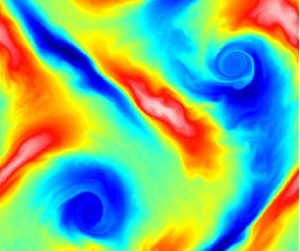
On the non-local nature of turbulent fluxes of passive scalars
-
- Journal:
- Journal of Fluid Mechanics / Volume 986 / 10 May 2024
- Published online by Cambridge University Press:
- 30 April 2024, A8
-
- Article
- Export citation
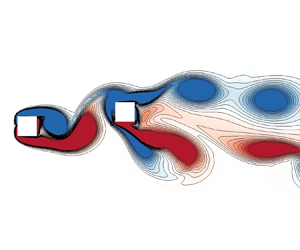
Flow-induced vibration of two tandem square cylinders at low Reynolds number: transitions among vortex-induced vibration, biased oscillation and galloping
-
- Journal:
- Journal of Fluid Mechanics / Volume 986 / 10 May 2024
- Published online by Cambridge University Press:
- 30 April 2024, A10
-
- Article
- Export citation
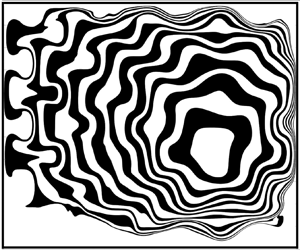
Confinement-induced drift in Marangoni-driven transport of surfactant: a Lagrangian perspective
-
- Journal:
- Journal of Fluid Mechanics / Volume 986 / 10 May 2024
- Published online by Cambridge University Press:
- 30 April 2024, A5
-
- Article
-
- You have access
- Open access
- HTML
- Export citation
-
Successive drops of coloured ink mixed with surfactant are deposited onto a thin film of water to create marbling patterns in the Japanese art technique of Suminagashi. To understand the physics behind this and other applications where surfactant transports adsorbed passive matter at gas–liquid interfaces, we investigate the Lagrangian trajectories of material particles on the surface of a thin film of a confined viscous liquid under Marangoni-driven spreading by an insoluble surfactant. We study a model problem in which several deposits of exogenous surfactant simultaneously spread on a bounded rectangular surface containing a pre-existing endogenous surfactant. We derive Eulerian and Lagrangian formulations of the equations governing the Marangoni-driven surface flow. Both descriptions show how confinement can induce drift and flow reversal during spreading. The Lagrangian formulation captures trajectories without the need to calculate surfactant concentrations; however, concentrations can still be inferred from the Jacobian of the map from initial to current particle position. We explore a link between thin-film surfactant dynamics and optimal transport theory to find the approximate equilibrium locations of material particles for any given initial condition by solving a Monge–Ampère equation. We find that as the endogenous surfactant concentration $\delta$ vanishes, the equilibrium shapes of deposits using the Monge–Ampère approximation approach polygons with corners curving in a self-similar manner over lengths scaling as $\delta ^{1/2}$. We explore how Suminagashi patterns may be produced by using computationally efficient successive solutions of the Monge–Ampère equation.


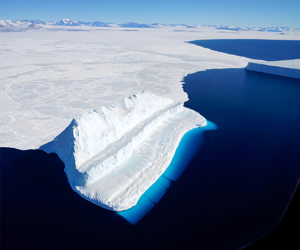
Boussinesq-type equations of hydroelastic waves in shallow water
-
- Journal:
- Journal of Fluid Mechanics / Volume 985 / 25 April 2024
- Published online by Cambridge University Press:
- 30 April 2024, A45
-
- Article
- Export citation
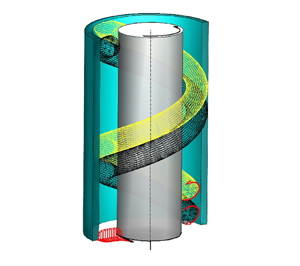
Axial friction coefficient of turbulent spiral Poiseuille flows
-
- Journal:
- Journal of Fluid Mechanics / Volume 986 / 10 May 2024
- Published online by Cambridge University Press:
- 30 April 2024, A6
-
- Article
-
- You have access
- Open access
- HTML
- Export citation
-
Direct numerical simulations of spiral Poiseuille flows in a narrow gap geometry are performed with the aim of identifying the mechanisms governing the dynamics of the axial friction coefficient. The investigation has explored a small portion of the Reynolds number–Taylor number phase space ( $600 \leq Re \leq 5766$ and $1500 \leq Ta \leq 5000$), for which reference experimental results are available. The study is focused on the mechanism leading to the enhancement of the axial friction coefficient with the Taylor number when the Reynolds number is kept constant. The analysis of the spatial distribution of the Reynolds stress tensor and of the turbulent energy budget has evidenced the key role of the pressure–strain correlation in the energy transfer from the azimuthal to the axial component. The latter eventually determines the increase of the axial friction coefficient through the enhanced radial mixing of axial momentum. Data have also shown that the flow dynamics is heavily dependent on the $Ta/Re$ ratio, and different regimes develop (ranging from laminar to turbulent), each with peculiar behaviours.

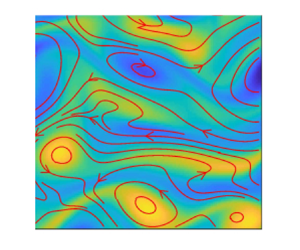
Large-scale patterns set the predictability limit of extreme events in Kolmogorov flow
-
- Journal:
- Journal of Fluid Mechanics / Volume 986 / 10 May 2024
- Published online by Cambridge University Press:
- 30 April 2024, A2
-
- Article
-
- You have access
- Open access
- HTML
- Export citation
-
Events of extreme intensity in turbulent flows from atmospheric to industrial scales have a strong social and economic impact, and hence there is a need to develop models and indicators which enable their early prediction. Part of the difficulty here stems from the intrinsic sensitivity to initial conditions of turbulent flows. Despite recent progress in understanding and predicting extreme events, the question of how far in advance they can be ideally predicted (without model error and subject only to uncertainty in the initial conditions) remains open. Here we study the predictability limit of extreme dissipation bursts in the two-dimensional Kolmogorov flow by applying information-theoretic measures to massive statistical ensembles with more than $10^7$ direct numerical simulations. We find that extreme events with similar intensity and structure can exhibit disparate predictability due to different causal origins. Specifically, we show that highly predictable extreme events evolve from distinct large-scale circulation patterns. We thus suggest that understanding all the possible routes to the formation of extreme events is necessary to assess their predictability.

Buckled elastic sheet as a vortex generator in dual channels
-
- Journal:
- Journal of Fluid Mechanics / Volume 985 / 25 April 2024
- Published online by Cambridge University Press:
- 29 April 2024, A39
-
- Article
- Export citation
-
This study presents a dual-channel vortex generator (VG) that leverages the snap-through behaviour of flexible sheets. The VG outperforms a similar-sized rigid VG in generating vortices within dual-channel flows while minimizing pressure loss. Numerical simulations using the immersed boundary-lattice Boltzmann method analyse the dynamics and vortex generation performance of the sheet under various system parameters. Two distinct modes are identified for the elastic sheet: a sustained snap-through mode (SSTM) and a dormant mode (DM). The sheet's mode is predominantly influenced by its length ratio (L*), bending stiffness $(K_b^\ast )$ and flow strength, with the mass ratio having a minimal impact. The sheet exhibiting regular SSTM can effectively generate vortices in both channels and the vortex generation performance can be conveniently tuned by altering the sheet's initial buckling (i.e. L*). An increase in $K_b^\ast $ results in a higher critical Reynolds number (Rec) required for mode transition. An increase in L*, however, initially raises Rec and then lowers it, suggesting an optimal length ratio (approximately 0.7 for our considered system) for minimizing the Rec necessary to trigger SSTM. Furthermore, a disparity in the flow strength between channels is found to suppress the snap-through of the sheet; a greater disparity, however, is permissible to induce the SSTM of more compliant sheets. These findings underscore the potential of snap-through behaviour for enhanced flow manipulation in dual-channel systems.


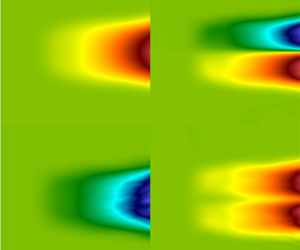
Non-locality of mean scalar transport in two-dimensional Rayleigh–Taylor instability using the macroscopic forcing method
-
- Journal:
- Journal of Fluid Mechanics / Volume 985 / 25 April 2024
- Published online by Cambridge University Press:
- 29 April 2024, A47
-
- Article
-
- You have access
- Open access
- HTML
- Export citation
Design and fabrication of optically transparent transmitarrays using inkjet-printing technology
-
- Journal:
- International Journal of Microwave and Wireless Technologies / Volume 16 / Issue 7 / September 2024
- Published online by Cambridge University Press:
- 29 April 2024, pp. 1162-1172
-
- Article
- Export citation
Compliant mechanism design of combined aircraft wing for stable separation
-
- Journal:
- The Aeronautical Journal / Volume 128 / Issue 1326 / August 2024
- Published online by Cambridge University Press:
- 29 April 2024, pp. 1665-1680
-
- Article
- Export citation
Artificial neural network for preliminary design and optimisation of civil aero-engine nacelles
-
- Journal:
- The Aeronautical Journal / Volume 128 / Issue 1328 / October 2024
- Published online by Cambridge University Press:
- 29 April 2024, pp. 2261-2280
-
- Article
-
- You have access
- Open access
- HTML
- Export citation
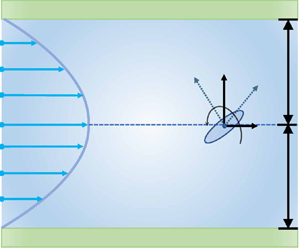
Migration of confined micro-swimmers subject to anisotropic diffusion
-
- Journal:
- Journal of Fluid Mechanics / Volume 985 / 25 April 2024
- Published online by Cambridge University Press:
- 29 April 2024, A44
-
- Article
- Export citation
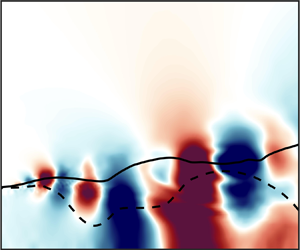
Spectral proper orthogonal decomposition of harmonically forced turbulent flows
-
- Journal:
- Journal of Fluid Mechanics / Volume 985 / 25 April 2024
- Published online by Cambridge University Press:
- 29 April 2024, A42
-
- Article
- Export citation
A fast-running physics-based wake model for a semi-infinite wind farm
-
- Journal:
- Journal of Fluid Mechanics / Volume 985 / 25 April 2024
- Published online by Cambridge University Press:
- 29 April 2024, A43
-
- Article
-
- You have access
- Open access
- HTML
- Export citation
