Refine search
Actions for selected content:
212937 results in Engineering
On the low-frequency flapping motion in flow separation
-
- Journal:
- Journal of Fluid Mechanics / Volume 984 / 10 April 2024
- Published online by Cambridge University Press:
- 12 April 2024, A76
-
- Article
- Export citation
Design, cultivation and acoustic analysis of a building-sized mycelium sculpture
-
- Journal:
- Research Directions: Biotechnology Design / Volume 2 / 2024
- Published online by Cambridge University Press:
- 12 April 2024, e4
-
- Article
-
- You have access
- Open access
- HTML
- Export citation
Turbulence induced by a swarm of rising bubbles from coarse-grained simulations
-
- Journal:
- Journal of Fluid Mechanics / Volume 984 / 10 April 2024
- Published online by Cambridge University Press:
- 12 April 2024, A68
-
- Article
- Export citation
-
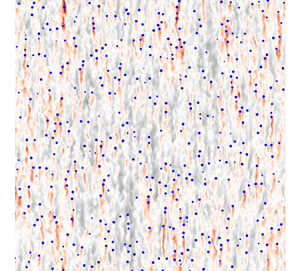
We performed numerical simulations of a homogeneous swarm of bubbles rising at large Reynolds number, $Re=760$, with volume fractions ranging from 1 % to 10 %. We consider a simplified model in which the interfaces are not resolved, but which allows us to simulate flows with a large number of bubbles and to emphasize the interactions between bubble wakes. The liquid phase is described by solving, on an Eulerian grid, the Navier–Stokes equations, including sources of momentum which model the effect of the bubbles. The dynamics of each bubble is determined within the Lagrangian framework by solving an equation of motion involving the hydrodynamic forces exerted by the fluid accounting for the correction of the fictitious self-interaction of a bubble with its own wake. The comparison with experiments shows that this coarse-grained simulations approach can reliably describe the dynamics of the resolved flow scales. We use conditional averaging to characterize the mean bubble wakes and obtain in particular the typical shear imposed by the rising bubbles. On the basis of the spectral decomposition of the energy budget, we observe that the flow is dominated by production at large scales and by dissipation at small scales and we rule out the presence of an intermediate range in which the production and dissipation are locally in balance. We propose that the $k^{-3}$ subrange of the energy spectra results from the mean shear rate imposed by the bubbles, which controls the rate of return to isotropy.


Different scenarios in sloshing flows near the critical filling depth
-
- Journal:
- Journal of Fluid Mechanics / Volume 984 / 10 April 2024
- Published online by Cambridge University Press:
- 12 April 2024, A73
-
- Article
-
- You have access
- Open access
- HTML
- Export citation
-
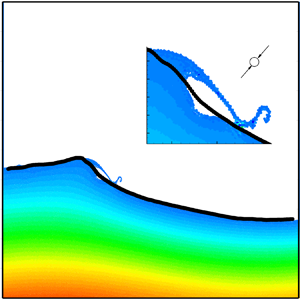
In the present paper, the sloshing flow in a cuboid tank forced to oscillate horizontally is investigated with both experimental and numerical approaches. The filling depth chosen is $h/L=0.35$ (with h the water depth and L the tank height), which is close to the critical depth. According to Tadjbakhsh & Keller (J. Fluid Mech., vol. 8, issue 3, 1960, pp. 442–451), as the depth passes through this critical value the response of the resonant sloshing dynamics changes from ‘hard spring’ to ‘soft spring’. The experimental tank has a thickness of $0.1L$, reducing three-dimensional effects. High-resolution digital camera and capacitance wave probes are used for time recording of the surface elevation. By varying the oscillation period and the amplitude of the motion imposed on the tank, different scenarios are identified in terms of free-surface evolution. Periodic and quasi-periodic regimes are found in most of the frequencies analysed but, among these, sub-harmonic regimes are also identified. Chaotic energetic regimes are found with motions of greater amplitude. Typical tools of dynamical systems, such as Fourier spectra and phase maps, are used for the regime identification, while the Hilbert–Huang transform is used for further insight into doubling-frequency and tripling-period bifurcations. For the numerical investigation, an advanced and well-established smoothed particle hydrodynamics method is used to aid the understanding of the physical phenomena involved and to extend the range of frequencies investigated experimentally.


The dynamics of fibres dispersed in viscoelastic turbulent flows
-
- Journal:
- Journal of Fluid Mechanics / Volume 984 / 10 April 2024
- Published online by Cambridge University Press:
- 12 April 2024, A72
-
- Article
-
- You have access
- Open access
- HTML
- Export citation
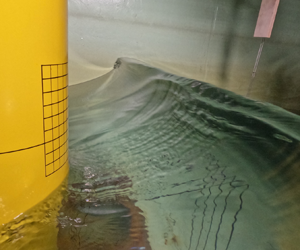
Wave front perturbation effect on the variability of monopile wave impact loads
-
- Journal:
- Journal of Fluid Mechanics / Volume 984 / 10 April 2024
- Published online by Cambridge University Press:
- 12 April 2024, A65
-
- Article
-
- You have access
- Open access
- HTML
- Export citation
-
The slamming wave force and pressure variabilities for monopile wave impacts are studied as functions of wave breaking shape and transverse perturbations on the breaking wave front. The impacting wave topology is characterized as slosh, flip-through, $\varOmega$, overturning and fully broken. Fifty test repetitions are conducted for each type of wave impact to assess the variability of force impulse, force and pressure. The results for the unperturbed cases show that the slamming force is highest among the nominal slosh, flip-through and $\varOmega$ tests, and that the slamming force variability is highest for the first two. We demonstrate that the slamming force and pressure variabilities decrease notably after selecting and regrouping the tests by similar crest heights and temporal slopes measured at an upstream wave gauge. The group representing $\varOmega$ wave impacts shows the largest mean slamming force and peak pressure, and their variability is the highest among all groups. Further, the effect of lateral perturbations on the pressure, force and impulse variabilities is investigated. Due to the perturbations, the slamming pressure variability for the wave impacts in which the wave front hits the monopile surface increases significantly. The variability of the slamming force is also increased for the perturbed impacts; however, it is smaller than the slamming pressure variability. The force impulse variability shows a low sensitivity to perturbations, and its magnitude is smaller than that of the force variability. Finally, the slamming pressure using fifteen pressure sensors for five selected events is studied. For these tests, oscillations at frequencies associated with structural or bubble oscillations are seen. Further, the air entertainment is documented through video recordings.


Departure from the statistical equilibrium of large scales in forced three-dimensional homogeneous isotropic turbulence
-
- Journal:
- Journal of Fluid Mechanics / Volume 984 / 10 April 2024
- Published online by Cambridge University Press:
- 12 April 2024, A71
-
- Article
- Export citation
-
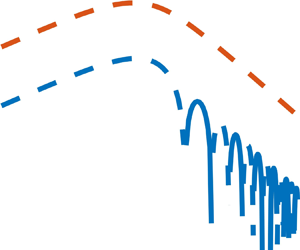
We study the statistically steady states of the forced dissipative three-dimensional homogeneous isotropic turbulence at scales larger than the forcing scale in real separation space. The probability density functions (p.d.f.s) of longitudinal velocity difference at large separations are close to, but deviate from, Gaussian, measured by their non-zero odd parts. The analytical expressions of the third-order longitudinal structure functions derived from the Kármán–Howarth–Monin equation prove that the odd-part p.d.f.s of velocity differences at large separations are small but non-zero. Specifically, when the forcing effect in the displacement space decays exponentially as the displacement tends to infinity, the odd-order longitudinal structure functions have a power-law decay with an exponent of $-$2, implying a significant coupling between large and small scales. Under the assumption that forcing controls the large-scale dynamics, we propose a conjugate regime to Kolmogorov's inertial range, independent of the forcing scale, to capture the odd parts of p.d.f.s. Thus, dynamics of large scales departs from the absolute equilibrium, and we can partially recover small-scale information without explicitly resolving small-scale dynamics. The departure from the statistical equilibrium is quantified and found to be viscosity-independent. Even though this departure is small, it is significant and should be considered when studying the large scales of the forced three-dimensional homogeneous isotropic turbulence.

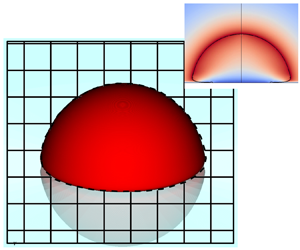
Direct numerical simulations of microlayer formation during heterogeneous bubble nucleation
-
- Journal:
- Journal of Fluid Mechanics / Volume 984 / 10 April 2024
- Published online by Cambridge University Press:
- 12 April 2024, A70
-
- Article
- Export citation
Preface
-
- Book:
- Flow Control
- Published online:
- 04 April 2024
- Print publication:
- 11 April 2024, pp xi-xiv
-
- Chapter
- Export citation
16 - Retrospection and Outlook
-
- Book:
- Measurement in Fluid Mechanics
- Published online:
- 25 April 2024
- Print publication:
- 11 April 2024, pp 595-598
-
- Chapter
- Export citation
Theory of small-scale self-focusing of spatially partially coherent beams and its implications for high-power laser systems
-
- Journal:
- High Power Laser Science and Engineering / Volume 12 / 2024
- Published online by Cambridge University Press:
- 11 April 2024, e31
-
- Article
-
- You have access
- Open access
- HTML
- Export citation
9 - Shock–Boundary-Layer Interaction
-
- Book:
- Flow Control
- Published online:
- 04 April 2024
- Print publication:
- 11 April 2024, pp 377-407
-
- Chapter
- Export citation
8 - Fluid Mechanical Apparatus and Experimental Practices
-
- Book:
- Measurement in Fluid Mechanics
- Published online:
- 25 April 2024
- Print publication:
- 11 April 2024, pp 296-344
-
- Chapter
- Export citation
Experimental studies on the Hartmann tube
-
- Journal:
- The Aeronautical Journal / Volume 128 / Issue 1328 / October 2024
- Published online by Cambridge University Press:
- 11 April 2024, pp. 2281-2307
-
- Article
-
- You have access
- Open access
- HTML
- Export citation
Multiband circularly-polarized stacked elliptical patch antenna with eye-shaped slot for GNSS applications
-
- Journal:
- International Journal of Microwave and Wireless Technologies / Volume 16 / Issue 7 / September 2024
- Published online by Cambridge University Press:
- 11 April 2024, pp. 1229-1235
-
- Article
- Export citation
New momentum integral equation applicable to boundary layer flows under arbitrary pressure gradients
-
- Journal:
- Journal of Fluid Mechanics / Volume 984 / 10 April 2024
- Published online by Cambridge University Press:
- 11 April 2024, A64
-
- Article
- Export citation
-
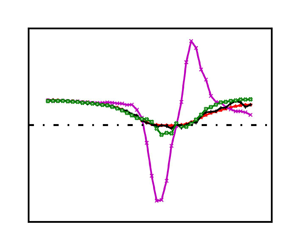
By incorporating the traditionally overlooked advective term in the wall-normal momentum equation, a new momentum integral equation is developed for two-dimensional incompressible turbulent boundary layers under arbitrary pressure gradients. The classical Kármán's integral arises as a special instance of the new momentum integral equation when the pressure gradient is weak. The new momentum integral equation's validity is substantiated by direct numerical simulation data. Unlike the classical Kármán's integral, which is limited to predicting wall shear stress within mild pressure gradients, the new momentum integral equation accurately computes wall shear stress across a broad range of pressure gradients, even in the presence of strong adverse pressure gradients that lead to flow separation. Moreover, a new pressure parameter $\beta _\kappa$ is introduced through examining terms in the new momentum integral equation. This parameter naturally quantifies the pressure gradient's influence on turbulent boundary layers and offers guidance for applying the classical Kármán's integral. Additionally, to facilitate experimental determination of wall shear stress under strong pressure gradients, an approximate integral equation is proposed that relies solely on easily measurable variables. Validation against direct numerical simulation data demonstrates that this simplified equation provides reasonably accurate estimates of wall shear stress in turbulent boundary layers experiencing strong pressure gradients.

1 - Flow Properties and Basic Principles
-
- Book:
- Measurement in Fluid Mechanics
- Published online:
- 25 April 2024
- Print publication:
- 11 April 2024, pp 3-30
-
- Chapter
- Export citation
5 - Free Shear Layers and Jets
-
- Book:
- Flow Control
- Published online:
- 04 April 2024
- Print publication:
- 11 April 2024, pp 175-219
-
- Chapter
- Export citation
2 - Measuring Systems
-
- Book:
- Measurement in Fluid Mechanics
- Published online:
- 25 April 2024
- Print publication:
- 11 April 2024, pp 31-95
-
- Chapter
- Export citation
10 - Measurement of Flow Rate
-
- Book:
- Measurement in Fluid Mechanics
- Published online:
- 25 April 2024
- Print publication:
- 11 April 2024, pp 381-396
-
- Chapter
- Export citation
