Refine search
Actions for selected content:
212937 results in Engineering
Absorptive reconfigurable bandstop filter with ultra-wide frequency tuning range using distributed lossy resonators
-
- Journal:
- International Journal of Microwave and Wireless Technologies / Volume 16 / Issue 3 / April 2024
- Published online by Cambridge University Press:
- 08 April 2024, pp. 400-408
-
- Article
- Export citation
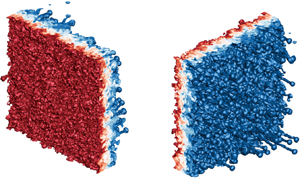
Mixing and inter-scale energy transfer in Richtmyer–Meshkov turbulence
-
- Journal:
- Journal of Fluid Mechanics / Volume 984 / 10 April 2024
- Published online by Cambridge University Press:
- 08 April 2024, A56
-
- Article
- Export citation
FEM-based eigenstructure recovery of a space truss with active members
-
- Journal:
- The Aeronautical Journal / Volume 128 / Issue 1327 / September 2024
- Published online by Cambridge University Press:
- 08 April 2024, pp. 2023-2037
-
- Article
- Export citation
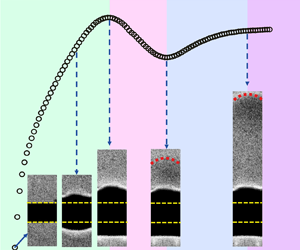
Formation and evolution of laminar thermal structures: correlation to the thermal boundary layer and effects of heating time
-
- Journal:
- Journal of Fluid Mechanics / Volume 984 / 10 April 2024
- Published online by Cambridge University Press:
- 08 April 2024, A60
-
- Article
- Export citation
-
We report an experimental study of the formation and evolution of laminar thermal structures generated by a small heat source, with a focus on their correlation to the thermal boundary layer and effects of heating time $t_{heat}$. The experiments are performed over the flux Rayleigh number ( $Ra_f$) range $2.1\times 10^6 \leq Ra_f \leq 3.6\times 10^{7}$ and the Prandtl number ( $Pr$) range $28.6 \leq Pr \leq 904.7$. The corresponding Rayleigh number ( $Ra= t_{heat}\,Ra_{f}/\tau _0\,Pr$) range is $900 \leq Ra \leq 4\times 10^{4}$, where $\tau _0$ is a diffusion time scale. For thermal structures generated by continuous heating (i.e. starting plumes), their formation process exists three characteristic times that are well reflected by changes in the thermal boundary layer thickness. These characteristic times, denoted as $t_{emit}$, $t_{recover}$ and $t_{static}$, correspond to the moments when the plume emission begins and completes, and when the thermal boundary layer becomes quasi-static, respectively. Their $Ra_f$– $Pr$ dependencies are found to be $t_{emit}/\tau _0\sim Ra_f^{-0.41}\,Pr^{0.41}$, $t_{recover}/\tau _0\sim Ra_f^{-0.48}\,Pr^{0.48}$ and $t_{static}/\tau _0\sim Ra_f^{-0.49}\,Pr^{0.33}$, respectively. Thermal structures generated by finite $t_{heat}$ exhibit similar evolution dynamics once $t_{heat} \ge t_{emit}$, with the accelerating stage behaving like starting plumes and the decay stage like thermals (i.e. a finite amount of buoyant fluids). It is further found that their maximum rising velocity experiences a transition in the $Ra$-dependence from $Ra$ to $(Ra\ln Ra)^{0.5}$ at $Ra \simeq 6000$; and their maximum acceleration reaches the value of starting plumes at $t_{heat}\simeq t_{recover}$, and remains unchanged for larger $t_{heat}$. In particular, the maximum rising velocity for the cases with $t_{heat} = t_{recover}$ follows a scaling relation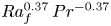 $Ra_f^{0.37}\,Pr^{-0.37}$, in contrast to the relation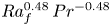 $Ra_f^{0.48}\,Pr^{-0.48}$ for starting plumes. This study provides a more comprehensive understanding of laminar thermal structures, which are relevant to a range of processes in nature and laboratory systems such as Rayleigh–Bénard convection.


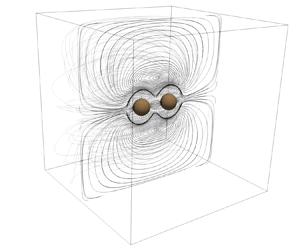
Pairwise interaction of spherical particles aligned in high-frequency oscillatory flow
-
- Journal:
- Journal of Fluid Mechanics / Volume 984 / 10 April 2024
- Published online by Cambridge University Press:
- 08 April 2024, A57
-
- Article
-
- You have access
- Open access
- HTML
- Export citation
Sub-filter-scale shear stress analysis in hypersonic turbulent Couette flow
-
- Journal:
- Journal of Fluid Mechanics / Volume 984 / 10 April 2024
- Published online by Cambridge University Press:
- 08 April 2024, A53
-
- Article
-
- You have access
- Open access
- HTML
- Export citation
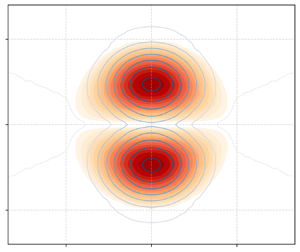
Equatorial modons in thermal rotating shallow water model
-
- Journal:
- Journal of Fluid Mechanics / Volume 984 / 10 April 2024
- Published online by Cambridge University Press:
- 08 April 2024, A58
-
- Article
- Export citation
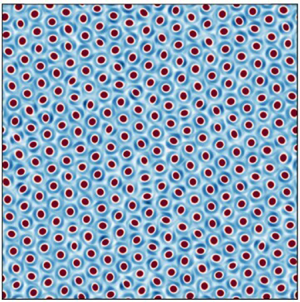
From a vortex gas to a vortex crystal in instability-driven two-dimensional turbulence
-
- Journal:
- Journal of Fluid Mechanics / Volume 984 / 10 April 2024
- Published online by Cambridge University Press:
- 08 April 2024, A41
-
- Article
- Export citation
A 4 × 4 Butler matrix with switching/steering beams based on new tunable phase difference couplers
-
- Journal:
- International Journal of Microwave and Wireless Technologies / Volume 16 / Issue 6 / July 2024
- Published online by Cambridge University Press:
- 08 April 2024, pp. 1033-1042
-
- Article
-
- You have access
- Open access
- HTML
- Export citation
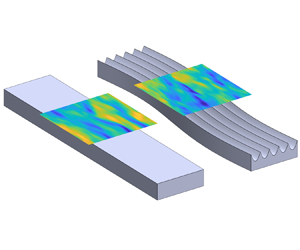
Manipulation of a turbulent boundary layer using sinusoidal riblets
-
- Journal:
- Journal of Fluid Mechanics / Volume 984 / 10 April 2024
- Published online by Cambridge University Press:
- 08 April 2024, A59
-
- Article
-
- You have access
- Open access
- HTML
- Export citation
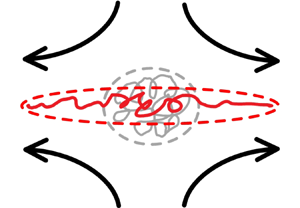
Elastic particle model for coil-stretch transition of dilute polymers in an elongational flow
-
- Journal:
- Journal of Fluid Mechanics / Volume 984 / 10 April 2024
- Published online by Cambridge University Press:
- 08 April 2024, A52
-
- Article
-
- You have access
- Open access
- HTML
- Export citation
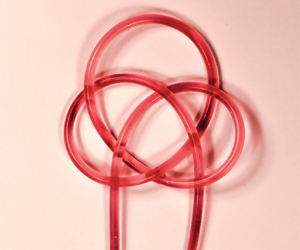
Elastohydrodynamic interactions in soft hydraulic knots
- Part of
-
- Journal:
- Journal of Fluid Mechanics / Volume 984 / 10 April 2024
- Published online by Cambridge University Press:
- 08 April 2024, A55
-
- Article
-
- You have access
- Open access
- HTML
- Export citation
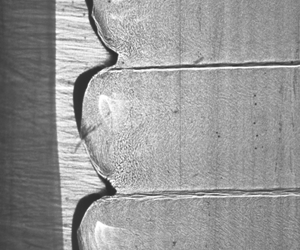
Laboratory experiments of melting ice in warm salt-stratified environments
-
- Journal:
- Journal of Fluid Mechanics / Volume 984 / 10 April 2024
- Published online by Cambridge University Press:
- 05 April 2024, A42
-
- Article
-
- You have access
- Open access
- HTML
- Export citation
-
Melting icebergs provide nearly half of the total freshwater flux from ice shelves to the ocean, but the availability of accurate, data-constrained melting rate parametrisations limits the correct representation of this process in ocean models. Here, we investigate the melting of a vertical ice face in a warm, salt-stratified environment in a laboratory setting. Observations of the depth-dependent melting rates ${m}$ and boundary layer flow speed $U$ are reported for a range of initially uniform far-field ambient temperatures $T_a$ above ${10}\,^{\circ }{\rm C}$. Ice scallops are characteristic features observed in all experiments, with the width of the scallops consistent with the theory of double-diffusive layers. The morphology of the scallops changes from symmetric about the scallop centre in the colder experiments to asymmetric in the warmer experiments. Observed melting rates are consistent with a melting rate scaling of the form ${m}\propto U\,\Delta T_a$ proposed by previous work in less extreme parameter regimes, where $\Delta T_a$ is the magnitude of thermal driving between the ambient and ice–fluid interface. Our results indicate that ice scalloping is closely linked to the naturally convecting flow of the ambient fluid. Depth-averaged melting rates depend on the buoyancy frequency in the ambient fluid, and double-diffusive convection promotes a turbulent-flux regime distinct from that explained previously in an unstratified regime. These findings have implications for parametrising melting rates of icebergs and glaciers in numerical models or potential freshwater harvesting operations, and provide insights into the interplay between stratification and ice melting.


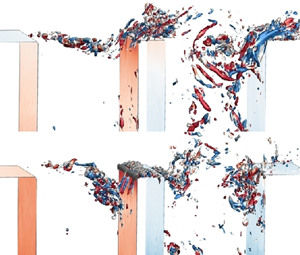
Flow–acoustic resonance mechanism in tandem deep cavities coupled with acoustic eigenmodes in turbulent shear layers
-
- Journal:
- Journal of Fluid Mechanics / Volume 984 / 10 April 2024
- Published online by Cambridge University Press:
- 05 April 2024, A19
-
- Article
- Export citation
-
This study presents the interplay of flow and acoustics within tandem deep cavities, focusing on the resonance mechanism occurring between turbulent shear layers and acoustic eigenmodes. The arrangement inside the tandem deep cavities includes both close and remote configurations. A combined fully coupled and decoupled aeroacoustic simulation strategy was devised. Employing an advanced high-order spectral/hp element method in conjunction with implicit large eddy simulation, the nonlinear compressible Navier–Stokes equations were solved to acquire internal flow–acoustic resonant field. In parallel, the linearized Navier–Stokes equations were tackled to determine coherent shear layer perturbations with external acoustic forcing. Based on acoustic measurements, the mainstream Reynolds number approaches approximately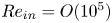 $R{e_{in}} = {O}({10^5})$, where we identified the presence of frequency lock-in and a resonance range. Aeroacoustic noise sources were examined by implementing spectral proper orthogonal decomposition to decompose the pressure fields into hydrodynamic and acoustic components. As feedback intensified, the flow characteristics by the acoustic forcing effect and the flow-interactive effect were categorized according to the development of concurrent turbulent shear layers. Subsequently, the alternating and synchronous behaviours of concurrent shear layers resonated with the out-of-phase and in-phase acoustic eigenmodes were identified, and the corresponding large-scale counter-rotating vortex pairs and co-rotating vortex structures at the cavity entrances were extracted. The acoustic power generated by the Coriolis force was calculated using Howe's vortex-sound analogy, and the aeroacoustic energy transfer mechanism between large-scale shear layer vortices with acoustic eigenmodes was further explored. Finally, a linear response of coherent perturbations of the concurrent shear layers by external acoustic forcing was established. The amplification of flow in the streamwise direction toward the main duct led to the formation of coherent vortex structures, accompanied by separation bubbles into the main duct.
Bandpass filter with multiple selective absorptive stopbands for 28 GHz transmitters
-
- Journal:
- International Journal of Microwave and Wireless Technologies / Volume 16 / Issue 7 / September 2024
- Published online by Cambridge University Press:
- 05 April 2024, pp. 1081-1088
-
- Article
- Export citation
A single-layer multimode high gain circularly polarized metasurface antenna using CMA for C-band applications
-
- Journal:
- International Journal of Microwave and Wireless Technologies / Volume 16 / Issue 7 / September 2024
- Published online by Cambridge University Press:
- 05 April 2024, pp. 1218-1228
-
- Article
- Export citation
GLULA: Linear attention-based model for efficient human activity recognition from wearable sensors
-
- Journal:
- Wearable Technologies / Volume 5 / 2024
- Published online by Cambridge University Press:
- 05 April 2024, e10
-
- Article
-
- You have access
- Open access
- HTML
- Export citation
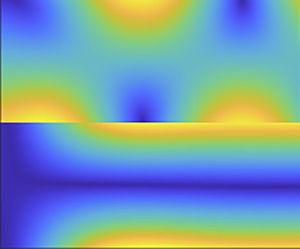
A thin-plate approximation for ocean wave interactions with an ice shelf
-
- Journal:
- Journal of Fluid Mechanics / Volume 984 / 10 April 2024
- Published online by Cambridge University Press:
- 05 April 2024, A48
-
- Article
-
- You have access
- Open access
- HTML
- Export citation
Acute suppression of lower limb spasm by sacral afferent stimulation for people with spinal cord injury: A pilot study
-
- Journal:
- Wearable Technologies / Volume 5 / 2024
- Published online by Cambridge University Press:
- 05 April 2024, e9
-
- Article
-
- You have access
- Open access
- HTML
- Export citation
Fermenting knits: A material-driven exploration of knit-based bacterial cellulose biocomposite textile materials through fibre reassembly
-
- Journal:
- Research Directions: Biotechnology Design / Volume 2 / 2024
- Published online by Cambridge University Press:
- 05 April 2024, e3
-
- Article
-
- You have access
- Open access
- HTML
- Export citation
